Recognition: unknown
A New Measurement of the Extragalactic Background Light using 15\,yr of {it Fermi}-Large Area Telescope Data
Pith reviewed 2026-05-10 17:29 UTC · model grok-4.3
The pith
Fermi gamma-ray observations of 1576 blazars detect extragalactic background light absorption at 23 sigma significance.
A machine-rendered reading of the paper's core claim, the machinery that carries it, and where it could break.
Core claim
Using 15 years of Fermi-LAT data and 1576 blazars, the EBL attenuation is detected with ~23 sigma significance. The optical depth is measured in 19 redshift bins extending to z=4.3. This permits reconstruction of the EBL evolution, which shows general consistency with recent models, and constitutes the most precise determination of the EBL with GeV gamma rays.
What carries the argument
The imprint of EBL absorption on the gamma-ray spectra of blazars, from which the optical depth is extracted in multiple redshift bins.
Load-bearing premise
The observed spectral softening in the blazar sample is produced entirely by EBL absorption rather than by intrinsic source physics, selection effects, or unmodeled instrumental systematics.
What would settle it
A dataset of blazar spectra showing redshift-dependent spectral softening inconsistent with the reported optical depths or lacking the expected increase with distance would contradict the central claim.
Figures


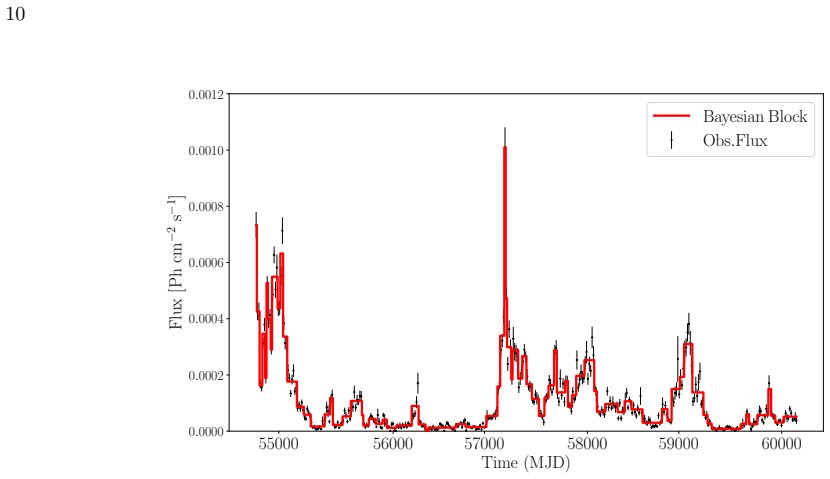


read the original abstract
The extragalactic background Light (EBL) from ultraviolet to infrared comprises the emission from all stars, galaxies, and actively accreting black holes in the observable Universe. A precise measurement of the EBL is critically important to probe models of star formation and galaxy evolution. The EBL can be measured via the absorption imprint left on the spectra of gamma-ray blazars. In this work, we rely on 15 years of {\it Fermi}-LAT data and 1576 blazars to measure the EBL optical depth in the $0<z<4.3$ range. We detect the EBL attenuation with $\sim23\sigma$ significance and measure the optical depth in 19 redshift bins, extending the coverage and improving on our previous results. This allows us to reconstruct the EBL evolution and find general consistency with recent EBL models. These results represent the most precise determination of the EBL with GeV $\gamma$ rays to date.
Editorial analysis
A structured set of objections, weighed in public.
Referee Report
Summary. The manuscript reports a measurement of the extragalactic background light (EBL) optical depth τ(E,z) derived from the gamma-ray spectra of 1576 blazars observed with the Fermi-LAT over 15 years. The authors claim a ~23σ detection of EBL attenuation, provide τ measurements in 19 redshift bins spanning 0 < z < 4.3, reconstruct the EBL evolution, and report general consistency with recent EBL models. The work is presented as an extension and improvement over prior results, constituting the most precise GeV-scale determination to date.
Significance. If the central result holds after addressing modeling assumptions, the large sample and extended redshift coverage would tighten constraints on the integrated star-formation history and galaxy evolution. The high claimed significance and bin-by-bin optical-depth reconstruction represent a potentially valuable data product for the field, provided the separation of intrinsic and extrinsic spectral effects is robust.
major comments (2)
- [Analysis section (spectral modeling and fitting)] The joint spectral fitting procedure (described in the analysis section) assumes intrinsic blazar spectra are adequately described by power-law or log-parabola forms with no additional redshift-dependent curvature. No quantitative test is presented for the possibility that a non-negligible fraction of the sample exhibits intrinsic softening that correlates with redshift or flux, which would systematically bias the recovered τ(E,z) values and the 23σ significance claim.
- [Sample selection and data analysis] The sample selection of 1576 blazars and any redshift-dependent cuts are not shown to be free of bias toward harder spectra at low z. Without explicit checks (e.g., control samples or Monte Carlo simulations of selection effects), the attribution of all observed spectral softening to EBL attenuation remains unverified and load-bearing for the 19-bin measurement.
minor comments (2)
- [Abstract and discussion] The abstract states results are 'in general consistency with recent EBL models' but does not specify whether any model parameters were adjusted to the current dataset or used purely for post-hoc comparison; this should be clarified in the text.
- [Figures and tables] Figure captions and table headers should explicitly state the energy range and redshift binning used for the optical-depth measurements to allow direct comparison with prior work.
Simulated Author's Rebuttal
We thank the referee for their careful and constructive review of our manuscript. We address each major comment point by point below. Where the comments identify areas requiring additional validation, we have revised the manuscript to incorporate the requested tests and clarifications, which we believe further support the robustness of our results.
read point-by-point responses
-
Referee: [Analysis section (spectral modeling and fitting)] The joint spectral fitting procedure (described in the analysis section) assumes intrinsic blazar spectra are adequately described by power-law or log-parabola forms with no additional redshift-dependent curvature. No quantitative test is presented for the possibility that a non-negligible fraction of the sample exhibits intrinsic softening that correlates with redshift or flux, which would systematically bias the recovered τ(E,z) values and the 23σ significance claim.
Authors: We agree that verifying the absence of redshift- or flux-correlated intrinsic curvature is important for the reliability of the optical-depth measurement. In the original analysis, the spectral model for each source (power law or log parabola) was selected via a likelihood-ratio test, which already incorporates curvature when statistically preferred. To directly address the concern, the revised manuscript includes a new set of Monte Carlo simulations in which artificial redshift-dependent intrinsic softening is injected into the spectra prior to refitting. These tests show that the recovered τ(E,z) values in the 19 redshift bins and the overall ~23σ significance remain consistent with the reported results within uncertainties, indicating that any such bias does not materially affect the conclusions. revision: yes
-
Referee: [Sample selection and data analysis] The sample selection of 1576 blazars and any redshift-dependent cuts are not shown to be free of bias toward harder spectra at low z. Without explicit checks (e.g., control samples or Monte Carlo simulations of selection effects), the attribution of all observed spectral softening to EBL attenuation remains unverified and load-bearing for the 19-bin measurement.
Authors: The selection criteria are described in Section 2 and are based on detection significance and spectral-fit quality to ensure reliable parameter estimation. We acknowledge that explicit validation against selection biases is warranted. In the revised manuscript we have added (i) the spectral-index distribution versus redshift and flux, (ii) Monte Carlo simulations of the full selection pipeline, and (iii) a control-sample comparison using low-redshift blazars. These checks demonstrate no significant bias toward harder spectra at low redshift and confirm that the observed spectral softening is consistent with EBL attenuation rather than an artifact of the selection process. revision: yes
Circularity Check
No significant circularity detected in the EBL optical-depth measurement
full rationale
The derivation consists of a direct spectral fit to 15 years of Fermi-LAT data on 1576 blazars, extracting the EBL optical depth in 19 redshift bins under the modeling assumption that all observed softening is due to attenuation. The result is then compared to existing EBL models for consistency rather than derived from them. No quoted step reduces the claimed 23σ detection or binned τ(E,z) values to a self-definition, a fitted parameter relabeled as a prediction, or a load-bearing self-citation chain. The analysis is self-contained against the gamma-ray dataset and standard likelihood fitting; external benchmarks are used only for post-hoc validation.
Axiom & Free-Parameter Ledger
axioms (1)
- domain assumption Blazar spectra are power laws modified only by EBL absorption and known instrumental effects
Reference graph
Works this paper leans on
-
[1]
2018, ApJ, 865, 159
Abdalla, H., & B¨ ottcher, M. 2018, ApJ, 865, 159
2018
-
[2]
2024, MNRAS, 532, 198, doi: 10.1093/mnras/stae1514
Abdalla, H., Razzaque, S., B¨ ottcher, M., Finke, J., & Dom´ ınguez, A. 2024, MNRAS, 532, 198, doi: 10.1093/mnras/stae1514
-
[3]
2020, MNRAS, 494, 5590
Abdalla, H., Adam, R., Aharonian, F., et al. 2020, MNRAS, 494, 5590
2020
-
[4]
A., Ackermann, M., Ajello, M., et al
Abdo, A. A., Ackermann, M., Ajello, M., et al. 2010, ApJ, 723, 1082, doi: 10.1088/0004-637X/723/2/1082
-
[5]
2018, Science, 362, 1031, doi: 10.1126/science.aat8123
Abdollahi, S., Ackermann, M., Ajello, M., et al. 2018, Science, 362, 1031, doi: 10.1126/science.aat8123
-
[6]
2013, A&A, 550, A4
Abramowski, A., Acero, F., Aharonian, F., et al. 2013, A&A, 550, A4
2013
-
[7]
2012, Science, 338, 1190
Ackermann, M., Ajello, M., Allafort, A., et al. 2012, Science, 338, 1190
2012
-
[8]
2018, ApJS, 237, 32
Ackermann, M., Ajello, M., Baldini, L., et al. 2018, ApJS, 237, 32
2018
-
[9]
1993, arXiv preprint astro-ph/9312045
Aharonian, F., Coppi, P., & Voelk, H. 1993, arXiv preprint astro-ph/9312045
-
[10]
2006, Nature, 440, 1018
Aharonian, F., Akhperjanian, A., Bazer-Bachi, A., et al. 2006, Nature, 440, 1018
2006
-
[11]
B., et al
Aharonian, F., Akhperjanian, A., De Almeida, U. B., et al. 2007, A&A, 475, L9
2007
-
[12]
Ajello, M., Shaw, M. S., Romani, R. W., et al. 2012, ApJ, 751, 108, doi: 10.1088/0004-637X/751/2/108
-
[13]
2022, ApJS, 263, 24, doi: 10.3847/1538-4365/ac9523
Ajello, M., Baldini, L., Ballet, J., et al. 2022, ApJS, 263, 24, doi: 10.3847/1538-4365/ac9523
-
[14]
2008, Science, 320, 1752
Albert, J., Aliu, E., Anderhub, H., et al. 2008, Science, 320, 1752
2008
-
[15]
2001, PhRvD, 64, 036005, doi: 10.1103/PhysRevD.64.036005
Amelino-Camelia, G., & Piran, T. 2001, PhRvD, 64, 036005, doi: 10.1103/PhysRevD.64.036005
-
[16]
Andrews, S. K., Driver, S. P., Davies, L. J. M., et al. 2017, MNRAS, 470, 1342, doi: 10.1093/mnras/stx1279
-
[17]
B., Abdo, A
Atwood, W. B., Abdo, A. A., Ackermann, M., et al. 2009, The Astrophysical Journal, 697, 1071
2009
-
[18]
Baldry, I. K., & Glazebrook, K. 2003, ApJ, 593, 258, doi: 10.1086/376502
-
[19]
2008b, MNRAS, 389, 989, doi: 10.1111/j.1365-2966.2008.13627.x
Barrau, A., Gorecki, A., & Grain, J. 2008, MNRAS, 389, 919, doi: 10.1111/j.1365-2966.2008.13607.x
-
[20]
D., et al
Baxter, J., Dom´ ınguez, A., Finke, J. D., et al. 2026, ApJ, submitted
2026
-
[21]
A., Freedman, W
Bernstein, R. A., Freedman, W. L., & Madore, B. F. 2002, ApJ, 571, 107
2002
-
[22]
2022, Galaxies, 10, 39
Biteau, J., & Meyer, M. 2022, Galaxies, 10, 39
2022
-
[23]
Biteau, J., & Williams, D. A. 2015, ApJ, 812, 60
2015
-
[24]
2005, Astroparticle Physics, 23, 598, doi: 10.1016/j.astropartphys.2005.03.009
Blanch, O., & Martinez, M. 2005, Astroparticle Physics, 23, 598, doi: 10.1016/j.astropartphys.2005.03.009
-
[25]
2025, A&A, 694, L10, doi: 10.1051/0004-6361/202453361
Blinov, D., & Novikova, P. 2025, A&A, 694, L10, doi: 10.1051/0004-6361/202453361
-
[26]
Bruel, P., Burnett, T., Digel, S., et al. 2018, arXiv preprint arXiv:1810.11394
-
[27]
2020, JCAP, 2020, 027, doi: 10.1088/1475-7516/2020/09/027 19
Buehler, R., Gallardo, G., Maier, G., et al. 2020, JCAP, 2020, 027, doi: 10.1088/1475-7516/2020/09/027 19
-
[28]
Chen, A., Reyes, L. C., & Ritz, S. 2004, ApJ, 608, 686, doi: 10.1086/383456
-
[29]
2022, ApJ, 925, 136, doi: 10.3847/1538-4357/ac3aee D’Ammando, F., Antolini, E., Tosti, G., et al
Cheng, Y.-T., & Chang, T.-C. 2022, ApJ, 925, 136, doi: 10.3847/1538-4357/ac3aee D’Ammando, F., Antolini, E., Tosti, G., et al. 2013, MNRAS, 431, 2481, doi: 10.1093/mnras/stt344
-
[30]
2018, Monthly Notices of the Royal Astronomical Society, 480, 768
Davies, L., Robotham, A., Driver, S., et al. 2018, Monthly Notices of the Royal Astronomical Society, 480, 768
2018
-
[31]
D., Cavadini, M., Razzaque, S., et al
Dermer, C. D., Cavadini, M., Razzaque, S., et al. 2011, ApJL, 733, L21
2011
-
[32]
2019, ApJL, 874, L7, doi: 10.3847/2041-8213/ab0c10 Dom´ ınguez, A., & Ajello, M
Desai, A., Helgason, K., Ajello, M., et al. 2019, ApJL, 874, L7, doi: 10.3847/2041-8213/ab0c10
-
[33]
2006, A&A, 451, 417 Dom´ ınguez, A., & Ajello, M
Dole, H., Lagache, G., Puget, J.-L., et al. 2006, A&A, 451, 417 Dom´ ınguez, A., & Ajello, M. 2015, ApJL, 813, L34
2006
-
[34]
2011a, Journal of Cosmology and Astroparticle Physics, 2011, 020
Dominguez, A., S´ anchez-Conde, M., & Prada, F. 2011a, Journal of Cosmology and Astroparticle Physics, 2011, 020
2011
-
[35]
Dominguez, A., Primack, J. R., Rosario, D., et al. 2011b, MNRAS, 410, 2556 Dom´ ınguez, A., Wojtak, R., Finke, J., et al. 2019, ApJ, 885, 137 Dom´ ınguez, A., Østergaard Kirkeberg, P., Wojtak, R., et al. 2024, MNRAS, 527, 4632, doi: 10.1093/mnras/stad3425 Dom´ ınguez, A., L´ ainez, M., Paliya, V. S., et al. 2024, MNRAS, 527, 4763
-
[36]
P., Hill, D
Driver, S. P., Hill, D. T., Kelvin, L. S., et al. 2011, MNRAS, 413, 971
2011
-
[37]
P., Andrews, S
Driver, S. P., Andrews, S. K., Davies, L. J., et al. 2016, ApJ, 827, 108
2016
-
[38]
2013, Astroparticle Physics, 43, 112, doi: 10.1016/j.astropartphys.2012.09.003
Dwek, E., & Krennrich, F. 2013, Astroparticle Physics, 43, 112, doi: 10.1016/j.astropartphys.2012.09.003
-
[39]
2013, PhRvD, 88, 043002, doi: 10.1103/PhysRevD.88.043002
Fairbairn, M. 2013, PhRvD, 88, 043002, doi: 10.1103/PhysRevD.88.043002
-
[40]
Fazio, G. G., & Stecker, F. W. 1970, Nature, 226, 135, doi: 10.1038/226135a0 Fermi-LAT Collaboration, Abdollahi, S., Ackermann, M., et al. 2018, Science, 362, 1031, doi: 10.1126/science.aat8123
-
[41]
D., Ajello, M., Dom´ ınguez, A., et al
Finke, J. D., Ajello, M., Dom´ ınguez, A., et al. 2022, ApJ, 941, 33
2022
-
[42]
D., & Razzaque, S
Finke, J. D., & Razzaque, S. 2009, ApJ, 698, 1761
2009
-
[43]
Finke, J. D., & Razzaque, S. 2023, ApJL, 942, L21, doi: 10.3847/2041-8213/acade1
-
[44]
D., Razzaque, S., & Dermer, C
Finke, J. D., Razzaque, S., & Dermer, C. D. 2010, ApJ, 712, 238
2010
-
[45]
D., Reyes, L
Finke, J. D., Reyes, L. C., Georganopoulos, M., et al. 2015, ApJ, 814, 20
2015
-
[46]
Foreman-Mackey, D., Hogg, D. W., Lang, D., & Goodman, J. 2013, PASP, 125, 306, doi: 10.1086/670067
-
[47]
2017, A&A, 603, A34
Franceschini, A., & Rodighiero, G. 2017, A&A, 603, A34
2017
-
[48]
2008, A&A, 487, 837
Franceschini, A., Rodighiero, G., & Vaccari, M. 2008, A&A, 487, 837
2008
-
[49]
D., & Reyes, L
Georganopoulos, M., Finke, J. D., & Reyes, L. C. 2010, ApJL, 714, L157
2010
-
[50]
C., Somerville, R
Gilmore, R. C., Somerville, R. S., Primack, J. R., & Dom´ ınguez, A. 2012, MNRAS, 422, 3189
2012
-
[51]
Gould, R. J., & Schr´ eder, G. P. 1967a, Physical Review, 155, 1408, doi: 10.1103/PhysRev.155.1408 —. 1967b, Physical Review, 155, 1404, doi: 10.1103/PhysRev.155.1404 Gr´ eaux, L., Biteau, J., & Nievas Rosillo, M. 2024, ApJL, 975, L18, doi: 10.3847/2041-8213/ad85c9
-
[52]
A., Kocevski, D
Grogin, N. A., Kocevski, D. D., Faber, S., et al. 2011, ApJS, 197, 35
2011
-
[53]
G., Arendt, R
Hauser, M. G., Arendt, R. G., Kelsall, T., et al. 1998, ApJ, 508, 25
1998
-
[54]
Hsu, Q.-N., Cowie, L. L., Chen, C.-C., & Barger, A. J. 2024, ApJL, 964, L32, doi: 10.3847/2041-8213/ad3421
-
[55]
A., et al
Inoue, Y., Inoue, S., Kobayashi, M. A., et al. 2013, ApJ, 768, 197
2013
-
[56]
2015, ApJ, 805, 33
Khaire, V., & Srianand, R. 2015, ApJ, 805, 33
2015
-
[57]
doi:10.1093/mnras/stz174 , eprint =
Khaire, V., & Srianand, R. 2019, MNRAS, 484, 4174, doi: 10.1093/mnras/stz174
-
[58]
1999, ApJL, 518, L21, doi: 10.1086/312057 Klu´ zniak, W
Kifune, T. 1999, ApJL, 518, L21, doi: 10.1086/312057 Klu´ zniak, W. 1999, Astroparticle Physics, 11, 117, doi: 10.1016/S0927-6505(99)00070-5
-
[59]
2021, Monthly Notices of the Royal Astronomical Society, 503, 2033, doi: 10.1093/mnras/stab540
Koushan, S., Driver, S. P., Bellstedt, S., et al. 2021, MNRAS, 503, 2033, doi: 10.1093/mnras/stab540 L´ ainez, M., Nievas-Rosillo, M., Dom´ ınguez, A., et al. 2025, arXiv e-prints, arXiv:2502.11888, doi: 10.48550/arXiv.2502.11888
-
[60]
R., Postman, M., Weaver, H
Lauer, T. R., Postman, M., Weaver, H. A., et al. 2021, ApJ, 906, 77
2021
-
[61]
Lauer, T. R., Postman, M., Spencer, J. R., et al. 2022, ApJL, 927, L8, doi: 10.3847/2041-8213/ac573d
-
[62]
2014, Annual Review of Astronomy and Astrophysics, 52, 415
Madau, P., & Dickinson, M. 2014, Annual Review of Astronomy and Astrophysics, 52, 415
2014
-
[63]
2017, ApJ, 840, 39, doi: 10.3847/1538-4357/aa6af9
Madau, P., & Fragos, T. 2017, ApJ, 840, 39, doi: 10.3847/1538-4357/aa6af9
-
[64]
A., Scully, S
Malkan, M. A., Scully, S. T., & Stecker, F. W. 2021, ApJ, 909, 52
2021
-
[65]
Malkan, M. A., Scully, S. T., & Stecker, F. W. 2021, ApJ, 909, 52, doi: 10.3847/1538-4357/abda3f
-
[66]
2005, ApJ, 626, 31
Matsumoto, T., Matsuura, S., Murakami, H., et al. 2005, ApJ, 626, 31
2005
-
[67]
2011, ApJ, 737, 2
Matsuura, S., Shirahata, M., Kawada, M., et al. 2011, ApJ, 737, 2
2011
-
[68]
2003, ApJ, 591, 119, doi: 10.1086/375182 20 Mu˜ noz, J
Mattila, K. 2003, ApJ, 591, 119, doi: 10.1086/375182 20 Mu˜ noz, J. B., Mirocha, J., Chisholm, J., Furlanetto, S. R., & Mason, C. 2024, MNRAS, 535, L37, doi: 10.1093/mnrasl/slae086
-
[69]
Nikishov, A. I. 1962, JETP, 393, 14
1962
-
[70]
2021, MNRAS, 508, 6128
Paiano, S., Treves, A., Franceschini, A., & Falomo, R. 2021, MNRAS, 508, 6128
2021
-
[71]
S., Dom´ ınguez, A., Cabello, C., et al
Paliya, V. S., Dom´ ınguez, A., Cabello, C., et al. 2020, ApJL, 903, L8, doi: 10.3847/2041-8213/abbc06
-
[72]
R., Parker, J
Postman, M., Lauer, T. R., Parker, J. W., et al. 2024, ApJ, 972, 95
2024
-
[73]
Tavecchio, F. 2010, MNRAS, 405, L76, doi: 10.1111/j.1745-3933.2010.00862.x
-
[74]
Protheroe, R. J., & Meyer, H. 2000, Physics Letters B, 493, 1, doi: 10.1016/S0370-2693(00)01113-8
-
[75]
2020, ApJ, 898, 18, doi: 10.3847/1538-4357/ab96c4
Rajagopal, M., Kaur, A., Ajello, M., et al. 2020, ApJ, 898, 18, doi: 10.3847/1538-4357/ab96c4
-
[76]
2012, A&A, 538, A26, doi: 10.1051/0004-6361/201118159
Rau, A., Schady, P., Greiner, J., et al. 2012, A&A, 538, A26, doi: 10.1051/0004-6361/201118159
-
[77]
2021, ApJ, 912, 54, doi: 10.3847/1538-4357/abe87b
Rodrigues, X., Garrappa, S., Gao, S., et al. 2021, ApJ, 912, 54, doi: 10.3847/1538-4357/abe87b
-
[78]
G., et al
Saldana-Lopez, A., Dom´ ınguez, A., P´ erez-Gonz´ alez, P. G., et al. 2021, MNRAS, 507, 5144
2021
-
[79]
Scargle, J. D. 1998, ApJ, 504, 405, doi: 10.1086/306064
-
[80]
2007, ApJS, 172, 1, doi: 10.1086/516585
Scoville, N., Aussel, H., Brusa, M., et al. 2007, ApJS, 172, 1, doi: 10.1086/516585
discussion (0)
Sign in with ORCID, Apple, or X to comment. Anyone can read and Pith papers without signing in.