Discrete-Time Model of a Two-Speed PowerShift suitable for Real-Time Control and Simulation
Pith reviewed 2026-05-10 16:30 UTC · model grok-4.3
The pith
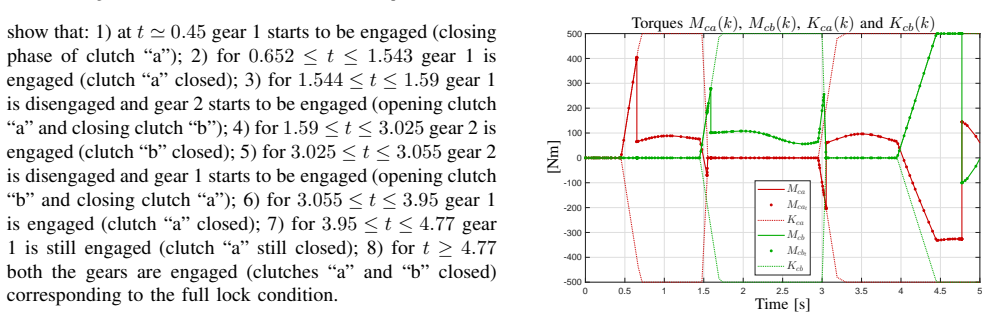
A discrete-time model computes the exact torque needed to engage clutches in a two-speed powershift, including simultaneous full-lock cases.
A machine-rendered reading of the paper's core claim, the machinery that carries it, and where it could break.
Core claim
The paper establishes that a discrete-time formulation yields the exact torque commands that bring the clutches to full engagement without residual slip, for both single-clutch and simultaneous full-lock conditions, and that this formulation directly supplies the control logic needed for those phases.
What carries the argument
The discrete-time exact-torque computation that handles single-clutch and simultaneous full-lock engagement.
If this is right
- Exact torque values can be computed directly for both single-clutch and simultaneous full-lock engagement.
- Control logic for engagement and disengagement phases follows immediately from the torque model.
- The approach shows clear computational advantages for real-time execution compared with continuous-time models.
Where Pith is reading between the lines
- The method could be ported to embedded vehicle controllers that lack the resources to solve differential equations at each time step.
- If the discrete approximation holds under real friction variation, similar torque calculations might be derived for transmissions with more than two speeds.
- Hardware testing under temperature swings would be needed to confirm that no retuning is required beyond the discrete model.
Load-bearing premise
The torques calculated at each discrete step will produce exact engagement even when real clutch friction, hydraulic response, or other continuous effects are not perfectly known in advance.
What would settle it
Implement the discrete-time controller on physical two-speed powershift hardware and measure whether clutch slip reaches zero at the exact predicted instants under varying loads and temperatures.
Figures




read the original abstract
In this paper, a new discrete-time approach to model the clutches engagement/disengagement in a two-speed powershift is proposed. The core idea is the development of a model for the computation of the exact torque needed to achieve the clutches engagement, including both the cases of single clutch engagement and of simultaneous clutch engagement (full lock condition). Based on this, the control logic for the clutches engagement and disengagement phases is also developed. The advantages in terms of real-time applicability with respect to the continuous-time version are shown through extensive simulation results.
Editorial analysis
A structured set of objections, weighed in public.
Referee Report
Summary. The manuscript proposes a discrete-time model for clutch engagement and disengagement in a two-speed PowerShift transmission. The central contribution is a method to compute the exact torque required to achieve clutch engagement (including single-clutch and simultaneous full-lock cases), together with the associated control logic for engagement/disengagement phases. Advantages for real-time applicability relative to continuous-time models are asserted on the basis of simulation results.
Significance. If the exact-torque derivation is rigorous and the discretization preserves the zero-relative-speed property under the stated assumptions, the work could provide a computationally lighter alternative for embedded transmission control. The explicit treatment of the full-lock condition is a useful technical detail for shift-quality applications. However, the absence of quantitative metrics, error bounds, or robustness tests limits the immediate practical impact.
major comments (3)
- [Abstract] Abstract: the claim that 'extensive simulation results' demonstrate real-time advantages supplies no quantitative metrics (e.g., CPU-time ratios, settling-time errors, or comparison against a continuous-time baseline or alternative discrete scheme), no error bounds, and no hardware-in-the-loop validation. This information is load-bearing for the central suitability-for-real-time-control assertion.
- [Model derivation] Derivation of exact torque (model section): the discrete-time torque expression is presented as exact under the assumption that the underlying continuous clutch dynamics (inertia, friction, speeds) are perfectly known and free of unmodeled effects. No sensitivity analysis or perturbation test is shown; if temperature-dependent friction or hydraulic delay is present, the precomputed torque will leave residual slip, violating the exactness guarantee.
- [Simulation results] Simulation results section: all reported trajectories appear to be generated under nominal parameter values and ideal actuation. This does not probe the stability of the discrete-time lock condition when sensor noise, parameter drift, or actuation delay is introduced, which directly tests the weakest assumption identified in the skeptic note.
minor comments (2)
- [Notation] Notation: define all symbols (torque, relative speed, inertia) at first use and ensure they remain consistent between the continuous-time reference model and the discrete-time equations.
- [Figures] Figures: add quantitative insets or tables reporting computation time, torque error norms, and relative-speed convergence steps to make the real-time advantage concrete rather than qualitative.
Simulated Author's Rebuttal
We thank the referee for the constructive feedback on our manuscript. We address each major comment point by point below, indicating where revisions will be made to improve clarity and strengthen the presentation of results.
read point-by-point responses
-
Referee: [Abstract] Abstract: the claim that 'extensive simulation results' demonstrate real-time advantages supplies no quantitative metrics (e.g., CPU-time ratios, settling-time errors, or comparison against a continuous-time baseline or alternative discrete scheme), no error bounds, and no hardware-in-the-loop validation. This information is load-bearing for the central suitability-for-real-time-control assertion.
Authors: We agree that the abstract would benefit from explicit quantitative metrics to support the real-time applicability claim. In the revised manuscript, we will update the abstract to include specific metrics from the simulations, such as average CPU-time ratios relative to the continuous-time model, engagement settling times, and discretization error bounds. These will be drawn from the existing simulation data and presented with direct comparisons. revision: yes
-
Referee: [Model derivation] Derivation of exact torque (model section): the discrete-time torque expression is presented as exact under the assumption that the underlying continuous clutch dynamics (inertia, friction, speeds) are perfectly known and free of unmodeled effects. No sensitivity analysis or perturbation test is shown; if temperature-dependent friction or hydraulic delay is present, the precomputed torque will leave residual slip, violating the exactness guarantee.
Authors: The torque expression is derived to be exact under the idealized assumptions of perfect knowledge of inertia, friction, and speeds, which are explicitly stated in the model section. This closed-form solution is the core technical contribution for real-time implementation. We will add a new paragraph in the model section discussing the implications of these assumptions and the conditions required for exact engagement. A full sensitivity analysis to effects such as temperature-dependent friction or hydraulic delays is beyond the scope of the present theoretical derivation and would require new experimental data. revision: partial
-
Referee: [Simulation results] Simulation results section: all reported trajectories appear to be generated under nominal parameter values and ideal actuation. This does not probe the stability of the discrete-time lock condition when sensor noise, parameter drift, or actuation delay is introduced, which directly tests the weakest assumption identified in the skeptic note.
Authors: The reported simulations validate the exact zero-relative-speed lock condition under the nominal conditions matching the model assumptions. To address robustness concerns, we will expand the simulation results section with additional cases that include bounded sensor noise, parameter drift, and small actuation delays, demonstrating that the discrete-time lock remains stable with bounded residual slip. revision: yes
Circularity Check
No significant circularity; derivation presented as independent discretization of continuous dynamics
full rationale
The paper's core claim is a discrete-time model that computes the exact torque required for clutch engagement (single or simultaneous) in a two-speed powershift transmission. The abstract frames this as a derived model based on discretization of continuous-time clutch dynamics (inertia, friction, speeds), with control logic built on top and advantages shown via simulation. No equations or derivation steps are visible in the provided text that reduce the 'exact torque' computation to a fitted parameter, self-definition, or self-citation chain. The approach is presented as a new modeling technique rather than a renaming of known results or an ansatz smuggled via prior work. The reader's note correctly identifies the absence of explicit circularity, and the derivation remains self-contained against external benchmarks like standard discrete-time control theory. No load-bearing step collapses to its own inputs by construction.
Axiom & Free-Parameter Ledger
Reference graph
Works this paper leans on
-
[1]
Hybrid electric vehicle propulsion system a rchitectures of the e-cvt type,
J. Miller, “Hybrid electric vehicle propulsion system a rchitectures of the e-cvt type,” IEEE Transactions on Power Electronics , vol. 21, no. 3, pp. 756–767, 2006
work page 2006
-
[2]
Energetic macros copic repre- sentation and inversion-based control,
A. Bouscayrol and B. Lemaire-Semail, “Energetic macros copic repre- sentation and inversion-based control,” Encyclopedia of electrical and electronic power engineering , vol. 3, pp. 365–375, 2023
work page 2023
-
[3]
D. Tebaldi and R. Zanasi, “The power-oriented graphs mod eling technique: From the fundamental principles to the systemat ic, step-by- step modeling of complex physical systems,” IEEE Access , vol. 13, pp. 32 470–32 485, 2025
work page 2025
-
[4]
Interconne ction schemes in modeling and control,
P . Borja, J. Ferguson, and A. van der Schaft, “Interconne ction schemes in modeling and control,” IEEE Control Systems Letters , vol. 7, pp. 2287–2292, 2023
work page 2023
-
[5]
J. C. Maxwell, “On physical lines of force,” Philosophical Magazine, vol. 21, no. 139, pp. 161–175, March 1861
-
[6]
W. Zhao and H. Zhang, “Coupling control strategy of force and displacement for electric differential power steering sys tem of electric vehicle with motorized wheels,” IEEE Transactions on V ehicular Technology, vol. 67, no. 9, pp. 8118–8128, 2018
work page 2018
-
[7]
Energy savings of a hybrid truck using a ravigneaux gear tra in,
W. Lhomme, A. Bouscayrol, S. A. Syed, S. Roy, F. Gailly, an d O. Pape, “Energy savings of a hybrid truck using a ravigneaux gear tra in,” IEEE Transactions on V ehicular Technology, vol. 66, no. 10, pp. 8682–8692, 2017
work page 2017
-
[8]
M. R. Nielsen, S. Deng, A. B. Mirza, B. F. Kjærsgaard, A. B. Jorgensen, H. Zhao, Y . Li, S. Munk-Nielsen, and F. Luo, “High-p ower electronic applications enabled by medium voltage silicon -carbide technology: An overview,” IEEE Transactions on Power Electronics , vol. 40, no. 1, pp. 987–1011, 2025
work page 2025
-
[9]
A. I. Ramones, C. Monissen, Z. Wang, and J. Andert, “Estim ation of the magnet temperature via a lumped parameter thermal net work in real time for the control of pmsm,” in 2022 European Control Conference (ECC) , 2022, pp. 1192–1197
work page 2022
-
[10]
Simulation of v ariable dynamic dimension systems: The clutch example,
R. Zanasi, G. Sandoni, and R. Morselli, “Simulation of v ariable dynamic dimension systems: The clutch example,” in 2001 European Control Conference (ECC) , 2001, pp. 3149–3154
work page 2001
-
[11]
A. J. V an Der Schaft and H. Schumacher, An introduction to hybrid dynamical systems . springer, 2007, vol. 251
work page 2007
-
[12]
Modelling and simulation of static and coulomb friction in a class of automotive syste ms,
R. Morselli, R. Zanasi, and P . Ferracin, “Modelling and simulation of static and coulomb friction in a class of automotive syste ms,” International Journal of Control , vol. 79, no. 05, pp. 508–520, 2006
work page 2006
-
[13]
Coordin ated control of gear shifting process with multiple clutches for power-shift transmission,
B. Li, D. Sun, M. Hu, X. Zhou, J. Liu, and D. Wang, “Coordin ated control of gear shifting process with multiple clutches for power-shift transmission,” Mechanism and Machine Theory , vol. 140, pp. 274– 291, 2019
work page 2019
-
[14]
Control of gear shi fts in dual clutch transmission powertrains,
P . D. Walker, N. Zhang, and R. Tamba, “Control of gear shi fts in dual clutch transmission powertrains,” Mechanical Systems and Signal Processing, vol. 25, no. 6, pp. 1923–1936, 2011, interdisciplinary Aspects of V ehicle Dynamics
work page 1923
-
[15]
A new model for control of systems with friction,
C. Canudas de Wit, H. Olsson, K. Astrom, and P . Lischinsk y, “A new model for control of systems with friction,” IEEE Transactions on Automatic Control, vol. 40, no. 3, pp. 419–425, 1995
work page 1995
discussion (0)
Sign in with ORCID, Apple, or X to comment. Anyone can read and Pith papers without signing in.