Role of particle volume fraction on particulate suspension droplet evolution, transition and Hysteresis
Pith reviewed 2026-05-10 17:30 UTC · model grok-4.3
The pith
Increasing particle volume fraction shifts the dripping-to-jetting transition to lower flow rates and widens hysteresis in suspension jets.
A machine-rendered reading of the paper's core claim, the machinery that carries it, and where it could break.
Core claim
With rising particle volume fraction, the dripping-to-jetting transition proceeds via chaotic dripping; jetting begins at lower inflow velocities during forward sweeps; the reverse transition occurs at lower flow rates than the forward sweep; the hysteresis loop between flow rate and pinch-off length widens; and both the frequency of droplet pinch-off and the droplet size distribution decrease.
What carries the argument
Particle volume fraction, which alters critical inflow velocities for regime changes and modifies the recurrent pinch-off escape that sets droplet size distribution.
Load-bearing premise
The measured shifts in transition points and hysteresis width are caused primarily by the particle volume fraction itself rather than by unmeasured secondary effects such as particle aggregation or small changes in fluid properties at the fixed nozzle-to-particle diameter ratio.
What would settle it
If forward and reverse flow-rate sweeps performed with identical suspensions but with particles replaced by non-interacting neutrally buoyant spheres of the same size show no change in the critical transition velocities or hysteresis width, the claim would be supported; persistence of the shifts under those conditions would falsify it.
Figures




read the original abstract
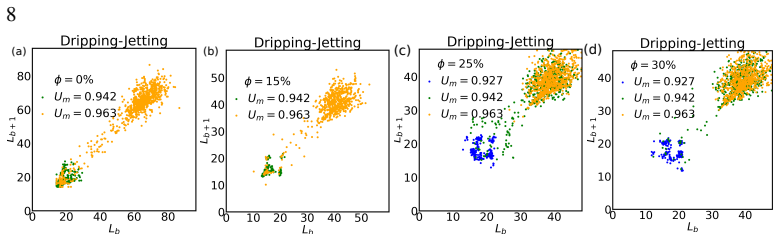
We study the transitional dynamics of the non-Brownian particulate Newtonian liquid jet for different particle volume fractions ($\phi$). We focus on the influence of particle volume fraction on the critical inflow velocity at which the dripping-jetting (i.e., dripping to jetting and jetting to dripping) transition occurs for the ratio of the nozzle diameter to the particle diameter ($D_n/D_p$=20). The experiments were conducted by increasing (forward sweep) and decreasing (reverse sweep) the flow rate. These experiments were repeated for different volume fractions. We observe, with an increase in particle volume fraction, the transition from the dripping to the jetting regime occurs through a chaotic dripping regime. With an increase in the particle volume fraction, the jetting regime has occurred at early flow rates during dripping to jetting transition (in forward sweep), and the jetting to dripping transition (reverse sweep) occurred at a lower flow rate than the forward sweep. The particle volume fraction impacts the hysteresis observed for the Newtonian fluid. Due to the changes in the critical flow rate where transition occur, the widening of the hysteresis loop of flow rate with the pinchoff length is observed. The transition from dripping to jetting is observed to have the recurrent escape of the pinchoff mechanism as the jet length changes, influencing the droplet size distribution. The frequency of droplet pinchoff and droplet size have decreased as the particle volume fraction has increased. As the particle volume fraction increases, the size distribution between the dripping and jetting regimes decreases.
Editorial analysis
A structured set of objections, weighed in public.
Referee Report
Summary. The paper experimentally studies the role of particle volume fraction φ on the dripping-jetting transitions and associated hysteresis in non-Brownian particulate suspensions at a fixed nozzle-to-particle diameter ratio of 20. By performing forward and reverse flow-rate sweeps, the authors report that higher φ introduces a chaotic dripping regime, causes the jetting regime to onset at lower flow rates during forward sweeps, results in reverse transitions at lower flow rates than forward, widens the hysteresis loop between flow rate and pinch-off length, and leads to decreased droplet pinch-off frequency and narrower size distributions.
Significance. If the observed effects can be confidently attributed to φ rather than confounding factors, the results would provide valuable experimental data on how particles influence jet breakup dynamics and hysteresis in droplet formation. The use of bidirectional sweeps to quantify hysteresis is a positive aspect, offering direct evidence of path-dependent behavior in these systems. This could inform models of multiphase jetting relevant to applications in printing, spraying, and material processing. However, the current lack of supporting rheological data reduces the immediate impact.
major comments (1)
- [Experimental Methods] The experimental description (abstract and methods) does not include rheological measurements such as viscosity versus shear rate for the suspensions at different φ, nor in-situ imaging or statistics on particle spatial distribution near the nozzle. This is load-bearing for the central claim because the reported shifts in transition points, chaotic regime, and hysteresis widening are attributed directly to increasing φ, yet non-Brownian particles at Dn/Dp=20 can alter effective viscosity or induce aggregation/settling; without these controls the causality cannot be isolated from the skeptic concern.
minor comments (3)
- No error bars, standard deviations, or mention of the number of repeated trials are provided for the critical flow rates, hysteresis widths, or droplet statistics, which weakens confidence in the consistency of the trends across φ values.
- The abstract states that 'the size distribution between the dripping and jetting regimes decreases' with φ; this phrasing is ambiguous and should be clarified with quantitative metrics (e.g., standard deviation of droplet diameters) and reference to specific figures.
- It is unclear whether the same nozzle and particle batch were used for all φ or if any settling time or mixing protocol was standardized between sweeps.
Simulated Author's Rebuttal
We thank the referee for their thorough review and constructive feedback. We address the major comment point by point below.
read point-by-point responses
-
Referee: [Experimental Methods] The experimental description (abstract and methods) does not include rheological measurements such as viscosity versus shear rate for the suspensions at different φ, nor in-situ imaging or statistics on particle spatial distribution near the nozzle. This is load-bearing for the central claim because the reported shifts in transition points, chaotic regime, and hysteresis widening are attributed directly to increasing φ, yet non-Brownian particles at Dn/Dp=20 can alter effective viscosity or induce aggregation/settling; without these controls the causality cannot be isolated from the skeptic concern.
Authors: We agree that rheological characterization and particle distribution statistics would strengthen the manuscript by more firmly isolating the role of φ. In the revised version we will add viscosity-versus-shear-rate curves for each suspension, confirming Newtonian response and quantifying any φ-dependent effective-viscosity increase. We will also include quantitative statistics (e.g., local volume-fraction profiles and nearest-neighbor distributions) extracted from the existing high-speed imaging sequences near the nozzle exit, demonstrating the absence of measurable aggregation or settling under the conditions studied. These additions will directly address the causality concern. revision: yes
Circularity Check
No circularity: purely experimental observations with no derived predictions or self-referential equations
full rationale
The manuscript is an experimental study reporting direct measurements of dripping-jetting transitions, hysteresis loops, droplet frequency, and size distributions as functions of particle volume fraction phi under forward/reverse flow-rate sweeps at fixed Dn/Dp=20. No equations, models, or fitted parameters are introduced whose outputs are then presented as independent predictions. All reported trends (earlier jetting onset, widened hysteresis, reduced frequency/size) are measured quantities, not quantities obtained by fitting or self-citation that reduce to the input data by construction. The work therefore contains no load-bearing derivation steps that could exhibit circularity.
Axiom & Free-Parameter Ledger
axioms (1)
- domain assumption Particles are non-Brownian and do not aggregate or alter the Newtonian character of the base liquid at the tested volume fractions.
Reference graph
Works this paper leans on
-
[1]
International Journal of Multiphase Flow 104, 206–213
R/u.pc/b.pc/i.pc/o.pc-R/u.pc/b.pc/i.pc/o.pc, M/a.pc/r.pc/i.pc/a.pc/n.pc/o.pc, T/a.pc/c.pc/o.pc/n.pc/e.pc/t.pc, P/a.pc/l.pc/o.pc/m.pc/a.pc & S/e.pc/v.pc/i.pc/l.pc/l.pc/a.pc, A/l.pc/e.pc/j.pc/a.pc/n.pc/d.pc/r.pc/o.pc 2018 Dripping dynamics and transitions at high bond numbers. International Journal of Multiphase Flow 104, 206–213. S/a.pc/f.pc/r.pc/o.pc/n.pc...
work page 2018
-
[2]
In Conference on Fluid Mechanics and Fluid Power , pp
S/a.pc/r.pc/v.pc/a.pc, K/i.pc/s.pc/h.pc/o.pc/r.pc/k.pc/u.pc/m.pc/a.pc/r.pc, /m.pc/u.pc/r.pc/t.pc/h.pc/y.pc , T/e.pc/j.pc/a.pc/s.pc G & T/o.pc/m.pc/a.pc/r.pc, G/a.pc/u.pc/r.pc/a.pc/v.pc2022 Particle filtration in suspension droplet breakup. In Conference on Fluid Mechanics and Fluid Power , pp. 387–394. Springer. S/a.pc/r.pc/v.pc/a.pc, K/i.pc/s.pc/h.pc/o.pc...
work page 2014
discussion (0)
Sign in with ORCID, Apple, or X to comment. Anyone can read and Pith papers without signing in.