A time-domain approach for motion-explicit evaluation of loads on floating structures in fully nonlinear waves
Pith reviewed 2026-05-10 17:24 UTC · model grok-4.3
The pith
A time-domain method evaluates second-order hydrodynamic loads on floating structures using nonlinear wave kinematics and instantaneous body motions.
A machine-rendered reading of the paper's core claim, the machinery that carries it, and where it could break.
Core claim
The paper establishes a novel time-domain approach for motion-explicit evaluation of loads, where a closed-form expression for the potential force component is derived as a generalization of the Pinkster approximation to fully nonlinear waves, the quadratic force component is reformulated to account for the total nonlinear body motion and velocity rather than first-order counterparts, the radiation potential is treated in the time domain while incident and scattering contributions use wavenumber-domain transfer functions, and the overall force model is coupled with a time-domain motion solver to permit consideration of instantaneous body motion and velocity in the force calculation.
What carries the argument
The closed-form potential force expression that generalizes the Pinkster approximation to fully nonlinear waves by applying wavenumber-domain transfer functions to pseudo-spectral wave fields, combined with time-domain treatment of the radiation potential and reformulation of quadratic forces using total nonlinear body motion and velocity.
Load-bearing premise
The method assumes that outputs from standard frequency-domain radiation-diffraction analysis remain sufficiently accurate when applied to fully nonlinear wave kinematics.
What would settle it
Direct comparison of the predicted motions of the moored container ship against measurements in fully nonlinear waves would confirm the reported significant improvements or reveal that discrepancies with standard theory persist.
Figures





read the original abstract
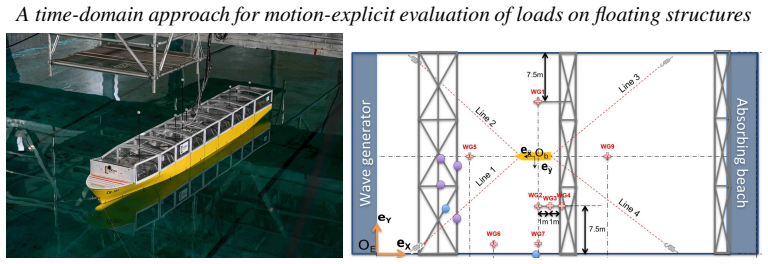
This paper presents a novel method for evaluating second-order consistent hydrodynamic loads, which employs nonlinear wave and body kinematics. The pseudo-spectral formulation of nonlinear potential flow wave solvers is exploited, permitting the application of transfer functions on the nonlinear incident wave field. A closed-form expression is accordingly derived for the potential force component, which constitutes a generalisation of the Pinkster approximation to fully nonlinear waves. Moreover, the quadratic force component is reformulated to account for the total nonlinear body motion and velocity rather than their first-order counterparts. Hence, the traditional assumption that first-order body motions are significantly larger than the second-order components, which is violated in the case of moored floating structures, is circumvented. To this end, the radiation potential is treated in the time domain and is distinguished from the incident and scattering wave contributions, which are considered through wavenumber-domain transfer functions. An important advantage of the proposed approach is that it is established on the output of radiation-diffraction analysis in the frequency domain, and therefore is highly practical and efficient. Finally, the derived force model is coupled with a time-domain motion solver, which permits the consideration of the instantaneous body motion and velocity in the force calculation. The solver is employed to investigate the motions of a moored container ship, and the results demonstrate significant improvements over standard second-order radiation-diffraction theory.
Editorial analysis
A structured set of objections, weighed in public.
Referee Report
Summary. The paper presents a time-domain method for second-order consistent hydrodynamic load evaluation on floating structures using fully nonlinear wave kinematics. It exploits pseudo-spectral nonlinear potential-flow wave solvers to apply wavenumber-domain transfer functions (from standard frequency-domain radiation-diffraction analysis) directly to the nonlinear incident field, yielding a closed-form generalization of the Pinkster approximation for the potential force. The quadratic force term is reformulated to incorporate the total instantaneous nonlinear body motion and velocity rather than first-order quantities only. Radiation is treated in the time domain while incident and scattering contributions use transfer functions; the resulting force model is coupled to a time-domain motion solver and demonstrated on a moored container ship, where it reportedly yields significant improvements over conventional second-order radiation-diffraction theory.
Significance. If the second-order consistency of the hybrid formulation holds, the approach offers a practical and computationally efficient route to incorporate fully nonlinear incident-wave effects into engineering load calculations without requiring a complete nonlinear boundary-element or CFD solution. By retaining existing frequency-domain radiation-diffraction outputs and adding only a time-domain radiation step, it could improve motion predictions for moored vessels in steep waves where the usual small-motion assumption fails. The demonstration case provides initial evidence of practical utility.
major comments (2)
- [§3] §3 (derivation of closed-form potential force): the claim that linear wavenumber-domain transfer functions remain second-order consistent when applied to a fully nonlinear incident field requires explicit justification. The decomposition separates incident/scattered contributions (via transfer functions) from radiation (time-domain), but any unaccounted cross-interactions between the nonlinear incident kinematics and the linear scattering/radiation potentials would generate O(ε³) errors that contaminate the intended second-order result; an error estimate or comparison against a fully nonlinear reference solution is needed to confirm consistency.
- [§4 and §5] §4 (quadratic force reformulation) and §5 (container-ship results): the reformulation replaces first-order body motion/velocity with total nonlinear quantities, which is load-bearing for the moored-structure claim. However, the paper must quantify the difference this change produces relative to the classical Pinkster quadratic term and demonstrate that the observed improvements are not dominated by other modeling choices (e.g., wave-solver accuracy or mooring model).
minor comments (2)
- [Abstract] The abstract states that results 'demonstrate significant improvements' but supplies no quantitative metrics (e.g., RMS error reduction, peak-load difference, or comparison against measurements); these should be stated explicitly.
- [§2] Notation for the pseudo-spectral wave solver and the wavenumber-domain transfer functions should be introduced once and used consistently; several symbols appear without prior definition in the early sections.
Simulated Author's Rebuttal
We thank the referee for the constructive comments and positive assessment of the manuscript's potential. We address each major comment point by point below, providing justifications where possible and outlining specific revisions to strengthen the paper.
read point-by-point responses
-
Referee: [§3] §3 (derivation of closed-form potential force): the claim that linear wavenumber-domain transfer functions remain second-order consistent when applied to a fully nonlinear incident field requires explicit justification. The decomposition separates incident/scattered contributions (via transfer functions) from radiation (time-domain), but any unaccounted cross-interactions between the nonlinear incident kinematics and the linear scattering/radiation potentials would generate O(ε³) errors that contaminate the intended second-order result; an error estimate or comparison against a fully nonlinear reference solution is needed to confirm consistency.
Authors: We appreciate the referee's request for explicit justification on this point. The linear transfer functions represent the first-order scattering operator applied to the incident potential. Since the nonlinear incident field already incorporates terms up to second order, the linear scattering response to its second-order component is formally third-order. In the force calculation, these terms do not enter the second-order loads. We will revise §3 to include a detailed order-of-magnitude analysis confirming that unaccounted cross-interactions remain O(ε³) and are consistent with the second-order framework. We will also add a short validation subsection comparing the hybrid approach against a fully nonlinear reference solution for a simplified body geometry to support the consistency claim. revision: yes
-
Referee: [§4 and §5] §4 (quadratic force reformulation) and §5 (container-ship results): the reformulation replaces first-order body motion/velocity with total nonlinear quantities, which is load-bearing for the moored-structure claim. However, the paper must quantify the difference this change produces relative to the classical Pinkster quadratic term and demonstrate that the observed improvements are not dominated by other modeling choices (e.g., wave-solver accuracy or mooring model).
Authors: We agree that quantifying the impact of the quadratic force reformulation is essential. In the revised §4, we will add an explicit analytical and numerical comparison between the classical Pinkster quadratic term (using only first-order motions/velocities) and our reformulated version (using total nonlinear kinematics), highlighting the differences for moored structures where the small-motion assumption fails. For the results in §5, we will include additional simulations that isolate this effect by using identical nonlinear wave kinematics and mooring models while toggling only between the classical and reformulated quadratic terms. This will demonstrate that the reported improvements in motion predictions for the container ship arise primarily from the reformulation rather than from the wave solver or mooring model. Sensitivity checks on these components will also be provided. revision: yes
Circularity Check
No circularity: derivation builds on independent external frequency-domain outputs and external nonlinear solvers.
full rationale
The paper presents a generalization of the Pinkster approximation by applying wavenumber-domain transfer functions (from standard frequency-domain radiation-diffraction analysis) to nonlinear incident wave fields generated by a pseudo-spectral solver, while reformulating the quadratic force term to use total instantaneous body motion and velocity and treating radiation separately in the time domain. No quoted equations or steps reduce the derived closed-form force expressions to the paper's own fitted inputs, self-cited results, or prior ansatzes by construction. The central claims remain independent of the target outputs and rely on externally supplied linear transfer functions and nonlinear wave kinematics without self-referential forcing or renaming of known results.
Axiom & Free-Parameter Ledger
axioms (2)
- domain assumption Fluid is inviscid, irrotational and incompressible (potential flow).
- domain assumption Radiation potential can be separated and treated in the time domain while incident and scattering contributions use wavenumber-domain transfer functions.
Reference graph
Works this paper leans on
-
[1]
A/g.pc/a.pc/r.pc/w.pc/a.pc/l.pc, P . & M/a.pc/n.pc/u.pc/e.pc/l.pc, L.2011 Incorporating irregular nonlinear waves in coupled simulation and reliability studies of offshore wind turbines. Applied Ocean Research 33 (3), 215–227. B/a.pc/i.pc, W . & E/a.pc/t.pc/o.pc/c.pc/k.pc T/a.pc/y.pc/l.pc/o.pc/r.pc, R.2006 Higher-order boundary element simulation of fully ...
work page 2011
-
[2]
F/e.pc/r.pc/r.pc/a.pc/n.pc/t.pc, P ., L/e.pc T/o.pc/u.pc/z.pc´ /e.pc, D. & P/e.pc/l.pc/l.pc/e.pc/t.pc/i.pc/e.pc/r.pc, K.2003 Non-linear time-domain models for irregular wave diffr action about offshore structures. International Journal for Numerical Methods in Fluids 43 (10-11), 1257–1277. F/i.pc/t.pc/z.pc/g.pc/e.pc/r.pc/a.pc/l.pc/d.pc, C. J., T/a.pc/y.pc/l...
work page 2003
-
[3]
K/u.pc/r.pc/n.pc/i.pc/a.pc, R. & D/u.pc/c.pc/r.pc/o.pc/z.pc/e.pc/t.pc, G.2023 NEMOH: Open-source boundary element solver for comput ation of first- and second-order hydrodynamic loads in the frequency domai n. Computer Physics Communications 292, 108885. L/e.pc/e.pc, C. H.1995 Wamit theory manual. T ech. Rep.. Massachusetts Institute of Technology. M/a.pc/...
work page 2023
-
[4]
R/o.pc/b.pc/e.pc/r.pc/t.pc/s.pc/o.pc/n.pc, A. N., /e.pc/t.pc /a.pc/l.pc2020 OC6 Phase I: Investigating the underprediction of low-frequency hydrodynamic loads and responses of a floating wind turbine. Journal of Physics: Conference Series 1618, 032033. R/o.pc/b.pc/e.pc/r.pc/t.pc/s.pc/o.pc/n.pc, A. N., /e.pc/t.pc /a.pc/l.pc.2017 OC5 Project Phase II: V alid...
work page 2017
-
[5]
T/e.pc/n.pc/g.pc, B., J/i.pc/n.pc, R. & C/o.pc/n.pc/g.pc, L.2016 A twice expansion analysis method in the time-domain fo r wave action on a floater translating with a large amplitude. Ocean Engineering 118, 138–151. W /a.pc/l.pc/k.pc/e.pc/r.pc, D. A. G., T/a.pc/y.pc/l.pc/o.pc/r.pc, P . H. & E/a.pc/t.pc/o.pc/c.pc/k.pc T/a.pc/y.pc/l.pc/o.pc/r.pc, R.2004 The ...
work page 2016
discussion (0)
Sign in with ORCID, Apple, or X to comment. Anyone can read and Pith papers without signing in.