Sharp mean Hadamard inequalities and polyconvex integrands that give rise to convex functionals
Pith reviewed 2026-05-13 21:26 UTC · model grok-4.3
The pith
Mean Hadamard inequalities in two dimensions turn polyconvex integrands into strictly convex functionals, ensuring unique minimizers under mixed boundary conditions.
A machine-rendered reading of the paper's core claim, the machinery that carries it, and where it could break.
Core claim
Sharp mean Hadamard inequalities in two dimensions allow certain polyconvex integrands to produce convex integral functionals; convexity of the functional then guarantees uniqueness of minimizers subject to mixed Dirichlet-Neumann boundary conditions.
What carries the argument
The family of sharp mean Hadamard inequalities, which supply lower bounds on averages of the determinant in terms of averages of matrix norms or singular values and thereby convert polyconvexity into strict convexity of the energy.
If this is right
- The functional is strictly convex, so the minimization problem has at most one solution.
- Uniqueness holds specifically for mixed Dirichlet and Neumann boundary conditions.
- The same mean inequalities can be used to establish convexity for related polyconvex energies in two dimensions.
Where Pith is reading between the lines
- The technique may extend to other variational problems in nonlinear elasticity where polyconvexity is already known but strict convexity is harder to obtain.
- Numerical verification of the mean inequalities could be turned into a practical test for whether a given integrand produces a convex functional.
- Analogous mean inequalities in three dimensions, if found, would allow similar uniqueness statements for three-dimensional polyconvex models.
Load-bearing premise
The integrand must be polyconvex and obey growth conditions that let the mean Hadamard inequalities force strict convexity of the full functional.
What would settle it
An explicit polyconvex integrand that satisfies the mean Hadamard inequalities yet admits two distinct admissible functions with identical mixed boundary data that both achieve the same minimal energy value.
Figures
read the original abstract
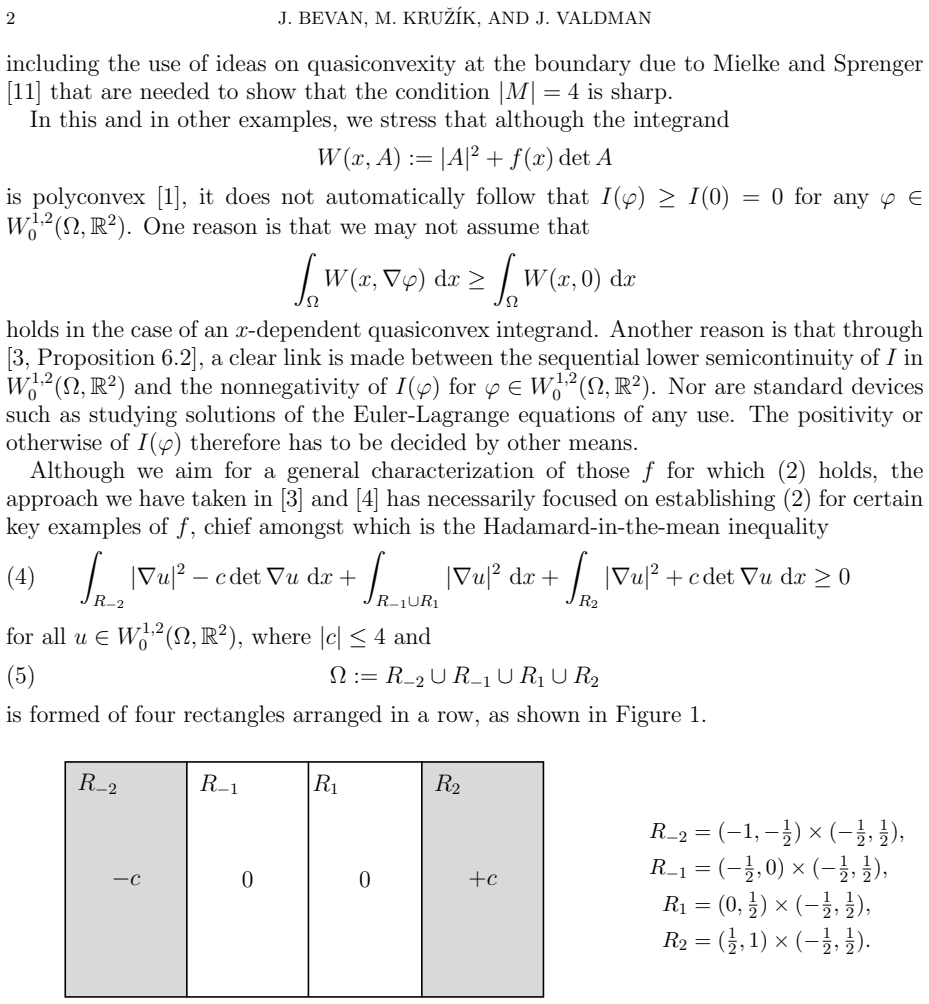
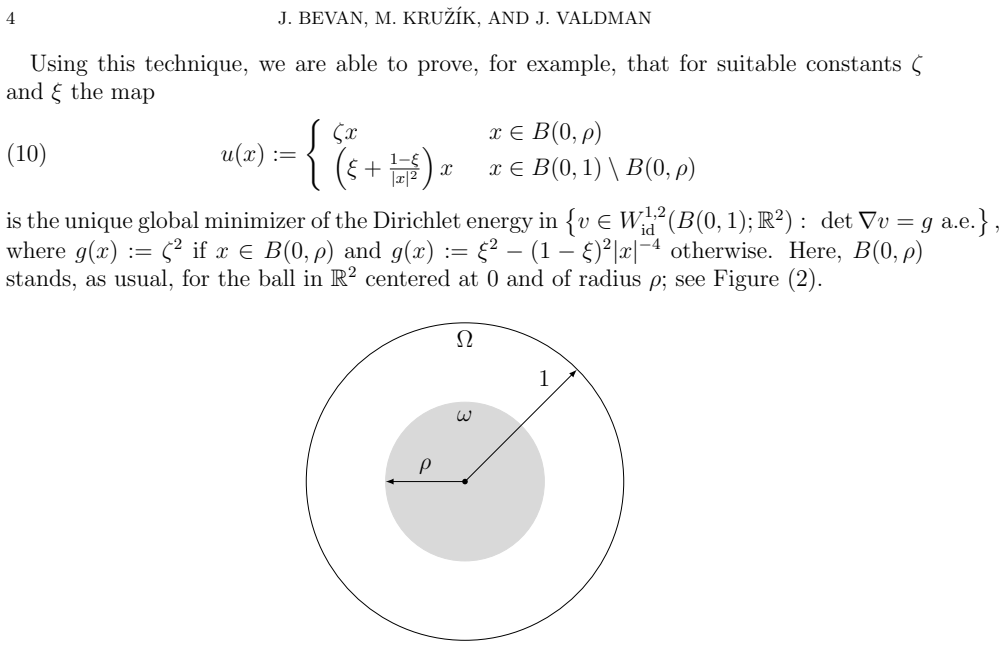
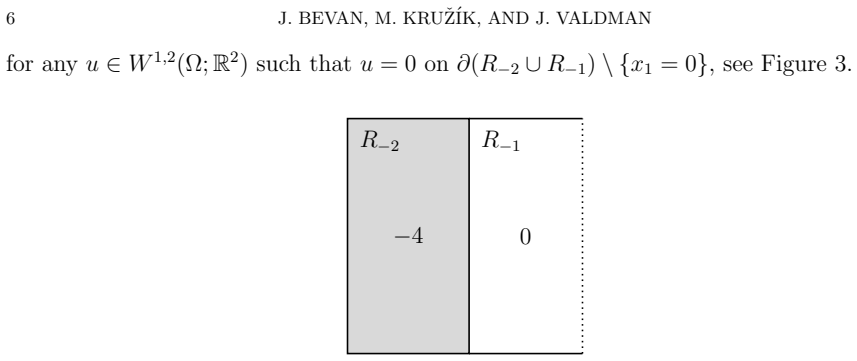
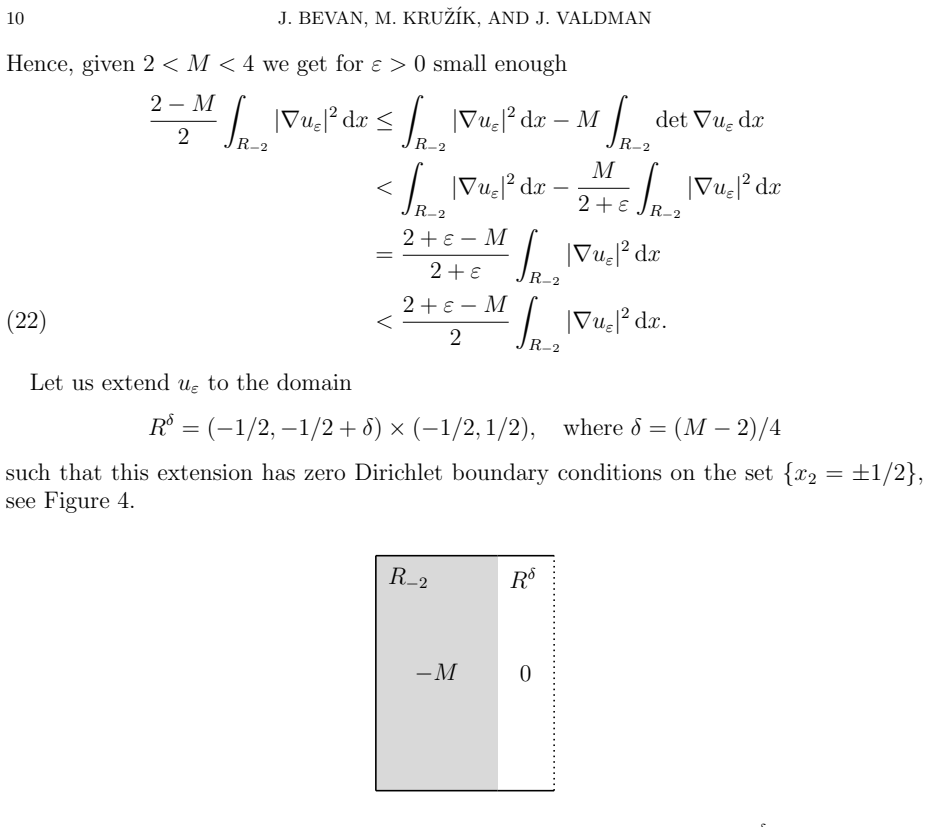
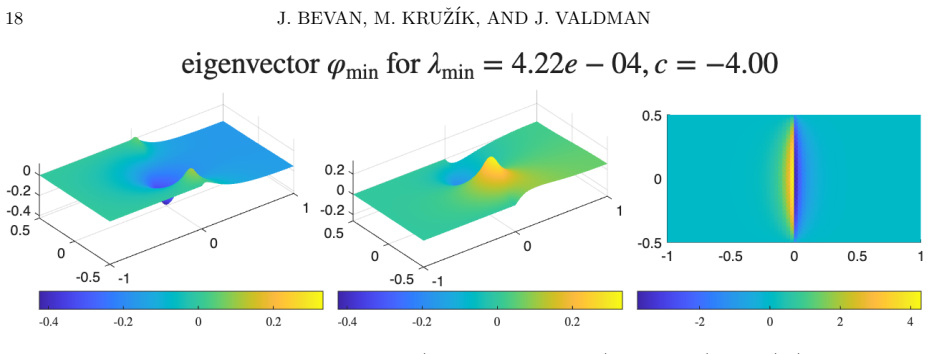
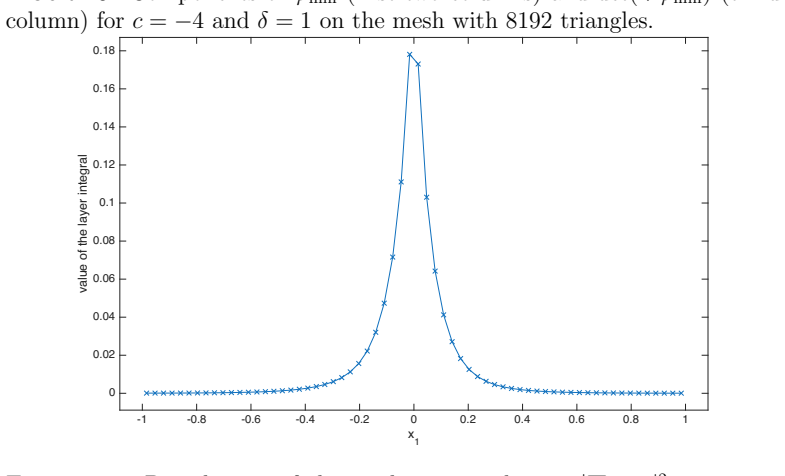
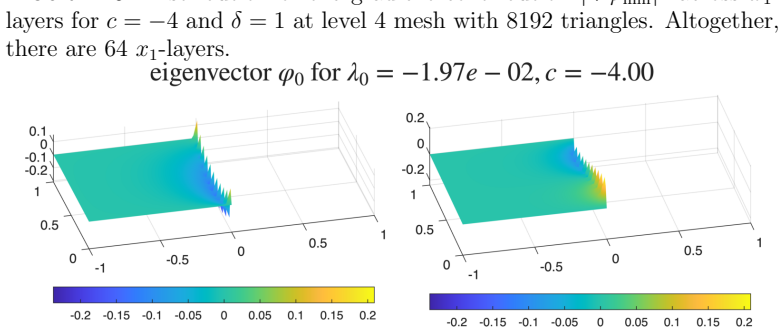
We investigate several instances of the Hadamard inequality in the mean in two dimensions. As a consequence, we prove the uniqueness of minimizers of an integral functional with a polyconvex integrand, subject to mixed Dirichlet and Neumann boundary conditions. The theoretical findings are complemented by computational experiments that illustrate the behavior of the minimizers.
Editorial analysis
A structured set of objections, weighed in public.
Referee Report
Summary. The manuscript derives sharp mean Hadamard inequalities in two dimensions and applies them to establish that certain polyconvex integrands induce strictly convex integral functionals. This convexity is then used to prove uniqueness of minimizers for the associated variational problem subject to mixed Dirichlet-Neumann boundary conditions. Numerical experiments are included to illustrate the behavior of the minimizers.
Significance. If the sharp inequalities are correctly established and the passage to strict convexity of the functional holds without additional assumptions, the work supplies a concrete analytic tool for uniqueness results in polyconvex variational problems, a setting central to nonlinear elasticity. The combination of the mean-inequality approach with mixed boundary conditions and the supporting computations strengthens the contribution, provided the derivations remain parameter-free as claimed.
minor comments (3)
- [Main results] The statement of the main uniqueness theorem (likely Theorem 4.1 or 5.1) should explicitly list the precise growth and convexity hypotheses on the integrand that are needed for the mean Hadamard inequality to imply strict convexity of the energy; the current wording leaves the transition slightly implicit.
- [Computational experiments] In the numerical section, the choice of finite-element spaces, mesh refinement strategy, and stopping criteria for the minimization algorithm are not fully specified; adding these details would improve reproducibility of the reported minimizer profiles.
- [Section 3] A few notational inconsistencies appear between the statement of the mean Hadamard inequality and its application in the convexity proof (e.g., the precise averaging measure used); a short clarifying remark or cross-reference would eliminate any ambiguity.
Simulated Author's Rebuttal
We thank the referee for the positive assessment of our manuscript and for recommending minor revision. The referee's summary accurately captures our derivation of sharp mean Hadamard inequalities in two dimensions and their use in establishing uniqueness for polyconvex integral functionals under mixed Dirichlet-Neumann boundary conditions. No specific major comments were provided in the report.
Circularity Check
No significant circularity detected
full rationale
The paper derives sharp mean Hadamard inequalities in 2D from first principles and then applies them to establish strict convexity of a polyconvex integrand under stated growth conditions, which directly implies uniqueness of minimizers for the mixed boundary-value problem. No step reduces by construction to a fitted parameter, self-definition, or self-citation chain; the inequalities are proved independently and the convexity implication follows from standard properties of polyconvexity without renaming or smuggling prior results. The computational experiments are presented only as illustration. The derivation chain is therefore self-contained against external mathematical benchmarks.
Axiom & Free-Parameter Ledger
axioms (1)
- domain assumption The integrand is polyconvex
Reference graph
Works this paper leans on
-
[1]
J. M. Ball: Convexity conditions and existence theorems in nonlinear elasticity.Arch. Rat. Mech. Anal.,63, no. 4 (1977), 337–403. J. M. Ball, J. Marsden. Quasiconvexity at the boundary, positivity of the second variation and elastic stability.Arch. Rat. Mech. Anal.86(1984), 251–277
work page 1977
-
[2]
J. Bevan. On double-covering stationary points of a constrained Dirichlet energy.Ann. Inst. H. Poincar´e Anal. Non Lin´eaire31(2014), 391–411
work page 2014
- [3]
-
[4]
https://doi.org/10.1016/j.na.2024.113523
- [5]
-
[6]
Dacorogna.Direct Methods in the Calculus of Variations.2nd ed
B. Dacorogna.Direct Methods in the Calculus of Variations.2nd ed. Springer Science+Business Media, 2008. B. Dacorogna, P. Marcellini.Implicit Partial Differential Equations.Progress in nonlinear differential equations and their applications 37, Birkh¨ auser, Boston, 1999
work page 2008
-
[7]
M. Dengler, J. Bevan. A uniqueness criterion and a counterexample to regularity in an incompressible variational problem. Arxiv:2205.07694, 2022. I. Fonseca, S. M¨ uller, P. Pedregal. Analysis of concentration and oscillation effects generated by gradients.SIAM J. Math. Anal.29(1998), 736–756
-
[8]
M. Giaquinta and E. Giusti. On the regularity of minima of variational integrals.Acta Math.148 (1982), 31–46. T. Iwaniec. Nonlinear Cauchy-Riemann operators inR n Trans. AMS354(2002), 1961-–1995
work page 1982
-
[9]
T. Iwaniec, A. Lutoborski. Integral estimates for null Lagrangians.Arch. Ration. Mech. Anal.125 (1993), 25–79
work page 1993
-
[10]
T. Iwaniec, A. Lutoborski. Polyconvex functionals for nearly conformal deformations.SIAM J. Math. Anal.27(1996), 609–619
work page 1996
-
[11]
F. John. Uniqueness of non-linear elastic equilibrium for prescribed boundary displacements and sufficiently small strains.Comm. Pure Appl. Math.XXV(1972), 617–634
work page 1972
- [12]
-
[13]
C. B. Morrey, Jr. Multiple integrals in the calculus of variations. Reprint of the 1966 edition. Classics in Mathematics. Springer-Verlag, Berlin, 2008
work page 1966
-
[14]
D.Y. Gao, P. Neff, I. Roventa, C. Thiel. On the convexity of nonlinear elastic energies in the right Cauchy-Green tensor.J. Elasticity127(2017), 303–308
work page 2017
-
[15]
J. Sivaloganathan, S.J. Spector. On the uniqueness of energy einimizers in finite elasticity.J. Elast. 133(2018), 73–103. 20 J. BEVAN, M. KRU ˇZ´IK, AND J. VALDMAN
work page 2018
-
[16]
D.E. Spector, S.J. Spector. Uniqueness of equilibrium with sufficiently small strains in finite elasticity. Arch. Ration. Mech. Anal.233(2019), 409–449. (J. Bevan)School of Mathematics and Physics, University of Surrey, Guildford, GU2 7XH, United Kingdom. Email address:j.bevan@surrey.ac.uk (M. Kruˇ z´ ık)Czech Academy of Sciences, Institute of Information...
work page 2019
discussion (0)
Sign in with ORCID, Apple, or X to comment. Anyone can read and Pith papers without signing in.