Generalized Kolmogorov systems with applications to astrophysics and biology
Pith reviewed 2026-05-10 17:46 UTC · model grok-4.3
The pith
Generalized Kolmogorov systems admit heteroclinic trajectories that connect equilibria in models of self-gravitating particles and predator-prey dynamics.
A machine-rendered reading of the paper's core claim, the machinery that carries it, and where it could break.
Core claim
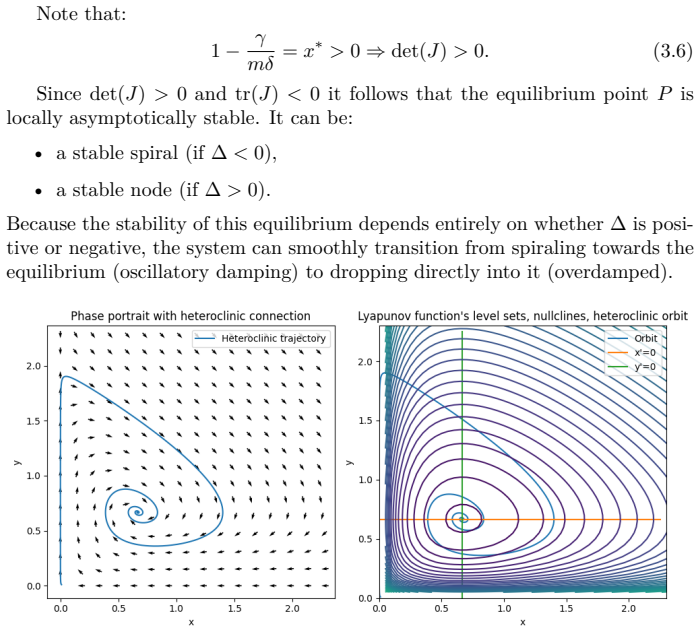
We prove the existence of a heteroclinic trajectory in generalized Kolmogorov systems and demonstrate its application to astrophysical models for self-gravitating particles and predator-prey systems in biology.
What carries the argument
The generalized Kolmogorov system, a functional extension of classic Lotka-Volterra type equations, together with the theorem that guarantees a heteroclinic orbit connecting equilibria under the stated conditions.
If this is right
- Heteroclinic trajectories provide a mechanism for transitions between equilibrium states in self-gravitating particle systems.
- The same trajectories describe possible shifts between population equilibria in predator-prey models.
- The existence result supplies an analytical tool for studying long-term dynamical behavior in both astrophysical and biological contexts.
- Models built on these systems can now incorporate explicit connecting orbits between different asymptotic regimes.
Where Pith is reading between the lines
- If the required conditions hold approximately in real gravitational or ecological data, the trajectories could be observable as slow transitions between clustered and dispersed states.
- The proof technique might extend to related non-autonomous or stochastic variants of Kolmogorov systems used in population dynamics.
- Numerical continuation methods could be used to track these orbits in higher-dimensional astrophysical simulations.
Load-bearing premise
The generalized Kolmogorov system must satisfy the specific conditions under which the existence theorem for the heteroclinic trajectory applies.
What would settle it
A concrete counterexample of a generalized Kolmogorov system satisfying the setup but containing no heteroclinic trajectory, or a numerical integration of the self-gravitating particle model that fails to exhibit the predicted connecting orbit.
Figures


read the original abstract
We consider generalized Kolmogorov system. We prove the existence of heteroclinic trajectory. We apply the results to astrophysical models for self-gravitating particles and predator-prey systems.
Editorial analysis
A structured set of objections, weighed in public.
Referee Report
Summary. The manuscript considers generalized Kolmogorov systems, proves the existence of heteroclinic trajectories, and applies the results to astrophysical models for self-gravitating particles and to predator-prey systems in biology.
Significance. If the existence result holds under explicitly stated conditions that are satisfied by the target models, the work could offer a unified dynamical-systems approach to heteroclinic behavior across astrophysical and ecological contexts. Such results are of interest when they yield concrete, verifiable predictions about long-term transitions in self-gravitating or population-dynamical systems.
major comments (2)
- [Abstract] Abstract (and entire manuscript): the central claim is an existence proof for heteroclinic trajectories, yet the text supplies neither a definition of the generalized Kolmogorov system, any hypotheses on the vector field, nor even a statement of the theorem or proof outline. Without these elements the claim cannot be evaluated.
- [Applications] Applications paragraph: the manuscript asserts applicability to self-gravitating-particle and predator-prey models but provides no explicit ODEs, no verification that the models satisfy the (unstated) hypotheses, and no indication of what the heteroclinic trajectory implies for the physical or biological quantities of interest.
minor comments (2)
- [Abstract] Abstract contains grammatical and number-agreement issues: 'generalized Kolmogorov system' should be 'a generalized Kolmogorov system' or 'generalized Kolmogorov systems'; 'heteroclinic trajectory' is singular while the context suggests possibly multiple orbits.
- No references to prior work on Kolmogorov systems, heteroclinic orbits in Hamiltonian or Lotka-Volterra systems, or related astrophysical/biological literature are supplied.
Simulated Author's Rebuttal
We thank the referee for the detailed and constructive report. The comments correctly identify that the submitted manuscript is too concise in its presentation of the mathematical framework and applications. We will prepare a major revision that supplies the missing elements while preserving the core results on heteroclinic trajectories in generalized Kolmogorov systems.
read point-by-point responses
-
Referee: [Abstract] Abstract (and entire manuscript): the central claim is an existence proof for heteroclinic trajectories, yet the text supplies neither a definition of the generalized Kolmogorov system, any hypotheses on the vector field, nor even a statement of the theorem or proof outline. Without these elements the claim cannot be evaluated.
Authors: We agree that the abstract and main text as submitted omit the necessary definitions, hypotheses, theorem statement, and proof outline, which prevents proper evaluation. In the revised manuscript we will expand both the abstract and the introduction to include: (i) a precise definition of the generalized Kolmogorov system, (ii) the explicit hypotheses imposed on the vector field, (iii) a clear statement of the existence theorem for heteroclinic trajectories, and (iv) a concise outline of the proof. These additions will be placed at the beginning of the paper so that the central claim can be assessed immediately. revision: yes
-
Referee: [Applications] Applications paragraph: the manuscript asserts applicability to self-gravitating-particle and predator-prey models but provides no explicit ODEs, no verification that the models satisfy the (unstated) hypotheses, and no indication of what the heteroclinic trajectory implies for the physical or biological quantities of interest.
Authors: We accept that the applications section is insufficiently detailed. The revision will contain: (i) the explicit systems of ODEs for the self-gravitating-particle model and the predator-prey model, (ii) direct verification that each model satisfies the hypotheses of the main theorem, and (iii) a discussion of the dynamical implications of the heteroclinic trajectories (for example, the long-term transition from one equilibrium configuration to another in the astrophysical setting, and the corresponding shift between population states in the biological setting). These changes will make the concrete predictions of the theory explicit. revision: yes
Circularity Check
No significant circularity detected
full rationale
The paper states it considers generalized Kolmogorov systems, proves existence of a heteroclinic trajectory under (presumably explicit) conditions, and applies the result to self-gravitating particle models and predator-prey systems. No equations, fitted parameters, self-citations, or ansatzes are visible in the abstract or summary that would allow any load-bearing step to reduce to its own inputs by construction. The central claim is a standard mathematical existence proof rather than a data-driven prediction or self-referential definition, making the derivation self-contained against external benchmarks.
Axiom & Free-Parameter Ledger
axioms (1)
- standard math Standard assumptions from dynamical systems theory sufficient to guarantee existence of heteroclinic orbits under the stated generalization.
Lean theorems connected to this paper
-
IndisputableMonolith/Cost/FunctionalEquation.leanwashburn_uniqueness_aczel unclear?
unclearRelation between the paper passage and the cited Recognition theorem.
Theorem 1.1 … (L(x,y))' = Gx Hz/x (x-w)^2 - Hy Gw/y (y-z)^2 … (L(x,y))' ≤ 0
-
IndisputableMonolith/Foundation/RealityFromDistinction.leanreality_from_one_distinction unclear?
unclearRelation between the paper passage and the cited Recognition theorem.
heteroclinic trajectory … bound X = H^{-1}_{[w,δ)}(G(cv))
What do these tags mean?
- matches
- The paper's claim is directly supported by a theorem in the formal canon.
- supports
- The theorem supports part of the paper's argument, but the paper may add assumptions or extra steps.
- extends
- The paper goes beyond the formal theorem; the theorem is a base layer rather than the whole result.
- uses
- The paper appears to rely on the theorem as machinery.
- contradicts
- The paper's claim conflicts with a theorem or certificate in the canon.
- unclear
- Pith found a possible connection, but the passage is too broad, indirect, or ambiguous to say the theorem truly supports the claim.
Reference graph
Works this paper leans on
- [1]
-
[2]
D. Bors, R. Stańczy, Models of particles of the Michie-King type , Comm. Math. Phys. 382 (2021), 1243–1262. http://www.doi.org/10. 1007/s00220-021-03981-8 10
work page 2021
-
[3]
D. Bors, R. Stańczy, Dynamical system describing cloud of particles , Jour- nal of Differential Equations 342 (2023), 21–23. http://www.doi.org/10. 1016/j.jde.2022.09.036
work page 2023
-
[4]
D. Bors, R. Stańczy, Mathematical model for Sagittarius A* and related Tolman-Oppenheimer-Volkoff equations, Mathematical Methods in the Ap- plied Science 46 (2023), 12052–12063. https://doi.org/10.1002/mma. 9165
work page doi:10.1002/mma 2023
-
[5]
D. Bors, R. Stańczy, Dynamical system for Tolman-Oppenheimer-Volkoff equation, Discrete and Continuous Dynamical Systems B 30 (2025), 4482–
work page 2025
-
[6]
http://doi.org/0.3934/dcdsb.2025032
-
[7]
V. Crespi, C.R. Argüelles, E.A. Becerra-Vergara, M.F. Mestre, F, Peissker, J.A. Rueda, R. Ruffini, The dynamics of S-stars and G-sources orbiting a supermassive compact object made of fermionic dark matter , Mon. Notices Royal Astron. Soc. 546 (2026), 1–14. https://doi.org/10.1093/mnras/ staf1854
-
[8]
S. Lenhart., J.T. Workman Optimal Control Applied to Biological Mod- els, Chapman and Hall, New York, 2007. https://doi.org/10.1201/ 9781420011418
work page 2007
-
[9]
M. Ibrahim, Optimal harvesting of a predator-prey system with marine reserve, Scientific African 14 (2021), e01048. https://doi.org/10.1016/ j.sciaf.2021.e01048
work page 2021
-
[10]
Koposov, Boubert, Li, Erkal, Da Costa, Zucker, Ji, Kuehn, Lewis, Mackey, Simpson, Shipp, Wan, Belokurov, Bland-Hawthorn, Martell, Nordlander, Pace, De Silva, Discovery of a nearby 1700 km/s star ejected from the Milky Way by Sgr A* Mon. Not. R. Astron. Soc. 491 (2020), 2465–2480
work page 2020
-
[11]
Sigmund, Kolmogorov and population dynamics , in: É
K. Sigmund, Kolmogorov and population dynamics , in: É. Charpentier, A. Lesne, N.K. Nikolski (eds.), Kolmogorov’s Heritage in Mathemat- ics, Springer-Verlag, Berlin, 2007, 177–186. https://doi.org/10.1007/ 978-3-540-36351-4
work page 2007
-
[12]
R. Stańczy, D. Bors, Dynamical system describing cloud of particles in relativistic and non-relativistic framework , Topol. Methods Nonl. Analysis, (2026). http://www.doi.org/10.12775/TMNA.2026.007 Robert Stańczy (corresponding author) stanczr@math.uni.wroc.pl ORCID: https://orcid.org/0000-0003-3317-2012 Uniwersytet Wrocławski Instytut Matematyczny Pl. Gr...
discussion (0)
Sign in with ORCID, Apple, or X to comment. Anyone can read and Pith papers without signing in.