Gaia astrometry disfavors a binary origin for long secondary periods
Pith reviewed 2026-05-10 17:27 UTC · model grok-4.3
The pith
Gaia astrometry shows most long secondary periods in red giants are not caused by binary companions.
A machine-rendered reading of the paper's core claim, the machinery that carries it, and where it could break.
Core claim
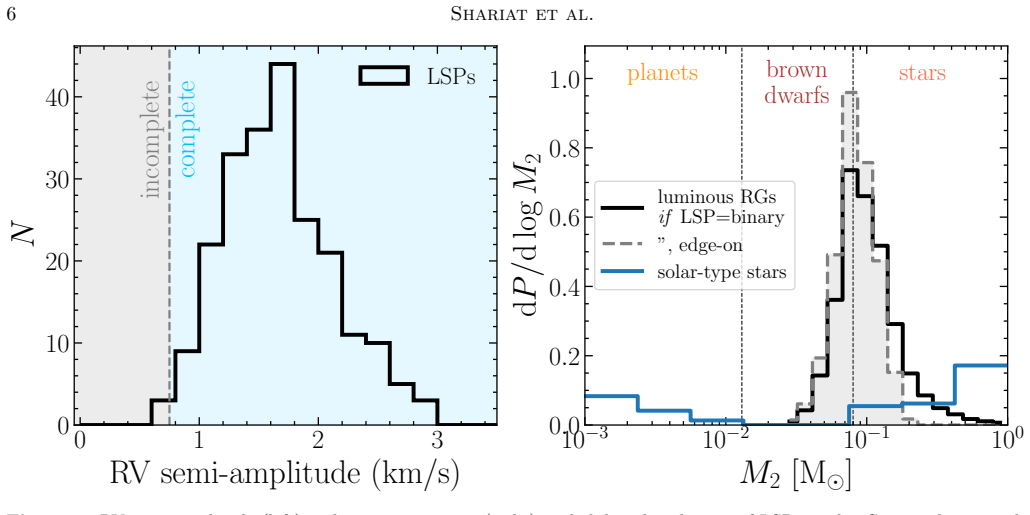
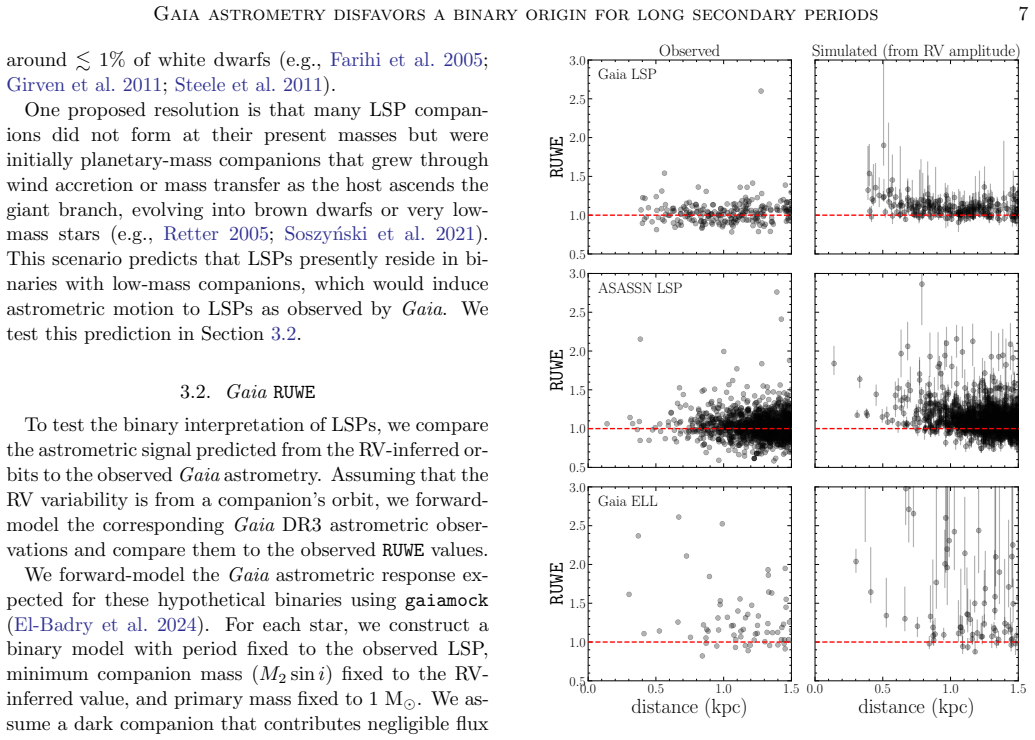
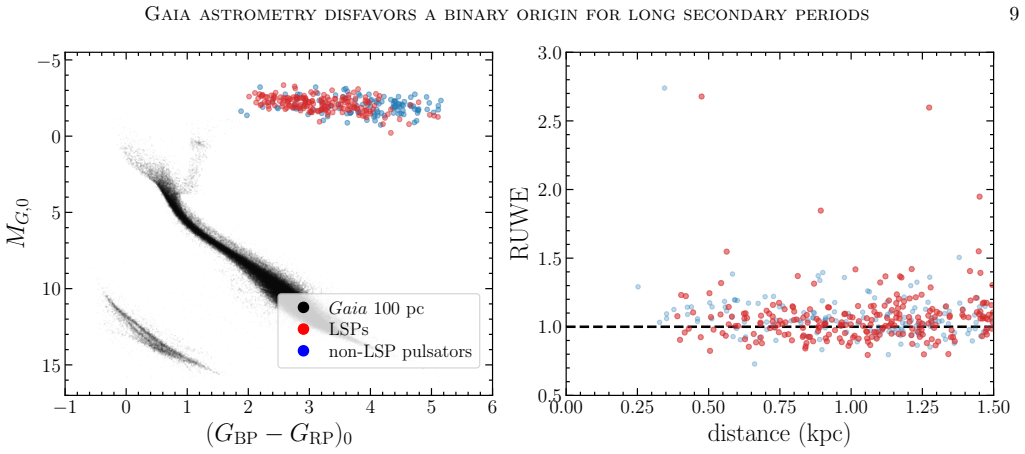
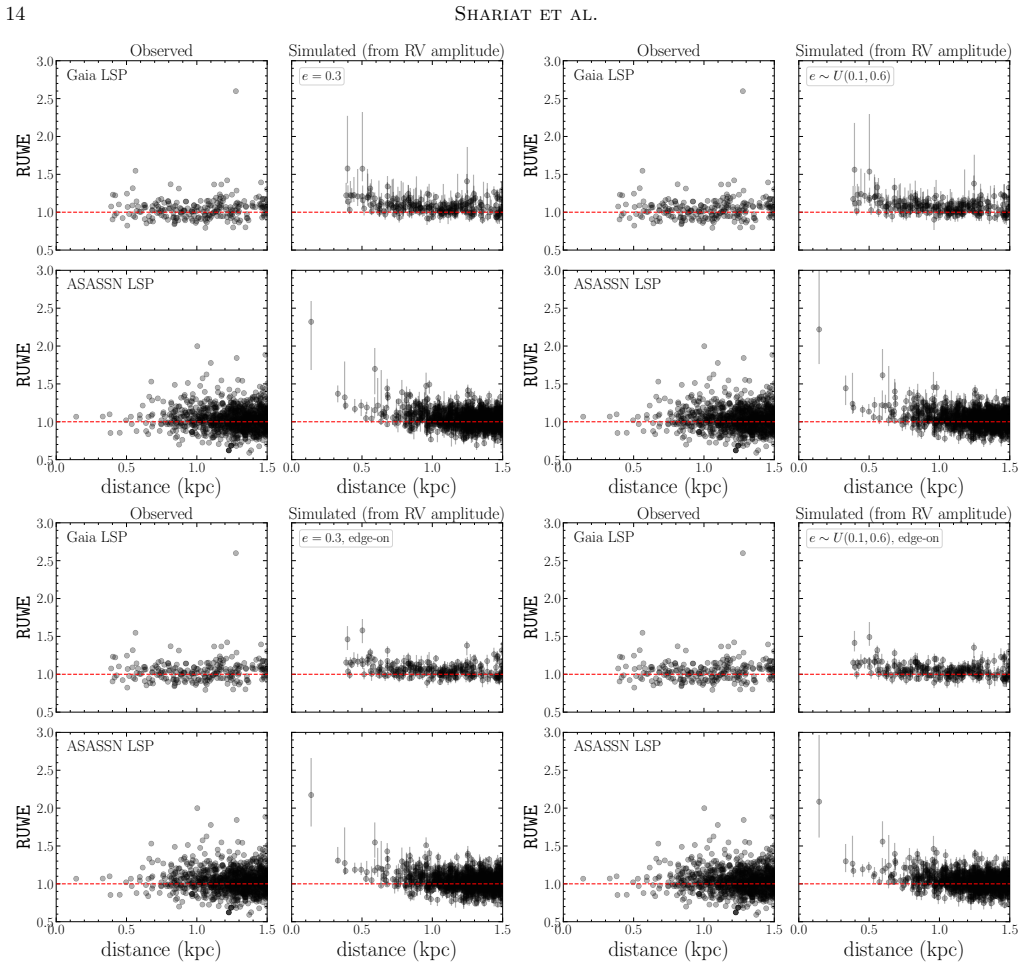
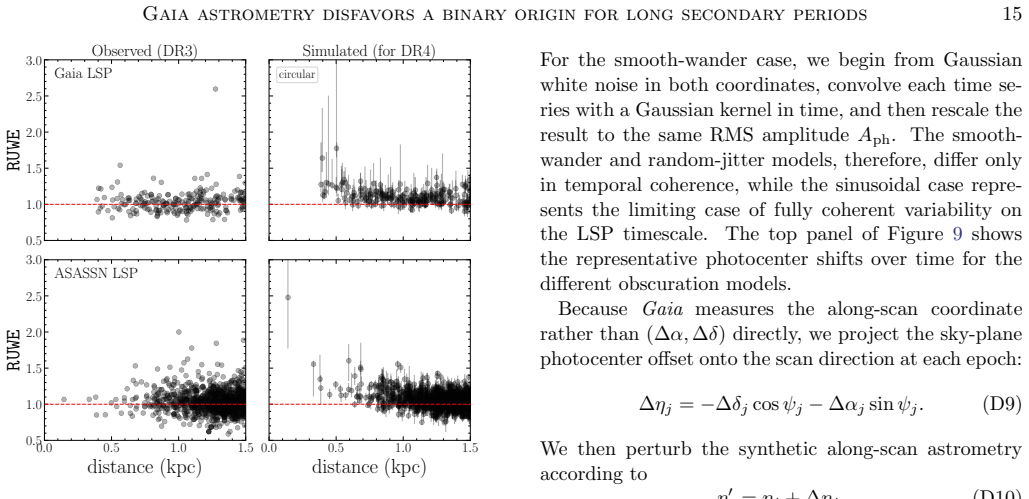
Interpreting the radial-velocity variability of LSP stars as orbital motion requires companions narrowly clustered near 0.1 solar masses at separations of 1-3 AU. Forward modeling of the astrometric signature these companions would produce in Gaia DR3 predicts elevated RUWE values. The actual RUWE distribution for nearby LSP stars lies systematically below those predictions and matches expectations for single stars, disfavoring low-mass stellar or substellar companions as the dominant origin of LSPs.
What carries the argument
Forward modeling of Gaia DR3 astrometric signatures to predict RUWE for binary systems whose masses and separations are inferred from observed radial-velocity amplitudes.
If this is right
- The brown-dwarf desert around solar-type stars extends to the red-giant phase for the relevant separations.
- Most LSP stars should show no detectable astrometric or spectroscopic signature of a companion.
- Alternative single-star mechanisms must account for both the photometric LSP and the RV modulation.
- The fraction of true binaries among LSP stars is much lower than previously inferred from RV data alone.
Where Pith is reading between the lines
- Similar RUWE tests can be applied to other classes of variables whose RV signals have been attributed to companions.
- Pulsation models for red giants will need to incorporate a mechanism that produces stable multi-year photometric cycles without requiring a companion.
- Higher-precision astrometry from future missions could tighten the upper limit on any residual binary fraction.
Load-bearing premise
That the observed radial-velocity variability is produced by orbital motion of a companion.
What would settle it
A sample of LSP stars in which the measured RUWE values match the elevated predictions calculated for 0.1-solar-mass companions at 1-3 AU, or direct imaging or radial-velocity confirmation of such companions.
Figures
read the original abstract
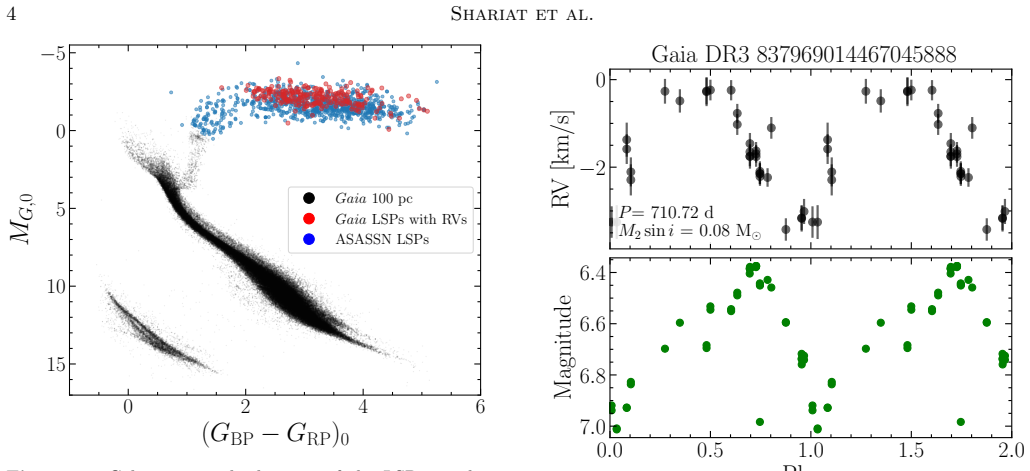
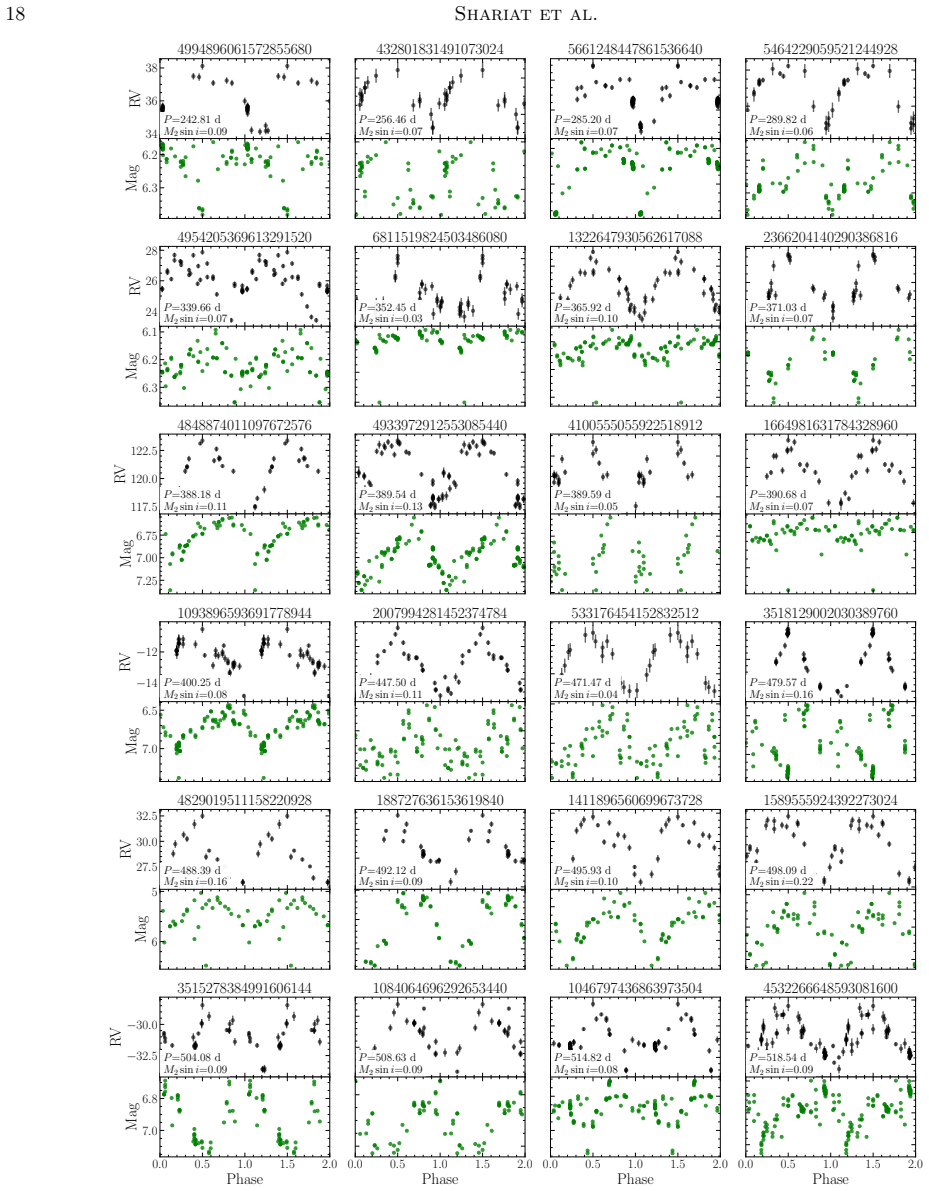
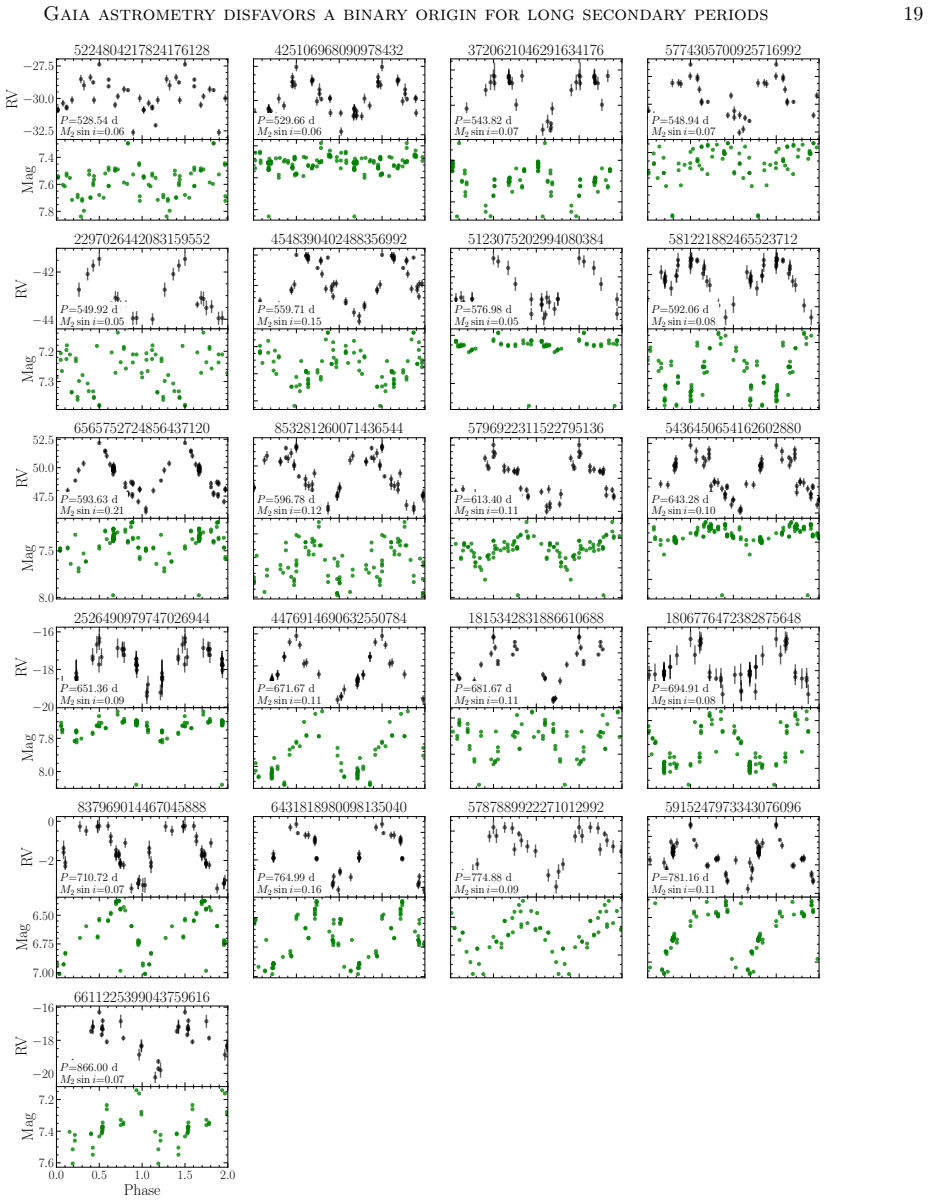
Approximately one-third of luminous pulsating red giant stars exhibit long secondary periods (LSPs): stable photometric variability with periods of several months to years in addition to their much shorter primary pulsation cycles. Now nearly a century after their discovery, the physical origin of LSPs remains unresolved. A leading explanation invokes binarity, in which the LSP corresponds to the orbital period of a low-mass companion responsible for both the photometric variability and the radial-velocity (RV) modulation. We test this hypothesis using a nearby sample of LSP stars from the {\it Gaia} Focused Product Release, which provides multi-epoch RVs and contemporaneous optical photometry. We find that interpreting the observed RV variability as orbital motion implies companion masses narrowly distributed around $M_2 \approx 0.1~{\rm M_\odot}$ with separations of 1--3 au, placing them squarely in the brown dwarf desert observed around their solar-type progenitors. Assuming such companions exist, we then forward-model the astrometric signature expected in {\it Gaia} DR3 and predict systematically elevated {\tt RUWE} values for nearby LSPs. In contrast, the observed {\tt RUWE} of nearby LSP stars is systematically lower than these predictions and consistent with most systems exhibiting LSPs being single. This discrepancy disfavors low-mass stellar or substellar companions as the dominant origin of LSPs in evolved stars, motivating a further exploration of alternative stellar mechanisms.
Editorial analysis
A structured set of objections, weighed in public.
Referee Report
Summary. The paper claims that RV variations in a sample of nearby LSP red giants, if interpreted as orbital motion, imply low-mass companions (M2 ≈ 0.1 M⊙ at 1–3 au). Forward-modeling the expected Gaia DR3 astrometric perturbations for these parameters predicts systematically elevated RUWE values, yet the observed RUWE distribution for the same stars is low and consistent with single-star solutions. This discrepancy is used to disfavor a binary origin for LSPs and to motivate alternative stellar mechanisms.
Significance. If the forward-modeling of RUWE is accurate and the RV-to-orbit conversion holds, the result provides a direct, falsifiable test that weakens the long-standing binary-companion hypothesis for LSPs. The approach usefully combines Gaia RVs, photometry, and astrometry on a well-defined nearby sample and yields a clear observational prediction that can be checked with future data releases.
major comments (2)
- [RUWE forward-modeling section] The RUWE forward-modeling section does not appear to inject the actual Gaia DR3 epoch times, attitude history, and scanning-law geometry for each target before refitting the single-star astrometric solution. For orbital periods of several hundred days (comparable to the 34-month DR3 time span), the astrometric signal can be partially absorbed into the fitted parallax and proper-motion terms; without the real scanning law the predicted excess noise is likely overestimated, directly affecting the claimed discrepancy with the observed low RUWE values.
- [RV analysis and companion-parameter derivation] The conversion from observed RV semi-amplitude to companion mass and separation (leading to the narrow M2 ≈ 0.1 M⊙, 1–3 au distribution) assumes the RV variability is purely Keplerian and that the stars are viewed at random inclinations. No quantitative assessment is given of how non-orbital contributions to the RV signal or selection effects in the LSP sample would alter the predicted RUWE distribution.
minor comments (2)
- [Sample selection] Clarify the exact definition and error treatment of the 'nearby' sample cut and whether RUWE values are taken directly from the Gaia archive or recomputed.
- [Results] The abstract states that the observed RUWE is 'consistent with most systems exhibiting LSPs being single'; a quantitative statement of the fraction of stars whose RUWE lies within the single-star locus would strengthen this claim.
Simulated Author's Rebuttal
We are grateful to the referee for their insightful comments, which have helped us improve the clarity and robustness of our analysis. Below, we provide a point-by-point response to the major comments. We maintain that our conclusions are supported by the data, but we will make revisions to address the concerns raised.
read point-by-point responses
-
Referee: The RUWE forward-modeling section does not appear to inject the actual Gaia DR3 epoch times, attitude history, and scanning-law geometry for each target before refitting the single-star astrometric solution. For orbital periods of several hundred days (comparable to the 34-month DR3 time span), the astrometric signal can be partially absorbed into the fitted parallax and proper-motion terms; without the real scanning law the predicted excess noise is likely overestimated, directly affecting the claimed discrepancy with the observed low RUWE values.
Authors: We thank the referee for highlighting this limitation in our forward-modeling of the RUWE. Our approach uses a simplified estimation of the astrometric wobble without the full Gaia DR3 scanning law and epoch data. We agree that this can lead to an overestimation of the predicted RUWE for orbital periods comparable to the DR3 baseline, as some of the signal may be absorbed into the fitted parameters. This is a valid point, and we will revise the manuscript to explicitly discuss this approximation and its implications. Specifically, we will note that while the predicted RUWE may be somewhat overestimated, the observed values are still systematically lower and consistent with single-star solutions, thereby maintaining the discrepancy with the binary model. A full simulation is beyond the scope of the current work but will be pursued in follow-up research. We believe this addition will strengthen the paper by providing necessary context. revision: partial
-
Referee: The conversion from observed RV semi-amplitude to companion mass and separation (leading to the narrow M2 ≈ 0.1 M⊙, 1–3 au distribution) assumes the RV variability is purely Keplerian and that the stars are viewed at random inclinations. No quantitative assessment is given of how non-orbital contributions to the RV signal or selection effects in the LSP sample would alter the predicted RUWE distribution.
Authors: Our conversion from RV semi-amplitudes to companion parameters follows the standard procedure for testing the binary hypothesis, assuming Keplerian motion and random inclinations. We did not include a quantitative assessment of non-orbital RV contributions or selection effects because the primary aim is to evaluate the binary scenario under the assumptions commonly adopted in the literature. If non-orbital effects are present, it would undermine the binary interpretation, supporting our overall conclusion. We will revise the manuscript to include a discussion of these assumptions and their potential effects on the RUWE predictions. This will involve adding a qualitative analysis of how such factors might influence the results, without altering the main findings. The revision will be made in the methods and discussion sections. revision: partial
Circularity Check
No significant circularity; derivation uses independent RV-to-orbit mapping and external Gaia forward model
full rationale
The paper's chain starts from observed RV variability interpreted as orbital motion to derive companion masses and separations (M2 ≈ 0.1 M⊙, 1-3 au). It then applies an external forward-modeling procedure based on Gaia DR3 scanning law, attitude, and single-star solution fitting to predict RUWE values for those parameters. Observed RUWE is compared directly to this prediction. This is a test against external astrometric data and instrument properties rather than any self-referential fit, definition, or self-citation chain. No step reduces by construction to the inputs; the discrepancy is falsifiable outside the paper's equations. Minor self-citations, if present, are not load-bearing for the central claim.
Axiom & Free-Parameter Ledger
free parameters (1)
- companion mass and separation distribution
axioms (2)
- domain assumption Observed RV variability is produced by Keplerian orbital motion of a companion
- standard math Gaia RUWE reliably traces excess astrometric noise from unresolved companions
Reference graph
Works this paper leans on
-
[1]
2020, MNRAS, 496, 1922, doi: 10.1093/mnras/staa1522
Belokurov, V., Penoyre, Z., Oh, S., et al. 2020, MNRAS, 496, 1922, doi: 10.1093/mnras/staa1522 Chiavassa, A., Freytag, B., & Schultheis, M. 2018, A&A, 617, L1, doi: 10.1051/0004-6361/201833844 Chiavassa, A., Kudritzki, R., Davies, B., Freytag, B., & de Mink, S. E. 2022, A&A, 661, L1, doi: 10.1051/0004-6361/202243568 Courtney-Barrer, B., Haubois, X., Wood,...
-
[2]
https://dms.cosmos.esa.int/COSMOS/doc fetch. php?id=1566327 MacLeod, M., Blunt, S., De Rosa, R. J., et al. 2025, ApJ, 978, 50, doi: 10.3847/1538-4357/ad93c8 Marcy, G. W., & Butler, R. P. 2000, PASP, 112, 137, doi: 10.1086/316516 Nicholls, C. P., Wood, P. R., Cioni, M.-R. L., & Soszy´ nski, I. 2009, MNRAS, 399, 2063, doi: 10.1111/j.1365-2966.2009.15401.x O...
discussion (0)
Sign in with ORCID, Apple, or X to comment. Anyone can read and Pith papers without signing in.