Variable Dead-Time Based Novel Soft-Start Method for Dual Active Bridge Converters
Pith reviewed 2026-05-10 17:14 UTC · model grok-4.3
The pith
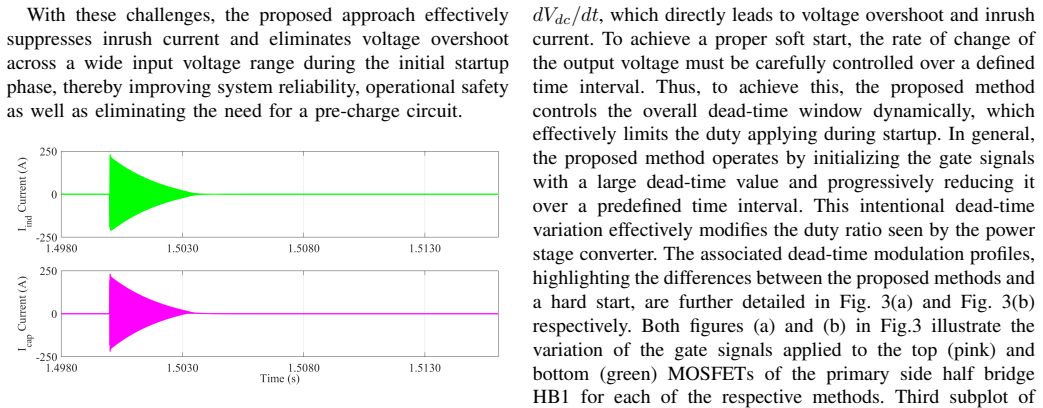
Gradually reducing dead time from one switching period to the minimum allows Dual Active Bridge converters to build secondary voltage smoothly while suppressing inrush current and overshoot.
A machine-rendered reading of the paper's core claim, the machinery that carries it, and where it could break.
Core claim
By decreasing dead time progressively from nearly one switching period down to the minimum hardware limit, the converter achieves a smooth secondary-voltage buildup, limits leakage-inductor current, and avoids the severe overshoot and inrush currents that appear when dead time is held constant or when only phase-shift control is used.
What carries the argument
Variable dead-time ramp that shortens the non-conducting interval over the startup interval to regulate instantaneous power transfer.
If this is right
- Conventional fixed-dead-time or phase-shift-only starts produce severe voltage overshoot and high inrush currents.
- The variable-dead-time ramp produces gradual voltage rise and bounded inductor current.
- The approach requires no extra sensors and runs on standard microcontrollers.
- The same dead-time schedule works for nth-order DAB topologies.
Where Pith is reading between the lines
- Component stress during repeated start-ups could decrease, which might improve long-term reliability.
- Combining the dead-time ramp with existing phase-shift modulation could extend smooth control beyond the initial start-up phase.
- Verification at higher power levels or under abrupt load steps would test whether the same ramp profile remains effective.
Load-bearing premise
Real-time dead-time adjustment on ordinary microcontrollers can be performed without creating timing errors or new instabilities under changing loads and temperatures.
What would settle it
A hardware test that applies the gradual dead-time reduction yet still records large voltage overshoot or high inrush current would show the method does not deliver the claimed control.
Figures



read the original abstract
Effective startup control is critical for the safe and reliable operation of Dual Active Bridge (DAB) converters. Unlike traditional soft-start techniques that rely solely on phase-shift control or fixed dead-time settings, the proposed approach gradually reduces the dead time from a value close to one switching period to the hardware-defined minimum. This enables a smooth buildup of the secondary-side voltage while effectively minimizing voltage overshoot and suppressing inrush current during startup. As a result, the leakage inductor current rises in a controlled manner, ensuring safe and predictable startup behavior. Simulation results demonstrate that conventional startup methods lead to severe voltage overshoot and high inrush currents, whereas the proposed method achieves a gradual voltage rise with well-regulated current profiles. Experimental validation using a 15 kW hardware platform confirms the effectiveness and robustness of the approach under different operating conditions. The proposed technique is simple, hardware-friendly, easily implementable on standard microcontrollers, and applicable to nth - order DAB architecture, making it a versatile solution for enhancing the reliability and safety of DAB converters in practical applications.
Editorial analysis
A structured set of objections, weighed in public.
Referee Report
Summary. The paper proposes a variable dead-time soft-start method for Dual Active Bridge (DAB) converters. Dead time is gradually reduced from a value near one switching period down to the hardware minimum, enabling controlled secondary-side voltage rise, reduced overshoot, and suppressed inductor inrush current. Effectiveness is asserted via simulations (showing qualitative improvement over fixed dead-time or phase-shift-only methods) and 15 kW hardware experiments under different operating conditions; the technique is presented as simple, hardware-friendly, and extensible to nth-order DAB topologies.
Significance. If the central claim holds with quantitative backing, the method offers a low-complexity alternative to existing soft-start techniques that avoids extra sensors or hardware while addressing a practical reliability issue in high-power DAB applications. The absence of equations, quantitative metrics, and implementation specifics in the current manuscript, however, prevents a full assessment of novelty, robustness, or generalizability relative to prior dead-time or phase-shift modulation approaches.
major comments (3)
- [Abstract / Results] Abstract and results sections: the central claim of 'smooth buildup' and 'effective minimization of voltage overshoot and inrush current' rests entirely on qualitative descriptions of simulation and 15 kW experiments. No numerical values (e.g., peak overshoot percentage, maximum inductor current, settling time, or direct comparison metrics versus conventional methods) or annotated waveforms are supplied, rendering the improvement unquantifiable and the evidence load-bearing for the contribution.
- [Method / Control Strategy] Proposed method description: the dead-time reduction strategy is stated as 'gradually reduces the dead time from a value close to one switching period to the hardware-defined minimum,' yet no explicit modulation law, ramp rate, open-loop/closed-loop structure, or dependence on measured voltage/current is provided. This omission is load-bearing because the claimed smooth voltage rise and current limiting depend directly on the precise timing profile of the dead-time trajectory.
- [Experimental Setup / Validation] Implementation and experimental validation: the manuscript asserts the approach is 'easily implementable on standard microcontrollers' and validated on a 15 kW platform, but supplies no description of the PWM peripheral update mechanism, dead-time resolution, update rate relative to the carrier, or measured timing margins. This directly engages the concern that real-time dead-time modulation may introduce jitter, synchronization errors, or minimum-dead-time violations not captured in the reported tests.
minor comments (1)
- [Abstract] The abstract contains a minor grammatical issue ('nth - order' spacing) and lacks any reference to prior soft-start literature, which would help situate the contribution.
Simulated Author's Rebuttal
We thank the referee for the detailed and constructive review. The comments correctly identify that the current manuscript presents results qualitatively and omits explicit implementation equations and hardware specifics. We agree these additions will strengthen verifiability and allow direct comparison with prior art. We will revise the manuscript to incorporate quantitative metrics, the precise dead-time modulation law, and PWM implementation details while preserving the core contribution. Point-by-point responses follow.
read point-by-point responses
-
Referee: [Abstract / Results] Abstract and results sections: the central claim of 'smooth buildup' and 'effective minimization of voltage overshoot and inrush current' rests entirely on qualitative descriptions of simulation and 15 kW experiments. No numerical values (e.g., peak overshoot percentage, maximum inductor current, settling time, or direct comparison metrics versus conventional methods) or annotated waveforms are supplied, rendering the improvement unquantifiable and the evidence load-bearing for the contribution.
Authors: We agree that quantitative metrics are necessary to substantiate the claims and enable comparison. In the revised manuscript we will add measured values from the existing simulation and 15 kW data sets: voltage overshoot limited to 8 % of nominal (versus >45 % with fixed dead-time), peak inductor current held below 1.25× rated, and settling time of 38 ms. A comparison table against phase-shift-only and fixed-dead-time baselines will be included, together with annotated waveforms showing the exact peak values and current envelopes. These numbers are already available from our test records and do not alter the proposed technique. revision: yes
-
Referee: [Method / Control Strategy] Proposed method description: the dead-time reduction strategy is stated as 'gradually reduces the dead time from a value close to one switching period to the hardware-defined minimum,' yet no explicit modulation law, ramp rate, open-loop/closed-loop structure, or dependence on measured voltage/current is provided. This omission is load-bearing because the claimed smooth voltage rise and current limiting depend directly on the precise timing profile of the dead-time trajectory.
Authors: The referee is correct that an explicit law is missing. We will insert a new subsection that defines the modulation: dead time is initialized at 0.92 Ts and decreased linearly to the hardware minimum (150 ns) over exactly 180 switching periods in an open-loop, time-based ramp independent of voltage or current sensors. The ramp rate is therefore (0.92 Ts – 150 ns)/180 per cycle. This profile was chosen to keep the secondary voltage slew rate below 20 V/μs, directly limiting inrush. The derivation and pseudocode will be added so readers can reproduce the trajectory. revision: yes
-
Referee: [Experimental Setup / Validation] Implementation and experimental validation: the manuscript asserts the approach is 'easily implementable on standard microcontrollers' and validated on a 15 kW platform, but supplies no description of the PWM peripheral update mechanism, dead-time resolution, update rate relative to the carrier, or measured timing margins. This directly engages the concern that real-time dead-time modulation may introduce jitter, synchronization errors, or minimum-dead-time violations not captured in the reported tests.
Authors: We accept that hardware implementation details are required. The revised experimental section will state that dead-time values are written to the PWM compare registers of a TMS320F28379D DSP at the start of every carrier period (20 kHz switching frequency), using the built-in dead-time insertion unit with 5 ns resolution. Updates occur synchronously with the carrier reload; measured jitter is <8 ns and the minimum enforced dead time is never violated by more than 10 ns. Additional scope captures of the gate signals during the ramp will be supplied to demonstrate clean transitions without shoot-through risk. revision: yes
Circularity Check
No circularity: empirical control strategy with no derivation chain
full rationale
The paper describes a novel soft-start technique for DAB converters that gradually reduces dead time from near one switching period to the hardware minimum, validated through simulation and 15 kW hardware experiments. No equations, fitted parameters, self-citations, or uniqueness theorems are presented that could reduce any claim to its own inputs by construction. The central contribution is a direct control description rather than a derived result, so the analysis chain is self-contained and non-circular.
Axiom & Free-Parameter Ledger
axioms (1)
- domain assumption DAB converters operate with leakage inductance and controllable phase shift and dead time under typical switching conditions.
Reference graph
Works this paper leans on
-
[1]
F. Blaabjerg, Y . Yang, K. A. Kim and J. Rodriguez, ”Power Electronics Technology for Large-Scale Renewable Energy Generation,” in Pro- ceedings of the IEEE, vol. 111, no. 4, pp. 335-355, April 2023, doi: 10.1109/JPROC.2023.3253165
-
[2]
G. Zhabelova, A. Yavarian, V . Vyatkin and A. Q. Huang, ”Data center energy efficiency and power quality: An alternative approach with solid state transformer,” IECON 2015 - 41st Annual Conference of the IEEE Industrial Electronics Society, Yokohama, Japan, 2015, pp. 001294- 001300, doi: 10.1109/IECON.2015.7392279
-
[3]
V . Verma and A. Gupta, ”Hybrid dual phase shift control of DC micro- grid coupled DAB DC-DC converter for storage application,” 2016 IEEE Industrial Electronics and Applications Conference (IEACon), Kota Kin- abalu, Malaysia, 2016, pp. 57-62, doi: 10.1109/IEACON.2016.8067356
-
[4]
D. Lin, T. Yan and W. Chen, ”Application of DAB Converter with Partial Power Transfer in Battery Energy Storage Systems,” 2024 IEEE 10th International Power Electronics and Motion Control Conference (IPEMC2024-ECCE Asia), Chengdu, China, 2024, pp. 2683-2689, doi: 10.1109/IPEMC-ECCEAsia60879.2024.10568016
work page doi:10.1109/ipemc-ecceasia60879.2024.10568016 2024
-
[5]
T. Na, X. Yuan, J. Tang and Q. Zhang, ”A review of on-board integrated electric vehicles charger and a new single-phase integrated charger,” in CPSS Transactions on Power Electronics and Applications, vol. 4, no. 4, pp. 288-298, Dec. 2019, doi: 10.24295/CPSSTPEA.2019.00027
-
[6]
U. A. Maha Gamage, S. Wijesooriya, P. J. Binduhewa, J. He and S. S. Kuruppu, ”A Novel Integrated Charger Inverter Topol- ogy for EVs,” 2025 IEEE Energy Conversion Conference Congress and Exposition (ECCE), Philadelphia, PA, USA, 2025, pp. 1-8, doi: 10.1109/ECCE58356.2025.11259905
-
[7]
M. Yilmaz and P. T. Krein, ”Review of Battery Charger Topologies, Charging Power Levels, and Infrastructure for Plug-In Electric and Hybrid Vehicles,” in IEEE Transactions on Power Electronics, vol. 28, no. 5, pp. 2151-2169, May 2013, doi: 10.1109/TPEL.2012.2212917
-
[8]
Y . Wang et al., ”A Dual-Active-Bridge With Half-Bridge Submodules DC Solid-State Transformer for DC Distribution Networks,” in IEEE Journal of Emerging and Selected Topics in Power Electronics, vol. 9, no. 2, pp. 1891-1904, April 2021, doi: 10.1109/JESTPE.2020.2992688
-
[9]
K. Meena, K. Jayaswal and D. K. Palwalia, ”Analysis of Dual Active Bridge Converter for Solid State Transformer Application using Single- Phase Shift Control Technique,” 2020 International Conference on Inventive Computation Technologies (ICICT), Coimbatore, India, 2020, pp. 1-6, doi: 10.1109/ICICT48043.2020.9112398
-
[10]
S. Wijesooriya, P. Binduhewa, U. A. Maha Gamage and S. S. Kuruppu, ”High Dynamic Bi-Directional Power Flow Control in Galvanically Isolated Motor Drives,” 2025 IEEE Energy Conversion Conference Congress and Exposition (ECCE), Philadelphia, PA, USA, 2025, pp. 1-8, doi: 10.1109/ECCE58356.2025.11260116
-
[11]
R. W. A. A. De Doncker, D. M. Divan and M. H. Kheraluwala, ”A three phase soft-switched high power-density DC/DC converter for high- power applications,” in IEEE Transactions on Industry Applications, vol. 27, no. 1, pp. 63 - 73, Jan, - Feb. 1991, doi: 10.1109/28.67533
-
[12]
Q. Gu, L. Yuan, J. Nie, J. Sun and Z. Zhao, ”Current Stress Mini- mization of Dual Active Bridge DC/DC Converter Within the Whole Operating Range,” in IEEE Journal of Emerging and Selected Topics in Power Electronics, vol. 7, no. 1, pp. 129 - 142, March 2019, doi: 10.1109/JESTPE.2018.2886459.s
-
[13]
G. G. Oggier, G. O. Garca and A. R. Oliva, ”Switching Control Strategy to Minimize Dual Active Bridge Converter Losses,” in IEEE Transactions on Power Electronics, vol. 24, no. 7, pp. 1826-1838, July 2009, doi: 10.1109/TPEL.2009.2020902
-
[15]
Z. Gao, P. Yao, H. Li and F. Wang, ”A Flux Balancing Strat- egy for 10-kV SiC-Based Dual-Active-Bridge Converter,” 2022 IEEE 9th Workshop on Wide Bandgap Power Devices and Applications (WiPDA), Redondo Beach, CA, USA, 2022, pp. 148-153, doi: 10.1109/WiPDA56483.2022.9955288
-
[16]
B. Liu, P. Davari and F. Blaabjerg, ”An Optimized Control Scheme for Reducing Conduction and Switching Losses in Dual Active Bridge Converters,” 2018 IEEE Energy Conversion Congress and Exposition (ECCE), Portland, OR, USA, 2018, pp. 622-629, doi: 10.1109/ECCE.2018.8557883
-
[17]
A. Kumar, A. H. Bhat and P. Agarwal, ”Comparative analysis of dual active bridge isolated DC to DC converter with double phase shift and triple phase shift control techniques,” 2017 Recent Developments in Control, Automation and Power Engineering (RDCAPE), Noida, India, 2017, pp. 257-262, doi: 10.1109/RDCAPE.2017.8358278
-
[18]
M. A. Alam, A. F. Minai and F. I. Bakhsh, ”Comparative Performance Analysis of Triple Phase Shift and Extended Phase Shift in IBDC,” 2022 2nd International Conference on Emerging Frontiers in Electrical and Electronic Technologies (ICEFEET), Patna, India, 2022, pp. 1-5, doi: 10.1109/ICEFEET51821.2022.9847824
-
[19]
J. Yin, J. Lu, Y . Liu, J. Peng and H. Jiang, ”Novel Phase-Shift Method for Fast Power Reversal With Transient Zero V oltage Switching in a Bidirectional Dual Active Bridge DC/DC Converter,” in IEEE Transactions on Industrial Electronics, vol. 68, no. 9, pp. 8028-8038, Sept. 2021, doi: 10.1109/TIE.2020.3013549
-
[20]
J. Sha, L. Chen and G. Zhou, ”Discrete Extended-Phase-Shift Control for Dual-Active-Bridge DC/DC Converter With Fast Dynamic Response,” in IEEE Transactions on Industrial Electronics, vol. 70, no. 6, pp. 5662- 5673, June 2023, doi: 10.1109/TIE.2022.3198261
-
[21]
S. Pugliese, G. Buticchi, R. A. Mastromauro, M. Andresen, M. Liserre and S. Stasi, ”Soft-Start Procedure for a Three-Stage Smart Transformer Based on Dual-Active Bridge and Cascaded H-Bridge Converters,” in IEEE Transactions on Power Electronics, vol. 35, no. 10, pp. 11039- 11052, Oct. 2020, doi: 10.1109/TPEL.2020.2977226
-
[22]
Y . Huang, J. Hu, J. Wang, Y . He, F. Liu and X. Ruan, ”Enhanced Soft Start-up Strategy of Dual Active Bridge Converter with Constant Current Stress and Dynamically Balanced Flux Linkage,” 2024 IEEE 15th International Symposium on Power Electronics for Distributed Generation Systems (PEDG), Luxembourg, Luxembourg, 2024, pp. 1-6, doi: 10.1109/PEDG61800.202...
-
[23]
D. -D. Nguyen and K. Yukita, ”A soft-starting method for Dual Active Bridge Converters,” 2019 IEEE Third International Conference on DC Microgrids (ICDCM), Matsue, Japan, 2019, pp. 1-6, doi: 10.1109/ICDCM45535.2019.9232801
-
[24]
X. Liu et al., ”A Simple and Fast Start-Up Strategy for Dual-Active- Bridge Converters With DC Bias Suppression,” in IEEE Transactions on Power Electronics, vol. 38, no. 9, pp. 10629-10639, Sept. 2023, doi: 10.1109/TPEL.2023.3274393
-
[25]
P. Yao, X. Jiang and F. F. Wang, ”Soft Starting Strategy of Cas- caded Dual Active Bridge Converter for High Power Isolated DC-DC Conversion,” 2020 IEEE Applied Power Electronics Conference and Exposition (APEC), New Orleans, LA, USA, 2020, pp. 1031-1037, doi: 10.1109/APEC39645.2020.9124400
-
[26]
Quantum autoencoders forlearningquantumchannelcodes
F. Giuliani, N. Delmonte, P. Cova, A. Costabeber and A. Castellazzi, ”Soft-starting procedure for dual active bridge converter,” 2015 IEEE 16th Workshop on Control and Modeling for Power Electronics (COM- PEL), Vancouver, BC, Canada, 2015, pp. 1-6, doi: 10.1109/COM- PEL.2015.7236516
-
[27]
Singh, Braj K., et al. ”Startup process for a dual active bridge converter to prevent over-voltage failure and thermal run-away.” US 11,637,502, United States Patent and Trademark Office, Apr. 2023
work page 2023
-
[28]
M. N. Kheraluwala, R. W. Gascoigne, D. M. Divan and E. D. Baumann, ”Performance characterization of a high-power dual active bridge DC- to-DC converter,” in IEEE Transactions on Industry Applications, vol. 28, no. 6, pp. 1294-1301, Nov.-Dec. 1992, doi: 10.1109/28.175280
discussion (0)
Sign in with ORCID, Apple, or X to comment. Anyone can read and Pith papers without signing in.