Recognition: unknown
The Milky Way Tomography with Subaru Hyper Suprime-Cam. II. Global halo structure
Pith reviewed 2026-05-10 15:33 UTC · model grok-4.3
The pith
The Milky Way's smooth stellar halo follows a double power-law density profile with a break radius of 17.4 kpc.
A machine-rendered reading of the paper's core claim, the machinery that carries it, and where it could break.
Core claim
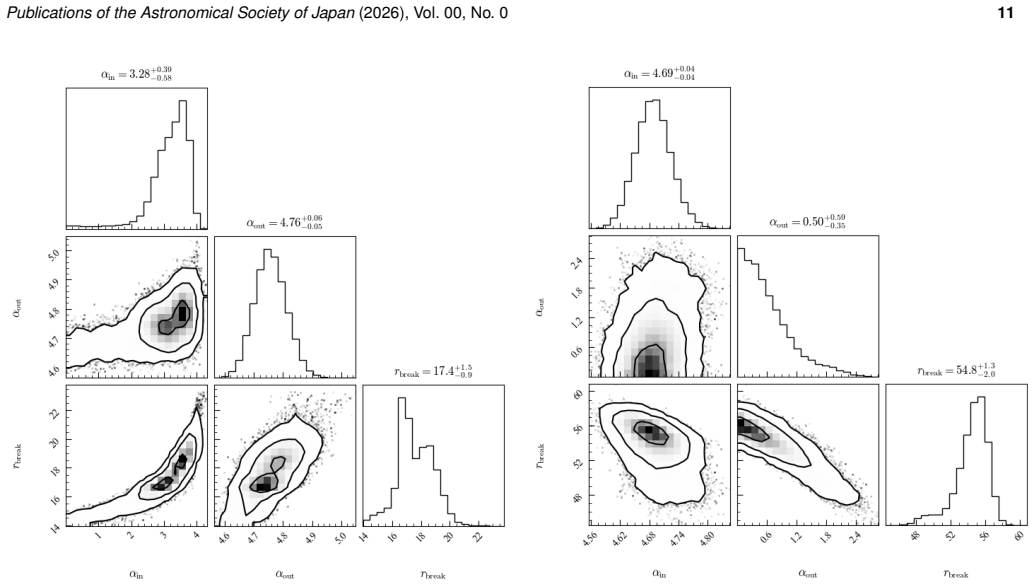
Applying a forward-modeling framework that accounts for distance uncertainties, solar position, and survey geometry to a large sample of main-sequence turn-off stars in the HSC-SSP catalog shows that the smooth stellar halo is well described by a double power-law density profile with inner slope approximately -3.3, outer slope approximately -4.8, and break radius of 17.4 kpc. The derived outer steep slope supports a formation picture in which early massive accretion events dominate the present-day halo structure.
What carries the argument
The forward-modeling framework that converts the observed distribution of main-sequence turn-off stars into constraints on a broken power-law density profile while incorporating selection effects and geometric limits.
If this is right
- The steep outer slope is consistent with the halo being shaped by early massive accretion events such as Gaia Enceladus/Sausage.
- The break radius of 17.4 kpc marks a transition between inner and outer halo regimes in the density distribution.
- Ongoing wide-field surveys will tighten constraints on the global halo structure and its assembly history.
Where Pith is reading between the lines
- If the profile holds globally it implies the outer halo consists mostly of debris from a small number of early massive mergers.
- Matching the observed break radius and slopes against simulations could distinguish between specific merger mass and timing scenarios.
- Adding kinematic information to the same stars could test whether the density transition coincides with changes in orbital properties.
Load-bearing premise
The selected main-sequence turn-off stars serve as clean, unbiased tracers of the smooth halo density and the model fully captures all selection effects, distance uncertainties, and survey geometry.
What would settle it
A deeper or wider survey that measures a significantly different outer density slope or break radius in previously unsampled regions of the halo would falsify the fitted double power-law parameters.
Figures



read the original abstract
We investigate the structure of the Milky Way's stellar halo within 70 kpc of the Sun using a wide-field photometric catalog obtained from the Hyper Suprime-Cam (HSC) Subaru Strategic Program (HSC-SSP). We employ a large sample of main-sequence turn-off stars as distance tracers. To robustly derive the structural parameters of the stellar halo, we develop a forward-modeling framework that explicitly accounts for distance uncertainties, the solar position, and the limited sky coverage of the survey. Applying this method to the HSC-SSP catalog, we found that the smooth stellar halo is well described by a double power-law density profile, with inner and outer slope of approximately -3.3 and -4.8, respectively, with a break radius of 17.4 kpc. The outer steep density slope derived in this work supports a picture in which the present-day structure of the Milky Way's stellar halo is influenced by early massive accretion events, consistent with inferences from kinematic substructures such as Gaia Enceladus/Sausage. Ongoing wide-field imaging surveys, including UNIONS and LSST, will provide further constraints on the structure of the stellar halo and key insights into its formation history.
Editorial analysis
A structured set of objections, weighed in public.
Referee Report
Summary. The manuscript investigates the structure of the Milky Way's stellar halo within 70 kpc using main-sequence turn-off stars from the HSC-SSP photometric catalog. A forward-modeling framework is developed to account for distance uncertainties, solar position, and limited sky coverage, leading to the conclusion that the smooth halo follows a double power-law density profile with inner slope approximately -3.3, outer slope -4.8, and break radius 17.4 kpc.
Significance. If robust, the result strengthens evidence that the outer stellar halo was shaped by early massive accretion events, consistent with kinematic substructures such as Gaia-Enceladus. The explicit forward-modeling of observational effects is a methodological strength that improves upon simpler approaches, and the parameters provide testable inputs for halo formation models. The work also highlights the potential of wide-field photometry for future surveys including UNIONS and LSST.
major comments (2)
- [Methods] The forward-modeling framework is presented as accounting for distance errors and survey geometry, yet the manuscript does not include end-to-end mock recovery tests that inject the reported double power-law profile (inner slope -3.3, outer -4.8, break 17.4 kpc), apply the identical photometric selection and distance-error kernel, and demonstrate unbiased retrieval of the input parameters. This validation is load-bearing for the outer slope and break radius, which are most sensitive to the high-distance tail and any residual selection incompleteness beyond 30 kpc.
- [Results] The assumption that the photometrically selected MSTO sample provides an unbiased tracer of the smooth halo density is central to the result but receives limited quantitative support; potential residual contamination or incompleteness at large radii could systematically affect the recovered outer slope without additional tests or diagnostics.
minor comments (2)
- Notation for the power-law slopes and break radius should be defined consistently in the text and equations to avoid ambiguity when comparing to prior literature.
- Figure captions could more explicitly distinguish model predictions from binned data points and indicate the radial range over which the fit is performed.
Simulated Author's Rebuttal
We thank the referee for their constructive review and positive assessment of the significance of our results. We address each major comment below and describe the revisions we will implement to strengthen the validation of our forward-modeling approach and the robustness of the MSTO tracer assumptions.
read point-by-point responses
-
Referee: [Methods] The forward-modeling framework is presented as accounting for distance errors and survey geometry, yet the manuscript does not include end-to-end mock recovery tests that inject the reported double power-law profile (inner slope -3.3, outer -4.8, break 17.4 kpc), apply the identical photometric selection and distance-error kernel, and demonstrate unbiased retrieval of the input parameters. This validation is load-bearing for the outer slope and break radius, which are most sensitive to the high-distance tail and any residual selection incompleteness beyond 30 kpc.
Authors: We agree that explicit end-to-end injection-recovery tests are important for demonstrating unbiased recovery of the outer slope and break radius. While our forward-modeling framework already incorporates distance uncertainties, solar position, and survey geometry into the likelihood, the submitted manuscript did not include full mock tests that inject the best-fit double power-law profile and recover it under identical selection and error kernels. We will add these tests in the revised manuscript, including multiple realizations to quantify any biases or uncertainties, particularly in the high-distance regime. revision: yes
-
Referee: [Results] The assumption that the photometrically selected MSTO sample provides an unbiased tracer of the smooth halo density is central to the result but receives limited quantitative support; potential residual contamination or incompleteness at large radii could systematically affect the recovered outer slope without additional tests or diagnostics.
Authors: We acknowledge that the current manuscript provides limited quantitative diagnostics on potential residual contamination or incompleteness in the MSTO sample at large radii. Our analysis relies on the photometric selection and the forward-modeling framework to mitigate biases, but we did not include dedicated simulations of contamination effects or incompleteness beyond 30 kpc. We will add further tests and diagnostics in the revision, such as mock catalogs incorporating plausible contaminant populations and comparisons with available spectroscopic data, to better quantify any impact on the outer slope. revision: yes
Circularity Check
No circularity: halo parameters obtained by direct forward-model fit to catalog
full rationale
The paper constructs a forward-modeling framework that incorporates distance uncertainties, solar position, and survey geometry, then applies it to fit a double power-law density profile directly to the HSC-SSP main-sequence turn-off star sample. The reported values (inner slope ≈−3.3, outer slope ≈−4.8, break radius 17.4 kpc) are the fitted outputs of this procedure. No equation or step reduces the target result to a quantity already defined in terms of itself, nor does any load-bearing premise collapse to a self-citation chain or prior ansatz from the same authors. The derivation remains self-contained against the input photometric catalog and selection function; standard parametric inference of this form does not trigger any of the enumerated circularity patterns.
Axiom & Free-Parameter Ledger
free parameters (3)
- inner power-law slope
- outer power-law slope
- break radius
axioms (2)
- domain assumption Main-sequence turn-off stars serve as reliable distance tracers for the stellar halo
- domain assumption The smooth halo component can be isolated from substructure and disk contamination
Reference graph
Works this paper leans on
-
[1]
Abbott, T. M. C., Abdalla, F. B., Allam, S. 2018, ApJS, 239, 18
2018
-
[2]
F., Zucker, D
Bell, E. F., Zucker, D. B. and Belokurov, V . 2008, ApJ, 680, 295
2008
-
[3]
B., Evans, N
Belokurov, V ., Zucker, D. B., Evans, N. W. 2006, ApJ, 642, L137
2006
-
[4]
W., Bell, E
Belokurov, V ., Evans, N. W., Bell, E. F. 2007, ApJ, 657, 89
2007
-
[5]
Belokurov, V ., Erkal, D., Evans, N. W. 2018, MNRAS, 478, 611
2018
-
[6]
2019, PASJ, 71, 114
Bosch, J., Armstrong, R., Bickerton, S. 2019, PASJ, 71, 114
2019
-
[7]
Bressan, A., Marigo, P., Girardi, L 2012 MNRAS, 427, 127
2012
-
[8]
S., & Johnston, K
Bullock, J. S., & Johnston, K. V . 2005, ApJ, 635, 931
2005
-
[9]
L., Majewski, S
Carlin, J. L., Majewski, S. R., Casetti-Dinescu, D. I. 2012, ApJ, 744, 25
2012
-
[10]
C., Lee, Y
Carollo, D., Beers, T. C., Lee, Y . S. 2007, Nat, 450, 1020
2007
-
[11]
Chambers, K. C., Magnier, E. A., Metcalfe, N. 2016, arXiv:1612.05560
work page internal anchor Pith review Pith/arXiv arXiv 2016
-
[12]
P., Cole, S., Frenk, C
Cooper, A. P., Cole, S., Frenk, C. S. 2010, MNRAS, 406, 744
2010
-
[13]
J., Belokurov, V ., Evans, N
Deason, A. J., Belokurov, V ., Evans, N. W. 2011, MNRAS, 416, 2903
2011
-
[14]
J., Belokurov, V ., Koposov, S
Deason, A. J., Belokurov, V ., Koposov, S. E. 2014, ApJ, 787, 30
2014
-
[15]
J., Lynden-Bell, D., & Sandage, A
Eggen, O. J., Lynden-Bell, D., & Sandage, A. R. 1962, ApJ, 136, 748
1962
-
[16]
S., McCarthy, I
Font, A. S., McCarthy, I. G., Crain, R. A. 2011, MNRAS, 416, 2802
2011
-
[17]
W., Lang, D
Foreman-Mackey, D., Hogg, D. W., Lang, D. 2013, PASP, 125, 306
2013
-
[18]
2025, PASJ, 77, 178
Fukushima, T., Chiba, M., and Tanaka, M. 2025, PASJ, 77, 178
2025
-
[19]
2025, AJ, 170, 324
Gwyn, S., McConnachie, A., W., Cuillandre, J. 2025, AJ, 170, 324
2025
-
[20]
J., Conroy, C., Johnson, B
Han, J. J., Conroy, C., Johnson, B. D. 2022, AJ, 164, 249
2022
-
[21]
Helmi, A., Babusiaux, C., Koppelman, H. H. 2018, Nature, 563, 85
2018
-
[22]
G., Rix, H
Hernitschek, N., Cohen, J. G., Rix, H. 2018, ApJ, 859, 31 Ivezi´c, Ž., Sesar, B., Juri ´c, M. 2008, ApJ, 684, 287 Ivezi´c, Ž., Kahn, S. M., Tyson, J. A. 2019, ApJ, 873, 111 Juri´c, M., Ivezi´c, Ž., Brooks, A. 2008, ApJ, 673, 864 Juri´c, M., Kantor, J., Lim, K. T. 2017, ASPC, 512, 279
2018
-
[23]
H., Helmi, A., Massari, D
Koppelman, H. H., Helmi, A., Massari, D. 2019, A&A, 631, L9
2019
-
[24]
2023, A&A, 669, A104
Kordopatis, G., Ibata, R., Famaey, B. 2023, A&A, 669, A104
2023
-
[25]
E., 2026, ApJ, 999, 108
Li, S., Wang, W., Koposov, S. E., 2026, ApJ, 999, 108
2026
-
[26]
A., Schlafly, E
Magnier, E. A., Schlafly, E. F., Finkbeiner, D. P. 2013, ApJS, 205, 20
2013
-
[27]
A., Grand, R
Monachesi, A., Gómez, F. A., Grand, R. J. J. 2019, MNRAS, 485, 2589
2019
-
[28]
C., Vasiliev, E., Iorio, G., 2019, 488, 1235
Myeong, G. C., Vasiliev, E., Iorio, G., 2019, 488, 1235
2019
-
[29]
J., Yanny, B., Rockosi, C
Newberg, H. J., Yanny, B., Rockosi, C. 2002, ApJ, 569, 245
2002
-
[30]
H., & Yanny, B
Newberg, J. H., & Yanny, B. 2015, JPhCS, 47, 195
2015
-
[31]
D., Smith, M
Nie, J. D., Smith, M. C., Belokurov, V . 2015, ApJ, 810, 153 Pila-Diéz, B., de Jong, J. T. A., Kuijken, K., van der Burg, R. F. J., &
2015
-
[32]
2015, A&A, 579, A38
Hoekstra, H. 2015, A&A, 579, A38
2015
-
[33]
G.& Norris, J
Ryan, S. G.& Norris, J. E. 1991, AJ, 101, 1865
1991
-
[34]
E., 1955, ApJ, 121, 161S
Salpeter, E. E., 1955, ApJ, 121, 161S
1955
-
[35]
F., Finkbeiner, D
Schlafly, E. F., Finkbeiner, D. P., Juri´c, M. 2012, ApJ, 756, 158
2012
-
[36]
F., Kirkby, D., Schlegel, D
Schlafly, E. F., Kirkby, D., Schlegel, D. J. 2023, AJ, 166, 259
2023
-
[37]
J., Finkbeiner, D
Schlegel, D. J., Finkbeiner, D. P., & Davis, M. 1998, ApJ, 500, 525
1998
-
[38]
1978, ApJ, 225, 357
Searle, L., & Zinn, R. 1978, ApJ, 225, 357
1978
-
[39]
Sesar, B., Ivezi´c, Ž., Lupton, R. H. 2007, AJ, 134, 2236
2007
-
[40]
Sesar, B., Ivezi´c, Ž, Grammer, S. H. 2010, ApJ, 708, 717
2010
-
[41]
Sesar, B., Hernitschek, N., Dierickx, M. I. P., Fardal, M. A., & Rix, H.-W. 2017, ApJ, 844, L4 Schörck, T., Christlieb, N., Cohen, J. G. 2009, A&A, 507, 817
2017
-
[42]
2018, ApJ, 862, 114 14Publications of the Astronomical Society of Japan(2026), Vol
Shipp, N., Drlica-Wagner, A., Balbinot, E. 2018, ApJ, 862, 114 14Publications of the Astronomical Society of Japan(2026), Vol. 00, No. 0
2018
-
[43]
Springel, V ., White, S. D. M., Jenkins, A. 2005, Nature, 435, 629
2005
-
[44]
2024, PASJ, 76, 205
Suzuki, Y ., Chiba, M., Komiyama, Y . 2024, PASJ, 76, 205
2024
-
[45]
S., Chiba, M
Takada, M., Ellis, R. S., Chiba, M. 2014, PASJ, 66, 1
2014
-
[46]
L., Stubbs, C
Tonry, J. L., Stubbs, C. W., Lykke, K. R. 2012, ApJ, 750, 99
2012
-
[47]
Unavane, M., Wyse, R. F. G., Gilmore, G. 1996, 278, 727
1996
-
[48]
2021, MNRAS, 501, 2279
Vasiliev, E., Belokurov, V ., & Erkal, D. 2021, MNRAS, 501, 2279
2021
-
[49]
K., Zinn, R., Andrews, P
Vivas, A. K., Zinn, R., Andrews, P. 2001, ApJ, 554, L33
2001
-
[50]
L., Evans, N
Watkins, L. L., Evans, N. W., Belokurov, V . 2009, MNRAS, 398, 1757
2009
-
[51]
White, S. D. M., & Rees, M. J. 1978, MNRAS, 183, 341
1978
-
[52]
, Rix, H., Ma, Z
Xue, X. , Rix, H., Ma, Z. 2015, 809, 144
2015
-
[53]
2009, AJ, 137, 4377
Yanny, B., Rockosi, C., Newberg, H., J. 2009, AJ, 137, 4377
2009
-
[54]
G., Adelman, J., Anderson, J
York, D. G., Adelman, J., Anderson, J. E. 2000, AJ, 120, 1579
2000
-
[55]
2012, RAA, 12, 723Z
Zhao, G., Zhao, Y ., Chu, Y . 2012, RAA, 12, 723Z
2012
-
[56]
Zwitter, T., Matijeviˇc, G., Breddels, M. A. 2010, A&A, 522, 54
2010
discussion (0)
Sign in with ORCID, Apple, or X to comment. Anyone can read and Pith papers without signing in.