3D Kinetic Simulations of Driven Reconnection in Merging Flux Tubes
Pith reviewed 2026-05-10 16:33 UTC · model grok-4.3
The pith
3D simulations of merging flux tubes show early delays but converge to a fast reconnection rate of 0.08-0.10 and particle cutoff near 50 sigma_in.
A machine-rendered reading of the paper's core claim, the machinery that carries it, and where it could break.
Core claim
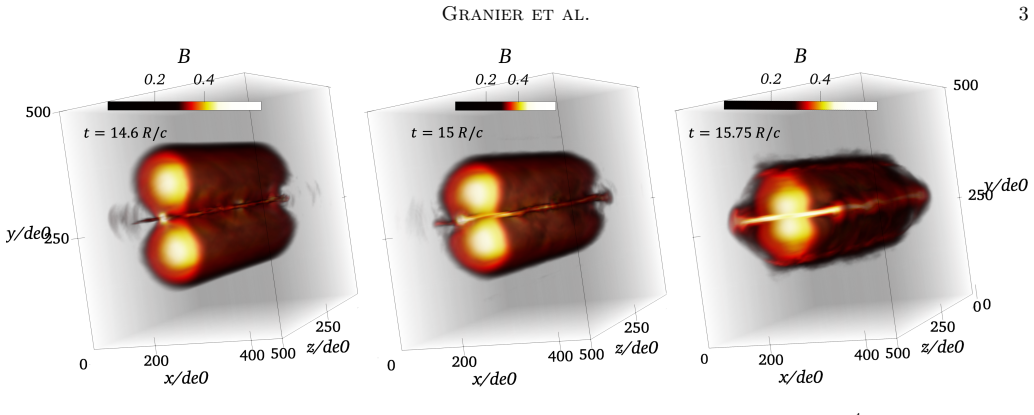
In driven reconnection of merging Lundquist-type force-free flux tubes, 3D effects delay the onset of tearing and kink instabilities relative to 2D, with guide fields further suppressing drift-kink modes. All configurations nonetheless transition to a fast-merging regime with reconnection rate 0.08-0.10 that coincides with a reduction in the local guide-to-reconnecting field ratio inside the current sheet. Particle acceleration yields a high-energy cutoff gamma_cut / sigma_in approximately 50 with weak drive dependence, consistent with electric-field-limited energization, producing similar power-law spectra across runs.
What carries the argument
The transient reduction of the guide-to-reconnecting field ratio inside the current sheet that enables the universal fast-merging phase and sets the duration of electric-field-limited particle acceleration.
If this is right
- Reconnection proceeds at the same normalized rate 0.08-0.10 once the fast-merging phase begins, independent of dimensionality or early instability details.
- The high-energy particle cutoff converges to gamma_cut/sigma_in approximately 50 with only weak dependence on external drive strength.
- Nonthermal spectra remain similar with power-law indices between 1.6 and 2.0 across all 2D and 3D runs.
- Strong guide fields mainly suppress drift-kink activity while leaving tearing-mode growth comparatively intact.
- Increasing the external drive accelerates the linear growth of both tearing and drift-kink instabilities.
Where Pith is reading between the lines
- The reported convergence implies that particle spectra from astrophysical flux-tube mergers could be predictable even when full three-dimensional geometry is present.
- Laboratory pair-plasma experiments could directly test the predicted onset delays and the universal cutoff value under controlled drive conditions.
- Introducing ions would likely alter both the delay timescales and the achieved cutoff because the mass ratio and additional instabilities change the current-sheet dynamics.
- The transient drop in guide-to-reconnecting field ratio inside the sheet offers a potential observable signature for spacecraft or remote-sensing measurements of merging events.
Load-bearing premise
The simulations assume a collisionless strongly magnetized pair plasma with Lundquist-type force-free initial conditions and an externally imposed drive whose strength and geometry represent astrophysical conditions.
What would settle it
An experiment or observation that finds the high-energy particle cutoff depends strongly on driving strength or that the reconnection rate differs markedly between equivalent 2D and 3D merging setups would contradict the reported convergence.
Figures


read the original abstract
We present 2D and 3D Particle-in-Cell simulations of driven collisionless magnetic reconnection triggered by the compression and merger of two Lundquist-type force-free flux tubes in a strongly magnetized pair plasma, with a focus on magnetic energy dissipation and particle acceleration. We show that 3D effects systematically delay the onset of reconnection in comparison with equivalent 2D runs, an effect further enhanced by a strong guide field, due to reduced linear growth rates and phase decoherence of oblique modes. Increasing the external drive accelerates both tearing and drift-kink instabilities, while a strong guide field suppresses coherent drift-kink activity and has a comparatively mild impact on tearing. Despite these differences in early-time dynamics, all simulations enter a fast-merging phase characterized by a normalized reconnection rate 0.08--0.10, coinciding with a transient reduction of the guide-to-reconnecting field ratio inside the current sheet. The high-energy cutoff of accelerated particles converges to a common asymptotic value, gamma_cut/sigma_in ~ 50, with only a weak dependence on the driving strength. This behavior is consistent with an electric-field-limited acceleration process, in which the maximum energy is set by the reconnection electric field and the duration of the energization phase. The resulting nonthermal particle spectra are similar across all runs, with power-law indices p ~ 1.6--2.0.
Editorial analysis
A structured set of objections, weighed in public.
Referee Report
Summary. The manuscript presents 2D and 3D particle-in-cell simulations of driven collisionless magnetic reconnection triggered by the merger of two Lundquist-type force-free flux tubes in a strongly magnetized pair plasma. It reports that 3D effects and strong guide fields delay reconnection onset relative to 2D cases due to reduced growth rates and phase decoherence of oblique modes, while external drive accelerates tearing and drift-kink instabilities. Despite these early-time differences, all runs converge to a fast-merging regime with normalized reconnection rate 0.08--0.10 coinciding with a transient drop in the guide-to-reconnecting field ratio inside the current sheet. The high-energy particle cutoff converges to gamma_cut/sigma_in ~50 with weak drive dependence, interpreted as electric-field-limited acceleration, yielding similar nonthermal spectra with indices p~1.6--2.0.
Significance. If the reported convergence holds, the work establishes the robustness of fast reconnection rates and an electric-field-limited particle cutoff across dimensionality and parameters in kinetic pair-plasma reconnection. This is significant for astrophysical applications involving merging flux tubes, as it suggests that early-time 3D and guide-field variations do not alter the late-time dissipation and acceleration properties. The consistency across multiple simulation setups strengthens the case for universal features in such systems.
major comments (2)
- [Results section (reconnection rate discussion)] Results section (reconnection rate discussion): The central claim of a common fast-merging phase rests on the normalized rate being 0.08--0.10 across all runs; the manuscript must explicitly define the normalization (e.g., relative to which upstream Alfvén speed or inflow velocity) and include time histories or a table with quantitative values and uncertainties for each 2D/3D and guide-field case to substantiate the quoted range.
- [Particle spectra section] Particle spectra section: The claim that gamma_cut/sigma_in converges to ~50 with only weak dependence on driving strength is load-bearing for the electric-field-limited interpretation; the text should specify the precise definition of sigma_in (magnetization parameter) and the operational definition of the cutoff (e.g., spectral break location or exponential fit parameter) together with supporting spectra plots for varying drive amplitudes.
minor comments (2)
- [Abstract and introduction] Abstract and introduction: The term 'Lundquist-type force-free flux tubes' is used without a brief inline definition or citation; adding one sentence would improve accessibility for readers outside the immediate subfield.
- [Methods] Methods: The 3D simulation parameters (grid resolution, particles per cell, box size) are not summarized in a table; including such a table would facilitate assessment of numerical convergence and reproducibility.
Simulated Author's Rebuttal
We thank the referee for the careful review and the positive recommendation for minor revision. The comments highlight opportunities to improve clarity on key quantitative claims. We address each point below and will incorporate the requested definitions, data, and figures in the revised manuscript.
read point-by-point responses
-
Referee: Results section (reconnection rate discussion): The central claim of a common fast-merging phase rests on the normalized rate being 0.08--0.10 across all runs; the manuscript must explicitly define the normalization (e.g., relative to which upstream Alfvén speed or inflow velocity) and include time histories or a table with quantitative values and uncertainties for each 2D/3D and guide-field case to substantiate the quoted range.
Authors: We agree that an explicit definition and supporting quantitative data are needed. The normalized reconnection rate is defined as E_rec / (v_A,in * B_rec / c), where v_A,in is the upstream Alfvén speed computed from the reconnecting field component and the upstream density. We will add this definition to the Results section. In addition, we will include a new table listing the time-averaged rate (with standard deviation as uncertainty) for each run during the fast-merging phase, together with a brief reference to the time histories already shown in the figures. These additions will substantiate the quoted 0.08--0.10 range without altering the scientific conclusions. revision: yes
-
Referee: Particle spectra section: The claim that gamma_cut/sigma_in converges to ~50 with only weak dependence on driving strength is load-bearing for the electric-field-limited interpretation; the text should specify the precise definition of sigma_in (magnetization parameter) and the operational definition of the cutoff (e.g., spectral break location or exponential fit parameter) together with supporting spectra plots for varying drive amplitudes.
Authors: We accept this request for precision. Sigma_in is the upstream magnetization parameter sigma_in = B_up^2 / (4 pi n_up m c^2) evaluated far from the current sheet. The cutoff gamma_cut is operationally defined as the Lorentz factor at which the spectrum falls one e-folding below the extrapolated power-law fit. We will state both definitions explicitly in the revised text. We will also add a supplementary figure (or panel) displaying the particle energy spectra for the different drive amplitudes, confirming the weak dependence of the cutoff and supporting the electric-field-limited interpretation. revision: yes
Circularity Check
No significant circularity; results are direct simulation outputs
full rationale
The paper reports outcomes from 2D and 3D Particle-in-Cell simulations of driven reconnection in merging flux tubes. Key results—the normalized reconnection rate of 0.08-0.10 and particle cutoff gamma_cut/sigma_in ~50—are measured directly from the simulation data across parameter variations. These are not derived via equations that reduce to self-definition, fitted inputs renamed as predictions, or self-citation chains. The observed convergence in the fast-merging phase and spectral similarity are empirical findings from the runs, not forced by construction from the initial setup or ansatzes. The electric-field-limited interpretation is post-hoc commentary and does not alter the reported numerical values. No load-bearing self-citations, uniqueness theorems, or renamings of known results appear in the provided text that would create circularity.
Axiom & Free-Parameter Ledger
axioms (2)
- domain assumption Collisionless plasma approximation holds throughout the simulation domain
- domain assumption Initial Lundquist-type force-free flux tubes remain valid until external drive is applied
Reference graph
Works this paper leans on
-
[1]
D., Bhattacharjee, A., & Daughton, W
Baalrud, S. D., Bhattacharjee, A., & Daughton, W. 2018, Physics of Plasmas, 25, 022115, doi: 10.1063/1.5020777
-
[2]
and Granier, Camille and Vos, Jesse , title =
Bacchini, F., Werner, G. R., Granier, C., & Vos, J. 2025, ApJL, 991, L9, doi: 10.3847/2041-8213/ae0197
-
[3]
Barkov, M. V., & Komissarov, S. S. 2016, Monthly Notices of the Royal Astronomical Society, 458, 1939, doi: 10.1093/mnras/stw384
-
[4]
2012, ApJ, 750, 129, doi: 10.1088/0004-637X/750/2/129
Bessho, N., & Bhattacharjee, A. 2012, ApJ, 750, 129, doi: 10.1088/0004-637X/750/2/129
-
[5]
2005, Physics of Plasmas, 12, 032309, doi: 10.1063/1.1857912
Borgogno, D., Grasso, D., Porcelli, F., et al. 2005, Physics of Plasmas, 12, 032309, doi: 10.1063/1.1857912
-
[6]
Cerutti, B., Werner, G. R., Uzdensky, D. A., & Begelman, M. C. 2013, ApJ, 770, 147, doi: 10.1088/0004-637X/770/2/147
-
[7]
Cerutti, B., Werner, G. R., Uzdensky, D. A., & Begelman, M. C. 2014, The Astrophysical Journal, 782, 104, doi: 10.1088/0004-637X/782/2/104
-
[8]
2016, Journal of Plasma Physics, 82, 595820601, doi: 10.1017/S002237781600101X
Comisso, L., & Bhattacharjee, A. 2016, Journal of Plasma Physics, 82, 595820601, doi: 10.1017/S002237781600101X
-
[9]
Dahlin, J. T., Drake, J., & Swisdak, M. 2015, in Solar Heliospheric and INterplanetary Environment (SHINE 2015), 17
work page 2015
-
[10]
2011, Nature Physics, 7, 539, doi: 10.1038/nphys1965
Daughton, W., Roytershteyn, V., Karimabadi, H., et al. 2011, Nature Physics, 7, 539, doi: 10.1038/nphys1965
-
[11]
Granier, C., Borgogno, D., Comisso, L., et al. 2022, Phys. Rev. E, 106, L043201, doi: 10.1103/PhysRevE.106.L043201
-
[12]
2025, The Astrophysical Journal, 992, 193, doi: 10.3847/1538-4357/ae0738
Granier, C., Grošelj, D., Comisso, L., & Bacchini, F. 2025, The Astrophysical Journal, 992, 193, doi: 10.3847/1538-4357/ae0738
-
[13]
Granier, C., Tassi, E., Laveder, D., Passot, T., & Sulem, P. L. 2024, Physics of Plasmas, 31, 032115, doi: 10.1063/5.0185897
-
[14]
2014, PhRvL, 113, 155005, doi: 10.1103/PhysRevLett.113.155005 13
Guo, F., Li, H., Daughton, W., & Liu, Y.-H. 2014, PhRvL, 113, 155005, doi: 10.1103/PhysRevLett.113.155005
-
[15]
2021, ApJ, 919, 111, doi: 10.3847/1538-4357/ac0918
Guo, F., Li, X., Daughton, W., et al. 2021, ApJ, 919, 111, doi: 10.3847/1538-4357/ac0918
-
[16]
2015, ApJ, 806, 167, doi: 10.1088/0004-637X/806/2/167
Guo, F., Liu, Y. H., Daughton, W., & Li, H. 2015, The Astrophysical Journal (Online), 806, doi: 10.1088/0004-637X/806/2/167
-
[17]
2021, The Astrophysical Journal, 912, 48, doi: 10.3847/1538-4357/abedac
Hakobyan, H., Petropoulou, M., Spitkovsky, A., & Sironi, L. 2021, The Astrophysical Journal, 912, 48, doi: 10.3847/1538-4357/abedac
-
[18]
2023, ApJ, 943, 105, doi: 10.3847/1538-4357/acab05
Hakobyan, H., Philippov, A., & Spitkovsky, A. 2023a, The Astrophysical Journal, 943, 105, doi: 10.3847/1538-4357/acab05
-
[19]
Hakobyan, H., Ripperda, B., & Philippov, A. A. 2023b, ApJL, 943, L29, doi: 10.3847/2041-8213/acb264
-
[20]
Hakobyan, H., Spitkovsky, A., Chernoglazov, A., et al. 2023c, PrincetonUniversity/tristan-mp-v2: v2.6, Zenodo, doi: 10.5281/zenodo.7566725
-
[21]
2024, arXiv e-prints, doi: 10.48550/arXiv.2404.15662
Hoshino, M. 2024, arXiv e-prints, doi: 10.48550/arXiv.2404.15662
-
[22]
2017, The Astrophysical Journal, 849, 75, doi: 10.3847/1538-4357/aa906d
Huang, Y.-M., Comisso, L., & Bhattacharjee, A. 2017, The Astrophysical Journal, 849, 75, doi: 10.3847/1538-4357/aa906d
-
[23]
2011, Physics of Plasmas, 18, 111207, doi: 10.1063/1.3647505
Ji, H., & Daughton, W. 2011, Physics of Plasmas, 18, 111207, doi: 10.1063/1.3647505
-
[24]
Kuznetsova, M. M., & Zeleny, L. M. 1985, Plasma Physics and Controlled Fusion, 27, 363, doi: 10.1088/0741-3335/27/4/001 Granier et al.11
-
[25]
Lapenta, G. 2008, Phys. Rev. Lett., 100, 235001, doi: 10.1103/PhysRevLett.100.235001
-
[27]
2015, PhRvL, 114, 095002, doi: 10.1103/PhysRevLett.114.095002
Liu, Y.-H., Guo, F., Daughton, W., Li, H., & Hesse, M. 2015, PhRvL, 114, 095002, doi: 10.1103/PhysRevLett.114.095002
-
[28]
Loureiro, N. F., Schekochihin, A. A., & Cowley, S. C. 2007, Physics of Plasmas, 14, 100703, doi: 10.1063/1.2783986
-
[29]
Lyutikov, M., Sironi, L., Komissarov, S. S., & Porth, O. 2017, Journal of Plasma Physics, 83, 635830602, doi: 10.1017/S002237781700071X
-
[30]
Begelman, M. C. 2020, Monthly Notices of the Royal Astronomical Society, 498, 799, doi: 10.1093/mnras/staa2346
-
[31]
Parker, E. N. 1963, ApJS, 8, 177, doi: 10.1086/190087
-
[32]
2018, Monthly Notices of the Royal Astronomical Society, 481, 5687, doi: 10.1093/mnras/sty2702
Petropoulou, M., & Sironi, L. 2018, Monthly Notices of the Royal Astronomical Society, 481, 5687, doi: 10.1093/mnras/sty2702
-
[33]
2017, MNRAS, 467, 3279, doi: 10.1093/mnras/stx379
Ripperda, B., Porth, O., Xia, C., & Keppens, R. 2017, MNRAS, 467, 3279, doi: 10.1093/mnras/stx379
-
[34]
Sironi, L., & Beloborodov, A. M. 2020, The Astrophysical Journal, 899, 52, doi: 10.3847/1538-4357/aba622
-
[35]
2014, ApJL, 783, L21, doi: 10.1088/2041-8205/783/1/L21
Sironi, L., & Spitkovsky, A. 2014, ApJL, 783, L21, doi: 10.1088/2041-8205/783/1/L21
-
[36]
Sironi, L., Uzdensky, D. A., & Giannios, D. 2025, ARA&A, 63, doi: 10.1146/annurev-astro-020325-115713
-
[37]
Stanier, A., Simakov, A. N., Chacón, L., & Daughton, W. 2015, Physics of Plasmas, 22, 101203, doi: 10.1063/1.4932330
-
[38]
Swisdak, M., Dahlin, J. T., & Drake, J. F. 2017, in AGU Fall Meeting Abstracts, Vol. 2017, AGU Fall Meeting
work page 2017
-
[39]
TenBarge, J. M., & Howes, G. G. 2013, The Astrophysical Journal Letters, 771, L27, doi: 10.1088/2041-8205/771/2/L27
-
[40]
A., Cerutti, B., & Begelman, M
Uzdensky, D. A., Cerutti, B., & Begelman, M. C. 2011, The Astrophysical Journal Letters, 737, L40, doi: 10.1088/2041-8205/737/2/L40
-
[41]
Werner, G. R., & Uzdensky, D. A. 2017, The Astrophysical Journal Letters, 843, L27, doi: 10.3847/2041-8213/aa7892 —. 2021, Journal of Plasma Physics, 87, 905870613, doi: 10.1017/S0022377821001185
-
[42]
Werner, G. R., Uzdensky, D. A., Cerutti, B., Nalewajko, K., & Begelman, M. C. 2016, ApJL, 816, L8, doi: 10.3847/2041-8205/816/1/L8
-
[43]
Magnetic reconnection , volume =
Yamada, M., Kulsrud, R., & Ji, H. 2010, Rev. Mod. Phys., 82, 603, doi: 10.1103/RevModPhys.82.603
-
[44]
Zenitani, S., & Hoshino, M. 2005, Phys. Rev. Lett., 95, 095001, doi: 10.1103/PhysRevLett.95.095001 —. 2007, The Astrophysical Journal, 670, 702, doi: 10.1086/522226 —. 2008, The Astrophysical Journal, 677, 530, doi: 10.1086/528708
-
[45]
2023, The Astrophysical Journal Letters, 956, L36, doi: 10.3847/2041-8213/acfe7c
Zhang, H., Sironi, L., Giannios, D., & Petropoulou, M. 2023, The Astrophysical Journal Letters, 956, L36, doi: 10.3847/2041-8213/acfe7c
-
[46]
Zhang, Q., Guo, F., Daughton, W., Li, H., & Li, X. 2021, Phys. Rev. Lett., 127, 185101, doi: 10.1103/PhysRevLett.127.185101
-
[47]
and Yamada, Masaaki , month = sep, year =
Zweibel, E. G., & Yamada, M. 2009, Annual Review of Astronomy and Astrophysics, 47, 291, doi: https://doi.org/10.1146/annurev-astro-082708-101726
discussion (0)
Sign in with ORCID, Apple, or X to comment. Anyone can read and Pith papers without signing in.