Recognition: unknown
Astrolabe: A Content-Addressable Hypergraph for Semantic Knowledge Management
Pith reviewed 2026-05-10 16:30 UTC · model grok-4.3
The pith
Astrolabe identifies knowledge entries by SHA-256 content hash and links them through ordered references of arbitrary width interpreted by plugins.
A machine-rendered reading of the paper's core claim, the machinery that carries it, and where it could break.
Core claim
We introduce Astrolabe, a content-addressable hypergraph for semantic knowledge management. Entries are identified by the SHA-256 hash of their content, carry an ordered reference list of arbitrary width, and store an opaque record string interpreted by plugins. The structure admits two orthogonal decompositions: by width and by depth. We demonstrate the framework with a plugin bridging informal and formal mathematics.
What carries the argument
Content-addressable hypergraph whose nodes are fixed by SHA-256 hashes of their content, whose edges are ordered lists of arbitrary length, and whose nodes carry opaque records whose meaning is supplied at runtime by domain plugins.
If this is right
- Knowledge collections become immutable and verifiable because each entry is permanently tied to its content hash.
- Relationships between entries can use any width of ordered references instead of being limited to fixed edge types.
- Different decompositions by reference width or by connection depth give independent views of the same knowledge base.
- Domain-specific plugins can add semantics on top of the core structure, as shown by the informal-to-formal mathematics bridge.
Where Pith is reading between the lines
- The same structure could serve as a backend for distributed, content-hashed collaborative editing tools.
- Applications in other fields that need flexible semantics, such as legal case linking or biological pathway mapping, could reuse the core mechanism.
- Scalability tests could measure how well width and depth decompositions support queries on growing collections of interlinked entries.
Load-bearing premise
That plugin interpretation of opaque records will supply enough practical semantics for everyday knowledge tasks without requiring heavy custom development or creating incompatible plugin sets.
What would settle it
A working implementation in which independent plugins produce inconsistent or unusable semantics on the same shared dataset, or in which the hypergraph cannot scale to thousands of interlinked entries without per-task custom code.
Figures




read the original abstract
Existing knowledge management tools either preserve prose but lose structural relationships, or capture relationships but restrict edge semantics to fixed vocabularies. We introduce Astrolabe, a content-addressable hypergraph for semantic knowledge management. Entries are identified by the SHA-256 hash of their content, carry an ordered reference list of arbitrary width, and store an opaque record string interpreted by plugins. The structure admits two orthogonal decompositions: by width and by depth. We demonstrate the framework with a plugin bridging informal and formal mathematics.
Editorial analysis
A structured set of objections, weighed in public.
Referee Report
Summary. The paper proposes Astrolabe, a content-addressable hypergraph for semantic knowledge management. Entries are identified by the SHA-256 hash of their content, carry an ordered reference list of arbitrary width, and store an opaque record string interpreted by plugins. The structure admits two orthogonal decompositions (by width and by depth). The framework is demonstrated via a plugin that bridges informal and formal mathematics.
Significance. If realized with consistent, non-fragmenting plugin semantics, the design could provide a flexible middle ground between prose-preserving and relation-capturing tools by combining cryptographic content addressing with extensible records. The content-addressable core and arbitrary-width references are standard, so any novelty and utility rest on the plugin layer; without specification or evaluation, the practical significance for real-world knowledge management remains prospective rather than demonstrated.
major comments (3)
- [Abstract] Abstract: The central claim that entries store an 'opaque record string interpreted by plugins' is load-bearing for semantic knowledge management, yet no plugin interface, record format, conflict-resolution rules, or versioning scheme is defined. This leaves open the risk of incompatible plugin ecosystems, directly undermining the weakest assumption identified in the proposal.
- [Abstract] Abstract: The assertion that the structure 'admits two orthogonal decompositions: by width and by depth' is stated without definitions of width or depth, without a formal hypergraph model, and without any proof or illustration that the decompositions are orthogonal or useful for knowledge management tasks.
- [Abstract] Abstract: The demonstration 'with a plugin bridging informal and formal mathematics' is asserted without any description of the plugin's record format, how it operates on the hypergraph, or any evaluation (qualitative or quantitative) of its effectiveness or generality.
minor comments (1)
- The manuscript would benefit from explicit comparison to related content-addressable systems (e.g., IPFS, Git) and hypergraph models to clarify the incremental contribution beyond standard primitives.
Simulated Author's Rebuttal
We thank the referee for their thoughtful and constructive comments. We address each major comment point by point below.
read point-by-point responses
-
Referee: [Abstract] Abstract: The central claim that entries store an 'opaque record string interpreted by plugins' is load-bearing for semantic knowledge management, yet no plugin interface, record format, conflict-resolution rules, or versioning scheme is defined. This leaves open the risk of incompatible plugin ecosystems, directly undermining the weakest assumption identified in the proposal.
Authors: The manuscript presents Astrolabe primarily as a conceptual architecture, with the plugin mechanism described at a high level to highlight extensibility. We agree that the lack of a specified plugin interface, record format, conflict-resolution rules, or versioning scheme leaves the practical realization of semantic knowledge management underspecified and risks incompatible implementations. In the revised manuscript we will add a section proposing a minimal plugin interface, including a basic record format together with guidelines for conflict resolution and versioning. revision: yes
-
Referee: [Abstract] Abstract: The assertion that the structure 'admits two orthogonal decompositions: by width and by depth' is stated without definitions of width or depth, without a formal hypergraph model, and without any proof or illustration that the decompositions are orthogonal or useful for knowledge management tasks.
Authors: We acknowledge that the manuscript asserts the existence of two orthogonal decompositions without supplying definitions or a supporting model. Width denotes the length of an entry's ordered reference list; depth denotes the length of reference chains obtained by recursive traversal. Orthogonality would mean the two axes can be varied independently. Because these elements are not formalized or illustrated, the claim remains unsubstantiated. The revised version will include explicit definitions, a concise formal model of the hypergraph, and a simple example showing the utility of the decompositions for knowledge-management tasks. revision: yes
-
Referee: [Abstract] Abstract: The demonstration 'with a plugin bridging informal and formal mathematics' is asserted without any description of the plugin's record format, how it operates on the hypergraph, or any evaluation (qualitative or quantitative) of its effectiveness or generality.
Authors: The demonstration is offered as a high-level illustration of possible use rather than a fully specified or evaluated implementation. The manuscript supplies neither the plugin's record format, its operational mechanics on the hypergraph, nor any evaluation. We accept that this renders the demonstration more prospective than concrete. In revision we will either expand the description with a concrete record-format example and operational sketch or reframe the passage explicitly as a conceptual illustration, and we will outline possible evaluation criteria. revision: partial
Circularity Check
No circularity: purely definitional proposal with no derived predictions
full rationale
The manuscript introduces Astrolabe as a new data structure whose core properties (SHA-256 content addressing, arbitrary-width ordered references, and opaque plugin-interpreted records) are stated by definition rather than derived from equations, data fits, or prior results. No predictions, uniqueness theorems, or self-citations appear in the abstract or description; the two orthogonal decompositions are simply named partitions of the defined structure. The plugin layer is an explicit external assumption, not a self-referential claim that reduces to the input by construction. The work is therefore self-contained as a design proposal.
Axiom & Free-Parameter Ledger
axioms (2)
- standard math SHA-256 produces a unique identifier from content with negligible collision probability for practical purposes
- domain assumption Hypergraphs with ordered arbitrary-width edges can represent semantic relationships flexibly
invented entities (1)
-
Astrolabe hypergraph
no independent evidence
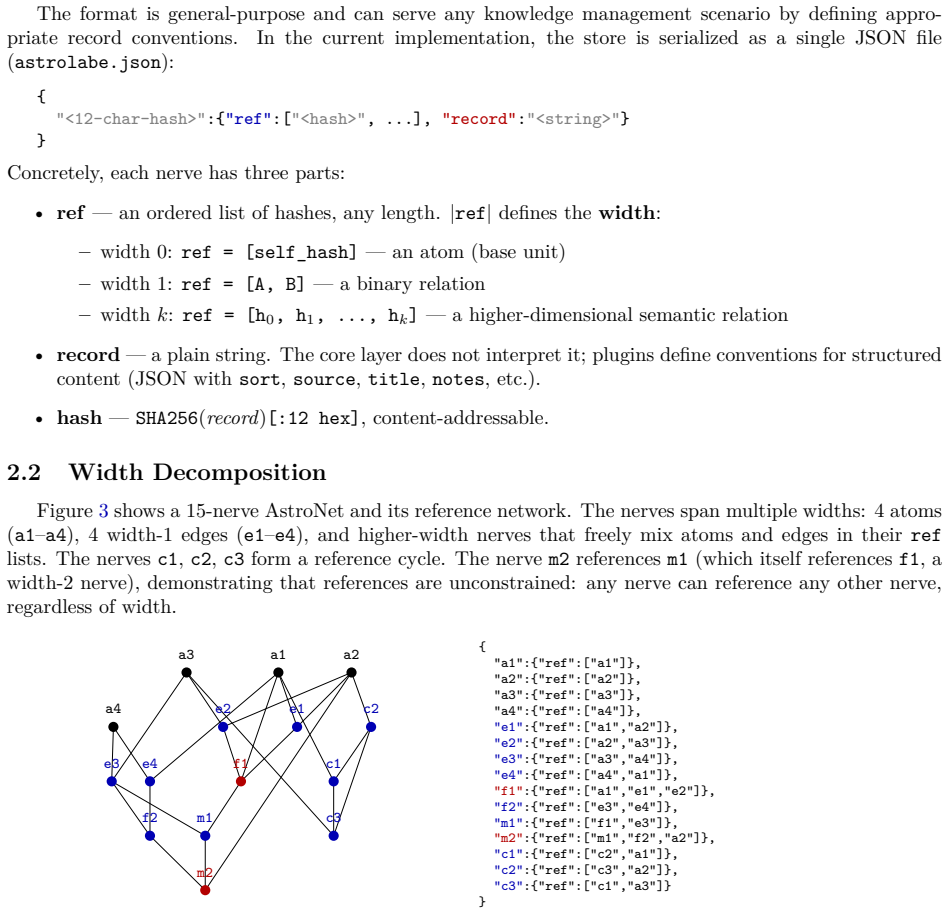
Reference graph
Works this paper leans on
-
[1]
AXLE : Axiom lean engine, 2025
Axiom . AXLE : Axiom lean engine, 2025. https://axiommath.ai
2025
-
[2]
Artificial Intelligence and the Structure of Mathematics
Maissam Barkeshli, Michael R. Douglas, and Michael H. Freedman. Artificial intelligence and the structure of mathematics. arXiv preprint arXiv:2604.06107 , 2026
work page internal anchor Pith review Pith/arXiv arXiv 2026
-
[3]
Aristotle: IMO-level Automated Theorem Proving
Harmonic Team . Aristotle: IMO -level automated theorem proving. arXiv preprint arXiv:2510.01346 , 2025
work page internal anchor Pith review arXiv 2025
-
[4]
Hypergraphdb: A generalized graph database
Borislav Iordanov. Hypergraphdb: A generalized graph database. In Web-Age Information Management (WAIM 2010 Workshops) , volume 6185 of LNCS , pages 25--36. Springer, 2010
2010
-
[5]
Logseq --- a privacy-first, open-source knowledge base, 2021
Logseq . Logseq --- a privacy-first, open-source knowledge base, 2021
2021
-
[6]
Content-addressing formal mathematics
Xinze Li, Marcello Paris, Samuel Schlesinger, and Simone Severini. Content-addressing formal mathematics. In preparation, 2026
2026
-
[7]
The multinetwork of Mathlib : Structure, data, and analysis
Xinze Li, Nanyun Peng, Patrick Shafto, and Simone Severini. The multinetwork of Mathlib : Structure, data, and analysis. In preparation, 2026
2026
-
[8]
leanblueprint: A blueprint for lean formalization projects, 2020
Patrick Massot. leanblueprint: A blueprint for lean formalization projects, 2020. https://github.com/leanprover-community/leanblueprint
2020
-
[9]
Gauss: An agent for autoformalization, 2026
Math Inc. Gauss: An agent for autoformalization, 2026. https://www.math.inc/gauss
2026
-
[10]
Obsidian --- a knowledge base that works on local markdown files, 2020
Obsidian . Obsidian --- a knowledge base that works on local markdown files, 2020
2020
-
[11]
Ipld --- interplanetary linked data, 2021
Protocol Labs . Ipld --- interplanetary linked data, 2021
2021
-
[12]
Roam research --- a note-taking tool for networked thought, 2020
Roam Research . Roam research --- a note-taking tool for networked thought, 2020
2020
-
[13]
Spivak and Robert E
David I. Spivak and Robert E. Kent. Ologs: A categorical framework for knowledge representation. PLoS ONE , 7(1):e24274, 2012
2012
-
[14]
LeanArchitect: Automating blueprint generation for humans and AI.arXiv preprint arXiv:2601.22554,
Thomas Zhu, Pietro Monticone, Jeremy Avigad, and Sean Welleck. LeanArchitect : Automating blueprint generation for humans and AI . arXiv preprint arXiv:2601.22554 , 2026
discussion (0)
Sign in with ORCID, Apple, or X to comment. Anyone can read and Pith papers without signing in.