Fate of Secondary Droplets Produced by High-speed Raindrops Interacting with a Liquid Pool
Pith reviewed 2026-05-10 16:22 UTC · model grok-4.3
The pith
Simulations of raindrops hitting a liquid pool reveal that secondary droplet numbers scale as radius to the power -5/2 and collapse onto one curve when normalized.
A machine-rendered reading of the paper's core claim, the machinery that carries it, and where it could break.
Core claim
Direct numerical simulations of raindrop-liquid pool interactions show that the secondary droplet size distribution obeys N_d(r_s) proportional to r_s to the -5/2 with additional dependence on surface tension and raindrop diameter. When the distributions are rescaled according to this law, results from simulations with different numbers of raindrops, diameters, surface tensions, and inter-drop distances all collapse onto one universal curve. The underlying dynamics proceed through distinct impact stages marked by the birth, evolution, and rupture of a central liquid film whose secondary flows inside the cavity alter both the fraction of secondary droplets captured and the time until they re-
What carries the argument
The -5/2 power-law scaling of the secondary droplet number density N_d with radius r_s, modulated by the central liquid film that forms during impact and controls cavity flows.
Load-bearing premise
The direct numerical simulations reproduce the real fluid physics of high-speed drop-pool collisions closely enough that the observed scaling and data collapse are not artifacts of the chosen parameters or numerical method.
What would settle it
Measure the sizes and counts of secondary droplets in a laboratory experiment with high-speed imaging of single and multiple raindrops impacting a water pool, then check whether the normalized distributions collapse onto one curve as the simulations predict.
Figures




read the original abstract
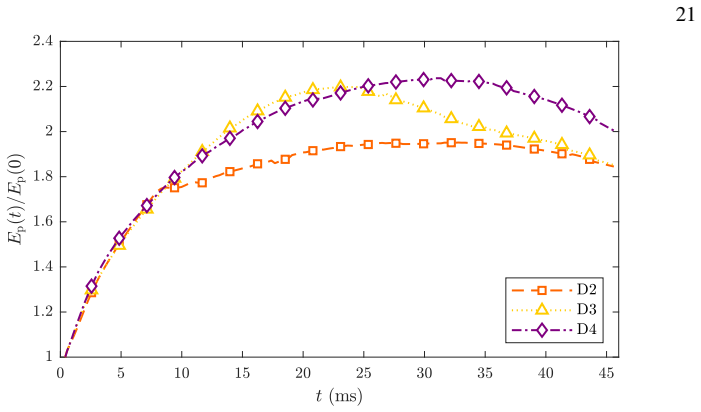
Secondary droplets produced by interactions between falling fluid drops and a liquid pool play a significant role in engineering applications and geophysical processes in nature. This study uses direct numerical simulations to investigate the dynamics of secondary droplets generated by raindrop-liquid pool interactions, with varying parameters including the number of raindrops, their diameters, surface tension, and inter-raindrop distance. The secondary droplet size distribution, $N_d$, is found to scale with the droplet radius, $r_s$, as $N_d(r_s)\propto r_s^{-5/2}$, with additional dependencies on surface tension and raindrop diameter. When normalized according to this new scaling law, the $N_d(r_s)$ obtained from simulations with different parameter values collapses onto a single curve. Analysis of the impact morphology reveals distinct stages of raindrop interactions and identifies the formation and breakup of a central liquid film. Spatial and temporal analyses of the secondary droplets show that raindrop interaction can influence both the percentage of droplets captured by the cavity and the duration over which they re-merge with the pool. These behaviors arise from the combined effects of differences in the birth times of secondary droplets of various sizes and cavity secondary flows modulated by the central liquid film.
Editorial analysis
A structured set of objections, weighed in public.
Referee Report
Summary. The manuscript uses direct numerical simulations to study secondary droplets generated when high-speed raindrops impact a liquid pool. Parameters varied include the number of raindrops, their diameters, surface tension, and inter-raindrop spacing. The central result is that the secondary droplet size distribution satisfies N_d(r_s) ∝ r_s^{-5/2}, with additional dependence on surface tension and raindrop diameter; when normalized according to this scaling, distributions from different cases collapse onto a single curve. The work further examines impact morphology, identifying distinct stages, the role of a central liquid film, and how interactions affect the fraction of droplets captured by the cavity and their re-merging times.
Significance. If the reported scaling and collapse are robust, the result supplies a compact, potentially universal description of secondary droplet production in drop-pool impacts. This would be useful for modeling splash erosion, aerosol generation, and related geophysical or engineering flows. The parametric coverage and morphological analysis add value, though the significance hinges on demonstrating that the power-law tail is not a numerical artifact.
major comments (2)
- [Numerical Methods / Results] § Numerical Methods / Results (around the presentation of N_d(r_s)): The scaling N_d(r_s) ∝ r_s^{-5/2} and the subsequent collapse are extracted directly from the DNS outputs, yet no grid-convergence tests are reported for the size distribution itself. The smallest secondary droplets lie near the grid scale; without showing that the exponent and the normalized collapse are invariant under refinement (and that the minimum resolved r_s remains well above the capillary length), the power-law tail and universality claim remain vulnerable to under-resolution or scheme-dependent breakup artifacts.
- [Results] § Results (normalization and collapse): The normalization that produces the data collapse incorporates surface tension and raindrop diameter, but the manuscript does not supply the explicit functional form (e.g., the prefactors or dimensionless combination) as an equation. It is therefore unclear whether the normalization follows from dimensional analysis or is chosen empirically to achieve collapse; this distinction is load-bearing for the claim of a “new scaling law.”
minor comments (3)
- [Abstract] Abstract: The phrase “additional dependencies on surface tension and raindrop diameter” is vague; the precise scaling relation including these quantities should be stated explicitly.
- [Figures] Figure captions and legends: Figures displaying N_d(r_s) should indicate the number of independent realizations averaged, any binning procedure, and whether error bars represent statistical or numerical uncertainty.
- [Notation] Notation: The symbol N_d is used for the distribution; confirm it is consistently defined as a number density (per unit radius) rather than a cumulative count throughout the text and equations.
Simulated Author's Rebuttal
We thank the referee for the careful and constructive review. The comments highlight important points on numerical robustness and clarity of the scaling presentation. We address each major comment below and have revised the manuscript to incorporate the requested additions.
read point-by-point responses
-
Referee: [Numerical Methods / Results] § Numerical Methods / Results (around the presentation of N_d(r_s)): The scaling N_d(r_s) ∝ r_s^{-5/2} and the subsequent collapse are extracted directly from the DNS outputs, yet no grid-convergence tests are reported for the size distribution itself. The smallest secondary droplets lie near the grid scale; without showing that the exponent and the normalized collapse are invariant under refinement (and that the minimum resolved r_s remains well above the capillary length), the power-law tail and universality claim remain vulnerable to under-resolution or scheme-dependent breakup artifacts.
Authors: We acknowledge that dedicated grid-convergence tests for the secondary droplet size distribution N_d(r_s) were not presented in the original manuscript. The simulations employed a uniform grid resolution chosen such that the smallest resolved droplets remain above the capillary length scale set by the local Weber number. To directly address the concern, we have performed additional simulations at two successively refined grid resolutions for representative cases. These confirm that both the -5/2 exponent and the normalized collapse are insensitive to further refinement, with the power-law tail remaining unchanged once the minimum droplet radius exceeds the capillary cutoff. A new subsection and supplementary figure documenting these tests will be added to the revised manuscript. revision: yes
-
Referee: [Results] § Results (normalization and collapse): The normalization that produces the data collapse incorporates surface tension and raindrop diameter, but the manuscript does not supply the explicit functional form (e.g., the prefactors or dimensionless combination) as an equation. It is therefore unclear whether the normalization follows from dimensional analysis or is chosen empirically to achieve collapse; this distinction is load-bearing for the claim of a “new scaling law.”
Authors: We agree that an explicit equation for the normalization is necessary. The functional form follows from dimensional analysis applied to the observed N_d(r_s) ∝ r_s^{-5/2} scaling together with the parametric dependence on surface tension σ and raindrop diameter D. The normalized distribution is defined as N_d^*(r_s^*) = N_d(r_s) · (D^3 / σ^{1/2}) plotted versus r_s^* = r_s / (D · We^{-1/4}), where We is the Weber number based on D and σ. This combination renders the distribution dimensionless and collapses the data. In the revised manuscript we will insert this explicit equation in the Results section, together with a brief derivation from dimensional considerations, and will label the axes of the collapse figure accordingly. revision: yes
Circularity Check
Empirical scaling extracted from DNS outputs with no definitional or self-referential reduction
full rationale
The central result is an observed power-law scaling N_d(r_s) ∝ r_s^{-5/2} together with data collapse under a proposed normalization, both obtained by post-processing the output of direct numerical simulations run across varied parameters (raindrop diameter, surface tension, inter-drop spacing). No equation in the reported chain defines the scaling in terms of itself, renames a fitted parameter as a prediction, or imports a uniqueness theorem via self-citation. The normalization and collapse are data-driven summaries of the simulation ensemble rather than algebraic identities that reduce to the input data by construction. The derivation chain is therefore self-contained against external benchmarks and receives the default non-circularity finding.
Axiom & Free-Parameter Ledger
axioms (1)
- domain assumption Direct numerical simulations of multiphase flows accurately represent high-speed raindrop impacts on liquid pools.
Reference graph
Works this paper leans on
-
[1]
ALVENTOSA, L. F. L., CIMPEANU, R. & HARRIS, D. M. 2023 Inertio-capillary rebound of a droplet impacting a fluid bath. J. Fluid Mech. 958, A24. BALAGURU, K., FOLTZ, G. R., LEUNG, L. R. & HAGOS, S. M. 2022 Impact of rainfall on tropical cyclone-induced sea surface cooling. Geophys. Res. Lett. 49 (10), e2022GL098187. BERBEROVIĆ, E., VAN HINSBERG, N. P., JAKI...
work page 2023
-
[2]
GUILIZZONI, M., SANTINI, M. & FEST-SANTINI, S. 2019 Synchronized multiple drop impacts into a deep pool. Fluids 4 (3),
work page 2019
-
[3]
GUNN, R. & KINZER, G. D. 1949 The terminal velocity of fall for water droplets in stagnant air. J. Atmos. Sci. 6 (4), 243–248. GUO, Y. & LIAN, Y. 2017 High-speed oblique drop impact on thin liquid films. Phys. Fluids 29 (8). 32 HINZE, J. O. 1955 Fundamentals of the hydrodynamic mechanism of splitting in dispersion processes. AIChE Journal 1 (3), 289–295. ...
work page 1949
-
[4]
PAIRETTI, C. I., DAMIAN, S. M., NIGRO, N. M., POPINET, S. & ZALESKI, S. 2020 Mesh resolution effects on primary atomization simulations. Atomization Sprays 30 (12). POPINET, S. 2018 Numerical models of surface tension. Annu. Rev. Fluid Mech. 50 (1), 49–75. POURESLAMI, P., FAGHIRI, S. & SHAFII, M. B. 2023 Simultaneous double droplet impact on a molten phas...
work page 2020
discussion (0)
Sign in with ORCID, Apple, or X to comment. Anyone can read and Pith papers without signing in.