Magnetohydrodynamic drag on an oscillating sphere in a rotating cavity
Pith reviewed 2026-05-10 15:48 UTC · model grok-4.3
The pith
A unified boundary-layer theory gives the magnetohydrodynamic drag on an oscillating sphere in a rotating cavity.
A machine-rendered reading of the paper's core claim, the machinery that carries it, and where it could break.
Core claim
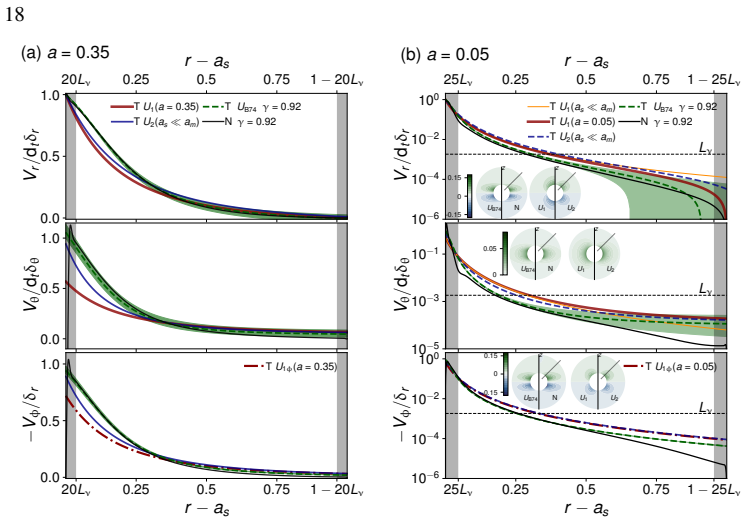
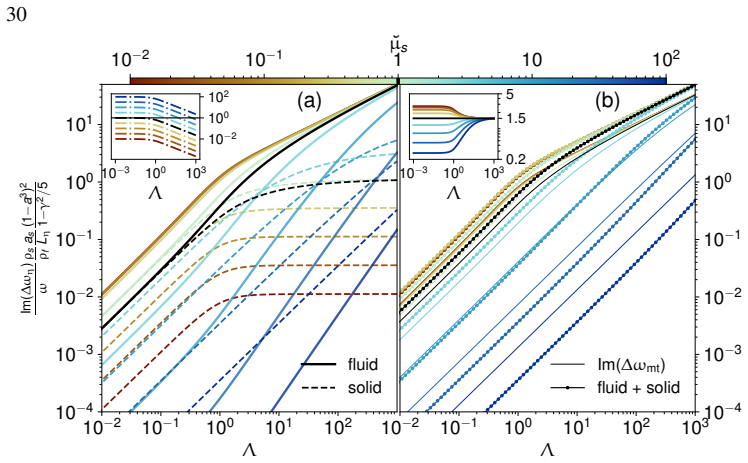
We develop a unified boundary-layer framework for magnetic and viscous effects in a fluid shell bounded by two solid regions with possibly different electromagnetic properties. We derive boundary layers and obtain the magnetohydrodynamic drag from Alfvén-wave radiation, viscous effects and Ohmic dissipation (accounting for pressure effects). The theory is extended to non-axisymmetric equatorial modes and to rotation perturbations of the polar mode, with stronger rotation treated through magnetohydrodynamic Stokes-Ekman boundary layers and a corrected inviscid solution of Busse (1974). Our magnetohydrodynamic simulations validate our theory, providing a quantitative framework for planetary (
What carries the argument
Unified boundary-layer framework that derives the drag from Alfvén-wave radiation, viscous effects and Ohmic dissipation while accounting for pressure and electromagnetic contrasts.
Load-bearing premise
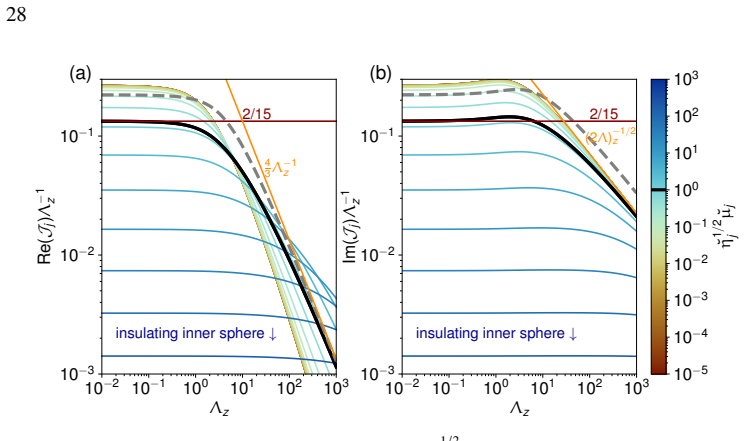
The analysis assumes small-amplitude translational oscillations so that linearised boundary-layer approximations remain valid, and electromagnetic contrasts between the solid sphere and fluid can be treated through standard matching conditions.
What would settle it
A simulation or experiment measuring drag at oscillation amplitudes large enough for nonlinear effects to appear would show clear deviation from the linear predictions if the small-amplitude assumption is false.
Figures








read the original abstract
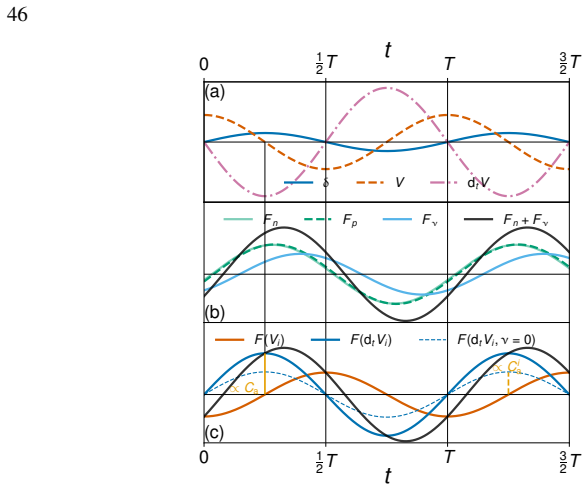
We analyse the magnetohydrodynamic drag on a sphere undergoing small-amplitude translational oscillations in a rotating spherical cavity. This provides a canonical model for oscillatory flows in confined rotating magnetohydrodynamic systems, where dissipation arises from the poorly constrained coupling between magnetic fields, rotation and viscosity. Such flows occur in planetary interiors, notably driven by the translational oscillations of the Earth's inner core along linear or circular trajectories (the polar and equatorial Slichter modes). They may also arise in the thin subsurface oceans of icy moons where strong confinement is expected. Previous theoretical studies considered only simplified limits, restricted to the polar mode: Stokes (1851) solved the viscous bounded problem without rotation or magnetic effects, revealing the importance of pressure, whereas Buffett and Goertz (1995) examined magnetic tension in a non-rotating inviscid unbounded fluid, neglecting magnetic pressure and confinement. We develop a unified boundary-layer framework for magnetic and viscous effects in a fluid shell bounded by two solid regions with possibly different electromagnetic properties. Large electromagnetic contrasts arise even in simple laboratory configurations, such as an iron sphere oscillating in a liquid-metal (e.g. Galinstan). We derive boundary layers and obtain the magnetohydrodynamic drag from Alfv\'en-wave radiation, viscous effects and Ohmic dissipation (accounting for pressure effects). The theory is extended to non-axisymmetric equatorial modes and to rotation perturbations of the polar mode, with stronger rotation treated through magnetohydrodynamic Stokes-Ekman boundary layers and a corrected inviscid solution of Busse (1974). Our magnetohydrodynamic simulations validate our theory, providing a quantitative framework for planetary interiors.
Editorial analysis
A structured set of objections, weighed in public.
Referee Report
Summary. The manuscript develops a unified boundary-layer theory for the magnetohydrodynamic drag on a sphere undergoing small-amplitude translational oscillations inside a rotating spherical cavity. It unifies viscous dissipation (building on Stokes 1851), magnetic tension and Alfvén-wave radiation (building on Buffett & Goertz 1995), and rotational effects via MHD Stokes-Ekman layers (extending Busse 1974), while accounting for pressure, confinement, and electromagnetic contrasts between the solid sphere and fluid. The analysis is extended to non-axisymmetric equatorial modes and rotation perturbations of the polar mode, with MHD simulations presented as validation to provide a quantitative framework for planetary interior flows such as the Earth's inner-core Slichter modes.
Significance. If the linearised derivations and simulation agreement hold, the work offers a valuable quantitative unification of previously separate limits for oscillatory flows in confined rotating MHD systems. The explicit treatment of pressure, boundary matching for electromagnetic contrasts, and extension to equatorial modes strengthen applicability to planetary interiors and laboratory liquid-metal experiments. The framework could serve as a benchmark for modeling dissipation in icy-moon oceans and core dynamics.
major comments (2)
- [Abstract] Abstract (final sentence on simulations): The central claim that 'Our magnetohydrodynamic simulations validate our theory' is load-bearing for the quantitative framework, yet no amplitude-scaling tests, Reynolds-number checks, or explicit confirmation that drag is independent of oscillation amplitude are reported. This leaves open the possibility that agreement arises from compensating errors rather than confirming the small-amplitude linearised boundary-layer analysis, especially for the extensions to equatorial modes and rotation perturbations.
- [Boundary layer derivations] Boundary-layer analysis (unified viscous-magnetic layers): The derivation of drag from Alfvén-wave radiation, viscous effects, Ohmic dissipation and pressure requires explicit demonstration that the interface matching conditions remain valid under the assumed electromagnetic contrasts (e.g., iron sphere in Galinstan) without additional surface-current or finite-conductivity corrections that could alter the leading-order drag.
minor comments (1)
- [Abstract] The abstract and introduction would benefit from a brief statement of the parameter regime (e.g., ranges of Ekman, magnetic Reynolds, and interaction numbers) in which the unified expressions are expected to hold.
Simulated Author's Rebuttal
We thank the referee for their careful reading of the manuscript and for the constructive comments, which help strengthen the validation of the theory. We respond to each major comment below and indicate the revisions that will be incorporated.
read point-by-point responses
-
Referee: [Abstract] Abstract (final sentence on simulations): The central claim that 'Our magnetohydrodynamic simulations validate our theory' is load-bearing for the quantitative framework, yet no amplitude-scaling tests, Reynolds-number checks, or explicit confirmation that drag is independent of oscillation amplitude are reported. This leaves open the possibility that agreement arises from compensating errors rather than confirming the small-amplitude linearised boundary-layer analysis, especially for the extensions to equatorial modes and rotation perturbations.
Authors: We agree that explicit confirmation of the linear regime is necessary to support the validation claim. The simulations were performed with non-dimensional oscillation amplitudes of order 10^{-3} or smaller, yielding Reynolds numbers (based on sphere radius and peak velocity) below 0.05, well within the linear regime where nonlinear advection is negligible. To address the concern directly, we will revise the manuscript by adding a new paragraph in the numerical methods and results sections (with an accompanying figure in the supplement) that demonstrates the drag coefficient remains constant across a range of small amplitudes for representative frequencies and modes, including the equatorial and rotation-perturbed cases. This will confirm that the reported agreement reflects the linearised boundary-layer analysis rather than compensating errors. revision: yes
-
Referee: [Boundary layer derivations] Boundary-layer analysis (unified viscous-magnetic layers): The derivation of drag from Alfvén-wave radiation, viscous effects, Ohmic dissipation and pressure requires explicit demonstration that the interface matching conditions remain valid under the assumed electromagnetic contrasts (e.g., iron sphere in Galinstan) without additional surface-current or finite-conductivity corrections that could alter the leading-order drag.
Authors: The electromagnetic interface conditions are derived from continuity of the tangential electric field and normal magnetic field, together with the jump in tangential magnetic field determined by the surface current (which vanishes at leading order for the high conductivity contrast between iron and Galinstan). Finite-conductivity corrections and induced surface currents enter only at higher order in the small magnetic Reynolds number and inverse conductivity ratio. We will revise the boundary-layer derivation section to include an explicit step-by-step matching calculation for the specific material properties considered, demonstrating that these corrections do not modify the leading-order expressions for the drag contributions from Alfvén-wave radiation, viscous dissipation, and Ohmic losses. revision: yes
Circularity Check
No significant circularity; derivation builds on external classics with independent extensions and simulation validation
full rationale
The manuscript presents a new unified boundary-layer analysis deriving MHD drag contributions from Alfvén-wave radiation, viscous dissipation, Ohmic losses and pressure effects, explicitly extending classical external results (Stokes 1851 for viscous bounded flow, Buffett & Goertz 1995 for magnetic tension, Busse 1974 for inviscid rotating solutions) with corrections and extensions to equatorial modes and MHD Stokes-Ekman layers. No equations reduce by construction to fitted inputs, self-definitions, or load-bearing self-citations; the linearised approximations and matching conditions are standard and stated as assumptions. Simulations provide independent numerical checks rather than tautological confirmation. The derivation chain therefore remains self-contained against external benchmarks.
Axiom & Free-Parameter Ledger
axioms (2)
- standard math Incompressible Navier-Stokes equations coupled to Maxwell equations in the MHD limit
- domain assumption Linearised small-amplitude oscillation assumption allowing boundary-layer treatment
Reference graph
Works this paper leans on
-
[1]
Acheson, D J & Hide, R1973 Hydromagnetics of rotating fluids.Reports on Progress in Physics36(2), 159–221. Ascher, U. M., Ruuth, S. J. & Wetton, B. T. R.1995 Implicit-explicit methods for time-dependent partial differential equations.SIAM J. Numer. Anal.32(3), 797–823. Basset, Alfred Barnard1888 III. On the motion of a sphere in a viscous liquid.Philosoph...
work page 1995
-
[2]
the unsteady hydromagnetic ekman-hartmann boundary-layer problem.Journal of Fluid Mechanics 39(3), 561–586. Bessel1828 Ueber die Unrichtigkeit der bisher bei den Pendelversuchen angewandten Reduction auf den luftleeren Raum. Auszug eines Schreibens des Herrn Professors und Ritters Bessel an den Herausgeber.Astronomische Nachrichten6(11), 149–150. Bouvier,...
work page 2015
-
[3]
Darrigol, O.2002 Between hydrodynamics and elasticity theory: The first five births of the Navier-Stokes equation.Archive for History of Exact Sciences56(2), 95–150. Debnath, L1972 On unsteady magnetohydrodynamic boundary layers in a rotating flow.ZAMM-Journal of Applied Mathematics and Mechanics/Zeitschrift f¨ur Angewandte Mathematik und Mechanik52(10), ...
work page 2002
-
[4]
Deleplace, B ´erang`ere & Cardin, Philippe2006 Viscomagnetic torque at the core mantle boundary
Delacroix, Jules & Davoust, Laurent2018 Drag upon a sphere suspended in a low magnetic-reynolds number mhd channel flow.Physical Review Fluids3(12), 123701. Deleplace, B ´erang`ere & Cardin, Philippe2006 Viscomagnetic torque at the core mantle boundary. Geophysical Journal International167(2), 557–566. Dormy, Emmanuel & Soward, Andrew M2007Mathematical as...
work page 1944
-
[5]
BG Teubner. Kotas, Charlotte W, Yoda, Minami & Rogers, Peter H2007 Visualization of steady streaming near oscillating spheroids.Experiments in fluids42, 111–121. Kozlov, Victor G., Kozlov, Nikolai V. & Subbotin, Stanislav V.2017 Steady flows in rotating spherical cavity excited by multi-frequency oscillations of free inner core.Acta Astronautica130, 43–51...
work page 2017
-
[6]
Oberbeck, A.1876 Ueber station ¨are Fl¨ ussigkeitsbewegungen mit Ber¨ ucksichtigung der inneren Reibung. De Gruyter1876(81), 62–80. Personnettaz, P., C´ebron, D., Scha¨effer, N., Deguen, R. & Mandea, M.2026 Damping the translational oscillations of the inner core.under review. Plunian, Franck, Gomez, Paul & Alboussi`ere, Thierry2025 Three-body anisotropic...
work page 2026
-
[7]
P.1964 Oscillating sphere in a rotating viscous fluid.AIAA Journal
Singh, M. P.1964 Oscillating sphere in a rotating viscous fluid.AIAA Journal. Singh, M. P.1965 Drag of a sphere oscillating in a conducting viscous medium.Physics of Fluids8(5),
work page 1964
-
[8]
Slichter, Louis B.1961 The fundamental free mode of the Earth’s inner.Proceedings of the National Academy of Sciences47(2), 186–190. Smylie, D. E.1999 Viscosity near Earth’s solid inner core.Science284(5413), 461–463. Smylie, Doug E. & McMillan, D.G.1998 Viscous and rotational splitting of the translational oscillations of Earth's solid inner core.Physics...
work page 1961
-
[9]
G.1843 On some cases of fluid motion
Stokes, G. G.1843 On some cases of fluid motion. InMathematical and Physical Papers, pp. 17–68. Cambridge, England, UK: Cambridge University Press. Stratton, Julius Adams2007Electromagnetic theory. John Wiley & Sons. Subbotin, Stanislav & Shiryaeva, Mariya2021 On the linear and non-linear fluid response to the circular forcing in a rotating spherical shel...
work page 1973
-
[10]
where the exact expression recovers the spherical-shell result of (Stratton 2007, p. 265), and the large-𝜇 𝑓 asymptotics retrieves equation 5.122 of Jackson (1977), illustrating efficient magnetic shielding by a thin high-permeability shell. For𝜇𝑠 =𝜇 𝑓 =𝜇 0, one obtains𝜇 1 =𝜇 0 and a𝜇 2 expression formally identical to (S2
work page 2007
-
[11]
(a) Real and (b) imaginary part
4 10−4 10−2 100 102 104 Pm 10−3 10−2 10−1 100 101 102 Re(λ±Lη) ∝ P □1/2 m (a) 10−4 10−2 100 102 104 Pm 10−2 10−1 100 101 Im(λ±Lη) ∝ P □1/2 m (b) λ+ λ□ Buffett & Goertz (1995) 10−4 10−3 10−2 10−1 100 101 102 Λ 10−410−2 100 102 104 Pm 10−4 10−2 100 102 104 Λ Re(λ+Lη) (c) 10−2 100 102 104 Pm Re(λ−Lη) 10−2 100 102 104 Pm Im(λ+Lη) 10−2 100 102 104 Pm 10−4 10−2...
work page 1995
-
[12]
equation 89 of Smylie & McMillan 1998), e.g
recovering the usual expressions for Stokes-Ekman boundary layers (see e.g. equation 89 of Smylie & McMillan 1998), e.g. found within rotating spheres in librations (Sauret & Diz `es 2013). The boundary layer thickness diverges at the so-called critical latitudes cos𝜃± =∓1/𝛾, which turns out to be also the case for the general expressions (6.19)-(6.20):𝜄+...
work page 1998
-
[13]
Consequently, the radial wavenumber𝜆of BG95 cannot be recovered as a limiting case
or certain quasi-static MHD regimes (Thess & Zikanov 2007), this approximation suppresses magnetic perturbations and yields only two wavenumbers, in contrast with the 6 four in (6.19)-(6.20). Consequently, the radial wavenumber𝜆of BG95 cannot be recovered as a limiting case. The magnetic Stokes-Ekman layer considered here therefore generalises the Stokes-...
work page 2007
discussion (0)
Sign in with ORCID, Apple, or X to comment. Anyone can read and Pith papers without signing in.