Visualising the Attractor Landscape of Neural Cellular Automata
Pith reviewed 2026-05-10 15:48 UTC · model grok-4.3
The pith
Neural cellular automata often show simple behavioral manifolds at the full-state level but complex ones when broken down to individual cells.
A machine-rendered reading of the paper's core claim, the machinery that carries it, and where it could break.
Core claim
By applying principal components analysis, dense and sparse autoencoders, and persistent homology to neural cellular automata, the authors establish that the underlying behavioral manifold is often simple and readily captured when the entire state is taken as a single data point, yet becomes highly complex when each cell state is treated separately, requiring more advanced techniques to make sense of it.
What carries the argument
The behavioral manifold of the NCA state, recovered at macroscopic (whole-configuration) versus microscopic (per-cell) scales through manifold learning and persistent homology.
If this is right
- Macroscopic analysis often suffices for capturing essential NCA behavior using standard dimensionality-reduction tools.
- Microscopic analysis reveals greater complexity and therefore requires advanced manifold and topological methods.
- The visualizations supply concrete routes for interpreting what an NCA has learned during training.
- Simple macro-level manifolds indicate that global patterns dominate the learned dynamics.
- Persistent homology can expose additional topological features once the micro-level complexity is addressed.
Where Pith is reading between the lines
- The macro-micro distinction could be tested on other emergent systems such as reaction-diffusion models or lattice-based simulations.
- Training procedures might be adjusted to favor macro-level simplicity as a way to improve interpretability.
- Linking the recovered manifolds directly to task performance could help predict how well an NCA will generalize.
- The computational cost of micro-level analysis may limit scaling unless more efficient topological methods are developed.
Load-bearing premise
The manifold learning and topological techniques recover the true behavioral manifold without significant distortion or loss of dynamics that matter for the NCA's function.
What would settle it
A neural cellular automaton in which the macroscopic manifold analysis fails to predict or explain observed state transitions that occur in direct simulation.
Figures


read the original abstract
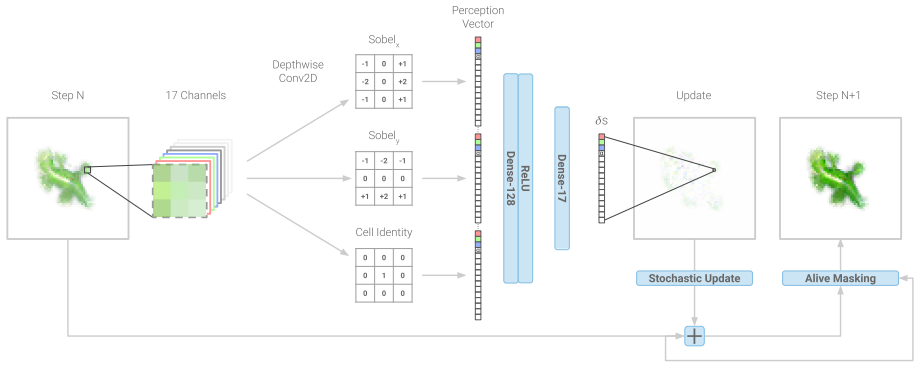
As Neural Cellular Automata (NCAs) are increasingly applied outside of the toy models in Artificial Life, there is a pressing need to understand how they behave and to build appropriate routes to interpret what they have learnt. By their very nature, the benefits of training NCAs are balanced with a lack of interpretability: we can engineer emergent behaviour, but have limited ability to understand what has been learnt. In this paper, we apply a variety of techniques to pry open the NCA black box and glean some understanding of what it has learnt to do. We apply techniques from manifold learning (principal components analysis and both dense and sparse autoencoders) along with techniques from topological data analysis (persistent homology) to capture the NCA's underlying behavioural manifold, with varying success. Results show that when analysis is performed at a macroscopic level (i.e. taking the entire NCA state as a single data point), the underlying manifold is often quite simple and can be captured and analysed quite well. When analysis is performed at a microscopic level (i.e. taking the state of individual cells as a single data point), the manifold is highly complex and more complicated techniques are required in order to make sense of it.
Editorial analysis
A structured set of objections, weighed in public.
Referee Report
Summary. The paper applies manifold learning (PCA, dense and sparse autoencoders) and topological data analysis (persistent homology) to Neural Cellular Automata (NCA) states in order to visualize their underlying attractor landscapes. It reports that macroscopic analysis—treating each full NCA grid as a single data point—typically yields a simple, low-dimensional manifold that these techniques capture effectively, while microscopic analysis—treating individual cells as data points—produces highly complex manifolds requiring more advanced methods. The work is positioned as a route to interpretability for NCAs beyond toy models.
Significance. If the visualizations faithfully reflect NCA dynamics, the distinction between tractable macro-scale and complex micro-scale manifolds would supply concrete tools for probing emergent behavior in trained NCAs, addressing a recognized interpretability gap. The empirical application of standard manifold and TDA methods to NCA trajectories is a useful first step, though the absence of quantitative validation limits immediate impact.
major comments (2)
- [Results (macro vs. micro comparisons)] The central claim that macro-level embeddings capture a 'simple' manifold while micro-level ones are 'highly complex' rests on visual inspection of PCA projections, autoencoder reconstructions, and persistence diagrams, but no quantitative metric is reported that verifies these reduced representations preserve NCA update dynamics or attractor properties (e.g., next-state prediction error in latent space, basin-boundary fidelity, or Lyapunov exponents). This validation gap directly affects whether the reported simplicity is a property of the NCA or an artifact of the chosen projections.
- [Methods and Discussion] The weakest assumption—that PCA, autoencoders, and persistent homology recover the true behavioral manifold without significant distortion—is not tested against any ground-truth property of the NCA transition rule. For instance, there is no check that points close in the learned embedding correspond to states that evolve similarly under the trained NCA update function.
minor comments (2)
- [Methods] Notation for state vectors and embedding dimensions is introduced without a consistent table or diagram; a single schematic relating grid size, macro/micro sampling, and latent dimensionality would improve readability.
- [Abstract and Results] The abstract states 'varying success' but the results section does not quantify failure modes (e.g., reconstruction loss curves or homology stability across random seeds).
Simulated Author's Rebuttal
We thank the referee for the constructive feedback, which identifies key opportunities to strengthen the validation of our manifold visualizations. We address each major comment below and will incorporate quantitative checks in the revised manuscript to better support our claims about macro- versus micro-scale attractor landscapes.
read point-by-point responses
-
Referee: [Results (macro vs. micro comparisons)] The central claim that macro-level embeddings capture a 'simple' manifold while micro-level ones are 'highly complex' rests on visual inspection of PCA projections, autoencoder reconstructions, and persistence diagrams, but no quantitative metric is reported that verifies these reduced representations preserve NCA update dynamics or attractor properties (e.g., next-state prediction error in latent space, basin-boundary fidelity, or Lyapunov exponents). This validation gap directly affects whether the reported simplicity is a property of the NCA or an artifact of the chosen projections.
Authors: We agree that visual inspection alone provides only qualitative support for the distinction between simple macro manifolds and complex micro manifolds. In the revision we will add quantitative metrics: reported explained variance ratios for PCA, reconstruction MSE for both dense and sparse autoencoders, and a dynamics-preservation check consisting of next-state prediction error computed in the latent space on held-out trajectories. These additions will be placed in the Results section alongside the existing figures. Full Lyapunov exponent estimation and basin-boundary fidelity analysis remain computationally prohibitive for the full state space and will be noted as future work rather than performed; however, the proposed checks directly address whether the embeddings preserve update dynamics. revision: yes
-
Referee: [Methods and Discussion] The weakest assumption—that PCA, autoencoders, and persistent homology recover the true behavioral manifold without significant distortion—is not tested against any ground-truth property of the NCA transition rule. For instance, there is no check that points close in the learned embedding correspond to states that evolve similarly under the trained NCA update function.
Authors: We accept that an explicit test against the NCA transition rule is necessary to rule out projection artifacts. We will add a new subsection in Methods describing the following validation: for each embedding (macro and micro), we sample 500 pairs of states that are nearest neighbors in the learned space and 500 random pairs, apply the trained NCA update for 5 steps, and report the mean Euclidean distance between the resulting states. Results will be summarized in the revised Discussion, showing that embedding neighbors evolve more similarly than random pairs. This provides direct evidence that proximity in the manifold corresponds to similar dynamical behavior under the learned rule. revision: yes
Circularity Check
No significant circularity; empirical application of standard techniques
full rationale
The paper collects states from trained NCAs and applies off-the-shelf manifold learning (PCA, dense/sparse autoencoders) and topological data analysis (persistent homology) at macro and micro scales. The central observation—that macroscopic states yield simpler manifolds while microscopic states are complex—is reported as a direct empirical outcome of these visualizations and diagrams, with no equations, derivations, or fitted parameters that reduce the result to its own inputs by construction. No self-citation chains, uniqueness theorems, or ansatzes are invoked to justify the core claim; the methods are externally validated techniques applied to observed data. The analysis remains self-contained and does not rely on tautological reductions.
Axiom & Free-Parameter Ledger
axioms (2)
- domain assumption The state space of an NCA can be meaningfully embedded into a lower-dimensional manifold that captures behavioral attractors.
- domain assumption Persistent homology on point clouds from NCA states reveals topological features of the attractor landscape.
discussion (0)
Sign in with ORCID, Apple, or X to comment. Anyone can read and Pith papers without signing in.