Recognition: unknown
A search for microscopic black holes, string balls, and sphalerons in proton-proton collisions at sqrt{s} = 13 TeV
Pith reviewed 2026-05-10 15:25 UTC · model grok-4.3
The pith
No signals for microscopic black holes, string balls or sphalerons appear in 13 TeV LHC data, excluding masses below 8.4-11.4 TeV in extra-dimension models.
A machine-rendered reading of the paper's core claim, the machinery that carries it, and where it could break.
Core claim
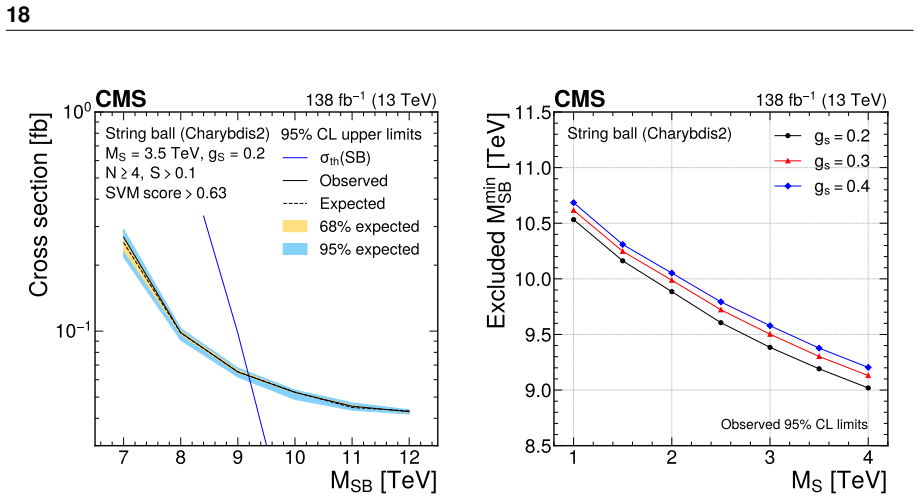
In models with large extra dimensions, semiclassical black holes and string balls with masses below 8.4-11.4 TeV and 9.0-10.7 TeV respectively are excluded at 95% confidence level, while an upper limit of 0.0034 at 95% CL is set on the fraction of quark-quark interactions above the 9 TeV sphaleron threshold, based on the absence of signals in the full 138 fb^{-1} dataset analyzed with a new phase-space proximity classification method.
What carries the argument
Phase-space proximity classification that groups events by kinematic similarity to isolate candidates with multiple high-momentum jets, leptons, and photons from background using shape-invariant control samples.
If this is right
- Semiclassical black hole production cannot occur at LHC energies for masses below the excluded range in large extra dimension models.
- Sphaleron transitions remain rare enough that fewer than 0.34 percent of quark interactions above 9 TeV produce them.
- Background processes fully account for all observed high-multiplicity events with no detectable new-physics contribution at current energies.
- Higher-luminosity or higher-energy runs are required to test the same models at larger mass scales.
Where Pith is reading between the lines
- The limits shrink the viable parameter space for low-scale quantum gravity scenarios that rely on large extra dimensions.
- The data-driven classification approach can be reused for other searches involving complex final states at future collider energies.
- Continued non-observation would further delay experimental access to any Planck-scale physics that becomes visible only above 10 TeV.
Load-bearing premise
The kinematic features and phase-space proximity metric separate potential signals from background without introducing biases that depend on the specific models being tested.
What would settle it
An observed excess of events with high scalar sum of transverse momenta that matches the predicted multiplicity and energy distribution for black hole or sphaleron decays in the same dataset would falsify the exclusion.
Figures



read the original abstract
A search for microscopic black holes, string balls, and electroweak sphalerons using proton-proton collisions at $\sqrt{s}$ = 13 TeV recorded with the CMS detector at the CERN LHC during the 2016$-$2018 data taking, and corresponding to an integrated luminosity of 138 fb$^{-1}$, is presented. Two search strategies based on control samples in data are used. Model-independent limits on the cross section of physics phenomena with multiple energetic jets, leptons, and photons are set using a method that relies on the shape invariance of the scalar sum of the transverse momenta of all objects in the event. Model-dependent limits on black hole and sphaleron production are set using a newly introduced method that has been developed for the identification of collider events with distinct kinematic features by separating them into classes based on phase space proximity. In the context of models with large extra dimensions, semiclassical black holes and string balls with masses below 8.4$-$11.4 TeV and 9.0$-$10.7 TeV, respectively, are excluded at 95% confidence level, significantly extending the reach beyond previous searches. Results of a dedicated search for electroweak sphalerons are used to derive an upper limit of 0.0034 at 95% confidence level on the fraction of quark-quark interactions above the nominal sphaleron transition energy threshold of 9 TeV.
Editorial analysis
A structured set of objections, weighed in public.
Referee Report
Summary. The paper presents a search for microscopic black holes, string balls, and electroweak sphalerons in 13 TeV pp collisions recorded by CMS with 138 fb^{-1} of 2016-2018 data. Model-independent cross-section limits for multi-jet/lepton/photon final states are derived from the shape invariance of the scalar sum of transverse momenta in data control samples. Model-dependent limits on black hole/string ball production and on the sphaleron fraction are obtained via a new event classification technique that partitions events according to a phase-space proximity metric constructed from kinematic features. In large-extra-dimensions models, semiclassical black holes below 8.4-11.4 TeV and string balls below 9.0-10.7 TeV are excluded at 95% CL, and an upper limit of 0.0034 is set on the fraction of quark-quark interactions above the 9 TeV sphaleron threshold.
Significance. If the new classification method is shown to be robust, the results would extend existing mass limits on black holes and string balls by several TeV and provide the first dedicated constraint on the sphaleron transition fraction at the LHC. The consistent use of data-driven control samples for both the model-independent and model-dependent analyses is a methodological strength that reduces dependence on Monte Carlo modeling of backgrounds.
major comments (1)
- [Section describing the new event-classification method] The model-dependent exclusions (black holes 8.4-11.4 TeV, string balls 9.0-10.7 TeV, sphaleron fraction <0.0034) are obtained exclusively from the newly introduced phase-space proximity classification. The manuscript must supply quantitative validation (signal-injection closure tests, purity-efficiency curves, or background-shape stability checks) demonstrating that the kinematic metric separates signal from QCD/multijet background without model-dependent biases in the variables used for the limits.
Simulated Author's Rebuttal
We thank the referee for the careful review and constructive feedback on our manuscript. We address the major comment below and will update the paper to incorporate the requested validation.
read point-by-point responses
-
Referee: [Section describing the new event-classification method] The model-dependent exclusions (black holes 8.4-11.4 TeV, string balls 9.0-10.7 TeV, sphaleron fraction <0.0034) are obtained exclusively from the newly introduced phase-space proximity classification. The manuscript must supply quantitative validation (signal-injection closure tests, purity-efficiency curves, or background-shape stability checks) demonstrating that the kinematic metric separates signal from QCD/multijet background without model-dependent biases in the variables used for the limits.
Authors: We agree that quantitative validation of the phase-space proximity classification is essential to substantiate the model-dependent results. In the revised manuscript we will add a new subsection presenting signal-injection closure tests (injecting simulated black-hole, string-ball, and sphaleron events into data control samples and verifying unbiased recovery of the injected yields), purity-efficiency curves versus the proximity-metric threshold, and background-shape stability checks obtained by varying control-region definitions and metric parameters. These studies will explicitly demonstrate that the kinematic metric separates signal from QCD/multijet background without introducing model-dependent biases in the variables entering the limit-setting procedure. revision: yes
Circularity Check
No significant circularity in derivation chain
full rationale
The paper's model-independent limits rely on shape invariance of scalar-sum distributions observed directly in data control samples, independent of any signal model or fitted parameters. Model-dependent limits normalize simulation to data without reducing the reported exclusions (black hole/string ball mass thresholds or sphaleron fraction) to any self-defined or fitted quantity by the paper's own equations. No self-definitional steps, fitted-input predictions, load-bearing self-citations, or ansatz smuggling are present; the new phase-space proximity classifier is an analysis tool whose validity is external to the limit-setting procedure itself.
Axiom & Free-Parameter Ledger
axioms (1)
- domain assumption Standard Model background processes are accurately modeled by Monte Carlo simulation and can be validated with data control samples.
Reference graph
Works this paper leans on
-
[1]
I. Antoniadis, N. Arkani-Hamed, S. Dimopoulos, and G. R. Dvali, “New dimensions at a millimeter to a fermi and superstrings at a TeV”,Phys. Lett. B436(1998) 257, doi:10.1016/S0370-2693(98)00860-0,arXiv:hep-ph/9804398
-
[2]
N. Arkani-Hamed, S. Dimopoulos, and G. R. Dvali, “The hierarchy problem and new dimensions at a millimeter”,Phys. Lett. B429(1998) 263, doi:10.1016/S0370-2693(98)00466-3,arXiv:hep-ph/9803315
-
[3]
N. Arkani-Hamed, S. Dimopoulos, and G. R. Dvali, “Phenomenology, astrophysics and cosmology of theories with submillimeter dimensions and TeV scale quantum gravity”, Phys. Rev. D59(1999) 086004,doi:10.1103/PhysRevD.59.086004, arXiv:hep-ph/9807344. References 21
-
[4]
L. Randall and R. Sundrum, “An alternative to compactification”,Phys. Rev. Lett.83 (1999) 4690,doi:10.1103/PhysRevLett.83.4690,arXiv:hep-th/9906064
-
[5]
A Large Mass Hierarchy from a Small Extra Dimension
L. Randall and R. Sundrum, “A large mass hierarchy from a small extra dimension”, Phys. Rev. Lett.83(1999) 3370,doi:10.1103/PhysRevLett.83.3370, arXiv:hep-ph/9905221
work page internal anchor Pith review doi:10.1103/physrevlett.83.3370 1999
-
[6]
S. Dimopoulos and G. L. Landsberg, “Black holes at the LHC”,Phys. Rev. Lett.87(2001) 161602,doi:10.1103/PhysRevLett.87.161602,arXiv:hep-ph/0106295
-
[7]
Black holes and submillimeter dimensions
P . C. Argyres, S. Dimopoulos, and J. March-Russell, “Black holes and submillimeter dimensions”,Phys. Lett. B441(1998) 96,doi:10.1016/S0370-2693(98)01184-8, arXiv:hep-th/9808138
-
[8]
High-energy colliders as black hole factories: The end of short distance physics
S. B. Giddings and S. D. Thomas, “High-energy colliders as black hole factories: The end of short distance physics”,Phys. Rev. D65(2002) 056010, doi:10.1103/PhysRevD.65.056010,arXiv:hep-ph/0106219
-
[9]
S. W. Hawking, “Particle creation by black holes”,Commun. Math. Phys.43(1975) 199, doi:10.1007/BF02345020. [Erratum:doi:10.1007/BF01608497]
-
[10]
Black holes and quantum gravity at the LHC
P . Meade and L. Randall, “Black holes and quantum gravity at the LHC”,JHEP05(2008) 003,doi:10.1088/1126-6708/2008/05/003,arXiv:0708.3017
-
[11]
Quantum black holes with charge, colour, and spin at the LHC
D. M. Gingrich, “Quantum black holes with charge, colour, and spin at the LHC”,J. Phys. G37(2010) 105008,doi:10.1088/0954-3899/37/10/105008,arXiv:0912.0826
-
[12]
Colorful quantum black holes at the LHC
X. Calmet, W. Gong, and S. D. H. Hsu, “Colorful quantum black holes at the LHC”,Phys. Lett. B668(2008) 20,doi:10.1016/j.physletb.2008.08.011,arXiv:0806.4605
-
[13]
String balls at the LHC and beyond
S. Dimopoulos and R. Emparan, “String balls at the LHC and beyond”,Phys. Lett. B526 (2002) 393,doi:10.1016/S0370-2693(01)01525-8,arXiv:hep-ph/0108060
-
[14]
’t Hooft, Symmetry Breaking Through Bell-Jackiw Anomalies, Phys
G. ’t Hooft, “Symmetry breaking through Bell-Jackiw anomalies”,Phys. Rev. Lett.37 (1976) 8,doi:10.1103/PhysRevLett.37.8
-
[15]
A saddle-point solution in the Weinberg-Salam theory,
F. R. Klinkhamer and N. S. Manton, “A saddle point solution in the Weinberg-Salam theory”,Phys. Rev. D30(1984) 2212,doi:10.1103/PhysRevD.30.2212
-
[16]
S. H. H. Tye and S. S. C. Wong, “Bloch wave function for the periodic sphaleron potential and unsuppressed baryon and lepton number violating processes”,Phys. Rev. D92 (2015) 045005,doi:10.1103/PhysRevD.92.045005,arXiv:1505.03690
-
[17]
Search for sphalerons in proton-proton collisions
J. Ellis and K. Sakurai, “Search for sphalerons in proton-proton collisions”,JHEP04 (2016) 086,doi:10.1007/JHEP04(2016)086,arXiv:1601.03654
-
[18]
On the phenomenology of sphaleron-induced processes at the LHC and beyond
A. Papaefstathiou, S. Pl ¨atzer, and K. Sakurai, “On the phenomenology of sphaleron-induced processes at the LHC and beyond”,JHEP12(2019) 017, doi:10.1007/JHEP12(2019)017,arXiv:1910.04761
-
[19]
ATLAS Collaboration, “Search for strong gravity in multijet final states produced in pp collisions at √s=13 TeV using the ATLAS detector at the LHC”,JHEP03(2016) 026, doi:10.1007/JHEP03(2016)026,arXiv:1512.02586. 22
-
[20]
ATLAS Collaboration, “Search for quantum black hole production in lepton+jet final states using proton-proton collisions at √s=13 TeV with the ATLAS detector”,Phys. Rev. D109(2024) 032010,doi:10.1103/PhysRevD.109.032010, arXiv:2307.14967
-
[21]
CMS Collaboration, “Search for black holes and sphalerons in high-multiplicity final states in proton-proton collisions at √s=13 TeV”,JHEP11(2018) 042, doi:10.1007/JHEP11(2018)042,arXiv:1805.06013
-
[22]
Search for microscopic black hole signatures at the Large Hadron Collider
CMS Collaboration, “Search for microscopic black hole signatures at the Large Hadron Collider”,Phys. Lett. B697(2011) 434,doi:10.1016/j.physletb.2011.02.032, arXiv:1012.3375
-
[23]
Search for microscopic black holes inppcollisions at √s=7 TeV
CMS Collaboration, “Search for microscopic black holes inppcollisions at √s=7 TeV”, JHEP04(2012) 061,doi:10.1007/JHEP04(2012)061,arXiv:1202.6396
-
[24]
Search for microscopic black holes inppcollisions at √s= 8 TeV
CMS Collaboration, “Search for microscopic black holes inppcollisions at √s= 8 TeV”, JHEP07(2013) 178,doi:10.1007/JHEP07(2013)178,arXiv:1303.5338
-
[25]
Search for black holes in high-multiplicity final states in proton-proton collisions at √s=13 TeV
CMS Collaboration, “Search for black holes in high-multiplicity final states in proton-proton collisions at √s=13 TeV”,Phys. Lett. B774(2017) 279, doi:10.1016/j.physletb.2017.09.053,arXiv:1705.01403
-
[26]
HEPData record for this analysis, 2025.doi:10.17182/hepdata.165871
-
[27]
The CMS experiment at the CERN LHC
CMS Collaboration, “The CMS experiment at the CERN LHC”,JINST3(2008) S08004, doi:10.1088/1748-0221/3/08/S08004,arXiv:1003.4038
-
[28]
Development of the CMS detector for the CERN LHC Run 3
CMS Collaboration, “Development of the CMS detector for the CERN LHC Run 3”, JINST19(2024) P05064,doi:10.1088/1748-0221/19/05/P05064, arXiv:2309.05466
-
[29]
Description and performance of track and primary-vertex reconstruction with the CMS tracker
CMS Collaboration, “Description and performance of track and primary-vertex reconstruction with the CMS tracker”,JINST9(2014) P10009, doi:10.1088/1748-0221/9/10/P10009,arXiv:1405.6569
-
[30]
The CMS phase-1 pixel detector upgrade
Tracker Group of the CMS Collaboration, “The CMS phase-1 pixel detector upgrade”, JINST16(2021) P02027,doi:10.1088/1748-0221/16/02/P02027, arXiv:2012.14304
-
[31]
Track impact parameter resolution for the full pseudo rapidity coverage in the 2017 dataset with the CMS Phase-1 pixel detector
CMS Collaboration, “Track impact parameter resolution for the full pseudo rapidity coverage in the 2017 dataset with the CMS Phase-1 pixel detector”, CMS Detector Performance Summary CMS-DP-2020-049, 2020
2017
-
[32]
2017 tracking performance plots
CMS Collaboration, “2017 tracking performance plots”, CMS Detector Performance Summary CMS-DP-2017-015, 2017
2017
-
[33]
Performance of the CMS Level-1 trigger in proton-proton collisions at √s=13 TeV
CMS Collaboration, “Performance of the CMS level-1 trigger in proton-proton collisions at √s=13 TeV”,JINST15(2020) P10017, doi:10.1088/1748-0221/15/10/P10017,arXiv:2006.10165
-
[34]
CMS Collaboration, “The CMS trigger system”,JINST12(2017) P01020, doi:10.1088/1748-0221/12/01/P01020,arXiv:1609.02366. References 23
-
[35]
Performance of the CMS high-level trigger during LHC Run 2
CMS Collaboration, “Performance of the CMS high-level trigger during LHC Run 2”, JINST19(2024) P11021,doi:10.1088/1748-0221/19/11/P11021, arXiv:2410.17038
-
[36]
BlackMax: A black-hole event generator with rotation, recoil, split branes, and brane tension
D.-C. Dai et al., “BlackMax: A black-hole event generator with rotation, recoil, split branes, and brane tension”,Phys. Rev. D77(2008) 076007, doi:10.1103/PhysRevD.77.076007,arXiv:0711.3012
-
[37]
CHARYBDIS: A black hole event generator
C. M. Harris, P . Richardson, and B. R. Webber, “CHARYBDIS: A black hole event generator”,JHEP08(2003) 033,doi:10.1088/1126-6708/2003/08/033, arXiv:hep-ph/0307305
-
[38]
Phenomenology of production and decay of spinning extra-dimensional black holes at hadron colliders
J. A. Frost et al., “Phenomenology of production and decay of spinning extra-dimensional black holes at hadron colliders”,JHEP10(2009) 014, doi:10.1088/1126-6708/2009/10/014,arXiv:0904.0979
-
[39]
BaryoGEN, a Monte Carlo generator for sphaleron-like transitions in proton-proton collisions
C. Bravo and J. Hauser, “BaryoGEN, a Monte Carlo generator for sphaleron-like transitions in proton-proton collisions”,JHEP11(2018) 041, doi:10.1007/JHEP11(2018)041,arXiv:1805.02786
-
[40]
The automation of next-to-leading order electroweak calculations
R. Frederix et al., “The automation of next-to-leading order electroweak calculations”, JHEP07(2018) 185,doi:10.1007/JHEP11(2018)07,arXiv:1804.10017. [Erratum:doi:10.1007/JHEP11(2021)085]
-
[41]
J. Alwall et al., “Comparative study of various algorithms for the merging of parton showers and matrix elements in hadronic collisions”,Eur. Phys. J. C53(2008) 473, doi:10.1140/epjc/s10052-007-0490-5,arXiv:0706.2569
-
[42]
Greybody factors for brane scalar fields in a rotating black-hole background
S. Creek, O. Efthimiou, P . Kanti, and K. Tamvakis, “Greybody factors for brane scalar fields in a rotating black-hole background”,Phys. Rev. D75(2007) 084043, doi:10.1103/PhysRevD.75.084043,arXiv:hep-th/0701288
-
[43]
Scalar emission in the bulk in a rotating black hole background
S. Creek, O. Efthimiou, P . Kanti, and K. Tamvakis, “Scalar emission in the bulk in a rotating black hole background”,Phys. Lett. B656(2007) 102, doi:10.1016/j.physletb.2007.09.050,arXiv:0709.0241
-
[44]
Improved analysis of black hole formation in high-energy particle collisions
H. Yoshino and V . S. Rychkov, “Improved analysis of black hole formation in high-energy particle collisions”,Phys. Rev. D71(2005) 104028, doi:10.1103/PhysRevD.71.104028,arXiv:hep-th/0503171. [Erratum: doi:10.1103/PhysRevD.77.089905]
-
[45]
Black hole remnants at the LHC
B. Koch, M. Bleicher, and S. Hossenfelder, “Black hole remnants at the LHC”,JHEP10 (2005) 053,doi:10.1088/1126-6708/2005/10/053,arXiv:hep-ph/0507138
-
[46]
H. Stoecker, “Stable TeV - black hole remnants at the LHC: Discovery through di-jet suppression, mono-jet emission and a supersonic boom in the quark-gluon plasma”,Int. J. Mod. Phys. D16(2007) 185,doi:10.1142/S0218271807009930, arXiv:hep-ph/0605062
-
[47]
Glimpses on the micro black hole Planck phase
F. Scardigli, “Glimpses on the micro black hole Planck phase”,Symmetry12(2020) 1519, doi:10.3390/sym12091519,arXiv:0809.1832
-
[48]
Study of highly-excited string states at the Large Hadron Collider
D. M. Gingrich and K. Martell, “Study of highly-excited string states at the Large Hadron Collider”,Phys. Rev. D78(2008) 115009,doi:10.1103/PhysRevD.78.115009, arXiv:0808.2512. 24
-
[49]
Extraction and validation of a new set of CMS PYTHIA8 tunes from underlying-event measurements
CMS Collaboration, “Extraction and validation of a new set of CMS PYTHIA8 tunes from underlying-event measurements”,Eur. Phys. J. C80(2020) 4, doi:10.1140/epjc/s10052-019-7499-4,arXiv:1903.12179
-
[50]
Parton distributions from high-precision collider data
NNPDF Collaboration, “Parton distributions from high-precision collider data”,Eur. Phys. J. C77(2017) 663,doi:10.1140/epjc/s10052-017-5199-5, arXiv:1706.00428
work page internal anchor Pith review Pith/arXiv arXiv doi:10.1140/epjc/s10052-017-5199-5 2017
-
[51]
Upgrades for the CMS simulation
CMS Collaboration, “Upgrades for the CMS simulation”,J. Phys.: Conf. Ser.608(2015) 012056,doi:10.1088/1742-6596/608/1/012056
-
[52]
Particle-flow reconstruction and global event description with the CMS detector
CMS Collaboration, “Particle-flow reconstruction and global event description with the CMS detector”,JINST12(2017) P10003,doi:10.1088/1748-0221/12/10/P10003, arXiv:1706.04965
work page internal anchor Pith review Pith/arXiv arXiv doi:10.1088/1748-0221/12/10/p10003 2017
-
[53]
Technical proposal for the Phase-II upgrade of the Compact Muon Solenoid
CMS Collaboration, “Technical proposal for the Phase-II upgrade of the Compact Muon Solenoid”, CMS Technical Proposal CERN-LHCC-2015-010, CMS-TDR-15-02, CMS, 2015
2015
-
[54]
Jet energy scale and resolution in the CMS experiment in pp collisions at 8 TeV
CMS Collaboration, “Jet energy scale and resolution in the CMS experiment in pp collisions at 8 TeV”,JINST12(2017), no. 02, P02014, doi:10.1088/1748-0221/12/02/P02014,arXiv:1607.03663
-
[55]
Pileup removal algorithms
CMS Collaboration, “Pileup removal algorithms”, CMS Physics Analysis Summary CMS-PAS-JME-14-001, CMS, 2014
2014
-
[56]
Jet algorithms performance in 13 TeV data
CMS Collaboration, “Jet algorithms performance in 13 TeV data”, CMS Physics Analysis Summary CMS-PAS-JME-16-003, CMS, 2017
2017
-
[57]
CMS Collaboration, “Performance of electron reconstruction and selection with the CMS detector in proton-proton collisions at √s= 8 TeV”,JINST10(2015) P06005, doi:10.1088/1748-0221/10/06/P06005,arXiv:1502.02701
-
[58]
Electron and photon reconstruction and identification with the CMS experiment at the CERN LHC
CMS Collaboration, “Electron and photon reconstruction and identification with the CMS experiment at the CERN LHC”,JINST16(2021) P05014, doi:10.1088/1748-0221/16/05/P05014,arXiv:2012.06888
-
[59]
Performance of CMS muon reconstruction in pp collision events at√s=7 TeV
CMS Collaboration, “Performance of CMS muon reconstruction in pp collision events at√s=7 TeV”,JINST7(2012) P10002,doi:10.1088/1748-0221/7/10/P10002, arXiv:1206.4071
-
[60]
CMS Collaboration, “Performance of the CMS muon detector and muon reconstruction with proton-proton collisions at √s=13 TeV”,JINST13(2018) P06015, doi:10.1088/1748-0221/13/06/P06015,arXiv:1804.04528
work page internal anchor Pith review Pith/arXiv arXiv doi:10.1088/1748-0221/13/06/p06015 2018
-
[61]
CMS Collaboration, “Performance of missing transverse momentum reconstruction in proton-proton collisions at √s=13 TeV using the CMS detector”,JINST14(2019) P07004,doi:10.1088/1748-0221/14/07/P07004,arXiv:1903.06078
-
[62]
Studies of quantum chromodynamics with the ALEPH detector
ALEPH Collaboration, “Studies of quantum chromodynamics with the ALEPH detector”,Phys. Rept.294(1998) 1,doi:10.1016/S0370-1573(97)00045-8
-
[63]
ATLAS Collaboration, “Measurement of event shapes at large momentum transfer with the ATLAS detector in pp collisions at √s=7 TeV”,Eur. Phys. J. C72(2012) 2211, doi:10.1140/epjc/s10052-012-2211-y,arXiv:1206.2135. References 25
-
[64]
ALICE Collaboration, “Transverse sphericity of primary charged particles in minimum bias proton-proton collisions at √s=0.9, 2.76 and 7 TeV”,Eur. Phys. J. C72(2012) 2124, doi:10.1140/epjc/s10052-012-2124-9,arXiv:1205.3963
-
[65]
Metric space of collider events
P . T. Komiske, E. M. Metodiev, and J. Thaler, “Metric space of collider events”,Phys. Rev. Lett.123(2019) 041801,doi:10.1103/PhysRevLett.123.041801, arXiv:1902.02346
-
[66]
The hidden geometry of particle collisions
P . T. Komiske, E. M. Metodiev, and J. Thaler, “The hidden geometry of particle collisions”, JHEP07(2020) 006,doi:10.1007/JHEP07(2020)006,arXiv:2004.04159
-
[67]
Which metric on the space of collider events?
T. Cai, J. Cheng, K. Craig, and N. Craig, “Which metric on the space of collider events?”, Phys. Rev. D105(2022) 076003,doi:10.1103/PhysRevD.105.076003, arXiv:2111.03670
-
[68]
Exploring the space of jets with CMS open data
P . T. Komiske et al., “Exploring the space of jets with CMS open data”,Phys. Rev. D101 (2020) 034009,doi:10.1103/PhysRevD.101.034009,arXiv:1908.08542
-
[69]
A robust measure of event isotropy at colliders
C. Cesarotti and J. Thaler, “A robust measure of event isotropy at colliders”,JHEP08 (2020) 084,doi:10.1007/JHEP08(2020)084,arXiv:2004.06125
-
[70]
The efficacy of event isotropy as an event shape observable
C. Cesarotti, M. Reece, and M. J. Strassler, “The efficacy of event isotropy as an event shape observable”,JHEP07(2021) 215,doi:10.1007/JHEP07(2021)215, arXiv:2011.06599
-
[71]
Optimal transport for a novel event description at hadron colliders
L. Gouskos et al., “Optimal transport for a novel event description at hadron colliders”, Phys. Rev. D108(2023) 096003,doi:10.1103/PhysRevD.108.096003, arXiv:2211.02029
-
[72]
Measurements of multijet event isotropies using optimal transport with the ATLAS detector
ATLAS Collaboration, “Measurements of multijet event isotropies using optimal transport with the ATLAS detector”,JHEP10(2023) 060, doi:10.1007/JHEP10(2023)060,arXiv:2305.16930
-
[73]
A. J. Larkoski and T. Melia, “Covariantizing phase space”,Phys. Rev. D102(2020) 094014,doi:10.1103/PhysRevD.102.094014,arXiv:2008.06508
-
[74]
The phase space distance between collider events
T. Cai et al., “The phase space distance between collider events”,JHEP09(2024) 054, doi:10.1007/JHEP09(2024)054,arXiv:2405.16698
-
[75]
C. Cortes and V . Vapnik, “Support-vector networks”,Mach. Learn.20(1995) 273, doi:10.1007/BF00994018
-
[76]
Sensitivity of searches for new signals and its optimization
G. Punzi, “Sensitivity of searches for new signals and its optimization”,eConf030908 (2003) MODT002,doi:10.48550/arXiv.physics/0308063, arXiv:physics/0308063
work page Pith review doi:10.48550/arxiv.physics/0308063 2003
-
[77]
The 2D Alphabet background modeling method and its use in the search for an excited bottom quark
L. Corcodilos, “The 2D Alphabet background modeling method and its use in the search for an excited bottom quark”. PhD thesis, Johns Hopkins University, 2021
2021
-
[78]
On the interpretation ofχ 2 from contingency tables, and the calculation of p
R. A. Fisher, “On the interpretation ofχ 2 from contingency tables, and the calculation of p”,J. Roy. Stat. Soc.85(1922) 87,doi:10.2307/2340521
-
[79]
Clarification of the Use of Chi Square and Likelihood Functions in Fits to Histograms
S. Baker and R. D. Cousins, “Clarification of the use of chi-square and likelihood functions in fits to histograms”,Nucl. Instrum. Meth.221(1984) 437, doi:10.1016/0167-5087(84)90016-4. 26
-
[80]
Precision luminosity measurement in proton-proton collisions at√s= 13 TeV with the CMS detector
CMS Collaboration, “Precision luminosity measurement in proton-proton collisions at√s= 13 TeV with the CMS detector”, CMS Physics Analysis Summary CMS-PAS-LUM-20-001, CMS, 2025
2025
discussion (0)
Sign in with ORCID, Apple, or X to comment. Anyone can read and Pith papers without signing in.