CisLunarSense: Opportunistic ISAC for Debris Detection at the Lunar Gateway
Pith reviewed 2026-05-10 15:21 UTC · model grok-4.3
The pith
The Lunar Gateway can detect space debris up to 700 km away using its existing Ka-band relay while more than doubling communication throughput.
A machine-rendered reading of the paper's core claim, the machinery that carries it, and where it could break.
Core claim
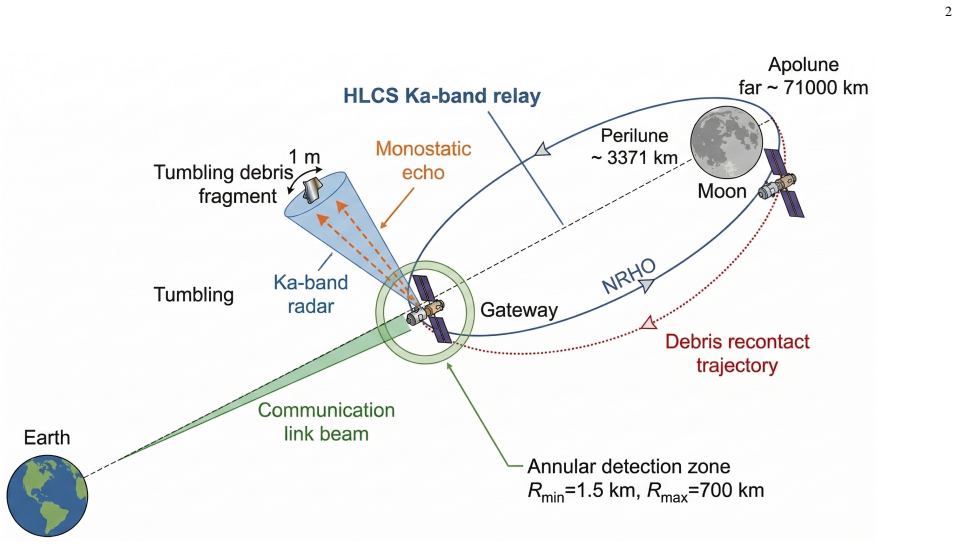
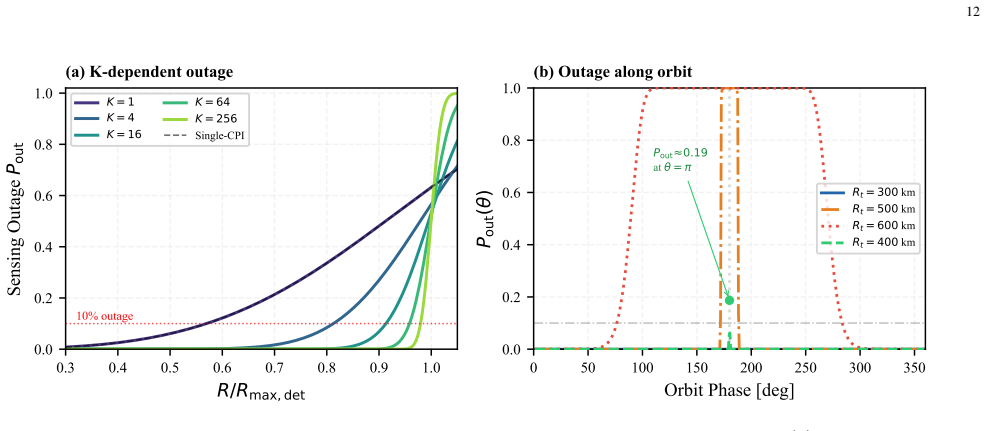
CisLunarSense exploits the Lunar Gateway's Ka-band relay for monostatic debris detection in an opportunistic sensing and communication framework. The authors derive an orbit-phase-dependent Cramér-Rao bound under OFDM interference using a 9:2 halo orbit model. Operational debris is detectable within 700 km with over 30 minutes warning, and external threats within 400-630 km. An adaptive allocation reduces sensing duty cycle to 19% and raises throughput to 90 Mbps, with outage analysis confirming 91% of maximum range at nominal integration.
What carries the argument
The orbit-phase-adaptive allocation scheme that varies the sensing duty cycle according to the Gateway's position in its halo orbit to balance debris detection performance against relay communication throughput.
Load-bearing premise
The results depend on the assumption that the selected sensing settings and the simplified orbital model accurately capture the real-world performance of the Gateway's relay hardware when used for sensing.
What would settle it
A measurement campaign that records the actual detection performance for debris at known distances and velocities during different orbit phases would directly test the claimed ranges and warning times.
Figures




read the original abstract
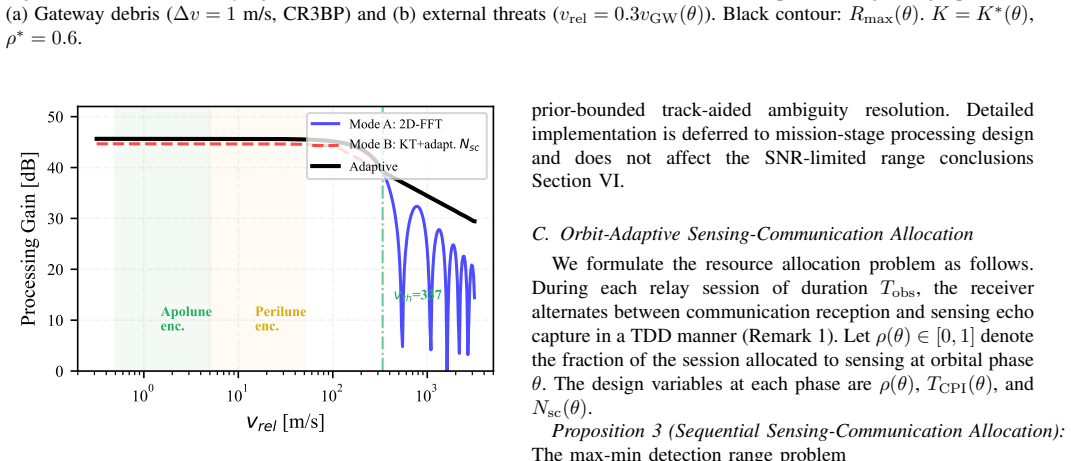
We propose CisLunarSense, an opportunistic integrated sensing and communication (ISAC) framework that exploits the Lunar Gateway's Ka-band relay for monostatic debris detection, addressing the absence of cislunar space situational awareness infrastructure beyond the reach of ground-based radars. Using NASA/ESA-documented system parameters with author-selected sensing settings and a CR3BP-based 9:2 near-rectilinear halo orbit model, we derive the orbit-phase-dependent Cram\'{e}r--Rao bound under OFDM inter-carrier interference, quantify a 36~dB cislunar sensing advantage over a ground-based Ka-band reference, and design a velocity-adaptive processor with mode switching at 337~m/s. Gateway operational debris ($v_\mathrm{rel} < 50$~m/s) is detectable within 700~km with over 30~minutes of warning; external threats ($v_\mathrm{rel}$ up to 500~m/s) remain detectable within 400--630~km. An orbit-phase-adaptive allocation reduces the sensing duty cycle from 60\% to 19\%, increasing relay throughput from 44 to 90~Mbps. A closed-form sensing outage probability for $K$-CPI non-coherent integration under Swerling~I fluctuation shows that the 10\%-outage detection range reaches 91\% of the deterministic maximum at the nominal operating point $K = 16$.
Editorial analysis
A structured set of objections, weighed in public.
Referee Report
Summary. The manuscript proposes CisLunarSense, an opportunistic ISAC framework that repurposes the Lunar Gateway's Ka-band relay for monostatic debris detection in cislunar space. Using NASA/ESA system parameters, author-selected sensing settings, and a CR3BP-based 9:2 near-rectilinear halo orbit (NRHO) model, it derives an orbit-phase-dependent Cramér-Rao bound (CRB) that incorporates OFDM inter-carrier interference (ICI). The work reports a 36 dB sensing advantage over ground-based Ka-band radars, detection ranges of 700 km (with >30 min warning) for operational debris at v_rel < 50 m/s and 400-630 km for external threats up to 500 m/s, a velocity-adaptive processor with mode switch at 337 m/s, and an orbit-phase-adaptive allocation that lowers sensing duty cycle from 60% to 19% (raising relay throughput from 44 to 90 Mbps). A closed-form sensing outage probability under Swerling-I fluctuation for K-CPI non-coherent integration is also provided, showing the 10%-outage range reaches 91% of the deterministic maximum at K=16.
Significance. If the CRB derivation and link-budget assumptions hold under the stated conditions, the work would be significant for cislunar space situational awareness by demonstrating how existing communications infrastructure can provide debris detection and early warning without dedicated sensors. This is particularly relevant for Artemis-era lunar operations. Strengths include the use of documented NASA/ESA parameters, the closed-form outage expression, and the explicit orbit-phase adaptation that ties sensing allocation to NRHO geometry; these elements support reproducibility and could inform future ISAC designs in constrained orbital environments.
major comments (1)
- [§3 (System Model and CRB Derivation), Eq. (12)] §3 (System Model and CRB Derivation), Eq. (12) and surrounding text on orbit-phase-dependent CRB under OFDM ICI: All headline quantitative results (700 km / 30 min warning for v_rel < 50 m/s, 400-630 km for v_rel ≤ 500 m/s, 36 dB advantage, duty-cycle reduction from 60% to 19%, and throughput increase to 90 Mbps) are obtained by thresholding this CRB and then applying the Swerling-I outage formula. The derivation depends on author-selected sensing settings (including K=16) and the specific Doppler-to-ICI mapping plus monostatic link-budget assumptions within the CR3BP 9:2 NRHO geometry; no sensitivity analysis to these choices or independent validation against external benchmarks is provided, which directly scales the reported ranges and adaptive-allocation gains.
minor comments (2)
- [Abstract] Abstract: The phrase 'author-selected sensing settings' is used without enumerating the concrete values (e.g., bandwidth, CPI count, or power allocation); listing the nominal operating point early would help readers assess the claims without immediately consulting the main text.
- [Throughout] Throughout: Notation for relative velocity (v_rel) and the 337 m/s mode-switch threshold is introduced without an explicit cross-reference to the underlying orbital-velocity distribution from the 9:2 NRHO; a short table or figure caption clarifying these thresholds would improve clarity.
Simulated Author's Rebuttal
We thank the referee for the constructive feedback on our manuscript. We address the major comment point by point below, providing clarifications on our parameter choices while agreeing to enhance the manuscript where feasible.
read point-by-point responses
-
Referee: [§3 (System Model and CRB Derivation), Eq. (12)] §3 (System Model and CRB Derivation), Eq. (12) and surrounding text on orbit-phase-dependent CRB under OFDM ICI: All headline quantitative results (700 km / 30 min warning for v_rel < 50 m/s, 400-630 km for v_rel ≤ 500 m/s, 36 dB advantage, duty-cycle reduction from 60% to 19%, and throughput increase to 90 Mbps) are obtained by thresholding this CRB and then applying the Swerling-I outage formula. The derivation depends on author-selected sensing settings (including K=16) and the specific Doppler-to-ICI mapping plus monostatic link-budget assumptions within the CR3BP 9:2 NRHO geometry; no sensitivity analysis to these choices or independent validation against external benchmarks is provided, which directly scales the reported ranges and adaptive-allocation gains.
Authors: We agree that the reported ranges, 36 dB advantage, and adaptive gains are obtained by applying the CRB threshold from Eq. (12) followed by the Swerling-I outage expression. The value K=16 is selected as a nominal operating point that balances sensing integration gain against the Gateway relay's communication duty cycle, consistent with the orbit-phase-adaptive allocation described in the manuscript. The Doppler-to-ICI mapping follows directly from the OFDM waveform parameters and relative velocities under the CR3BP 9:2 NRHO model using documented NASA/ESA Ka-band specifications. The monostatic link budget likewise employs those same published parameters. We acknowledge that the original submission does not contain an explicit sensitivity analysis over variations in K, ICI assumptions, or link-budget margins. In the revised manuscript we will add such an analysis, showing the impact of reasonable perturbations on the headline ranges and throughput gains. Independent validation against external benchmarks is not feasible at present because no published cislunar ISAC debris-detection benchmarks exist; our internal validation relies on the closed-form derivations, the use of documented system parameters, and direct comparison to the ground-based Ka-band reference case already included in the paper. revision: partial
- Independent validation against external benchmarks for cislunar ISAC debris detection, as no such published benchmarks currently exist in the literature.
Circularity Check
No significant circularity in derivation chain
full rationale
The paper derives orbit-phase-dependent CRB from the standard CR3BP 9:2 NRHO geometry plus an OFDM ICI model, using NASA/ESA-documented parameters together with author-selected sensing settings. All headline metrics (700 km / 30 min ranges, 36 dB advantage, 60 % to 19 % duty-cycle reduction, 44 to 90 Mbps throughput) are obtained by thresholding this CRB and applying the resulting phase-dependent policy. This is a conventional first-principles calculation chain; the outputs are mathematically determined by the chosen inputs and models rather than being equivalent to those inputs by construction. No self-definitional loops, fitted parameters renamed as predictions, or load-bearing self-citations appear. The derivation remains self-contained against external orbital and link-budget benchmarks.
Axiom & Free-Parameter Ledger
free parameters (2)
- author-selected sensing settings
- K = 16
axioms (3)
- domain assumption CR3BP-based 9:2 near-rectilinear halo orbit model
- domain assumption Swerling I fluctuation model
- domain assumption OFDM inter-carrier interference model
Reference graph
Works this paper leans on
-
[1]
National cislunar science and technology strategy,
National Science and Technology Council, “National cislunar science and technology strategy,” The White House Office of Science and Technology Policy, Washington, DC, Tech. Rep., Nov. 2022. [Online]. Available: https://bidenwhitehouse.archives.gov/wp-content/ uploads/2022/11/11-2022-NSTC-National-Cislunar-ST-Strategy.pdf
work page 2022
-
[2]
Disposal, deployment, and debris in near rectilinear halo orbits,
D. C. Davis, K. K. Boudad, S. M. Phillips, and K. C. Howell, “Disposal, deployment, and debris in near rectilinear halo orbits,” in29th AAS/AIAA Space Flight Mechanics Meeting, no. AAS 19-466, Ka’anapali, Maui, HI, Jan. 2019, nTRS: 20190000672
work page 2019
-
[3]
Jettison and disposal from near rectilinear halo orbits, part 1: Theory,
S. T. Scheuerle, D. C. Davis, E. M. Zimovan-Spreen, B. P. McCarthy, D. B. Henry, and K. C. Howell, “Jettison and disposal from near rectilinear halo orbits, part 1: Theory,” inAAS/AIAA Astrodynamics Specialist Conference, no. AAS 23-311, Big Sky, MT, Aug. 2023, nTRS: 20230010850
work page 2023
-
[4]
Cross- disciplinary deep space radar needs study,
M. F. Marshall, S. L. Schnee, V . Cruz-Klueber,et al., “Cross- disciplinary deep space radar needs study,” The Aerospace Corporation, Tech. Rep. ATR-2023-01267, July 2023, prepared for NASA Planetary Defense Coordination Office. [Online]. Available: https: //www.nasa.gov/wp-content/uploads/2023/10/atr-2023-01267.pdf
work page 2023
-
[5]
Establishing requirements for lunar and cislunar orbital debris tracking,
B. F. Barakat and M. T. Kezirian, “Establishing requirements for lunar and cislunar orbital debris tracking,”Journal of Space Safety Engineering, vol. 11, no. 3, pp. 446–453, Sept. 2024
work page 2024
-
[6]
Integrated sensing and communications: Toward dual-functional wire- less networks for 6G and beyond,
F. Liu, Y . Cui, C. Masouros, J. Xu, T. X. Han, Y . C. Eldar, and S. Buzzi, “Integrated sensing and communications: Toward dual-functional wire- less networks for 6G and beyond,”IEEE J. Sel. Areas Commun., vol. 40, no. 6, pp. 1728–1767, June 2022
work page 2022
-
[7]
An overview of signal processing techniques for joint communication and radar sensing,
J. A. Zhang, F. Liu, C. Masouros, R. W. Heath, Jr., Z. Feng, L. Zheng, and A. Petropulu, “An overview of signal processing techniques for joint communication and radar sensing,”IEEE J. Sel. Topics Signal Process., vol. 15, no. 6, pp. 1295–1315, Nov. 2021
work page 2021
-
[8]
Full-duplex OFDM radar with LTE and 5G NR waveforms: Challenges, solutions, and measure- ments,
C. Baquero Barneto, T. Riihonen, M. Turunen, L. Anttila, M. Fleischer, K. Stadius, J. Ryyn ¨anen, and M. Valkama, “Full-duplex OFDM radar with LTE and 5G NR waveforms: Challenges, solutions, and measure- ments,”IEEE Trans. Microw. Theory Techn., vol. 67, no. 10, pp. 4042– 4054, Oct. 2019
work page 2019
-
[9]
C. Sturm and W. Wiesbeck, “Waveform design and signal processing aspects for fusion of wireless communications and radar sensing,”Proc. IEEE, vol. 99, no. 7, pp. 1236–1259, July 2011
work page 2011
-
[10]
Radar-communications convergence: Coexistence, cooperation, and co-design,
A. R. Chiriyath, B. Paul, and D. W. Bliss, “Radar-communications convergence: Coexistence, cooperation, and co-design,”IEEE Trans. Cogn. Commun. Netw., vol. 3, no. 1, pp. 1–12, Mar. 2017
work page 2017
-
[11]
Signaling strategies for dual-function radar communications: An overview,
A. Hassanien, M. G. Amin, Y . D. Zhang, and F. Ahmad, “Signaling strategies for dual-function radar communications: An overview,”IEEE Aerosp. Electron. Syst. Mag., vol. 31, no. 10, pp. 36–45, Oct. 2016
work page 2016
-
[12]
Toward millimeter-wave joint radar communications: A signal processing perspective,
K. V . Mishra, M. R. Bhavani Shankar, V . Koivunen, B. Ottersten, and S. A. V orobyov, “Toward millimeter-wave joint radar communications: A signal processing perspective,”IEEE Signal Process. Mag., vol. 36, no. 5, pp. 100–114, Sept. 2019
work page 2019
-
[13]
H. Dong and O. B. Akan, “DebriSense: THz-based integrated sensing and communications (ISAC) for debris detection and classification in the Internet of Space (IoS),”IEEE Trans. Wireless Commun., vol. 24, no. 11, pp. 9282–9295, Nov. 2025
work page 2025
-
[14]
Space debris detection over intersatellite communication signals,
A. Anttonen, M. Kiviranta, and M. H ¨oyhty¨a, “Space debris detection over intersatellite communication signals,”Acta Astronautica, vol. 187, pp. 156–166, Oct. 2021
work page 2021
-
[15]
RSMA-based bistatic ISAC framework for LEO satellite systems,
J. Park, J. Seong, J. Ryu, Y . Mao, and W. Shin, “RSMA-based bistatic ISAC framework for LEO satellite systems,” inProc. IEEE Int. Conf. Commun. Workshops (ICC Workshops), June 2024, pp. 1–6
work page 2024
-
[16]
B. Dellandrea, D. Rovelli, M. Mascarello, C. Nardini, and A. Brocchetto, “HALO lunar communication system: The European module that con- nects the Gateway space station to the Moon,” in9th ESA International Workshop on Tracking, Telemetry and Command Systems for Space Applications, Noordwijk, The Netherlands, Nov. 2022
work page 2022
-
[17]
Gateway – a communications platform for lunar exploration,
S. K. Johnson, D. J. Mortensen, M. A. Chavez, and C. L. Woodland, “Gateway – a communications platform for lunar exploration,” in38th International Communications Satellite Systems Conference (ICSSC), Arlington, V A, Sept. 2021
work page 2021
-
[18]
On the effective- ness of OTFS for joint radar parameter estimation and communication,
L. Gaudio, M. Kobayashi, G. Caire, and G. Colavolpe, “On the effective- ness of OTFS for joint radar parameter estimation and communication,” IEEE Trans. Wireless Commun., vol. 19, no. 9, pp. 5951–5965, Sept. 2020
work page 2020
-
[19]
Optimized waveforms for 5G–6G communication with sensing: Theory, simulations and experiments,
S. D. Liyanaarachchi, T. Riihonen, C. B. Barneto, and M. Valkama, “Optimized waveforms for 5G–6G communication with sensing: Theory, simulations and experiments,”IEEE Trans. Wireless Commun., vol. 20, no. 12, pp. 8301–8315, Dec. 2021
work page 2021
-
[20]
Full-duplex techniques for satellite communications: Feasibility analysis and roadmap,
E. Lagunas, T. Ram ´ırez-Parracho, J. A. V ´asquez-Peralvo, J. L. Gonz´alez Rios, P. Losada-Sanisidro, C. Mosquera, R. L ´opez-Valcarce, P. N. Vummadisetty, and S. Chatzinotas, “Full-duplex techniques for satellite communications: Feasibility analysis and roadmap,”IEEE Open J. Commun. Soc., vol. 6, pp. 2130–2151, Mar. 2025, eSA FDSat Activity 4000140117/22/NL/CLP
work page 2025
-
[21]
A space-qualified, hermetically-sealed, Ka-band LNA with 2.0dB noise figure,
J. J. Sowers, M. Willis, T. Tieu, and W. Findley, “A space-qualified, hermetically-sealed, Ka-band LNA with 2.0dB noise figure,” in2001 IEEE GaAs IC Symposium, 23rd Annual Technical Digest, Baltimore, MD, Oct. 2001
work page 2001
-
[22]
Radar cross section of orbital debris objects,
Y .-L. Xu, T. Kennedy, and E. Stansbery, “Radar cross section of orbital debris objects,” in1st International Orbital Debris Conference, Sugar Land, TX, Dec. 2019, nTRS: 20190033903
work page 2019
-
[23]
Comprehensive radar cross-section “target typing
M. D. Hejduk and D. DePalma, “Comprehensive radar cross-section “target typing” investigation for spacecraft,” in20th AAS/AIAA Space Flight Mechanics Meeting, San Diego, CA, Feb. 2010
work page 2010
-
[24]
M. A. Richards,Fundamentals of Radar Signal Processing, 3rd ed. New York: McGraw-Hill Education, 2022
work page 2022
-
[25]
White paper: Gateway destination orbit model: A continuous 15 year NRHO reference trajectory,
D. E. Lee, “White paper: Gateway destination orbit model: A continuous 15 year NRHO reference trajectory,” NASA Johnson Space Center, Tech. Rep. JSC-E-DAA-TN72594, Aug. 2019, nTRS: 20190030294. [Online]. Available: https://ntrs.nasa.gov/citations/20190030294
-
[26]
OFDM radar algorithms in mobile communication net- works,
K. M. Braun, “OFDM radar algorithms in mobile communication net- works,” Dr.-Ing. Dissertation, Karlsruhe Institute of Technology (KIT), Karlsruhe, Germany, 2014
work page 2014
-
[27]
SAR imaging of moving targets,
R. P. Perry, R. C. DiPietro, and R. L. Fante, “SAR imaging of moving targets,”IEEE Trans. Aerosp. Electron. Syst., vol. 35, no. 1, pp. 188–200, Jan. 1999
work page 1999
-
[28]
Near rectilinear halo orbits and their application in cis-lunar space,
E. M. Zimovan, K. C. Howell, and D. C. Davis, “Near rectilinear halo orbits and their application in cis-lunar space,” in3rd IAA/AAS Conf. Dynamics Control Space Syst. (DyCoSS), no. IAA-AAS-DyCoSS3-125, Moscow, Russia, May 2017
work page 2017
-
[29]
V . G. Szebehely,Theory of Orbits: The Restricted Problem of Three Bodies. New York: Academic Press, 1967
work page 1967
-
[30]
Targeting cislunar near rectilinear halo orbits for human space exploration,
J. Williams, D. E. Lee, R. J. Whitley, K. A. Bokelmann, D. C. Davis, and C. F. Berry, “Targeting cislunar near rectilinear halo orbits for human space exploration,” in27th AAS/AIAA Space Flight Mechanics Meeting, no. AAS 17-267, San Antonio, TX, Feb. 2017, nTRS: 20170001352
work page 2017
discussion (0)
Sign in with ORCID, Apple, or X to comment. Anyone can read and Pith papers without signing in.