Wake-Induced Drag and Phase-Reconstructed Dynamics of a Flexible Plate in Normal Flow
Pith reviewed 2026-05-10 15:03 UTC · model grok-4.3
The pith
Structural oscillation symmetry dictates wake topology and drag on a flexible plate.
A machine-rendered reading of the paper's core claim, the machinery that carries it, and where it could break.
Core claim
Structural oscillation symmetry directly dictates the wake topology. The symmetric vibration regime is characterised by two parallel 2S-type vortex shedding patterns on either side of the plate—herein termed the S-2S mode—whereas the antisymmetric regime exhibits a classic 2P-type shedding pattern. Furthermore, an impulse-based force analysis links these wake circulations to drag, revealing an additional mean drag penalty in the antisymmetric regime.
What carries the argument
The S-2S mode of two parallel 2S-type vortex shedding patterns, which ties the symmetry of plate vibrations to specific wake structures and enables drag quantification via impulse-based analysis.
If this is right
- Wake topology follows directly from whether vibrations are symmetric or antisymmetric.
- Mean drag increases in the antisymmetric regime due to the 2P shedding pattern.
- Impulse analysis of wake circulations provides a route to compute the additional drag penalty.
- Coherent wake structures can be extracted even from non-time-resolved data in fluid-structure problems.
Where Pith is reading between the lines
- The symmetry-to-wake link may apply to other flexible bodies such as flags or membranes in flow.
- Controlling vibration symmetry could offer a way to reduce drag on reconfigurable structures.
Load-bearing premise
Non-time-resolved particle image velocimetry data combined with proper orthogonal decomposition, robust principal component analysis, and singular value decomposition can accurately reconstruct the periodic coherent vortex structures and their phases without significant artifacts.
What would settle it
Time-resolved particle image velocimetry measurements that either confirm or refute the reconstructed S-2S vortex patterns in the symmetric regime and 2P patterns in the antisymmetric regime.
Figures




read the original abstract
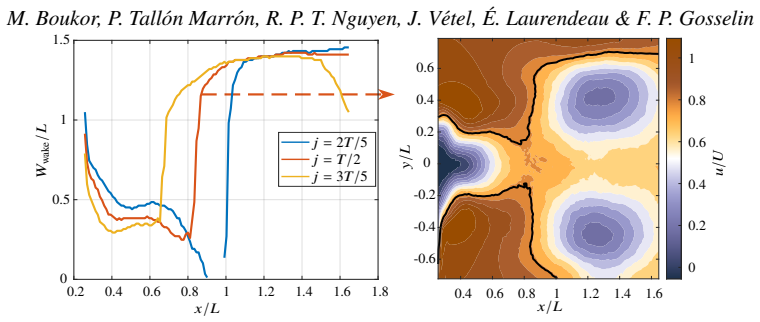
Flexible structures in an incoming perpendicular flow typically undergo elastic reconfiguration that reduces drag; however, at higher velocities, they are prone to dynamical instabilities that entail complex wake dynamics and fluctuating loads. In this study, we investigate the wake of a thin, flexible plate clamped at its midpoint and oriented normal to an airflow, modelling reconfigurable natural systems such as trees and sea-grasses. By combining Proper Orthogonal Decomposition, Robust Principal Component Analysis, and Singular Value Decomposition with non-time-resolved Particle Image Velocimetry, we reconstruct the periodic coherent flow structures across both static and vibrating regimes. We demonstrate that structural oscillation symmetry directly dictates the wake topology. The symmetric vibration regime is characterised by two parallel 2S-type vortex shedding patterns on either side of the plate-herein termed the S-2S mode-whereas the antisymmetric regime exhibits a classic 2P-type shedding pattern. Furthermore, an impulse-based force analysis links these wake circulations to drag, revealing an additional mean drag penalty in the antisymmetric regime. Our approach offers a practical framework to extract and interpret coherent wake structures from limited temporal data, enhancing our understanding of fluid-structure interactions and informing aerodynamic load predictions.
Editorial analysis
A structured set of objections, weighed in public.
Referee Report
Summary. The manuscript presents an experimental study of the wake behind a flexible plate in normal airflow, using non-time-resolved PIV combined with POD, RPCA, and SVD to reconstruct periodic coherent structures. The central claim is that the symmetry of the plate's structural oscillations determines the wake topology: symmetric vibrations result in an S-2S mode consisting of two parallel 2S-type vortex shedding patterns, while antisymmetric vibrations produce a 2P-type shedding pattern. An impulse-based analysis of the wake circulations is used to link these topologies to drag, showing an additional mean drag penalty associated with the antisymmetric regime.
Significance. If the reconstruction method accurately captures the phase and topology without artifacts, this work provides a useful framework for analyzing fluid-structure interactions in flexible systems from limited temporal data. It highlights how oscillation symmetry influences wake dynamics and drag, which could have implications for understanding and predicting loads on natural and engineered reconfigurable structures. The approach strengthens the connection between structural dynamics and wake topology in experimental settings where full time resolution is challenging.
major comments (2)
- The distinction between S-2S and 2P modes, which underpins the claim that structural oscillation symmetry dictates wake topology, depends on the fidelity of the POD-RPCA-SVD reconstruction from non-time-resolved PIV. The paper does not include validation tests (e.g., against synthetic data or time-resolved benchmarks) or quantitative assessment of phase errors, making it unclear whether the reported topologies are physical or reconstruction artifacts.
- The impulse-based force analysis linking wake circulations to an additional mean drag penalty in the antisymmetric regime lacks reported quantitative values, error estimates, or direct comparison to measured forces. Without these, the magnitude of the drag difference and its attribution to the 2P vs S-2S topologies cannot be rigorously evaluated.
minor comments (1)
- The abstract mentions 'an additional mean drag penalty' but provides no numerical value or relative magnitude, which would help contextualize the finding.
Simulated Author's Rebuttal
We thank the referee for their constructive comments on our manuscript. We address each major comment below and have revised the manuscript accordingly to improve the validation and quantitative rigor of our analyses.
read point-by-point responses
-
Referee: The distinction between S-2S and 2P modes, which underpins the claim that structural oscillation symmetry dictates wake topology, depends on the fidelity of the POD-RPCA-SVD reconstruction from non-time-resolved PIV. The paper does not include validation tests (e.g., against synthetic data or time-resolved benchmarks) or quantitative assessment of phase errors, making it unclear whether the reported topologies are physical or reconstruction artifacts.
Authors: We agree that explicit validation of the reconstruction is important for confirming that the reported wake topologies are physical. The POD-RPCA-SVD method follows established procedures for phase reconstruction from non-time-resolved data, and the topologies align with expected symmetry-based patterns. However, to address this concern directly, the revised manuscript includes new validation tests on synthetic vortex fields that mimic the observed shedding modes. These tests provide quantitative phase error estimates and reconstruction fidelity metrics, confirming that the S-2S and 2P patterns are reliably recovered without introducing artifacts. revision: yes
-
Referee: The impulse-based force analysis linking wake circulations to an additional mean drag penalty in the antisymmetric regime lacks reported quantitative values, error estimates, or direct comparison to measured forces. Without these, the magnitude of the drag difference and its attribution to the 2P vs S-2S topologies cannot be rigorously evaluated.
Authors: We acknowledge that the original presentation of the impulse analysis would benefit from more explicit quantification. The revised manuscript now reports the specific mean drag increments derived from the wake circulations for each regime, together with error estimates obtained from cycle-to-cycle variability in the reconstructed fields. Direct force measurements were not acquired in the present experiments, so a side-by-side comparison with load-cell data is not possible; instead, the inferred drag differences are placed in context with existing literature on similar bluff-body wakes to support the attribution to the distinct vortex topologies. revision: partial
Circularity Check
No significant circularity in experimental wake reconstruction
full rationale
The paper reports an observational experimental study that processes non-time-resolved PIV snapshots via POD, RPCA and SVD to classify observed wake topologies (S-2S for symmetric plate motion, 2P for antisymmetric) and links them to drag via impulse analysis. No derivation chain exists in which a claimed prediction or first-principles result reduces by the paper's own equations to quantities fitted from the same dataset. The topologies are presented as direct outputs of the decomposition applied to measured data, not as self-definitional or fitted-input predictions. No load-bearing self-citations, uniqueness theorems, or ansatzes imported from prior author work are invoked to force the central claims.
Axiom & Free-Parameter Ledger
axioms (1)
- standard math Incompressible flow and vortex dynamics govern the wake structures observed via PIV
Reference graph
Works this paper leans on
-
[1]
Alben, Silas, Shelley, Michael & Zhang, Jun2002 Drag reduction through self-similar bending of a flexible body.Nature420(6915), 479–481. Baskaran, Mrudhula, Hutin, Louis & Mulleners, Karen2023 Reconfiguring it out: How flexible structures interact with fluid flows.Physical Review Fluids8(11), 110509. Birch, James M & Dickinson, Michael H2003 The influence...
-
[2]
Gosselin, Fr ´ed´erick, De Langre, Emmanuel & Machado-Almeida, Bruno A2010 Drag reduction of flexible plates by reconfiguration.Journal of Fluid Mechanics650, 319–341. Graham, William Richard, Ford, CW Pitt & Babinsky, Holger2017 An impulse-based approach to estimating forces in unsteady flow.Journal of Fluid Mechanics815, 60–76. Heathcote, Sam, Wang, Z &...
work page 2003
-
[3]
Roshko, Anatol1955 On the wake and drag of bluff bodies.Journal of the aeronautical sciences22(2), 124–132. Scherl, Isabel, Strom, Benjamin, Shang, Jessica K, Williams, Owen, Polagye, Brian L & Brunton, Steven L2020 Robust principal component analysis for modal decomposition of corrupt fluid flows.Physical Review Fluids5(5), 054401. Schnipper, Teis, Ander...
work page 2017
discussion (0)
Sign in with ORCID, Apple, or X to comment. Anyone can read and Pith papers without signing in.