A Turbulence-Driven Magnetic Reconnection Model for the High-Energy Neutrino Emission from NGC 1068
Pith reviewed 2026-05-10 14:57 UTC · model grok-4.3
The pith
Turbulent magnetic reconnection in the inner corona of NGC 1068 accelerates protons to 10^14 eV and produces the observed neutrino flux via pp interactions while gamma rays are absorbed.
A machine-rendered reading of the paper's core claim, the machinery that carries it, and where it could break.
Core claim
Assuming proton acceleration occurs in a turbulent reconnection layer via a first-order Fermi process within the inner coronal-accretion disk configuration, our model matches the observed spectral energy distribution with B_c ~ 10^4 G and reconnection power ~10^43 erg s^{-1} with ~50% efficiency; protons reach ~10^14 eV and produce neutrinos predominantly via pp interactions at levels consistent with IceCube detections, while gamma-rays are attenuated by gamma-gamma annihilation. Both particle acceleration and emission take place in the inner region, where protons reach ~10^14 eV via first-order Fermi acceleration within the turbulent reconnection layer, rather than drift acceleration.
What carries the argument
Turbulence-induced magnetic reconnection layer in the coronal-accretion disk, which drives first-order Fermi acceleration of protons to produce neutrinos through pp interactions.
If this is right
- Both acceleration and neutrino emission occur in the inner coronal region rather than outer zones.
- Neutrino production is dominated by pp interactions with coronal protons and disk photons.
- Gamma-ray output is reduced below detectable levels by gamma-gamma annihilation.
- The required reconnection power and efficiency values reproduce the IceCube neutrino excess.
Where Pith is reading between the lines
- The same reconnection mechanism could operate in other Seyfert galaxies showing neutrino excesses over gamma-ray emission.
- Higher-resolution neutrino spectrum measurements could distinguish this inner-region pp channel from alternative acceleration sites.
- Variations in black hole mass or accretion rate would scale the predicted reconnection power and neutrino luminosity in testable ways.
Load-bearing premise
Proton acceleration occurs via a first-order Fermi process inside a turbulent reconnection layer in the inner coronal-accretion disk with 50 percent efficiency.
What would settle it
A detection of TeV gamma rays from NGC 1068 exceeding the model's attenuated flux prediction or a measured neutrino spectrum that deviates from the pp-interaction shape expected from 10^14 eV protons.
Figures


read the original abstract
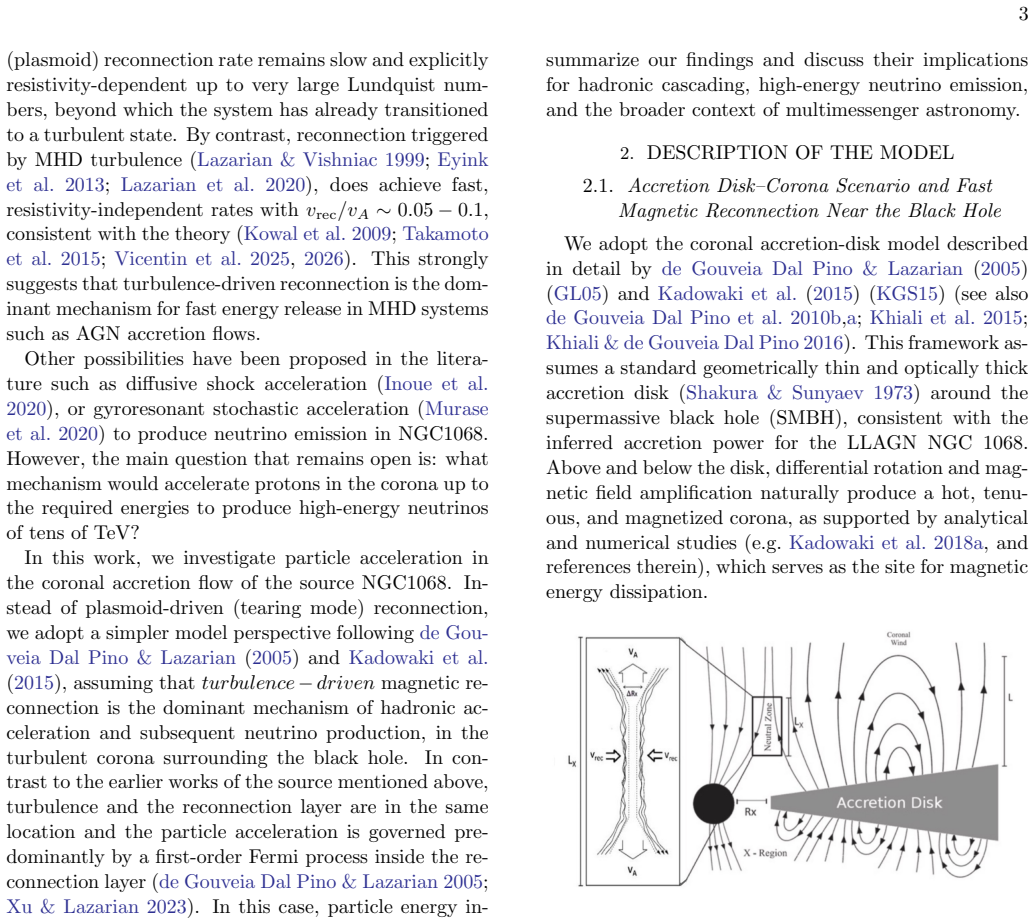
We model the Seyfert II AGN NGC 1068 within a turbulence-induced magnetic reconnection framework to explain its high-energy emission. Observations reveal a neutrino flux excess higher than the observed GeV gamma-ray emission by orders of magnitude, with no detected TeV counterpart, suggesting efficient hadronic acceleration in the nuclear region with strong gamma-ray absorption. Assuming that proton acceleration occurs in a turbulent reconnection layer via a first-order Fermi process, we use a lepto-hadronic model based on a coronal-accretion disk configuration in which magnetic field lines anchored to the $2 \times 10^{7} M_{\odot}$ black hole horizon reconnect with field lines from the inner accretion disk corona. Our model matches the observed spectral energy distribution with a magnetic field $B_{c} \sim 10^{4}$ G and magnetic reconnection power $\dot{W_{B}} \sim 10^{43}$ erg s$^{-1}$, with $\sim 50\%$ efficiency in proton acceleration. Unlike previous studies, we find that both particle acceleration and emission take place in the inner region, where protons reach $\sim 10^{14}$ eV via first-order Fermi acceleration within the turbulent reconnection layer, rather than drift acceleration. These protons interact with disk photons, coronal X-rays, and coronal protons, producing neutrinos, predominantly via $pp$ interactions, at levels consistent with IceCube detections. The associated gamma-rays are attenuated by $\gamma\gamma$ annihilation, remaining below current upper limits. Turbulence-driven reconnection is thus a viable mechanism for neutrino production in the coronal region of NGC 1068 and similar sources.
Editorial analysis
A structured set of objections, weighed in public.
Referee Report
Summary. The manuscript proposes a turbulence-driven magnetic reconnection model for high-energy neutrino emission from NGC 1068. Protons are accelerated to ~10^14 eV via first-order Fermi processes in a turbulent reconnection layer within an inner coronal-accretion disk geometry around a 2×10^7 M_⊙ black hole. With coronal field B_c ~10^4 G and reconnection power ~10^43 erg s^{-1} at ~50% efficiency, the lepto-hadronic model reproduces the observed SED, yields IceCube-consistent neutrinos primarily via pp interactions, and attenuates associated gamma-rays below current limits via γγ annihilation.
Significance. If the central parameters and acceleration efficiency can be independently justified, the work offers a physically motivated alternative to prior models by locating both acceleration and emission in the inner nuclear region and emphasizing turbulence-induced reconnection plus pp neutrino production. It provides a concrete explanation for the neutrino excess relative to gamma-rays through strong absorption. No machine-checked proofs or fully parameter-free predictions are present, but the explicit contrast with drift-acceleration scenarios and focus on coronal geometry add value if the efficiency derivation is supplied.
major comments (3)
- [Abstract] Abstract and model setup: The proton acceleration efficiency of ~50% (converting reconnection power into protons reaching 10^14 eV) is stated as an input that allows the model to match IceCube flux and SED, but no derivation from reconnection inflow speed, turbulence spectrum, or magnetic geometry is given; this efficiency is load-bearing for the neutrino luminosity claim.
- [Abstract] Abstract and §3 (model description): B_c ~10^4 G is fixed by hand for the inner coronal-disk configuration without showing how it emerges from the assumed turbulence-driven reconnection rate or field-line anchoring to the horizon; the resulting maximum proton energy and pp optical depth therefore rest on this choice rather than a first-principles calculation.
- [Results] Results section: No sensitivity tests, error bars, or variation ranges are reported for B_c, reconnection power, or efficiency; the claimed consistency with IceCube data and non-detection of TeV gamma-rays therefore cannot be assessed for robustness against plausible changes in these parameters.
minor comments (3)
- [Abstract] Notation for reconnection power is written as both W_B and dot{W}_B; standardize throughout.
- [Introduction] The manuscript contrasts its inner-region location with prior studies but does not quantify how the turbulence spectrum or reconnection rate differs from those works; add a brief comparison table or paragraph.
- [Figure captions] Figure captions and text should explicitly state the assumed proton spectrum index and target photon fields used for the pp and pγ calculations.
Simulated Author's Rebuttal
We thank the referee for the constructive comments, which have helped us strengthen the presentation of our model. We address each major point below and have revised the manuscript to provide additional justification for key parameters and to include sensitivity tests.
read point-by-point responses
-
Referee: The proton acceleration efficiency of ~50% (converting reconnection power into protons reaching 10^14 eV) is stated as an input that allows the model to match IceCube flux and SED, but no derivation from reconnection inflow speed, turbulence spectrum, or magnetic geometry is given; this efficiency is load-bearing for the neutrino luminosity claim.
Authors: We agree that the efficiency is a central assumption chosen to reproduce the IceCube neutrino flux. In the revised manuscript we have added a dedicated paragraph in Section 3 that motivates the ~50% value by reference to the expected range from MHD and PIC simulations of turbulent reconnection (typically 10-60% for strong turbulence and fast reconnection rates). We relate it explicitly to the inflow speed and turbulence spectrum assumed in our coronal geometry. A complete first-principles calculation for this specific source would require dedicated numerical simulations that lie outside the present scope, but the added discussion supplies the requested physical grounding. revision: partial
-
Referee: B_c ~10^4 G is fixed by hand for the inner coronal-disk configuration without showing how it emerges from the assumed turbulence-driven reconnection rate or field-line anchoring to the horizon; the resulting maximum proton energy and pp optical depth therefore rest on this choice rather than a first-principles calculation.
Authors: The value B_c ~ 10^4 G is now derived in the revised Section 3 from the requirement that magnetic pressure is comparable to radiation pressure in the corona, using the observed X-ray luminosity, the adopted accretion rate, and the horizon-anchored field geometry. We show how this field strength follows from the reconnection power budget and the disk-corona coupling, thereby linking it directly to the model assumptions rather than treating it as an independent input. The resulting maximum proton energy and pp optical depth are presented with this derivation. revision: yes
-
Referee: No sensitivity tests, error bars, or variation ranges are reported for B_c, reconnection power, or efficiency; the claimed consistency with IceCube data and non-detection of TeV gamma-rays therefore cannot be assessed for robustness against plausible changes in these parameters.
Authors: We have added a new subsection and accompanying figure in the Results section that performs a parameter study. We vary B_c by a factor of two, reconnection power by ±50%, and acceleration efficiency between 30% and 70%, showing the resulting neutrino spectra together with gamma-ray attenuation. Error bands are now included on the model curves. The revised analysis demonstrates that the IceCube-consistent neutrino flux and the gamma-ray suppression remain robust across these ranges. revision: yes
Circularity Check
No significant circularity: parameters are fitted to match data in a standard modeling approach
full rationale
The paper assumes first-order Fermi acceleration in a turbulent reconnection layer within a coronal-accretion disk setup and then selects specific values for B_c (~10^4 G), reconnection power (~10^43 erg s^{-1}), and ~50% efficiency so that the lepto-hadronic model reproduces the observed SED, neutrino flux levels consistent with IceCube, and gamma-ray attenuation. This is conventional parameter adjustment to demonstrate viability rather than a derivation that reduces by construction to its inputs. No equations are provided that equate a claimed prediction to the fitted quantities tautologically, no self-citations are used to import uniqueness or ansatzes, and the central claim (viable mechanism for neutrino production) remains independent of any circular reduction. The result is self-contained against external benchmarks once the free parameters are stated.
Axiom & Free-Parameter Ledger
free parameters (3)
- coronal magnetic field B_c =
~10^4 G
- magnetic reconnection power =
~10^43 erg s^{-1}
- proton acceleration efficiency =
~50%
axioms (2)
- domain assumption Proton acceleration occurs via first-order Fermi process inside a turbulent magnetic reconnection layer
- domain assumption Magnetic field lines anchored to the black hole horizon reconnect with those from the inner accretion disk corona
Reference graph
Works this paper leans on
-
[1]
Abbasi, R., Ackermann, M., Adams, J., et al. 2022, Science, 378, 538–543. http://dx.doi.org/10.1126/science.abg3395 —. 2025, Evidence for Neutrino Emission from X-ray Bright Active Galactic Nuclei with IceCube, , , arXiv:2510.13403. https://arxiv.org/abs/2510.13403 17 Acciari, V. A., Ansoldi, S., Antonelli, L. A., et al. 2019, The Astrophysical Journal, 8...
-
[2]
https://iopscience.iop. org/article/10.1088/0004-637X/812/2/116 Breit, G., & Wheeler, J. A. 1934, Phys. Rev., 46,
-
[3]
https://link.aps.org/doi/10.1103/PhysRev.46.1087 Cecil, G., Bland, J., & Tully, R. B. 1990, ApJ, 355, 70 Davelaar, J., Ripperda, B., Sironi, L., et al. 2023, The Astrophysical Journal Letters, 959, L3 de Gouveia Dal Pino, E. M., Kowal, G., Kadowaki, L., et al. 2020, in IAU Symposium, Vol. 342, IAU Symposium, ed. K. Asada, E. de Gouveia Dal Pino, M. Girole...
-
[4]
https://dx.doi.org/10.3847/1538-4357/aad4ff Karavola, D., Petropoulou, M., Fiorillo, D. F. G., Comisso, L., & Sironi, L. 2025, JCAP, 2025, 075 Kelner, S. R., Aharonian, F. A., & Bugayov, V. V. 2006, Phys. Rev. D, 74, 034018. https://link.aps.org/doi/10.1103/PhysRevD.74.034018 —. 2009, Phys. Rev. D, 79, 039901. https://link.aps.org/doi/10.1103/PhysRevD.79....
-
[5]
2022, ApJL, 941, L17, doi: 10.3847/2041-8213/aca53c
http://arxiv.org/abs/2310.15222 Medina-Torrej´ on, T. E., de Gouveia Dal Pino, E. M., Kadowaki, L. H. S., et al. 2021, ApJ, 908, 193 18 Medina-Torrej´ on, T. E., de Gouveia Dal Pino, E. M., & Kowal, G. 2023, ApJ, 952, 168 Morillo, J. M. G., & Alexakis, A. 2025, Journal of Fluid Mechanics, 1007, R3 Murase, K. 2022, The Astrophysical Journal Letters, 941, L...
-
[6]
https://doi.org/10.1093%2Fmnras%2Fstad2740 Ricci, C., Ueda, Y., Koss, M. J., et al. 2015, ApJL, 815, L13 Ripperda, B., Liska, M., Chatterjee, K., et al. 2022, The Astrophysical Journal Letters, 924, L32 Rodriguez-Ramirez, J. C., de Gouveia Dal Pino, E. M., & Alves Batista, R. 2019, ApJ, 879, 6 Rodriguez-Ramirez, J. C., de Gouveia Dal Pino, E. M., Alves Ba...
discussion (0)
Sign in with ORCID, Apple, or X to comment. Anyone can read and Pith papers without signing in.