On the Use of Bi-Objective Evolutionary Algorithms for the Stochastic MKP under Dynamic Constraints
Pith reviewed 2026-05-10 16:11 UTC · model grok-4.3
The pith
Four multi-objective evolutionary algorithms exhibit distinct behaviors on a stochastic multiple knapsack problem with dynamic capacity changes.
A machine-rendered reading of the paper's core claim, the machinery that carries it, and where it could break.
Core claim
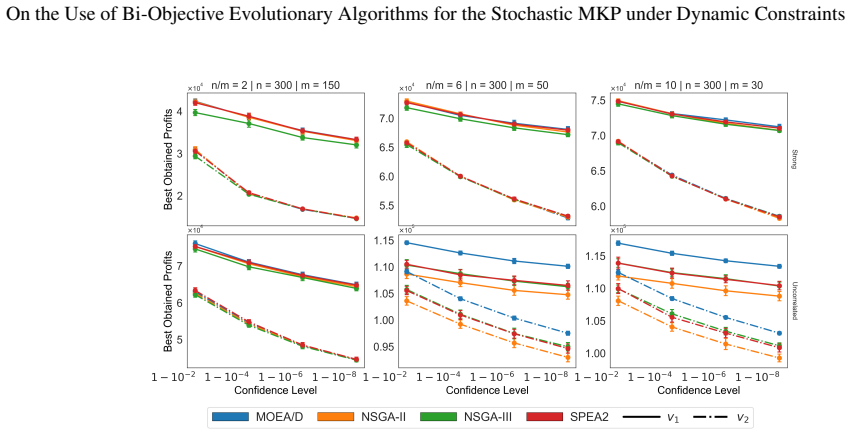
The authors formulate the stochastic MKP under dynamic constraints as a bi-objective optimization task that maximizes profit and the probability of satisfying capacity constraints at a given level. They then apply four representative MOEAs from the decomposition and dominance paradigms and evaluate them under controlled variations in uncertainty, thresholds, and capacity shifts to obtain comparative insights into the algorithms' relative behaviors.
What carries the argument
The bi-objective chance-constraint formulation that treats probabilistic capacity satisfaction as an explicit second objective alongside profit, allowing standard MOEAs to search the resulting trade-off surface under dynamic changes.
If this is right
- The relative effectiveness of decomposition-based and dominance-based MOEAs shifts with the degree of uncertainty in item weights.
- Capacity changes during optimization affect the quality of solutions found by each algorithm class differently.
- Raising the required confidence level changes the shape of the trade-off surfaces produced by the MOEAs.
- The bi-objective model enables explicit control over the profit-reliability balance in the presence of dynamics.
Where Pith is reading between the lines
- Similar bi-objective reformulations could be tested on other stochastic combinatorial problems such as scheduling or vehicle routing with time-varying resources.
- The observed patterns may suggest when to switch between algorithm styles as uncertainty or change frequency increases in a live system.
- Incorporating online estimation of capacity change patterns could further improve adaptation beyond the static test settings used here.
Load-bearing premise
The four chosen MOEAs together with the specific bi-objective chance-constraint model are representative enough to produce generalizable patterns about how decomposition-based versus dominance-based methods behave on stochastic dynamic knapsack problems.
What would settle it
Repeating the experiments with a wider collection of MOEAs from each paradigm or on substantially different problem instances and finding that the observed behavioral differences disappear or reverse would undermine the comparative insights.
Figures


read the original abstract
The multiple knapsack problem (MKP) generalizes the classical knapsack problem by assigning items to multiple knapsacks subject to capacity constraints. It is used to model many real-world resource allocation and scheduling problems. In practice, these optimization problems often involve stochastic and dynamic components. Evolutionary algorithms provide a flexible framework for addressing such problems under uncertainty and dynamic changes. In this paper, we investigate a stochastic and dynamic variant of MKP with chance constraints, where the item weights are modeled as independent normally distributed random variables and knapsack capacities change during the optimization process. We formulate the problem as a bi-objective optimization formulation that balances profit maximization and probabilistic capacity satisfaction at a given confidence level. We conduct an empirical comparison of four widely used multi-objective evolutionary algorithms (MOEAs), representing both decomposition- and dominance-based search paradigms. The algorithms are evaluated under varying uncertainty levels, confidence thresholds, and dynamic change settings. The results provide comparative insights into the behavior of decomposition-based and dominance-based MOEAs for stochastic MKP under dynamic constraints.
Editorial analysis
A structured set of objections, weighed in public.
Referee Report
Summary. The paper investigates a stochastic and dynamic variant of the Multiple Knapsack Problem (MKP) with chance constraints, modeling item weights as independent normally distributed random variables and allowing knapsack capacities to change during optimization. It formulates the problem as a bi-objective optimization task balancing profit maximization against probabilistic capacity satisfaction at a specified confidence level. An empirical comparison is conducted using four widely used multi-objective evolutionary algorithms (MOEAs) representing decomposition-based and dominance-based paradigms, evaluated across varying uncertainty levels, confidence thresholds, and dynamic change settings. The results are presented as providing comparative insights into algorithm behavior on this problem class.
Significance. If the empirical findings hold under rigorous validation, the work contributes practical insights into MOEA performance on stochastic resource allocation problems with dynamic elements, which are common in scheduling and logistics. The bi-objective chance-constraint formulation offers a transparent way to handle uncertainty without assuming specific distributions beyond normality. Strengths include the controlled experimental variations in uncertainty and dynamics. However, significance is tempered by the need for the selected algorithms and formulation to be representative enough for broader generalizations about decomposition vs. dominance paradigms.
major comments (2)
- Abstract: The central claim that the results 'provide comparative insights into the behavior of decomposition-based and dominance-based MOEAs' is load-bearing on the representativeness of the four chosen algorithms and the specific profit-vs-probabilistic-satisfaction bi-objective model. The abstract provides no justification for the algorithm selection or discussion of sensitivity to alternative MOEAs, chance-constraint encodings, or dynamic mechanisms; if performance patterns are instance- or algorithm-specific, the insights do not generalize to the broader problem class as claimed.
- Experimental design (results section): The abstract describes controlled variations in uncertainty, confidence level, and dynamics, but the soundness assessment requires verification of multiple independent runs, statistical tests for significance of differences, and appropriate baseline comparisons. Absence of these (or inadequate reporting) would undermine the reliability of any observed differences between decomposition- and dominance-based approaches.
minor comments (1)
- Abstract: The abstract is concise but would benefit from naming the specific four MOEAs (e.g., NSGA-II, MOEA/D) to allow immediate context for readers familiar with the field.
Simulated Author's Rebuttal
We thank the referee for the constructive feedback. We address each major comment below with clarifications from the manuscript and indicate planned revisions.
read point-by-point responses
-
Referee: Abstract: The central claim that the results 'provide comparative insights into the behavior of decomposition-based and dominance-based MOEAs' is load-bearing on the representativeness of the four chosen algorithms and the specific profit-vs-probabilistic-satisfaction bi-objective model. The abstract provides no justification for the algorithm selection or discussion of sensitivity to alternative MOEAs, chance-constraint encodings, or dynamic mechanisms; if performance patterns are instance- or algorithm-specific, the insights do not generalize to the broader problem class as claimed.
Authors: The manuscript selects four standard MOEAs (NSGA-II and SPEA2 as dominance-based; MOEA/D and IBEA as decomposition-based) explicitly because they are widely used representatives of each paradigm, as stated in Section 3.2. The bi-objective chance-constraint model is derived in Section 2 from the stochastic MKP formulation with normal weight distributions and dynamic capacities. The abstract is space-constrained and focuses on the core contribution; the full text provides the rationale and does not claim universal generalization beyond the studied settings. We will revise the abstract to include a concise note on algorithm representativeness. revision: partial
-
Referee: Experimental design (results section): The abstract describes controlled variations in uncertainty, confidence level, and dynamics, but the soundness assessment requires verification of multiple independent runs, statistical tests for significance of differences, and appropriate baseline comparisons. Absence of these (or inadequate reporting) would undermine the reliability of any observed differences between decomposition- and dominance-based approaches.
Authors: Section 4.1 of the manuscript specifies 30 independent runs per algorithm-instance pair to account for stochasticity in both the MOEAs and the chance-constraint evaluations. Performance is assessed via hypervolume and inverted generational distance, with pairwise differences tested for statistical significance using the Wilcoxon rank-sum test followed by Holm-Bonferroni correction; these results appear in Tables 2-5 and the accompanying text. The four algorithms serve as mutual baselines within the controlled experimental design that varies uncertainty level, confidence threshold, and change frequency. We will add an explicit summary paragraph in the revised experimental design subsection to improve visibility of these elements. revision: yes
Circularity Check
No circularity: empirical comparison with no derivation chain
full rationale
The paper is an empirical study that formulates the stochastic dynamic MKP as a bi-objective chance-constrained problem and compares four standard MOEAs (decomposition- and dominance-based) under varying uncertainty, confidence, and dynamic settings. No first-principles derivations, predictions, fitted parameters renamed as outputs, or self-citation load-bearing steps are present in the abstract or described methodology. All claims rest on experimental results rather than any closed-loop reduction of outputs to inputs by construction. This is the expected outcome for a pure benchmarking paper.
Axiom & Free-Parameter Ledger
Reference graph
Works this paper leans on
-
[1]
Hirad Assimi, Oscar Harper, Yue Xie, Aneta Neumann, and Frank Neumann. Evolutionary bi-objective opti- mization for the dynamic chance-constrained knapsack problem based on tail bound objectives. InEuropean Conference on Artificial Intelligence, ECAI 2020, volume 325, pages 307–314. IOS Press, 2020
work page 2020
-
[2]
The role of representations in dynamic knapsack problems
Jürgen Branke, Merve Orbayı, and ¸ Sima Uyar. The role of representations in dynamic knapsack problems. In Applications of Evolutionary Computing, pages 764–775. Springer Berlin Heidelberg, 2006. ISBN 978-3-540- 33238-1
work page 2006
-
[3]
Knapsack problems — an overview of recent advances
Valentina Cacchiani, Manuel Iori, Alberto Locatelli, and Silvano Martello. Knapsack problems — an overview of recent advances. part II: multiple, multidimensional, and quadratic knapsack problems.Computers & Operations Research, 143:105693, 2022. ISSN 0305-0548
work page 2022
-
[4]
Chance-constrained programming.Management science, 6(1):73–79, 1959
Abraham Charnes and William W Cooper. Chance-constrained programming.Management science, 6(1):73–79, 1959
work page 1959
-
[5]
Chandra Chekuri and Sanjeev Khanna. A polynomial time approximation scheme for the multiple knapsack problem.SIAM Journal on Computing, 35(3):713–728, 2005
work page 2005
-
[6]
Yoon Choi, Jingeun Kim, and Yourim Yoon. A comparison of binary and integer encodings in genetic algorithms for the maximum k-coverage problem with various genetic operators.Biomimetics, 10(5), 2025. ISSN 2313-7673
work page 2025
-
[7]
Carlos A. Coello Coello, Gary B. Lamont, and David A. Van Veldhuizen.Evolutionary algorithms for solving multi-objective problems. Springer, second edition, 2007
work page 2007
-
[8]
Gregory W. Corder and Dale I. Foreman.Nonparametric statistics for non-statisticians: A step-by-step approach. John Wiley & Sons, 2014
work page 2014
-
[9]
Dogan Corus, Pietro S. Oliveto, and Donya Yazdani. Automatic adaptation of hypermutation rates for multimodal optimisation. InProceedings of the 16th ACM/SIGEVO Conference on Foundations of Genetic Algorithms, FOGA
- [10]
-
[11]
K. Deb, A. Pratap, S. Agarwal, and T. Meyarivan. A fast and elitist multiobjective genetic algorithm: NSGA-II. IEEE Transactions on Evolutionary Computation, 6(2):182–197, 2002
work page 2002
-
[12]
Kalyanmoy Deb and Himanshu Jain. An evolutionary many-objective optimization algorithm using reference- point-based nondominated sorting approach, part I: Solving problems with box constraints.IEEE Transactions on Evolutionary Computation, 18(4):577–601, 2014. 11 On the Use of Bi-Objective Evolutionary Algorithms for the Stochastic MKP under Dynamic Constraints
work page 2014
-
[13]
Kalyanmoy Deb, Udaya Bhaskara Rao N., and S. Karthik. Dynamic multi-objective optimization and decision- making using modified NSGA-II: A case study on hydro-thermal power scheduling. InEvolutionary Multi- Criterion Optimization, pages 803–817. Springer Berlin Heidelberg, 2007. ISBN 978-3-540-70928-2
work page 2007
-
[14]
Mauro Dell’Amico, Maxence Delorme, Manuel Iori, and Silvano Martello. Mathematical models and decomposi- tion methods for the multiple knapsack problem.European Journal of Operational Research, 274(3):886–899,
-
[15]
Paolo Detti. A new upper bound for the multiple knapsack problem.Computers & Operations Research, 129: 105210, 2021
work page 2021
-
[16]
The chance constrained travelling thief problem: Problem formulations and algorithms
Thilina Pathirage Don, Aneta Neumann, and Frank Neumann. The chance constrained travelling thief problem: Problem formulations and algorithms. InProceedings of the Genetic and Evolutionary Computation Conference, GECCO 2024, page 214–222. ACM, 2024
work page 2024
-
[17]
Weighted-scenario optimisation for the chance constrained travelling thief problem
Thilina Pathirage Don, Aneta Neumann, and Frank Neumann. Weighted-scenario optimisation for the chance constrained travelling thief problem. InIEEE Congress on Evolutionary Computation, CEC 2025, pages 1–8. IEEE, 2025
work page 2025
-
[18]
Marcello Farina, Luca Giulioni, and Riccardo Scattolini. Stochastic linear model predictive control with chance constraints – a review.Journal of Process Control, 44:53–67, 2016. ISSN 0959-1524
work page 2016
-
[19]
Alex S Fukunaga. A branch-and-bound algorithm for hard multiple knapsack problems.Annals of Operations Research, 184(1):97–119, 2011
work page 2011
-
[20]
Alex S. Fukunaga and Satoshi Tazoe. Combining multiple representations in a genetic algorithm for the multiple knapsack problem. InIEEE Congress on Evolutionary Computation, CEC 2009, page 2423–2430. IEEE, 2009. ISBN 9781424429585
work page 2009
-
[21]
Gurobi optimizer reference manual, 2024
LLC Gurobi Optimization. Gurobi optimizer reference manual, 2024. URLhttps://www.gurobi.com
work page 2024
-
[22]
Effective 2- and 3-objective MOEA/D approaches for the chance constrained knapsack problem
Ishara Hewa Pathiranage, Frank Neumann, Denis Antipov, and Aneta Neumann. Effective 2- and 3-objective MOEA/D approaches for the chance constrained knapsack problem. InProceedings of the Genetic and Evolution- ary Computation Conference, GECCO 2024, page 187–195. ACM, 2024. ISBN 9798400704949
work page 2024
-
[23]
Using 3-objective evolutionary algorithms for the dynamic chance constrained knapsack problem
Ishara Hewa Pathiranage, Frank Neumann, Denis Antipov, and Aneta Neumann. Using 3-objective evolutionary algorithms for the dynamic chance constrained knapsack problem. InProceedings of the Genetic and Evolutionary Computation Conference, GECCO 2024, page 520–528. ACM, 2024
work page 2024
-
[24]
Randal Hickman and Todd Easton. Merging valid inequalities over the multiple knapsack polyhedron.International Journal of Operational Research, 24:214, 2015
work page 2015
-
[25]
Evolutionary dynamic multi-objective optimisation: a survey.ACM Computing Surveys, 55(4):1–47, 2022
Shouyong Jiang, Juan Zou, Shengxiang Yang, and Xin Yao. Evolutionary dynamic multi-objective optimisation: a survey.ACM Computing Surveys, 55(4):1–47, 2022
work page 2022
-
[26]
Seiji Kataoka and Takeo Yamada. Upper and lower bounding procedures for the multiple knapsack assignment problem.European Journal of Operational Research, 237(2):440–447, 2014. ISSN 0377-2217
work page 2014
-
[27]
Yacine Laalaoui and Rym M’Hallah. A binary multiple knapsack model for single machine scheduling with machine unavailability.Computers & Operations Research, 72:71–82, 2016
work page 2016
-
[28]
Mohamed Esseghir Lalami, Moussa Elkihel, Didier El Baz, and Vincent Boyer. A procedure-based heuristic for 0-1 multiple knapsack problems.International Journal of Mathematics in Operational Research, 4(3):214–224, 2012
work page 2012
-
[29]
Jiaxin Li, Dongsheng Li, Yuming Ye, and Xicheng Lu. Efficient multi-tenant virtual machine allocation in cloud data centers.Tsinghua Science and Technology, 20(1):81–89, 2015
work page 2015
-
[30]
Xuanfeng Li, Shengcai Liu, Jin Wang, Xiao Chen, Yew-Soon Ong, and Ke Tang. Chance-constrained multiple- choice knapsack problem: Model, algorithms, and applications.IEEE Transactions on Cybernetics, 54(12): 7969–7980, 2024
work page 2024
-
[31]
Simona Mancini, Michele Ciavotta, and Carlo Meloni. The multiple multidimensional knapsack with family-split penalties.European Journal of Operational Research, 289(3):987–998, 2021. ISSN 0377-2217
work page 2021
-
[32]
Hossein Mirzaei-Nasirabad Mehrnaz Mohtasham and Behrooz Alizadeh. Optimization of truck-shovel allocation in open-pit mines under uncertainty: a chance-constrained goal programming approach.Mining Technology, 130 (2):81–100, 2021
work page 2021
-
[33]
Evolutionary algorithms in large-scale open pit mine scheduling
Christie Myburgh and Kalyanmoy Deb. Evolutionary algorithms in large-scale open pit mine scheduling. In Proceedings of the 12th annual conference on genetic and evolutionary computation, pages 1155–1162, 2010. 12 On the Use of Bi-Objective Evolutionary Algorithms for the Stochastic MKP under Dynamic Constraints
work page 2010
-
[34]
Aneta Neumann and Frank Neumann. Optimising monotone chance-constrained submodular functions using evolutionary multi-objective algorithms. InParallel Problem Solving from Nature, PPSN XVI, 2020, Proceedings, Part I, volume 12269, pages 404–417. Springer, 2020
work page 2020
-
[35]
Aneta Neumann and Frank Neumann. Optimizing monotone chance-constrained submodular functions using evolutionary multiobjective algorithms.Evolutionary Computation, 33(3):363–393, 2025. ISSN 1063-6560
work page 2025
-
[36]
Diversity optimization for the detection and concealment of spatially defined communication networks
Aneta Neumann, Sharlotte Gounder, Xiankun Yan, Gregory Sherman, Benjamin Campbell, Mingyu Guo, and Frank Neumann. Diversity optimization for the detection and concealment of spatially defined communication networks. InProceedings of the Genetic and Evolutionary Computation Conference, GECCO 2023, pages 1436–1444. ACM, 2023
work page 2023
-
[37]
Frank Neumann and Carsten Witt. Runtime analysis of single- and multi-objective evolutionary algorithms for chance constrained optimization problems with normally distributed random variables. InInternational Joint Conference on Artificial Intelligence, IJCAI 2022, pages 4800–4806. International Joint Conferences on Artificial Intelligence Organization, 2022
work page 2022
-
[38]
3-objective pareto optimization for problems with chance constraints
Frank Neumann and Carsten Witt. 3-objective pareto optimization for problems with chance constraints. InGenetic and Evolutionary Computation Conference, GECCO 2023, page 731–739. ACM, 2023. ISBN 9798400701191
work page 2023
-
[39]
Trung Thanh Nguyen, Shengxiang Yang, and Juergen Branke. Evolutionary dynamic optimization: A survey of the state of the art.Swarm and Evolutionary Computation, 6:1–24, 2012. ISSN 2210-6502
work page 2012
-
[40]
Ishara Hewa Pathiranage and Aneta Neumann. On the use of evolutionary optimization for the dynamic chance constrained open-pit mine scheduling problem. InIEEE Congress on Evolutionary Computation, CEC 2026. IEEE, 2026. To appear
work page 2026
-
[41]
Kokila Kasuni Perera and Aneta Neumann. Multi-objective evolutionary algorithms with sliding window selec- tion for the dynamic chance-constrained knapsack problem. InProceedings of the Genetic and Evolutionary Computation Conference, GECCO 2024, page 223–231. ACM, 2024. ISBN 9798400704949
work page 2024
-
[42]
Multi-objective evolutionary approaches for the knap- sack problem with stochastic profits
Kokila Kasuni Perera, Frank Neumann, and Aneta Neumann. Multi-objective evolutionary approaches for the knap- sack problem with stochastic profits. InParallel Problem Solving from Nature – PPSN XVIII, pages 116–132. Springer Nature Switzerland, 2024. ISBN 978-3-031-70055-2
work page 2024
-
[43]
Pratyusha Rakshit, Amit Konar, and Swagatam Das. Noisy evolutionary optimization algorithms – a comprehensive survey.Swarm and Evolutionary Computation, 33:18–45, 2017. ISSN 2210-6502
work page 2017
-
[44]
A discrete particle swarm optimization for solving multiple knapsack problems
Zihui Ren and Jian Wang. A discrete particle swarm optimization for solving multiple knapsack problems. In Fifth International Conference on Natural Computation, 2009, volume 3, pages 166–170, 2009
work page 2009
-
[45]
Vahid Roostapour, Aneta Neumann, and Frank Neumann. Single- and multi-objective evolutionary algorithms for the knapsack problem with dynamically changing constraints.Theoretical Computer Science, 924:129–147, 2022. ISSN 0304-3975
work page 2022
-
[46]
Amit Shewale, Anil Mokhade, Amruta Lipare, and Neeraj Dhanraj Bokde. Efficient techniques for residential appliances scheduling in smart homes for energy management using multiple knapsack problem.Arabian Journal for Science and Engineering, 49(3):3793–3813, 2024
work page 2024
-
[47]
Sebastian Sitarz. Multiple criteria dynamic programming and multiple knapsack problem.Applied Mathematics and Computation, 228:598–605, 2014. ISSN 0096-3003
work page 2014
-
[48]
M.J.F. Souza, I.M. Coelho, S. Ribas, H.G. Santos, and L.H.C. Merschmann. A hybrid heuristic algorithm for the open-pit-mining operational planning problem.European Journal of Operational Research, 207(2):1041–1051,
-
[49]
Improving confidence in evolutionary mine scheduling via uncertainty discounting
Michael Stimson, William Reid, Aneta Neumann, Simon Ratcliffe, and Frank Neumann. Improving confidence in evolutionary mine scheduling via uncertainty discounting. InIEEE Congress on Evolutionary Computation, CEC 2023, pages 1–10. IEEE, 2023
work page 2023
-
[50]
Wadim Strielkowski, Lubomír Civín, Elena Tarkhanova, Manuela Tvaronaviˇcien˙e, and Yelena Petrenko. Renew- able energy in the sustainable development of electrical power sector: A review.Energies, 14(24), 2021. ISSN 1996-1073
work page 2021
-
[51]
Giwon Sur, Shun Yuel Ryu, JongWon Kim, and Hyuk Lim. A deep reinforcement learning-based scheme for solving multiple knapsack problems.Applied Sciences, 12(6):3068, 2022
work page 2022
-
[52]
A genetic algorithm for the multiple knapsack problem in dynamic environment
Ali Nadi Ünal. A genetic algorithm for the multiple knapsack problem in dynamic environment. InProceedings of the World Congress on Engineering and Computer Science, volume 2, page 2, 2013. 13 On the Use of Bi-Objective Evolutionary Algorithms for the Stochastic MKP under Dynamic Constraints
work page 2013
-
[53]
Andrew J. Wang and Brian C. Williams. Chance-constrained scheduling via conflict-directed risk allocation. In Proceedings of the Twenty-Ninth AAAI Conference on Artificial Intelligence, AAAI 2015, page 3620–3627. AAAI Press, 2015. ISBN 0262511290
work page 2015
-
[54]
Lina Wang, Yichao He, Xizhao Wang, Zihang Zhou, Haibin Ouyang, and Seyedali Mirjalili. A novel discrete differential evolution algorithm combining transfer function with modulo operation for solving the multiple knapsack problem.Information Sciences, 680:121170, 2024. ISSN 0020-0255
work page 2024
-
[55]
Yue Xie, Aneta Neumann, and Frank Neumann. Specific single- and multi-objective evolutionary algorithms for the chance-constrained knapsack problem. InProceedings of the Genetic and Evolutionary Computation Conference, GECCO 2020, page 271–279. ACM, 2020. ISBN 9781450371285
work page 2020
-
[56]
Yue Xie, Aneta Neumann, and Frank Neumann. Heuristic strategies for solving complex interacting stockpile blending problem with chance constraints. InProceedings of the Genetic and Evolutionary Computation Conference, GECCO 2021, page 1079–1087. ACM, 2021. ISBN 9781450383509
work page 2021
-
[57]
Sampling-based pareto optimization for chance-constrained monotone submodular problems
Xiankun Yan, Aneta Neumann, and Frank Neumann. Sampling-based pareto optimization for chance-constrained monotone submodular problems. InProceedings of the Genetic and Evolutionary Computation Conference, GECCO 2024, page 621–629. ACM, 2024
work page 2024
-
[58]
Qingfu Zhang and Hui Li. MOEA/D: A multiobjective evolutionary algorithm based on decomposition.IEEE Transactions on Evolutionary Computation, 11(6):712–731, 2007
work page 2007
-
[59]
Eckart Ziztler, Marco Laumanns, and Lothar Thiele. Spea2: Improving the strength pareto evolutionary algorithm for multiobjective optimization.Evolutionary methods for design, optimization, and control, pages 95–100, 2002. A Analysis of the Performance of Chance Constrained MKP Corresponding to Figures 1–3 in the main paper, Tables 2–9 report the mean and...
discussion (0)
Sign in with ORCID, Apple, or X to comment. Anyone can read and Pith papers without signing in.