Plasma lensing modeling of substructures on pulsar scintillation screens
Pith reviewed 2026-05-10 15:41 UTC · model grok-4.3
The pith
Plasma lensing models show that outer caustics in pulsar scintillation arclets constrain the maximum column density gradients of interstellar substructures.
A machine-rendered reading of the paper's core claim, the machinery that carries it, and where it could break.
Core claim
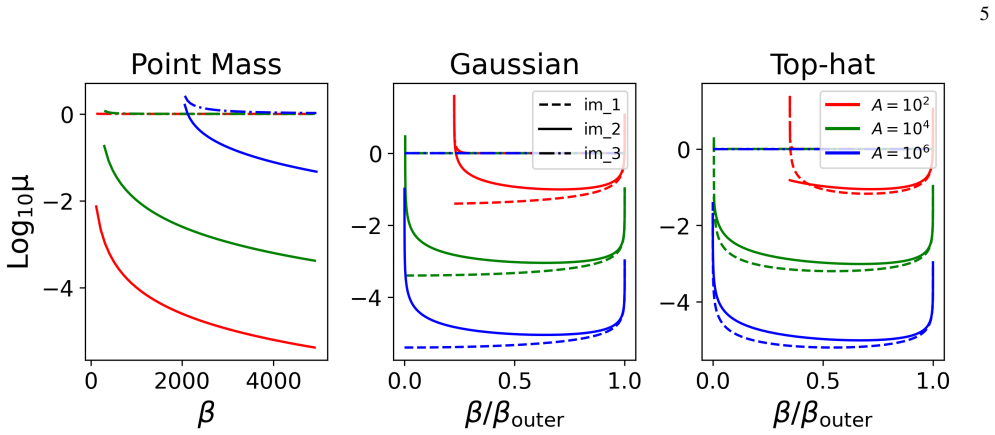
Using three lens models in a plasma lensing framework, the outer caustic emerges as the most prominent measurable feature of a substructure phase screen; its location constrains the maximum column density gradient. The inner caustic directly indicates substructure size for cases capable of extreme scattering. Even without observing caustics, the minimum span of substructure images supplies a lower limit on column density amplitude. Logarithmic brightness of individual arclets forms a concave function of pulsar-lens angular separation, in contrast to the convex distribution of all substructure images combined.
What carries the argument
Plasma lensing phase screens for discrete substructures, with outer and inner caustics and image brightness patterns produced by three chosen lens profiles.
If this is right
- Multiepoch or ultrawideband observations can locate outer caustics and thereby measure maximum column density gradients of the substructures.
- For substructures producing extreme-scattering events, inner caustic positions directly indicate substructure sizes.
- The minimum angular span containing substructure images can be measured to set a lower limit on column density amplitude even when caustics are undetected.
- The concave brightness function of individual arclets versus separation complements statistical analyses of collective substructure images.
Where Pith is reading between the lines
- This modeling could help distinguish whether interstellar plasma substructures arise from discrete clouds or from turbulence by supplying direct morphological constraints on density profiles.
- Similar caustic analysis applied to fast radio bursts or other coherent sources could extend gradient measurements to additional lines of sight through the Galaxy.
- Routine ultrawideband pulsar monitoring programs would enable statistical mapping of column density gradients across many sight lines without needing repeated epochs.
Load-bearing premise
Inverted arclets arise solely from discrete plasma lensing substructures whose phase screens are adequately described by the three chosen lens models without significant contributions from other scattering mechanisms or line-of-sight effects.
What would settle it
Observation of inverted arclets whose positions, frequency evolution, or brightness patterns cannot be reproduced by any of the three lens models for physically plausible substructure parameters.
Figures



read the original abstract
Radio pulsars, as highly coherent point sources, serve as powerful probes of the ionized interstellar medium (IISM). Pulsar scintillation observations have revealed inverted arclets on the secondary spectrum, indicating quasilinearly aligned images created by substructures on a scintillation screen. The density profiles of these substructures remain unconstrained but are crucial to identifying their physical nature. This work employs a plasma lensing framework to study observable features of substructure phase screens. Using three lens models, we identify the substructure properties that can be constrained by observables. The outer caustic is the most prominent feature of a lensing substructure, measurable via multiepoch or ultrawideband observations. Its location constrains the maximum column density gradient of the substructure. The inner caustic, though difficult to observe except for substructures capable of producing extreme-scattering events, directly indicates the substructure size. Even when caustic locations are not observed, the minimum span where substructure images exist can be measured and used to place a lower limit on the column density amplitude. The logarithmic brightness of individual arclets forms a concave function of the pulsar-lens angular separation, contrasting with the convex brightness distribution of all substructure images--highlighting the complementarity of individual arclets to statistical studies. These findings reveal the potential of pulsar scintillation to uncover IISM substructure and underscore the need for multiepoch and/or ultrawideband measurements to constrain discrete lensing morphologies and help reveal the nature of interstellar plasma structures.
Editorial analysis
A structured set of objections, weighed in public.
Referee Report
Summary. The manuscript employs a plasma lensing framework with three lens models to study substructures on pulsar scintillation screens. It identifies observable features including the outer caustic (constraining maximum column density gradient), inner caustic (indicating substructure size), and minimum image span (providing a lower limit on column density amplitude). It further claims that the logarithmic brightness of individual arclets forms a concave function of pulsar-lens angular separation, in contrast to the convex distribution for all substructure images combined, and emphasizes the need for multiepoch or ultrawideband observations to constrain discrete lensing morphologies.
Significance. If the mappings from lens models to observables hold, this work provides a useful forward-modeling approach to extract physical properties of IISM substructures from inverted arclets in secondary spectra. The emphasis on falsifiable predictions for caustic locations and brightness trends is a strength, potentially aiding in distinguishing discrete substructures from other scattering processes and guiding future observations.
major comments (2)
- [lens modeling and results sections] The central claims that outer-caustic location constrains maximum column density gradient, inner caustic gives substructure size, and minimum span gives amplitude lower limit rest on the assumption that these features arise purely from the three isolated lens models. The manuscript does not test whether the caustic loci or concave log-brightness relation survive when the phase screen is a superposition of the model plus a Kolmogorov turbulence component (as would be expected for realistic IISM). This is load-bearing for attributing the observed features uniquely to discrete substructures rather than distributed scattering or line-of-sight effects.
- [abstract and modeling framework] The abstract outlines the mappings from model features to observables, but the full paper lacks explicit derivations of the lens equations, any stated approximations, and validation against simulated data to confirm the claimed constraints. Without these, it is not possible to verify absence of post-hoc choices or to assess how the three models (whose specific forms are not named in the provided abstract) produce the reported caustic and brightness behaviors.
minor comments (2)
- [lens models section] The three lens models should be explicitly named and their functional forms (e.g., Gaussian, power-law) given with equations in the main text for reproducibility.
- [discussion] Minor clarification needed on how multiepoch or ultrawideband observations would isolate the outer caustic in practice, perhaps with a schematic or example calculation.
Simulated Author's Rebuttal
We thank the referee for the constructive feedback. The comments correctly identify areas where additional robustness checks and explicit documentation would strengthen the paper. We address each major comment below and will revise the manuscript to incorporate the suggested improvements.
read point-by-point responses
-
Referee: [lens modeling and results sections] The central claims that outer-caustic location constrains maximum column density gradient, inner caustic gives substructure size, and minimum span gives amplitude lower limit rest on the assumption that these features arise purely from the three isolated lens models. The manuscript does not test whether the caustic loci or concave log-brightness relation survive when the phase screen is a superposition of the model plus a Kolmogorov turbulence component (as would be expected for realistic IISM). This is load-bearing for attributing the observed features uniquely to discrete substructures rather than distributed scattering or line-of-sight effects.
Authors: We agree that the isolated-lens analysis is a necessary starting point but does not yet demonstrate robustness against a realistic turbulent background. The manuscript focuses on the pure signatures of discrete substructures precisely to establish falsifiable predictions for caustic locations and brightness trends. In the revision we will add a dedicated subsection with numerical simulations that superpose each of the three lens models onto a Kolmogorov phase screen of varying strength. These tests will show the range of substructure amplitudes for which the outer-caustic location, inner-caustic size indicator, and concave log-brightness relation of individual arclets remain identifiable above the turbulent noise. We will also discuss how multiepoch or ultrawideband data can help separate the discrete and distributed contributions. This addition directly addresses the concern about unique attribution. revision: yes
-
Referee: [abstract and modeling framework] The abstract outlines the mappings from model features to observables, but the full paper lacks explicit derivations of the lens equations, any stated approximations, and validation against simulated data to confirm the claimed constraints. Without these, it is not possible to verify absence of post-hoc choices or to assess how the three models (whose specific forms are not named in the provided abstract) produce the reported caustic and brightness behaviors.
Authors: The full manuscript names the three models (Gaussian, truncated power-law, and exponential column-density profiles) in Section 2 and derives the lens mapping and caustic conditions in the appendix. The thin-screen and geometric-optics approximations are stated in the modeling framework. Nevertheless, we accept that these elements could be presented more explicitly and with validation. In the revision we will (i) expand the main text with step-by-step derivations of the outer- and inner-caustic loci and the log-brightness relation, (ii) add a clear list of all approximations, and (iii) include a new validation subsection that compares the analytic predictions to ray-traced secondary spectra generated from the same phase screens. These changes will make the claimed constraints fully verifiable and eliminate any ambiguity about post-hoc choices. revision: yes
Circularity Check
Forward modeling of lens equations produces independent mappings to observables
full rationale
The paper applies three standard plasma lens models to derive caustic locations, image spans, and brightness trends as functions of substructure column density parameters. These relations are obtained by solving the lens equation forward from the chosen profiles, yielding constraints (outer caustic for max gradient, inner caustic for size, minimum span for amplitude lower limit) that are genuine outputs rather than tautologies or fits to the target data. No self-citations, self-definitional loops, or renamings of known results appear in the abstract or described chain; the claims remain self-contained against external lensing theory without reducing to the inputs by construction.
Axiom & Free-Parameter Ledger
free parameters (1)
- lens model parameters (three models)
axioms (1)
- domain assumption Substructures act as thin phase screens that produce multiple images via geometric optics lensing
Reference graph
Works this paper leans on
-
[1]
Bannister, K. W., Stevens, J., Tuntsov, A. V., et al. 2016, Science, 351, 354, doi: 10.1126/science.aac7673
- [2]
-
[3]
Brisken, W. F., Macquart, J. P., Gao, J. J., Rickett, B. J., & Coles, W. A. 2010, The Astrophysical Journal, 708, 232, doi: 10.1088/0004-637X/708/1/232
-
[4]
Clegg, A. W., Fey, A. L., & Lazio, T. J. W. 1998, The Astrophysical Journal, 496, 253, doi: 10.1086/305344
-
[5]
Coles, W. A., Frehlich, R. G., Rickett, B. J., & Codona, J. L. 1987, The Astrophysical Journal, 315, 666, doi: 10.1086/165168
-
[6]
M., Pidwerbetsky, A., & Lovelace, R
Cordes, J. M., Pidwerbetsky, A., & Lovelace, R. V. E. 1986, The Astrophysical Journal, 310, 737, doi: 10.1086/164728
-
[7]
Cordes, J. M., Rickett, B. J., Stinebring, D. R., & Coles, W. A. 2006, The Astrophysical Journal, 637, 346, doi: 10.1086/498332
-
[8]
Cordes, J. M., & Wolszczan, A. 1986, The Astrophysical Journal, 307, L27, doi: 10.1086/184722
-
[9]
2018, Monthly Notices of the Royal Astronomical Society, 475, 867, doi: 10.1093/mnras/stx3290 9
Er, X., & Rogers, A. 2018, Monthly Notices of the Royal Astronomical Society, 475, 867, doi: 10.1093/mnras/stx3290 9
-
[10]
Staelin, D. H. 1970, The Astrophysical Journal, 162, L169, doi: 10.1086/180647
-
[11]
Simon, R. S. 1994, The Astrophysical Journal, 430, 581, doi: 10.1086/174432
-
[12]
Fiedler, R. L., Dennison, B., Johnston, K. J., & Hewish, A. 1987, Nature, 326, 675, doi: 10.1038/326675a0
-
[13]
Gupta, Y., Rickett, B. J., & Lyne, A. G. 1994, Monthly Notices of the Royal Astronomical Society, 269, 1035, doi: 10.1093/mnras/269.4.1035
-
[14]
Hewish, A., Wolszczan, A., & Graham, D. A. 1985, Monthly Notices of the Royal Astronomical Society, 213, 167, doi: 10.1093/mnras/213.2.167
-
[15]
Hill, A. S., Stinebring, D. R., Asplund, C. T., et al. 2005, The Astrophysical Journal, 619, L171, doi: 10.1086/428347
-
[16]
Webber, A. B. 2003, The Astrophysical Journal, 599, 457, doi: 10.1086/379191
-
[17]
Roberts, P. 2020, Publications of the Astronomical Society of Australia, 37, e012, doi: 10.1017/pasa.2020.2
-
[18]
Johnston, S., Nicastro, L., & Koribalski, B. 1998, Monthly Notices of the Royal Astronomical Society, 297, 108, doi: 10.1046/j.1365-8711.1998.01461.x
-
[19]
Jow, D. L., Pen, U.-L., & Baker, D. 2024, Monthly Notices of the Royal Astronomical Society, 528, 6292, doi: 10.1093/mnras/stae300
-
[20]
L., Pen, U.-L., & Feldbrugge, J
Jow, D. L., Pen, U.-L., & Feldbrugge, J. 2022, arXiv, doi: 10.48550/arXiv.2204.12004
-
[21]
Lazio, T. J. W., Waltman, E. B., Ghigo, F. D., et al. 2001, The Astrophysical Journal Supplement Series, 136, 265, doi: 10.1086/322531
-
[22]
Liu, S., Pen, U.-L., Macquart, J. P., Brisken, W., & Deller, A. 2016, Monthly Notices of the Royal Astronomical Society, 458, 1289, doi: 10.1093/mnras/stw314
-
[23]
2023, Monthly Notices of the Royal Astronomical Society, 518, 1086, doi: 10.1093/mnras/stac3149
Basu, A. 2023, Monthly Notices of the Royal Astronomical Society, 518, 1086, doi: 10.1093/mnras/stac3149
-
[24]
2024, Monthly Notices of the Royal Astronomical Society, 527, 7568, doi: 10.1093/mnras/stad3683
Dolch, T. 2024, Monthly Notices of the Royal Astronomical Society, 527, 7568, doi: 10.1093/mnras/stad3683
-
[25]
I., Hoffman, Y., Knebe, A., et al
Pen, U.-L., & King, L. 2012, Monthly Notices of the Royal Astronomical Society: Letters, 421, L132, doi: 10.1111/j.1745-3933.2012.01223.x
-
[26]
2014, Monthly Notices of the Royal Astronomical Society, 442, 3338, doi: 10.1093/mnras/stu1020
Pen, U.-L., & Levin, Y. 2014, Monthly Notices of the Royal Astronomical Society, 442, 3338, doi: 10.1093/mnras/stu1020
-
[27]
Putney, M. L., & Stinebring, D. R. 2006, Chinese Journal of Astronomy and Astrophysics Supplement, 6, 233
work page 2006
-
[28]
Reardon, D. J., Main, R., Ocker, S. K., Shannon, R. M., & Bailes, M. 2025, Nature Astronomy, 9, 1053, doi: 10.1038/s41550-025-02534-6
-
[29]
Rickett, B. J. 1969, Nature, 221, 158, doi: 10.1038/221158a0
-
[30]
Roberts, J. A., & Ables, J. G. 1982, Monthly Notices of the Royal Astronomical Society, 201, 1119, doi: 10.1093/mnras/201.4.1119
-
[31]
Romani, R. W., Blandford, R. D., & Cordes, J. M. 1987, Nature, 328, 324, doi: 10.1038/328324a0
-
[32]
Schneider, P., Ehlers, J., & Falco, E. E. 1992, Gravitational Lenses, doi: 10.1007/978-3-662-03758-4
-
[33]
2021, Monthly Notices of the Royal Astronomical Society, 508, 125, doi: 10.1093/mnras/stab2522
Shi, X. 2021, Monthly Notices of the Royal Astronomical Society, 508, 125, doi: 10.1093/mnras/stab2522
-
[34]
2024a, Monthly Notices of the Royal Astronomical Society, 534, 1143, doi: 10.1093/mnras/stae2127
Shi, X. 2024a, Monthly Notices of the Royal Astronomical Society, 534, 1143, doi: 10.1093/mnras/stae2127
-
[35]
2024b, The Astrophysical Journal, 972, 118, doi: 10.3847/1538-4357/ad6761
Shi, X. 2024b, The Astrophysical Journal, 972, 118, doi: 10.3847/1538-4357/ad6761
-
[36]
2024c, The Astrophysical Journal, 975, 79, doi: 10.3847/1538-4357/ad75fb
Shi, X. 2024c, The Astrophysical Journal, 975, 79, doi: 10.3847/1538-4357/ad75fb
-
[37]
2021, Monthly Notices of the Royal Astronomical Society, 506, 6039, doi: 10.1093/mnras/stab2108
Shi, X., & Xu, Z. 2021, Monthly Notices of the Royal Astronomical Society, 506, 6039, doi: 10.1093/mnras/stab2108
-
[38]
2018, Monthly Notices of the Royal Astronomical Society, 478, 983, doi: 10.1093/mnras/sty1140
Simard, D., & Pen, U.-L. 2018, Monthly Notices of the Royal Astronomical Society, 478, 983, doi: 10.1093/mnras/sty1140
-
[39]
Simard, D., Pen, U.-L., Marthi, V. R., & Brisken, W. 2019, Monthly Notices of the Royal Astronomical Society, 488, 4963, doi: 10.1093/mnras/stz2046
-
[40]
2022, Monthly Notices of the Royal Astronomical Society, 515, 6198, doi: 10.1093/mnras/stac2160
Sprenger, T., Main, R., Wucknitz, O., Mall, G., & Wu, J. 2022, Monthly Notices of the Royal Astronomical Society, 515, 6198, doi: 10.1093/mnras/stac2160
-
[41]
Stinebring, D. R., McLaughlin, M. A., Cordes, J. M., Becker, K. M., & Goodman, J. E. E. 2001, The Astrophysical Journal, 549, L97, doi: 10.1086/319133
-
[42]
2004, MNRAS, 355, 819, doi: 10.1111/j.1365-2966.2004.08360.x
Walker, M. A., Melrose, D. B., Stinebring, D. R., & Zhang, C. M. 2004, Monthly Notices of the Royal Astronomical Society, 354, 43, doi: 10.1111/j.1365-2966.2004.08159.x
-
[43]
2005, MNRAS, 361, 776, doi: 10.1111/j.1365-2966.2005.09238.x
Walker, M. A., & Stinebring, D. R. 2005, Monthly Notices of the Royal Astronomical Society, 362, 1279, doi: 10.1111/j.1365-2966.2005.09396.x
-
[44]
Wolszczan, A., & Cordes, J. M. 1987, The Astrophysical Journal, 320, L35, doi: 10.1086/184972
-
[45]
Zhu, H., Baker, D., Pen, U.-L., Stinebring, D. R., & van Kerkwijk, M. H. 2023, The Astrophysical Journal, 950, 109, doi: 10.3847/1538-4357/accde0
discussion (0)
Sign in with ORCID, Apple, or X to comment. Anyone can read and Pith papers without signing in.