A discontinuous Galerkin method with fractal elements
Pith reviewed 2026-05-10 15:56 UTC · model grok-4.3
The pith
A discontinuous Galerkin method defined directly on fractal elements approximates elliptic problems in the Koch snowflake domain without polygonal prefractal approximations.
A machine-rendered reading of the paper's core claim, the machinery that carries it, and where it could break.
Core claim
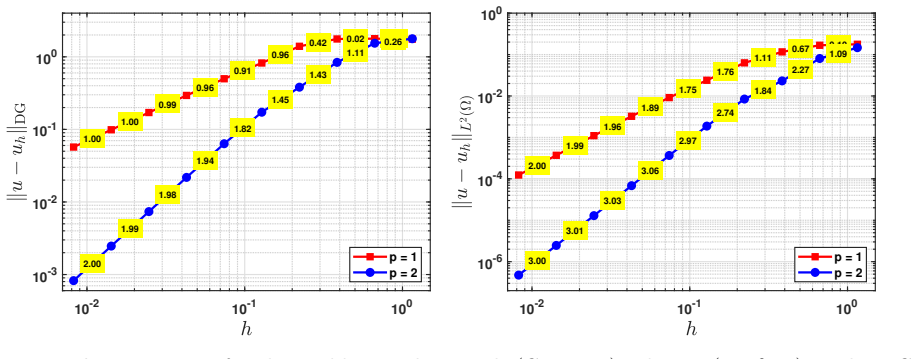
We formulate, analyse, and implement a discontinuous Galerkin finite element method on the Koch snowflake domain itself, using a geometry-conforming mesh of fractal elements each similar to the snowflake. Fluxes across inter-element fractal curves are represented weakly by integrals over element subdomains, which for local polynomial bases can be evaluated exactly via self-similarity. The method is shown to be well-posed and quasi-optimal, with a partial convergence theory, and numerical results demonstrate its effectiveness for piecewise linear and quadratic approximations of the Poisson problem and the Dirichlet eigenvalue problem.
What carries the argument
A geometry-conforming fractal tiling of the Koch snowflake domain in which each element is a scaled copy of the snowflake, combined with a weak representation of inter-element fluxes as subdomain integrals that are computed exactly using self-similarity for polynomial basis functions.
If this is right
- The method produces a well-posed and quasi-optimal discrete problem without first replacing the fractal boundary by a sequence of polygons.
- Flux integrals over fractal interfaces are replaced by exact subdomain integrals whose evaluation cost is independent of the fractal iteration depth for polynomial bases.
- The same framework applies directly to the Dirichlet eigenvalue problem on the snowflake.
- Partial convergence rates follow from the quasi-optimality result once an approximation property for the fractal-element spaces is established.
Where Pith is reading between the lines
- The same subdomain-integral technique could be tested on other self-similar fractals whose tiles admit an exact scaling relation for polynomial integrands.
- If the exact integral property extends to higher-degree polynomials, the method would immediately support higher-order DG approximations on the same meshes.
- The approach suggests a route to adaptive refinement that respects the fractal geometry at every level rather than stopping at a fixed prefractal stage.
Load-bearing premise
The weak integrals representing fluxes across fractal inter-element boundaries can be evaluated exactly using self-similarity when the local basis functions are polynomials.
What would settle it
A sequence of numerical solutions on successively refined fractal tilings that fails to converge in the energy norm to the known analytic solution of the Poisson problem on the Koch snowflake.
Figures






read the original abstract
We formulate, analyse, and implement a discontinuous Galerkin finite element method (DG-FEM) for the approximation of the solution of an elliptic boundary value problem in a domain with fractal boundary. We consider the case of the Poisson equation in the Koch snowflake domain with zero Dirichlet boundary conditions, but our methodology can be generalised to other cases. Rather than first approximating the snowflake domain by a polygonal "prefractal" and then applying a standard DG-FEM on the prefractal, we define a DG-FEM on the snowflake itself, using a geometry-conforming mesh (a fractal tiling) consisting of fractal elements, each similar to the original snowflake. Fluxes across inter-element boundaries, which are fractal curves, are represented in a weak way by integrals over element subdomains. We show how, for local polynomial basis functions, these integrals can be evaluated exactly using the similarity of the elements. We prove well-posedness and quasi-optimality of the method, and provide a partial convergence analysis. We present numerical results for piecewise linear and piecewise quadratic basis functions, which demonstrate the effectiveness of the method. We also apply our method to the related Dirichlet eigenvalue problem.
Editorial analysis
A structured set of objections, weighed in public.
Referee Report
Summary. The manuscript formulates, analyzes, and implements a discontinuous Galerkin finite element method for the Poisson equation (and related eigenvalue problem) on the Koch snowflake domain. It employs a geometry-conforming mesh of fractal elements similar to the domain itself, represents fluxes across fractal inter-element boundaries weakly via integrals over element subdomains, and evaluates those integrals exactly for local polynomial bases by exploiting self-similarity. Well-posedness and quasi-optimality are proved, a partial convergence analysis is given, and numerical results are shown for piecewise-linear and piecewise-quadratic elements.
Significance. If the central consistency and exact-evaluation claims hold, the work offers a direct, non-approximating approach to DG methods on self-similar fractal domains that avoids prefractal polygonal approximations; the explicit well-posedness and quasi-optimality proofs together with the exact self-similar quadrature for polynomials constitute a clear technical contribution, while the numerical experiments provide concrete evidence of practical effectiveness.
major comments (3)
- [Formulation section (abstract and §2)] The replacement of direct integration over fractal inter-element curves by weak subdomain integrals is load-bearing for the entire analysis (well-posedness, quasi-optimality, and partial convergence). The manuscript must supply a precise statement, in the appropriate trace space on the fractal boundary, showing that this substitution recovers the correct distributional flux; without it the discrete bilinear form analyzed in the proofs is not demonstrably the one implemented.
- [Implementation of the bilinear form (abstract and §3)] The claim that the subdomain integrals admit exact closed-form evaluation for polynomial bases via the Koch snowflake self-similarity recursion must be verified to terminate exactly rather than only approximately; if the infinite iterative construction prevents exact termination, the numerical results cannot be taken as confirmation of the theory.
- [Convergence analysis (abstract and §4)] The convergence analysis is described as partial and no explicit error bounds or rates are visible. This is a load-bearing gap: quasi-optimality alone does not guarantee that the method converges as the fractal mesh is refined, and the numerical results therefore lack theoretical anchoring.
minor comments (2)
- [Abstract] The abstract states that the methodology 'can be generalised to other cases' but gives no indication of which other problems or boundary conditions are intended; a single sentence would clarify scope.
- [Mesh construction] Notation for the fractal tiling and the self-similar subdomains should be introduced once with a clear diagram or recursive definition to avoid ambiguity when the integrals are later evaluated.
Simulated Author's Rebuttal
We thank the referee for the careful reading and constructive major comments. We address each point below and will revise the manuscript to incorporate the requested clarifications and extensions while preserving the core contributions on the geometry-conforming DG method with exact self-similar evaluation.
read point-by-point responses
-
Referee: [Formulation section (abstract and §2)] The replacement of direct integration over fractal inter-element curves by weak subdomain integrals is load-bearing for the entire analysis (well-posedness, quasi-optimality, and partial convergence). The manuscript must supply a precise statement, in the appropriate trace space on the fractal boundary, showing that this substitution recovers the correct distributional flux; without it the discrete bilinear form analyzed in the proofs is not demonstrably the one implemented.
Authors: We agree that an explicit equivalence statement is necessary for rigor. In the revised manuscript we will insert a new lemma in Section 2 that, working in the trace space dual to the appropriate fractional Sobolev space on the Koch curve (accounting for its Hausdorff dimension), shows via integration by parts on the self-similar subdomains that the weak subdomain-integral representation of the numerical flux coincides with the distributional interface term. This will confirm that the analyzed bilinear form is identical to the one implemented. revision: yes
-
Referee: [Implementation of the bilinear form (abstract and §3)] The claim that the subdomain integrals admit exact closed-form evaluation for polynomial bases via the Koch snowflake self-similarity recursion must be verified to terminate exactly rather than only approximately; if the infinite iterative construction prevents exact termination, the numerical results cannot be taken as confirmation of the theory.
Authors: The recursion terminates exactly for any fixed polynomial degree. Because the basis functions are polynomials of degree at most p, each application of the self-similarity map scales the integrand by a known factor and maps it to a polynomial of the same degree on a smaller copy; after a finite number of steps (at most p+1 per similarity branch) the remaining integrals reduce to explicit moments on the initial equilateral-triangle generators, which are computed in closed form. We will add a short inductive proof and pseudocode in Section 3 demonstrating finite termination and confirming that the reported numerics employ this exact procedure rather than truncation. revision: yes
-
Referee: [Convergence analysis (abstract and §4)] The convergence analysis is described as partial and no explicit error bounds or rates are visible. This is a load-bearing gap: quasi-optimality alone does not guarantee that the method converges as the fractal mesh is refined, and the numerical results therefore lack theoretical anchoring.
Authors: We accept that the present analysis is only partial and that quasi-optimality must be supplemented by approximation properties to obtain convergence under refinement. In the revised Section 4 we will derive explicit a priori error estimates by combining the existing quasi-optimality result with interpolation estimates on the fractal elements; these estimates follow from the self-similar subdivision and standard polynomial approximation theory applied level-by-level to the prefractal polygons. The resulting bounds will be stated in terms of the mesh-size parameter (subdivision level) and will directly anchor the observed numerical convergence for both linear and quadratic elements. revision: yes
Circularity Check
No significant circularity in derivation chain
full rationale
The paper defines a DG-FEM directly on the Koch snowflake domain using a fractal tiling mesh, represents inter-element fluxes weakly via subdomain integrals as a modeling choice to avoid direct fractal-curve integration, and derives exact evaluation formulas for polynomial bases from the independent geometric self-similarity of the Koch snowflake. Well-posedness, quasi-optimality, and partial convergence are then proved by adapting standard DG theory (bilinear form coercivity, continuity, and approximation properties) to this setting. No step reduces a claimed prediction or theorem to a fitted parameter, self-citation chain, or definitional tautology; the exact-integral claim is a constructive computation shown from the similarity recursion, not presupposed in the analysis. The derivation remains self-contained against external DG benchmarks and the known fractal geometry.
Axiom & Free-Parameter Ledger
axioms (1)
- domain assumption The Koch snowflake domain admits a self-similar fractal tiling by smaller copies of itself
Reference graph
Works this paper leans on
-
[1]
Y. Achdou and T. Deheuvels , A transmission problem across a fractal self-similar interface , SIAM J. Multiscale Model. Simul., 14 (2016), pp. 708–736
work page 2016
- [2]
-
[3]
D. N. Arnold , An interior penalty finite element method with discontinuous elements , SIAM J. Numer. Anal., 19 (1982), pp. 742–760
work page 1982
-
[4]
I. Babuška and B. Q. Guo , The h-p version of the finite element method for domains with curved boundaries, SIAM J. Numer. Anal., 25 (1988), pp. 837–861
work page 1988
-
[5]
P. Bagnerini, A. Buffa, and E. V acca , Finite elements for a prefractal transmission problem, C. R. Math., 342 (2006), pp. 211–214
work page 2006
-
[6]
P. Bagnerini, A. Buffa, and E. V acca , Mesh generation and numerical analysis of a Galerkin method for highly conductive prefractal layers , Appl. Numer. Math., 65 (2013), pp. 63– 78
work page 2013
-
[7]
C. Bandt , Self-similar sets 5. Integer matrices and fractal tilings of Rn, Proc. Amer. Math. Soc., (1991), pp. 549–562
work page 1991
-
[8]
Banjai , Eigenfrequencies of fractal drums , J
L. Banjai , Eigenfrequencies of fractal drums , J. Comput. Appl. Math., 198 (2007), pp. 1–18. 41 Γ, Ω Koch curve and snowflake §2.1 dimH(·), d = dim H(Γ) Hausdorff dimension §2.1 H 1 0 (Ω), H1(Ω), W 1 p (Ω) Sobolev spaces §2.2–2.3 C0,α(Ω), H2,2 µ (Ω), D2 Hölder and weighted Sobolev space, second derivatives §2.3 δ, µ Boundary distance function and integra...
work page 2007
-
[9]
J. Bannister, A. Gibbs, and D. P. Hewett , Acoustic scattering by impedance screens/ cracks with fractal boundary: well-posedness analysis and boundary element approximation , Math. Models Methods Appl. Sci., 32 (2022), pp. 291–319
work page 2022
-
[10]
J. Bannister, D. P. Hewett, and A. Gibbs , Scattering by fractal inhomogeneities via geometry-conforming Galerkin methods for the Lippmann-Schwinger equation . arXiv: 2602.05005
-
[11]
M. Barnsley and A. Vince , Fractal tilings from iterated function systems , Discrete Comput. Geom., 51 (2014), pp. 729–752
work page 2014
-
[12]
M. F. Barnsley and S. Demko , Iterated function systems and the global construction of fractals, Proc. Roy. Soc. Lond. A., 399 (1985), pp. 243–275
work page 1985
-
[13]
Biegert, On traces of Sobolev functions on the boundary of extension domains , Proc
M. Biegert, On traces of Sobolev functions on the boundary of extension domains , Proc. Am. Math. Soc., 137 (2009), pp. 4169–4176
work page 2009
-
[14]
S. C. Brenner and L. R. Scott , The mathematical theory of finite element methods , Springer, 2008
work page 2008
-
[15]
A. M. Caetano, S. N. Chandler-Wilde, X. Claeys, A. Gibbs, D. P. Hewett, and A. Moiola , Integral equation methods for acoustic scattering by fractals , Proc. R. Soc. A., (2025), p. 48120230650
work page 2025
-
[16]
A. M. Caetano, S. N. Chandler-Wilde, A. Gibbs, D. P. Hewett, and A. Moiola , A Hausdorff-measure boundary element method for acoustic scattering by fractal screens , Numer. Math., 156 (2024), pp. 463–532
work page 2024
- [17]
-
[18]
A. M. Caetano, D. P. Hewett, and A. Moiola , Density results for Sobolev, Besov and Triebel-Lizorkin spaces on rough sets , J. Funct. Anal., 281 (2021), p. 109019
work page 2021
-
[19]
A. Cangiani, Z. Dong, and E. Georgoulis , hp-version discontinuous Galerkin methods on essentially arbitrarily-shaped elements , Math. Comp., 91 (2022), pp. 1–35
work page 2022
-
[20]
A. Cangiani, Z. Dong, E. H. Georgoulis, and P. Houston , hp-Version Discontinuous Galerkin Methods on Polygonal and Polyhedral Meshes , Springer, 2017
work page 2017
-
[21]
Capitanelli , Robin boundary condition on scale irregular fractals , Commun
R. Capitanelli , Robin boundary condition on scale irregular fractals , Commun. Pure Appl. Anal., 9 (2010), pp. 1221–1234
work page 2010
-
[22]
R. Capitanelli and M. A. Vivaldi , Weighted estimates on fractal domains , Mathematika, 61 (2015), pp. 370–384
work page 2015
-
[23]
, Dynamical quasi-filling fractal layers , SIAM J. Math. Anal., 48 (2016), pp. 3931–3961
work page 2016
-
[24]
A. Carvalho and A. Caetano , On the Hausdorff dimension of continuous functions belong- ing to Hölder and Besov spaces on fractal d-sets , J. Fourier Anal. Appl., 18 (2012), pp. 386–409
work page 2012
-
[25]
Castillo , Performance of discontinuous Galerkin methods for elliptic PDEs , SIAM J
P. Castillo , Performance of discontinuous Galerkin methods for elliptic PDEs , SIAM J. Sci. Comput., 24 (2002), pp. 524–547. 43
work page 2002
- [26]
- [27]
-
[28]
S. N. Chandler-Wilde and D. P. Hewett , Well-posed PDE and integral equation formu- lations for scattering by fractal screens , SIAM J. Math. Anal., 50 (2018), pp. 677–717
work page 2018
-
[29]
S. N. Chandler-Wilde, D. P. Hewett, A. Moiola, and J. Besson , Boundary element methods for acoustic scattering by fractal screens , Numer. Math., 147 (2021), pp. 785–837
work page 2021
-
[30]
P. G. Ciarlet , The Finite Element Method for Elliptic Problems , North-Holland, 1978
work page 1978
-
[31]
G. Claret , Helmholtz transmission problem and intrinsic impedance scattering problem on extension domains . arXiv:2601.14866
- [32]
-
[33]
S. Creo, M. R. Lancia, P. Vernole, M. Hinz, and A. Teplyaev , Magnetostatic problems in fractal domains , in Analysis, Probability and Mathematical Physics on Fractals, World Scientific, 2020, pp. 477–502
work page 2020
-
[34]
D. A. Di Pietro and A. Ern , Mathematical Aspects of Discontinuous Galerkin Methods , Springer, 2011
work page 2011
-
[35]
F alconer, Fractal Geometry: Mathematical Foundations and Applications , Wiley, 3rd ed., 2014
K. F alconer, Fractal Geometry: Mathematical Foundations and Applications , Wiley, 3rd ed., 2014
work page 2014
-
[36]
W. F arkas and N. Jacob, Sobolev spaces on non smooth domains and Dirichlet forms related to subordinate reflecting diffusions , Math. Nachr., 224 (2001), pp. 75–104
work page 2001
- [37]
- [38]
-
[39]
D. S. Grebenkov and B.-T. Nguyen , Geometrical structure of Laplacian eigenfunctions , SIAM Rev., 55 (2013), pp. 601–667
work page 2013
-
[40]
Grisvard, Elliptic Problems in Nonsmooth Domains , Pitman, Boston, 1985
P. Grisvard, Elliptic Problems in Nonsmooth Domains , Pitman, Boston, 1985
work page 1985
-
[41]
K. Grochenig and A. Haas , Self-similar lattice tilings , J. Fourier Anal. Appl., 1 (1994), pp. 131–170
work page 1994
- [42]
- [43]
-
[44]
M. Hinz, A. Rozanova-Pierrat, and A. Teplyaev , Boundary value problems on non- Lipschitz uniform domains: stability, compactness and the existence of optimal shapes , Asymp- totic Anal., 134 (2023), pp. 25–61
work page 2023
-
[45]
J. E. Hutchinson , Fractals and self-similarity, Indiana Univ. Math. J., 30 (1981), pp. 713–747
work page 1981
- [46]
-
[47]
P. W. Jones , Quasiconformal mappings and extendability of functions in Sobolev spaces , Acta Math., 147 (1981), pp. 71–88
work page 1981
-
[48]
Keesling , The boundaries of self-similar tiles in Rn, Topol
J. Keesling , The boundaries of self-similar tiles in Rn, Topol. Appl., 94 (1999), pp. 195–205
work page 1999
- [49]
-
[50]
M. R. Lancia , A transmission problem with a fractal interface , Z. Anal. Anwend., 21 (2002), pp. 113–133
work page 2002
-
[51]
M. R. Lancia, M. Cefalo, and G. Dell Acqua , Numerical approximation of transmission problems across Koch-type highly conductive layers, Appl. Math. Comput., 218 (2012), pp. 5453– 5473
work page 2012
-
[52]
M. R. Lancia and P. Vernole , Irregular heat flow problems , SIAM J. Math. Anal., 42 (2010), pp. 1539–1567
work page 2010
-
[53]
, The Stokes problem in fractal domains: Asymptotic behaviour of the solutions , Discrete Contin. Dyn. Syst. - Ser. S, 13 (2020)
work page 2020
-
[54]
M. L. Lapidus , Fractals and vibrations: can you hear the shape of a fractal drum? , Fractals, 3 (1995), pp. 725–736
work page 1995
-
[55]
M. L. Lapidus, J. W. Neuberger, R. J. Renka, and C. A. Griffith , Snowflake har- monics and computer graphics: numerical computation of spectra on fractal drums , Int. J. Bifurcation Chaos, 6 (1996), pp. 1185–1210
work page 1996
-
[56]
M. L. Lapidus and E. P. J. Pearse , A tube formula for the Koch snowflake curve, with applications to complex dimensions , J. Lond. Math. Soc., II. Ser., 74 (2006), pp. 397–414
work page 2006
-
[57]
McLean , Strongly Elliptic Systems and Boundary Integral Equations , CUP, 2000
W. McLean , Strongly Elliptic Systems and Boundary Integral Equations , CUP, 2000
work page 2000
-
[58]
B. S. Mityagin , The zero set of a real analytic function , Math. Notes, 107 (2020), pp. 529–530
work page 2020
-
[59]
J. M. Neuberger, N. Sieben, and J. W. Swift , Computing eigenfunctions on the Koch snowflake: a new grid and symmetry , J. Comput. Appl. Math., 191 (2006), pp. 126–142
work page 2006
-
[60]
K. Nyström, Smoothness properties of solutions to Dirichlet problems in domains with a fractal boundary, PhD thesis, University of Umeå, 1994
work page 1994
-
[61]
L. G. Rogers , Degree-independent Sobolev extension on locally uniform domains , J. Funct. Anal., 235 (2006), pp. 619–665
work page 2006
-
[62]
F. Rösler and A. Stepanenko , Computing scattering resonances of rough obstacles . arXiv:2402.00846. 45
-
[63]
, Computing eigenvalues of the Laplacian on rough domains , Math. Comput., 93 (2024), pp. 111–161
work page 2024
-
[64]
B. Sapoval, T. Gobron, and A. Margolina , Vibrations of fractal drums , Phys. Rev. Lett., 67 (1991), p. 2974
work page 1991
- [65]
-
[66]
R. S. Strichartz , Evaluating integrals using self-similarity , American Math. Monthly, 107 (2000), pp. 316–326
work page 2000
-
[67]
R. S. Strichartz and Y. W ang , Geometry of self-affine tiles I , Indiana U. Math. J., (1999), pp. 1–23
work page 1999
-
[68]
E. R. Vrscay and C. J. Roehrig , Iterated function systems and the inverse problem of fractal construction using moments , in Computers and Mathematics, Springer, 1989, pp. 250–259
work page 1989
-
[69]
Ziemer , Weakly Differentiable Functions, Springer, 1989
W. Ziemer , Weakly Differentiable Functions, Springer, 1989. 46
work page 1989
discussion (0)
Sign in with ORCID, Apple, or X to comment. Anyone can read and Pith papers without signing in.