A Unified Approach to Human-Scale Blockage and Scattering Analysis in Sub-THz Propagation With Application to RF Sensing
Pith reviewed 2026-05-10 15:58 UTC · model grok-4.3
The pith
A unified framework models sub-THz blockage and scattering together to enable single-link human-scale sensing and localization.
A machine-rendered reading of the paper's core claim, the machinery that carries it, and where it could break.
Core claim
By integrating blockage and scattering effects as the birth-death dynamics of multipath components and applying statistical detection and classification to angle-delay measurements, accurate sensing and localization at sub-THz frequencies (105-175 GHz) is feasible from a single radio link, as shown by indoor measurements yielding 8-20 cm errors for static objects and 12-30 cm errors for humans.
What carries the argument
Birth-death dynamics of multipath components (MPCs), where newly formed, attenuated, or suppressed paths are identified and classified from angle-delay data to separate human-scale effects.
If this is right
- Static object localization reaches average errors of 8-20 cm depending on range and material.
- Passive human localization achieves 12-17 cm errors at 0.5 m and 26-30 cm at 2 m.
- Newly formed, attenuated, and suppressed multipath components can be identified with millimeter-scale delay resolution.
- Human-scale sensing and 2D/3D environment mapping become possible from a single radio link at sub-THz frequencies.
Where Pith is reading between the lines
- The single-link capability could simplify integration of sensing into future wireless networks that already use sub-THz bands.
- Extending the statistical classification to track time-varying MPCs might enable real-time motion or gesture detection.
- The approach could reduce reliance on dense multi-link setups for indoor monitoring or navigation applications.
Load-bearing premise
Statistically grounded detection and classification of multipath components from angle-delay measurements can reliably separate human-scale blockage and scattering effects without strong dependence on specific material properties or environment assumptions.
What would settle it
Measurements in environments with varying materials or complex multipath showing that MPC classification fails to separate blockage from scattering or that localization errors consistently exceed 30 cm would disprove the claim.
Figures


read the original abstract
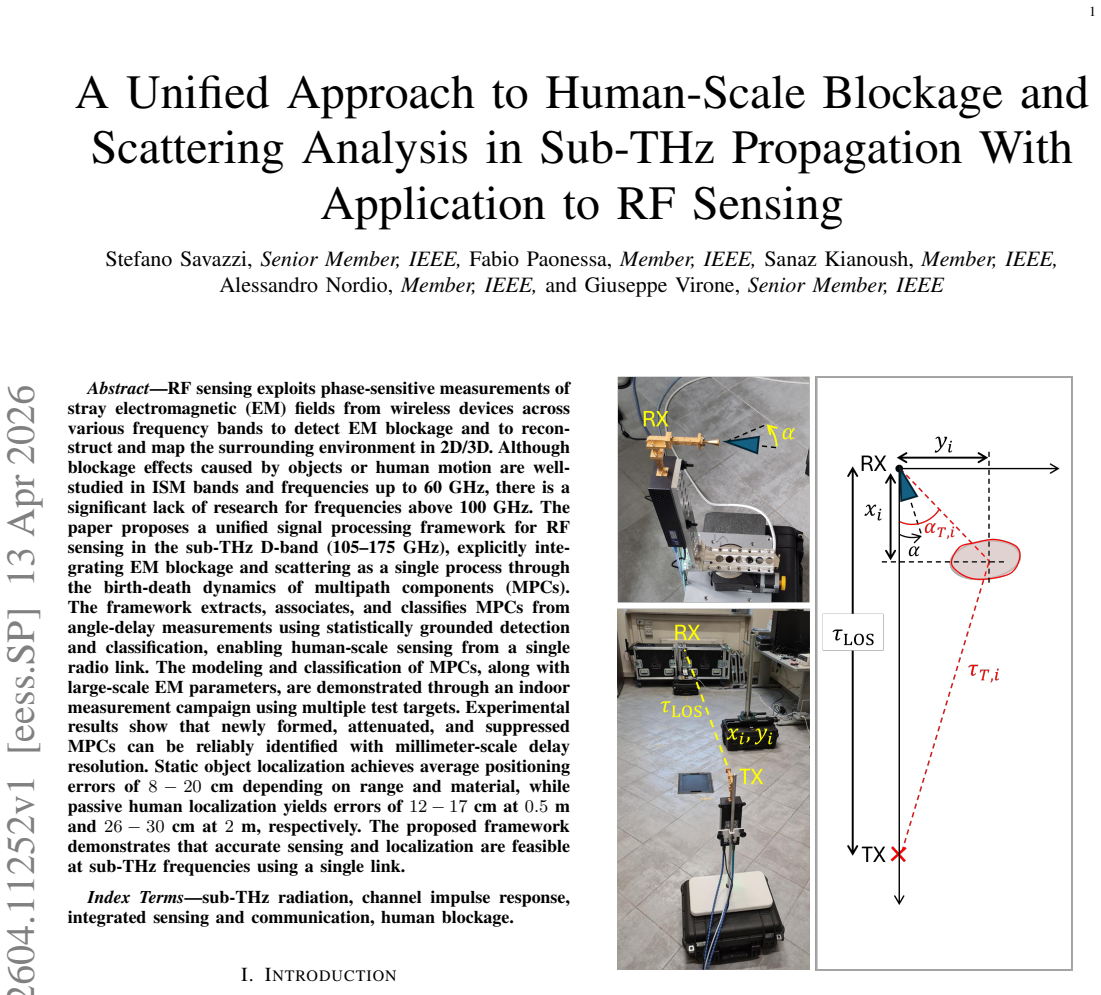
RF sensing exploits phase-sensitive measurements of stray electromagnetic (EM) fields from wireless devices across various frequency bands to detect EM blockage and to reconstruct and map the surrounding environment in 2D/3D. Although blockage effects caused by objects or human motion are well-studied in ISM bands and frequencies up to 60~GHz, there is a significant lack of research for frequencies above 100~GHz. The paper proposes a unified signal processing framework for RF sensing in the sub-THz D-band (105--175~GHz), explicitly integrating EM blockage and scattering as a single process through the birth-death dynamics of multipath components (MPCs). The framework extracts, associates, and classifies MPCs from angle-delay measurements using statistically grounded detection and classification, enabling human-scale sensing from a single radio link. The modeling and classification of MPCs, along with large-scale EM parameters, are demonstrated through an indoor measurement campaign using multiple test targets. Experimental results show that newly formed, attenuated, and suppressed MPCs can be reliably identified with millimeter-scale delay resolution. Static object localization achieves average positioning errors of $8-20$~cm depending on range and material, while passive human localization yields errors of 12-17cm at 0.5m and 26-30cm at 2m, respectively. The proposed framework demonstrates that accurate sensing and localization are feasible at sub-THz frequencies using a single link.
Editorial analysis
A structured set of objections, weighed in public.
Referee Report
Summary. The manuscript proposes a unified signal processing framework for RF sensing in the sub-THz D-band (105-175 GHz) that models blockage and scattering as a single process via the birth-death dynamics of multipath components (MPCs). MPCs are extracted, associated, and classified from angle-delay measurements using statistically grounded detection, enabling human-scale sensing and localization from a single radio link. Validation comes from an indoor measurement campaign with multiple test targets, reporting static object localization errors of 8-20 cm and passive human localization errors of 12-17 cm at 0.5 m and 26-30 cm at 2 m.
Significance. If the MPC classification holds under broader conditions, the work would be significant for sub-THz 6G sensing by showing that accurate single-link environment mapping and human detection are feasible at D-band frequencies. The experimental grounding in real measurements (rather than simulation) and the explicit integration of blockage/scattering dynamics are strengths that could influence propagation modeling and sensing system design.
major comments (2)
- [§IV] §IV (Measurement Campaign): The central claim of reliable human-scale sensing via statistically grounded MPC birth-death classification is load-bearing on robustness to material EM properties and environment geometry, yet validation is confined to one indoor campaign with specific test targets. No sensitivity analysis or cross-material tests are reported, so performance degradation outside this regime cannot be ruled out.
- [§III] §III (Framework): The abstract and framework description state that detection and classification are 'statistically grounded,' but the manuscript provides limited explicit detail on the exact thresholds, association rules, and post-processing steps that produce the quoted 8-30 cm localization errors. This obscures how the reported accuracies depend on the specific campaign data.
minor comments (2)
- [Table I] Table I or equivalent: clarify the exact number of MPCs tracked per scenario and any normalization applied to delay-angle data before classification.
- [Figures] Figure captions: ensure all panels explicitly label the frequency, range, and target type to aid reproducibility.
Simulated Author's Rebuttal
We thank the referee for the constructive and detailed review of our manuscript. The comments highlight important aspects of robustness and reproducibility that we will address through targeted revisions. Below we respond point by point to the major comments.
read point-by-point responses
-
Referee: [§IV] §IV (Measurement Campaign): The central claim of reliable human-scale sensing via statistically grounded MPC birth-death classification is load-bearing on robustness to material EM properties and environment geometry, yet validation is confined to one indoor campaign with specific test targets. No sensitivity analysis or cross-material tests are reported, so performance degradation outside this regime cannot be ruled out.
Authors: We agree that the experimental validation is limited to a single indoor campaign and specific test targets, which constrains strong claims about generalization across all materials and geometries. In the revised manuscript we will add a new subsection at the end of Section IV that explicitly discusses these limitations, including how the observed large-scale EM parameters (attenuation, delay spread) may vary with different materials. Using the existing measurement data we will also include a sensitivity analysis by systematically varying the detection thresholds and association parameters to quantify the resulting changes in birth-death classification accuracy and localization errors. While new cross-material or multi-geometry campaigns lie outside the scope of the current work, we will emphasize that the statistically grounded framework is designed to be adaptable once such data become available. revision: partial
-
Referee: [§III] §III (Framework): The abstract and framework description state that detection and classification are 'statistically grounded,' but the manuscript provides limited explicit detail on the exact thresholds, association rules, and post-processing steps that produce the quoted 8-30 cm localization errors. This obscures how the reported accuracies depend on the specific campaign data.
Authors: We appreciate this observation on the need for greater transparency. In the revised version we will substantially expand Section III to include the precise detection thresholds (e.g., the SNR and power-ratio criteria used for MPC birth/death decisions), the full association rules (including the distance and angle tolerances for MPC linking across snapshots and the birth-death transition model), and the post-processing pipeline that converts classified MPCs into the reported localization estimates. We will add an algorithmic description (in pseudocode) of the end-to-end procedure and will state the exact numerical parameter values employed for the D-band campaign. This will make clear the dependence of the 8-30 cm accuracies on the measurement conditions and improve reproducibility. revision: yes
Circularity Check
No significant circularity; results are empirical outputs from independent measurements
full rationale
The paper defines a unified MPC birth-death framework for integrating blockage and scattering, then applies statistically grounded detection/classification to angle-delay data from a dedicated indoor campaign. Localization errors (8-30 cm) are reported as direct experimental outcomes rather than quantities fitted or renamed from the same inputs. No self-definitional reductions, fitted-input predictions, or load-bearing self-citations appear in the chain; the modeling choice is presented as a hypothesis tested against fresh data. Minor unstated normalization details in MPC association do not rise to circularity under the required standard of explicit reduction by construction.
Axiom & Free-Parameter Ledger
Reference graph
Works this paper leans on
-
[1]
Wilson, et al., ”Radio tomographic imaging with wireless networks,” IEEE Trans
J. Wilson, et al., ”Radio tomographic imaging with wireless networks,” IEEE Trans. on Mobile Comp., vol. 9, no. 5, pp. 621–632, May 2010
work page 2010
-
[2]
THz ISAC: A Physical- Layer Perspective of Terahertz Integrated Sensing and Communication,
C. Han, Y . Wu, Z. Chen, Y . Chen and G. Wang, "THz ISAC: A Physical- Layer Perspective of Terahertz Integrated Sensing and Communication, "IEEE Communications Magazine, vol. 62, no. 2, pp. 102-108, February 2024, doi: 10.1109/MCOM.001.2200404
-
[3]
Holography with Dense Wireless Networks: A Case for Ethical Design,
S. Savazzi, S. Cammers-Goodwin, A. Paulus, S. Kianoush, D. Salami, S. Golipoor, Y . Liu, T. Eibert, C. Aydin, "Holography with Dense Wireless Networks: A Case for Ethical Design," IEEE Communi- cations Magazine, vol. 64, no. 3, pp. 94-100, March 2026, doi: 10.1109/MCOM.001.2400733
-
[4]
R.C. Shit, et al., ”Ubiquitous Localization (UbiLoc): A Survey and Taxonomy on Device Free Localization for Smart World,” IEEE Com- munications Surveys & Tutorials, vol. 21, no. 4, pp. 3532–3564, 2019
work page 2019
-
[5]
Ojeda, et al., ”Rx position effect on Device Free Indoor Localization in the 28 GHz band,” Proc
V . Ojeda, et al., ”Rx position effect on Device Free Indoor Localization in the 28 GHz band,” Proc. of the IEEE Sensors Applications Sympo- sium (SAS’2022), Sundsvall, pp. 1–6, Aug. 2022
work page 2022
-
[6]
A. Kankuppe, S. Park, P. T. Renukaswamy, P. Wambacq and J. Cran- inckx, ”A Wideband 62-mW 60-GHz FMCW Radar in 28-nm CMOS,” IEEE Transactions on Microwave Theory and Techniques, vol. 69, no. 6, pp. 2921-2935, June 2021, doi: 10.1109/TMTT.2021.3075437
-
[7]
C. Chaccour, M. N. Soorki, W. Saad, M. Bennis, P. Popovski, M. Deb- bah, “Seven defining features of Terahertz (THz) wireless systems: A fel- lowship of communication and sensing,” IEEE Communication Surveys and Tutorials, to appear 2024. DOI 10.1109/COMST.2022.3143454
-
[8]
Behavior recognition based on Wi-Fi CSI: Part 1 and 2
B. Guo, Y . J. Chen, N. Lane, Y . Liu and Z. Yu, "Behavior recognition based on Wi-Fi CSI: Part 1 and 2", IEEE Commun. Mag., vol. 55, no. 10, pp. 90, Oct. 2017
work page 2017
-
[9]
A Novel Bayesian Filter for RSS-Based Device- Free Localization and Tracking,
O. Kaltiokallio, et al. "A Novel Bayesian Filter for RSS-Based Device- Free Localization and Tracking," IEEE Transactions on Mobile Com- puting, vol. 20, no. 3, pp. 780-795, March 2021
work page 2021
-
[10]
EM Mod- els for Passive Body Occupancy Inference,
V . Rampa, G. G. Gentili, S. Savazzi and M. D’Amico, "EM Mod- els for Passive Body Occupancy Inference,” in IEEE Antennas and Wireless Propagation Letters," vol. 16, pp. 2517-2520, 2017, doi: 10.1109/LAWP.2017.2728369. 13
-
[11]
P. M. Holl and F. Reinhard, "Holography of Wi-Fi radiation", Phys. Rev. Lett., vol. 118, pp. 183901-May, 2017
work page 2017
-
[12]
Electromagnetic Models for Passive Detection and Localization of Multiple Bodies,
V . Rampa, G. G. Gentili, S. Savazzi and M. D’Amico, "Electromagnetic Models for Passive Detection and Localization of Multiple Bodies," in IEEE Transactions on Antennas and Propagation, vol. 70, no. 2, pp. 1462-1475, Feb. 2022, doi: 10.1109/TAP.2021.3111405
-
[13]
A Trajectory-Driven 3D Channel Model for Human Activity Recognition,
A. Abdelgawwad, et al. "A Trajectory-Driven 3D Channel Model for Human Activity Recognition," IEEE Access, vol. 9, pp. 103393-103406, 2021
work page 2021
-
[14]
M. Mohamed, et al., ”Physical-statistical channel model for off-body area network,” IEEE Antennas and Wireless Propagation Letters, vol. 16, pp. 1516–1519, 2017
work page 2017
-
[15]
Impact of Human Blockage on 5G Communication System in the 26GHz Band,
H. Dembele, M. LeBot, F. Gallee, P. Pajusco “Impact of Human Blockage on 5G Communication System in the 26GHz Band,” Proc of EuCAP, Mar. 2021
work page 2021
-
[16]
M. F. Khajeim, G. Moradi, R. S. Shirazi and S. Zhang, “A Body- Blockage Analysis and Comparison Between Humans and a Full- Body Phantom: Using measurements at 28 GHz,” IEEE Antennas and Propagation Magazine, vol. 64, no. 6, pp. 50-61, Dec. 2022
work page 2022
-
[17]
V . Beschastnyi et al., “Generating Measurement-based Synthetic Re- ceived Signal Power Data for 6G Sub-Terahertz Research with Micro- mobility and Blockage,” IEEE Access, Oct. 2025. doi: 10.1109/AC- CESS.2025.3617323
work page doi:10.1109/ac- 2025
-
[18]
Multiband Sub-THz Double Angular Characterization in Indoor Scenario,
M. Lotti, M. Caillet and R. D’Errico, “Multiband Sub-THz Double Angular Characterization in Indoor Scenario,” IEEE Transactions on Antennas and Propagation, vol. 71, no. 2, pp. 1747-1756, Feb. 2023
work page 2023
-
[19]
Y . Xing, T. S. Rappaport and A. Ghosh, “Millimeter Wave and Sub-THz Indoor Radio Propagation Channel Measurements, Models, and Compar- isons in an Office Environment,” IEEE Communications Letters, vol. 25, no. 10, pp. 3151-3155, Oct. 2021, doi: 10.1109/LCOMM.2021.3088264
-
[20]
Empirical blockage characterization and detection in indoor sub-THz communications,
A. Shurakov et al. “Empirical blockage characterization and detection in indoor sub-THz communications,” Computer Communications, no. 201, pp. 48-58, 2023
work page 2023
-
[21]
Y . Wang, X. Zhou, X. Liao, J. Zhang and J. Zhang, ”Channel Mea- surements and Multipath Characterization for Indoor Sub-Terahertz Communication,” IEEE Transactions on Vehicular Technology, vol. 74, no. 3, pp. 4393-4407, March 2025, doi: 10.1109/TVT.2024.3493119
-
[22]
Vector Network Analyzer Extension Modules,
Virginia Diodes Inc., “Vector Network Analyzer Extension Modules,” [Online]. Available: https://www.vadiodes.com/index.php/en/products/v ector-network-analyzer?id=852. Accessed: Jul. 21, 2025
work page 2025
-
[23]
L-611 Precision Rotation Stage,
Physik Instrumente (PI) SE & Co. KG, “L-611 Precision Rotation Stage,” [Online]. Available: https://www.physikinstrumente.com/en /products/rotation-stages/l-611-precision-rotation-stage-1202002. Accessed: Jul. 21, 2025
work page 2025
-
[24]
M-414 Precision High-Load Linear Stage,
Physik Instrumente (PI) SE & Co. KG, “M-414 Precision High-Load Linear Stage,” [Online]. Available: https://www.pionline.it/it/products/li near-stages/stages-with-stepper-dc-brushless-dc-bldc-motors/m-414-h igh-load-precision-stage-701755. Accessed: Jul. 21, 2025
work page 2025
-
[25]
Xie, et al., ”Precise power delay profiling with commodity Wi-Fi,” IEEE Trans
Y . Xie, et al., ”Precise power delay profiling with commodity Wi-Fi,” IEEE Trans. on Mobile Computing, vol. 18, no. 6, pp. 1342–1355, 2018
work page 2018
-
[26]
Wireless LAN sensing with smart antennas,
M. Santoboni, R. Bersan, S. Savazzi, A. Zecchin, V . Rampa and D. Piazza, “Wireless LAN sensing with smart antennas,” Proc. of EuCAP, Madrid, Spain, pp. 1-5, 2022
work page 2022
-
[27]
A General CA-CFAR Performance Analysis for Weibull-Distributed Clutter Environments,
L. P. Jim ´enez et al. “A General CA-CFAR Performance Analysis for Weibull-Distributed Clutter Environments,” IEEE Geoscience and Remote Sensing Letters, vol. 19, pp. 1-5, 2022
work page 2022
-
[28]
Abiodun M. Ikotun, Absalom E. Ezugwu, Laith Abualigah, Belal Abuhaija, Jia Heming, “K-means clustering algorithms: A comprehen- sive review, variants analysis, and advances in the era of big data,” Information Sciences, V olume 622, Pages 178-210, 2023
work page 2023
-
[29]
Technical Specification Group Radio Access Network; Study on Channel Model for Frequencies From 0.5 to 100 GHz (Release 16), Standard TR 38.901 V16.1.0, 3GPP, Oct. 2019
work page 2019
-
[30]
On Optimality of Gamma Approximation for Lognormal Shadowing Models,
S. Dang, J. Ye, M. A. Beach and M. Chafii, “On Optimality of Gamma Approximation for Lognormal Shadowing Models,” IEEE Antennas and Wireless Propagation Letters, vol. 22, no. 5, pp. 1099-1103, May 2023
work page 2023
-
[31]
S. Ju and T. S. Rappaport, “Statistical Channel Model of Wideband Sub-THz Radio Propagation in Indoor Factories at 142 GHz: Toward 6G Industrial Wireless Networks,” IEEE Trans. on Wireless Communi- cations, vol. 23, no. 11, pp. 16316-16331, Nov. 2024. Stefano Savazzi(Senior Member, IEEE) is a Senior Researcher at Consiglio Nazionale delle Ricerche (CNR), ...
work page 2024
discussion (0)
Sign in with ORCID, Apple, or X to comment. Anyone can read and Pith papers without signing in.