Proposal for a new spectrometer at ESS: Njord and Remora
Pith reviewed 2026-05-10 15:20 UTC · model grok-4.3
The pith
Njord focuses ESS neutrons into a tight beam while Remora runs a parallel spectrometer on the same port.
A machine-rendered reading of the paper's core claim, the machinery that carries it, and where it could break.
Core claim
By concentrating available brightness into a tightly focused beam at Njord and capturing the remaining spectral window with Remora on the shared beamport, the design aims to deliver higher effective flux for small-sample studies and increase overall experimental throughput without additional beamlines.
What carries the argument
The paired Njord-Remora instrument concept, with Njord providing beam focusing for high-intensity small-spot measurements and Remora adding a complementary spectrometer that uses the unused spectral component on the same port.
If this is right
- Studies of metal-organic frameworks and organic superconductors become possible on samples too small for current setups.
- Experiments requiring extreme conditions like high magnetic fields gain from the concentrated flux without longer run times.
- The same beamport supports two independent measurements, raising the total number of experiments per allocated slot.
- Quantum magnet and pressure-tuned material investigations can shift from marginal to routine data collection.
Where Pith is reading between the lines
- Similar dual-use beamport strategies could be adapted at other spallation sources to stretch limited neutron resources.
- The approach might shift instrument proposal priorities toward shared-port designs rather than entirely new beamlines.
- Long-term, it suggests testing whether spectral window sharing preserves resolution for both instruments in practice.
Load-bearing premise
The technical design for focusing the beam at Njord and separating the spectral window for Remora can be built and operated without major unexpected losses in performance or conflicts between the two instruments.
What would settle it
A side-by-side measurement of signal strength and background on a standard small sample in a pressure cell, comparing the proposed Njord focus against an existing ESS or other-facility instrument to check whether the projected intensity gain is realized.
Figures


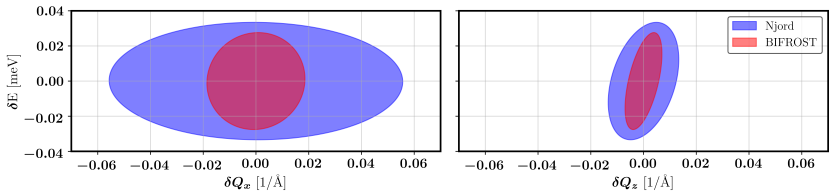

read the original abstract
Many of the most interesting scientific subjects are also the hardest to study with neutrons. Metal-organic frameworks, organic superconductors, quantum magnets, pressure-tuned materials, are systems where the relevant signals are weak, the samples are tiny, or the experiments need extreme sample environments such as pressure cells and high-field cryomagnets. Existing instruments often run into practical limits before the science is exhausted. For some questions the samples are simply too small; for others, the signal is buried in background or the required measurement time becomes prohibitive. This is both a scientific opportunity and a challenge for the European neutron scattering community. We present Njord and Remora as a paired instrument concept for the European Spallation Source (ESS). The proposal focuses on two linked problems: important science cases are being limited by neutron flux and sample geometry, and the community also needs more beamtime. Njord addresses the first by pushing the available brightness into a tightly focused beam, while Remora uses the remaining spectral window to add a complementary spectrometer on the same beamport.
Editorial analysis
A structured set of objections, weighed in public.
Referee Report
Summary. The manuscript proposes Njord and Remora as a paired instrument concept for the European Spallation Source (ESS). Njord is intended to deliver a tightly focused neutron beam to overcome flux and sample-geometry limitations for weak-signal studies (e.g., metal-organic frameworks, quantum magnets, pressure-tuned materials), while Remora exploits the remaining spectral window to operate a complementary spectrometer on the identical beamport, thereby increasing overall beamtime availability.
Significance. If the assumed optical performance and shared-beamport operation can be realized without substantial losses, the concept would address two recognized bottlenecks in neutron scattering—insufficient flux for small or extreme-environment samples and limited beamtime—potentially enabling new classes of experiments at ESS. The paired-instrument approach is a creative attempt to maximize the utility of a single beamport; however, the manuscript supplies no quantitative support for these gains, so the significance remains prospective rather than demonstrated.
major comments (1)
- Abstract: The central claim that Njord can extract a tightly focused beam while Remora simultaneously uses the remaining spectral window on the same ESS beamport, delivering net gains in signal strength and beamtime, is unsupported by any optical layout, ray-tracing results, flux estimates, resolution figures, or engineering assessment of spectral splitting or time-sharing. Without such evidence it is impossible to verify whether the assumed performance is attainable or whether major unforeseen conflicts or losses would arise.
Simulated Author's Rebuttal
We thank the referee for their careful reading and constructive feedback on our proposal manuscript. The referee correctly notes that the abstract advances a conceptual instrument pairing without quantitative optical or engineering support. We have revised the manuscript to clarify the prospective character of the claimed gains, to moderate the language in the abstract, and to add an outline of the planned validation steps.
read point-by-point responses
-
Referee: The central claim that Njord can extract a tightly focused beam while Remora simultaneously uses the remaining spectral window on the same ESS beamport, delivering net gains in signal strength and beamtime, is unsupported by any optical layout, ray-tracing results, flux estimates, resolution figures, or engineering assessment of spectral splitting or time-sharing. Without such evidence it is impossible to verify whether the assumed performance is attainable or whether major unforeseen conflicts or losses would arise.
Authors: We agree that the original abstract presented the performance advantages of the Njord-Remora pairing as if they were already demonstrated. The manuscript is a high-level scientific proposal whose primary purpose is to articulate the motivation for a new beamport-sharing concept and its potential scientific impact, not to deliver a completed instrument design. Detailed ray-tracing, flux calculations, and engineering studies of spectral splitting lie outside the scope of the present paper and are intended for subsequent technical design reports. To meet the referee's legitimate concern we have (i) rewritten the abstract to state that the gains are prospective and contingent on successful optical implementation, (ii) inserted a new section that sketches the proposed neutron-optical layout and the spectral-window partitioning scheme, and (iii) outlined the simulation strategy (McStas-based ray tracing, moderator-to-sample transport, and time-structure considerations) that will be used to quantify flux, resolution, and any cross-talk between the two instruments. These additions make the manuscript's claims commensurate with the evidence supplied while preserving its focus on the scientific case. revision: yes
Circularity Check
No circularity: conceptual proposal with no derivations or fitted quantities
full rationale
This is a forward-looking instrument proposal document rather than a derivation or modeling paper. The provided text and abstract contain no equations, no fitted parameters, no predictions derived from data subsets, and no self-citations used to justify uniqueness theorems or ansatzes. The central claims rest on qualitative descriptions of scientific needs and high-level instrument concepts; they do not reduce by construction to their own inputs. The absence of any load-bearing mathematical chain means the circularity patterns (self-definitional, fitted-input-called-prediction, etc.) are not applicable. The document is therefore self-contained against external benchmarks for the purpose of this analysis.
Axiom & Free-Parameter Ledger
axioms (1)
- domain assumption Neutron scattering experiments on certain materials are limited by available flux, sample geometry, and beamtime availability at current and planned facilities.
Reference graph
Works this paper leans on
-
[1]
The chemistry and applications of metal-organic frameworks
1H Furukawa, K. E. Cordova, M. O’Keeffe, and O. M. Yaghi, “The chemistry and applications of metal-organic frameworks”, Science341, 1230444 (2013). 2M. Alhamami, H. Doan, and C.-H. Cheng, “A review on breathing behaviors of metal-organic- frameworks (mofs) for gas adsorption”, Materials7, 3198–3250 (2014). 3S. Yuan, L. Feng, K. Wang, J. Pang, M. Bosch, C....
work page 2013
-
[2]
Fernandez-Alonso, D. D. Vos, S. Rudić, and J.-C. Tan, “Detecting molecular rotational dynam- ics complementing the low-frequency terahertz vibrations in a zirconium-based metal-organic framework”, Phys. Rev. Lett.118, 255502 (2017). 24X. Wang and Q. Zhang, “Organic quantum materials: a review”, SmartMat4, e1196 (2023). 25J. Bardeen, L. N. Cooper, and J. R...
work page 2017
-
[3]
Rapid and efficient hydrogen clathrate hydrate formation in confined nanospace
Martinez-Escandell, A. J. Ramirez-Cuesta, and J. Silvestre-Albero, “Rapid and efficient hydrogen clathrate hydrate formation in confined nanospace”, Nat. Commun.13, 5953 (2022). 14 45M. Ismail, M. Yebiyo, and I. Chaer, “A review of recent advances in emerging alternative heating and cooling technologies”, Energies14, 502 (2021). 46Y. Sun, S. An, Y. Gao, Z...
work page 2022
-
[4]
Uhlarz, T. Herrmannsdörfer, J. Wosnitza, V. Simonet, and S. Chattopadhyay, “Field-driven spin structure evolution in MnCr2S4 : A high-field single-crystal neutron diffraction study”, Phys. Rev. B110, 214416 (2024). 55H. Matsuda and T. Tsuneto, “Off-Diagonal Long-Range Order in Solids”, Prog. Theo. Phys. Suppl.46, 411–436 (1970). 56K.-S. Liu and M. E. Fish...
work page 2024
-
[5]
Giant Magnetic In-Plane Anisotropy and Competing Instabilities in Na3Co2SbO6
Zheng, Z. Ye, Y. Peng, I. A. Zaliznyak, J. M. Tranquada, and Y. Li, “Giant Magnetic In-Plane Anisotropy and Competing Instabilities in Na3Co2SbO6”, Phys. Rev. X12, 041024 (2024). 61Y. Gu, X. Li, Y. Chen, K. Iida, A. Nakao, K. Munakata, V. O. Garlea, Y. Li, G. Deng, I. A
work page 2024
-
[6]
In-plane multi-q magnetic ground state of Na3Co2SbO6
Zaliznyak, J. M. Tranquada, and Y. Li, “In-plane multi-q magnetic ground state of Na3Co2SbO6”, Phys. Rev. B109, L060410 (2024). 62Z. Hu, Y. Chen, Y. Cui, S. Li, C. Li, X. Xu, Y. Chen, X. Li, Y. Gu, R. Yu, R. Zhou, Y. Li, and W. Yu, “Field-induced phase transitions and quantum criticality in the honeycomb antiferromagnet Na3Co2SbO6”, Phys. Rev. B109, 05441...
work page 2024
-
[7]
Pressure tuning of Kitaev spin liquid candidate Na3Co2SbO6
Kumar, G. Jose, S. Samanta, W. Bi, Y. Xiao, D. Popov, Y. Wu, J.-W. Kim, H. Zheng, J. Yan, J. F. Mitchell, R. J. Hemley, and D. Haskel, “Pressure tuning of Kitaev spin liquid candidate Na3Co2SbO6”, Commun. phys.8, 310 (2025). 64R. Bewley, “The mushroom neutron spectrometer”, Nuclear Instruments and Methods in Physics Research Section A: Accelerators, Spect...
work page 2025
discussion (0)
Sign in with ORCID, Apple, or X to comment. Anyone can read and Pith papers without signing in.