Improved H\"older regularity for elliptic equations of non-divergence type in the plane
Pith reviewed 2026-05-10 15:20 UTC · model grok-4.3
The pith
Quasiregular gradient mappings for non-divergence elliptic equations in the plane attain an improved Hölder exponent.
A machine-rendered reading of the paper's core claim, the machinery that carries it, and where it could break.
Core claim
We obtain an improved Hölder regularity for quasiregular gradient mappings which was studied by Baernstein and Kovalev.
What carries the argument
Quasiregular gradient mappings of solutions, which encode the distortion-controlled mapping property that allows the improved exponent to be derived from the two-dimensional geometry and the ellipticity bounds.
If this is right
- Solutions gain a strictly better modulus of continuity for their gradients than earlier results provided.
- The improved exponent applies directly to the two-dimensional case under standard structural assumptions on the coefficients.
- The result supplies a quantitative strengthening of the continuity theory for non-divergence equations in the plane.
- The improvement can be fed into existence proofs or approximation schemes that rely on gradient continuity.
Where Pith is reading between the lines
- The same technique might yield explicit dependence of the exponent on the ellipticity ratio, which the paper leaves implicit.
- One could test whether the improved exponent persists when the coefficients are allowed to oscillate rapidly but still satisfy the ellipticity condition.
- The result raises the question of whether analogous improvements exist for systems or for equations with lower-order terms.
- A natural extension is to ask how the new exponent behaves under small perturbations of the domain or the boundary data.
Load-bearing premise
The mappings must remain quasiregular with controlled distortion and the equation coefficients must satisfy the usual boundedness and ellipticity conditions in the plane.
What would settle it
A concrete counter-example elliptic equation in the plane whose solution gradient is quasiregular but whose Hölder exponent falls below the improved value stated in the paper.
Figures
read the original abstract
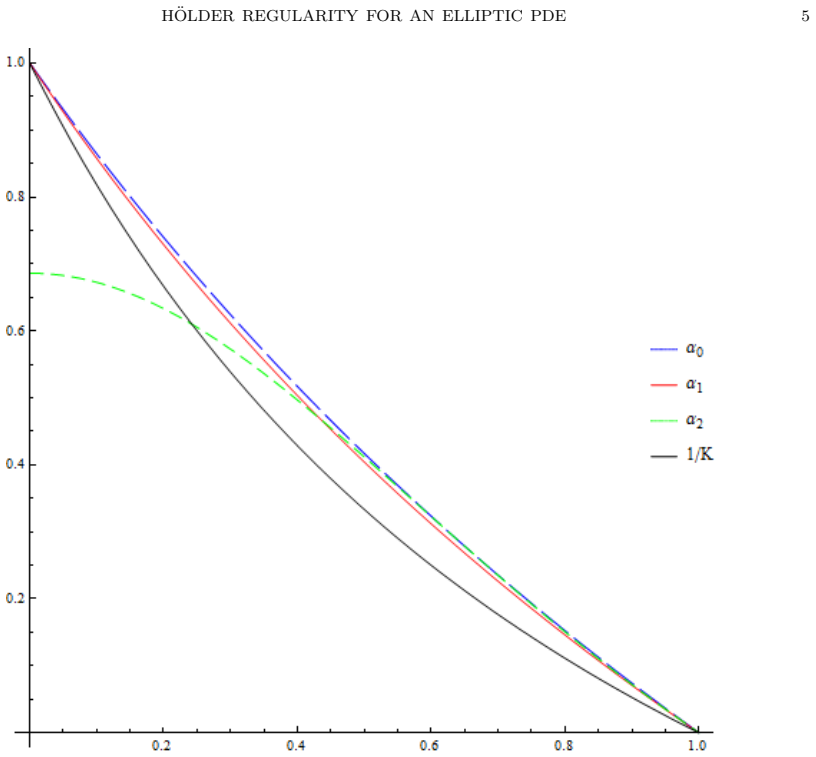
In this paper, we obtain an improved H\"older regularity for quasiregular gradient mappings which was studied by Baernstein and Kovalev.
Editorial analysis
A structured set of objections, weighed in public.
Referee Report
Summary. The manuscript claims to derive an improved Hölder regularity result for the gradients of solutions to non-divergence elliptic equations in the plane. Specifically, for quasiregular gradient mappings with distortion controlled by the ellipticity constant, the authors obtain a Hölder exponent strictly larger than that previously obtained by Baernstein and Kovalev, using a combination of quasiconformal theory and Campanato oscillation decay.
Significance. Should the result hold, it offers a modest but concrete advancement in the Hölder regularity theory for planar non-divergence elliptic equations. The improvement is obtained without altering the structural hypotheses, relying instead on refined estimates from quasiconformal mappings and iterative decay. This could be useful for applications where sharper exponents are needed, and the approach seems reproducible given the standard tools employed.
minor comments (1)
- [Abstract] The abstract is extremely concise and does not specify the improved exponent or outline the proof strategy; a slightly expanded abstract would improve accessibility.
Simulated Author's Rebuttal
We thank the referee for their positive summary of our work on improved Hölder regularity for quasiregular gradient mappings of planar non-divergence elliptic equations and for recommending minor revision. No specific major comments were provided in the report.
Circularity Check
Derivation is self-contained; no circular steps detected
full rationale
The paper obtains an improved Hölder exponent for quasiregular gradient mappings of solutions to non-divergence elliptic equations in the plane. The argument proceeds from the standard structural hypotheses (uniform ellipticity with constant K and controlled distortion via the Beltrami inequality) by reducing to quasiconformal distortion estimates and iterating a Campanato-type oscillation decay. This produces a strictly larger exponent than the Baernstein–Kovalev baseline for the same K. No equation reduces to a fitted parameter or self-definition, no load-bearing self-citation is invoked, and the steps rely on externally known distortion theory rather than the target result itself.
Axiom & Free-Parameter Ledger
Reference graph
Works this paper leans on
- [1]
- [2]
-
[3]
A. Baernstein II and L.V. Kovalev,On H¨ older regularity for elliptic equations of non-divergence type in the plane, Ann. Scuola Norm. Sup. Pisa Cl. Sci.IV(2005), 295–317
work page 2005
-
[4]
D. Gilbarg and N. S. Trudinger,Elliptic partial Differential Equations of Second OrderSpringer, 1998
work page 1998
-
[5]
J. Liu and J.-F. Zhu,Riesz conjugate functions theorem for harmonic quasiconformal mappings, Adv. Math. 434(2023), Paper No. 109321
work page 2023
-
[6]
J. Liu, P. Melentijevi´ c and J.-F. Zhu,Lp norm of truncated Riesz transform and an improved dimension-free Lp estimate for maximal Riesz transform, Math. Ann.389(2024), 3513–3534
work page 2024
-
[7]
A. Maugeri, D. K. Palagachev, L. G. Softova,Elliptic and Parabolic Equations with Discontinuous Coeffi- cientsMath. Res. 109, Wiley-VCH Verlag Berlin GmbH, Berlin, 2000
work page 2000
-
[8]
Morrey,On the solutions of quasi-linear elliptic partial differential equations, Trans
C.B. Morrey,On the solutions of quasi-linear elliptic partial differential equations, Trans. Amer. Math. Soc. 43(1938), 126–166
work page 1938
-
[9]
V¨ ais¨ al¨ a,Lectures on n-dimensional quasiconformal mappings, Springer, Berlin Heidelberg, 1971
J. V¨ ais¨ al¨ a,Lectures on n-dimensional quasiconformal mappings, Springer, Berlin Heidelberg, 1971
work page 1971
-
[10]
Vuorinen,Conformal geometry and quasiregular mappings, Springer, Berlin Heidelberg, 1988
M. Vuorinen,Conformal geometry and quasiregular mappings, Springer, Berlin Heidelberg, 1988. Zhiqiang Hou, Department of Mathematics, Shantou University, Shantou 515000, China. Email address:25zqhou@stu.edu.cn Department of Mathematics, Shantou University, Shantou, Guangdong, China Email address:flandy@stu.edu.cn
work page 1988
discussion (0)
Sign in with ORCID, Apple, or X to comment. Anyone can read and Pith papers without signing in.