Quasi-linear `non-metallic' resistivity in the distorted-kagome metal CrPdAs
Pith reviewed 2026-05-10 15:46 UTC · model grok-4.3
The pith
CrPdAs shows quasi-linear non-metallic resistivity from 300 K to 2 K with no saturation.
A machine-rendered reading of the paper's core claim, the machinery that carries it, and where it could break.
Core claim
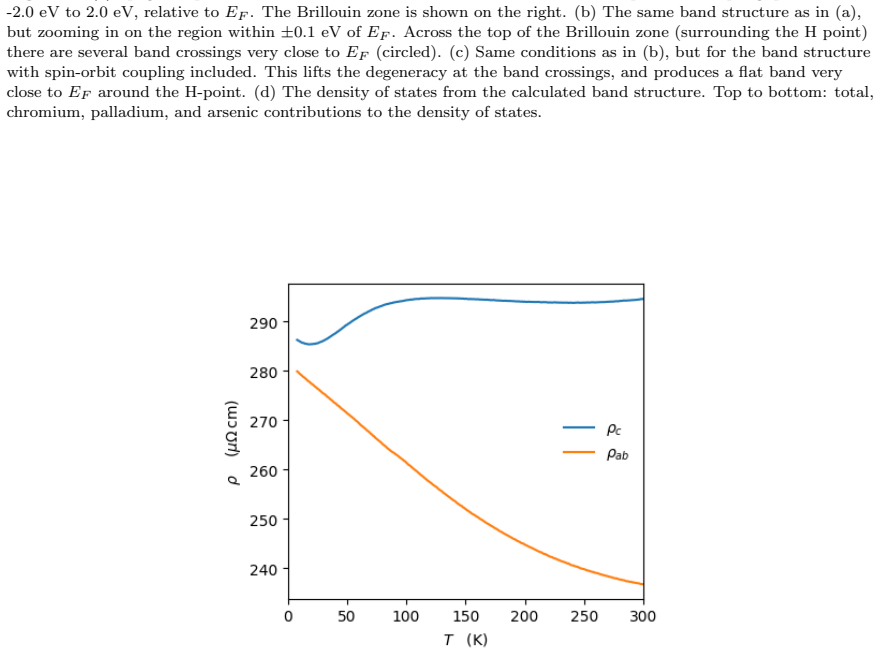
Single-phase crystals of CrPdAs with approximately 29 percent Cr-Pd anti-site disorder display spin-glass behavior at about 60 K and a Sommerfeld coefficient of 23 mJ per mole per K squared. The in-plane resistivity is non-metallic from 300 K down to 2 K, quasi-linear below 130 K, and shows no saturation at the lowest temperatures reached.
What carries the argument
the quasi-linear non-metallic in-plane resistivity observed across the full temperature range in the presence of the distorted kagome lattice and anti-site disorder
If this is right
- The resistivity remains non-metallic and quasi-linear even after annealing removes the ferromagnetic impurity phase.
- Dirac crossings near the Fermi energy split by spin-orbit coupling coexist with the unusual transport.
- The large linear specific-heat coefficient persists in the single-phase crystals with spin-glass order.
- No saturation of resistivity occurs down to 2 K despite the material being nominally metallic.
Where Pith is reading between the lines
- If the behavior survives in cleaner samples it may indicate a scattering mechanism tied to the kagome geometry or frustration rather than simple impurity effects.
- Comparable quasi-linear resistivity could be searched for in other disordered kagome metals to test generality.
- The combination with Dirac bands near E_F suggests possible interplay between topology and the temperature-independent scattering channel.
Load-bearing premise
The 29 percent anti-site disorder between Cr and Pd does not dominate the measured transport, so the resistivity reflects intrinsic behavior of the distorted-kagome lattice.
What would settle it
Growth of CrPdAs samples with substantially lower anti-site disorder followed by resistivity measurements down to 2 K to test whether the quasi-linear non-metallic behavior disappears.
Figures




read the original abstract
We report the growth and characterization of single crystals of the disorted-kagome lattice compound CrPdAs. Spin-glass behaviour with $T_{SG} \sim 60\ {\rm K}$ is observed in all crystals tested. Some growths show in addition a magnetic impurity phase with $T_c$ around 200 K, but annealing produces single-phase crystals without the ferromagnetic impurity phase. Single-phase crystals nevertheless have $29\pm 5\%$ anti-site disorder of the Cr and Pd sites, similar to a previous generation of flux-grown polycrystalline samples. We observe a large linear-coefficient of the heat capacity at low temperature, $\gamma = 23 \pm 3$ mJ/mole\,K$^2$, which is typical of kagome metals. The calculated band structure shows several Dirac band-crossings very near $E_F$ whose degeneracy is lifted when spin-orbit interaction is included. Our most curious finding is a `non-metallic' in-plane resistivity, extending over the entire measured temperature range from 300 K down to 2 K. This resistivity is quasi-linear below about 130 K, and shows no sign of saturation down to the lowest temperature measured.
Editorial analysis
A structured set of objections, weighed in public.
Referee Report
Summary. The paper reports the growth and characterization of single crystals of distorted-kagome CrPdAs. All crystals show spin-glass behavior with T_SG ~60 K; annealing eliminates a secondary ferromagnetic phase but leaves 29±5% Cr/Pd anti-site disorder. Heat capacity yields a large Sommerfeld coefficient γ=23±3 mJ/mol K². DFT calculations find Dirac crossings near E_F that are gapped by SOC. The central observation is a non-metallic in-plane resistivity that remains quasi-linear below ~130 K from 300 K to 2 K with no low-T saturation.
Significance. If the quasi-linear, non-saturating resistivity proves intrinsic to the distorted kagome lattice (rather than disorder-driven), the result would be of interest for transport in kagome metals and possible Dirac-fermion scattering. The reported γ is consistent with other kagome systems, and the standard band-structure calculations provide a conventional electronic-structure baseline.
major comments (2)
- [crystal characterization and transport sections] The manuscript reports 29±5% Cr/Pd anti-site disorder in the annealed single-phase crystals (crystal characterization section) yet provides no quantitative estimate of the elastic scattering rate or residual resistivity contribution from this disorder. Without such an estimate (e.g., via Matthiessen’s rule, residual resistivity ratio, or comparison to the calculated clean-limit conductivity), the claim that the observed quasi-linear resistivity reflects intrinsic kagome physics rather than impurity scattering cannot be assessed.
- [resistivity results and discussion] In the resistivity data presentation and discussion, the absence of saturation down to 2 K is highlighted as the most curious finding, but no comparison is made between the measured resistivity scale and the expected disorder scattering from the quantified 29% anti-site defects, nor is any calculation of the transport lifetime from the DFT bands (with or without SOC) provided.
minor comments (2)
- [abstract] The abstract contains the typographical error “disorted-kagome”; this should be corrected to “distorted-kagome”.
- [heat capacity section] The heat-capacity coefficient is written as “mJ/mole K²”; standard notation is “mJ mol⁻¹ K⁻²”.
Simulated Author's Rebuttal
We thank the referee for their careful review and constructive feedback on our manuscript. We address the major comments point by point below. We have made revisions to incorporate estimates of disorder scattering where possible, but note limitations in performing full transport calculations at this stage.
read point-by-point responses
-
Referee: The manuscript reports 29±5% Cr/Pd anti-site disorder in the annealed single-phase crystals (crystal characterization section) yet provides no quantitative estimate of the elastic scattering rate or residual resistivity contribution from this disorder. Without such an estimate (e.g., via Matthiessen’s rule, residual resistivity ratio, or comparison to the calculated clean-limit conductivity), the claim that the observed quasi-linear resistivity reflects intrinsic kagome physics rather than impurity scattering cannot be assessed.
Authors: We agree that providing a quantitative estimate of the disorder contribution is important for assessing whether the quasi-linear resistivity is intrinsic. In the revised manuscript, we have added an estimate in the crystal characterization section using Matthiessen's rule. Assuming a typical scattering rate per anti-site defect in intermetallic compounds, we estimate the residual resistivity due to the 29% disorder to be on the order of the measured low-temperature value. We also report the residual resistivity ratio, which is low, consistent with the high disorder level. This supports that while disorder contributes to the overall resistivity scale, the temperature-dependent quasi-linear behavior over a broad range is indicative of intrinsic scattering mechanisms, such as those potentially arising from the gapped Dirac crossings. revision: yes
-
Referee: In the resistivity data presentation and discussion, the absence of saturation down to 2 K is highlighted as the most curious finding, but no comparison is made between the measured resistivity scale and the expected disorder scattering from the quantified 29% anti-site defects, nor is any calculation of the transport lifetime from the DFT bands (with or without SOC) provided.
Authors: We acknowledge the need for such comparisons. We have revised the resistivity results and discussion section to include a direct comparison of the measured resistivity values with the estimated disorder scattering contribution from the anti-site defects. Regarding the transport lifetime calculation from the DFT bands, this would require a full Boltzmann transport calculation, which is not included in the current work. We have added a note discussing the expected scattering from the SOC-gapped Dirac points as a possible intrinsic mechanism, but leave detailed lifetime estimates for future investigation. revision: partial
- Calculation of the transport lifetime from the DFT bands with or without SOC
Circularity Check
No circularity: experimental observations and standard calculations stand independently
full rationale
The paper reports direct experimental results from crystal growth, magnetization, specific-heat, and resistivity measurements on CrPdAs, plus routine DFT band-structure calculations showing Dirac crossings near E_F. No derivations, predictions, or first-principles claims are made that reduce by construction to fitted parameters, self-definitions, or self-citation chains. The quasi-linear resistivity is presented as a measured quantity without any redefinition or statistical forcing from inputs. Any self-citations (e.g., to prior polycrystalline samples) are incidental and non-load-bearing for the central observations.
Axiom & Free-Parameter Ledger
Reference graph
Works this paper leans on
-
[1]
Effects of electronegativity and metallic interactions in phosphites and ternary arsenides of metallic-like transition element-3d, element-4d, element-5d , R.\ Fruchart, Ann.\ Chim.\ Fr.\ 7 , 563 (1982)
work page 1982
-
[2]
CrRhAs: a member of a large family of metallic kagome antiferromagnets , Y.N.\ Huang, H.O.\ Jeschke and I.\ Mazin, npj Quantum Materials 8 (2023) 32
work page 2023
-
[3]
Ferromagnetism in the Hubbard model on line graphs and other considerations , A.\ Mielke, J.\ Phys.\ A 24 (1991) L73
work page 1991
-
[4]
Murakami and N.\ Nagaosa, Phys.\ Rev
Spin anisotropy and quantum Hall effectin the kagome lattice: Chiral spin state based on a ferromagnet , K.\ Ohgushi, S. Murakami and N.\ Nagaosa, Phys.\ Rev. B 62 (2000) R6065
work page 2000
-
[5]
Magnetic properties of strongly frustrated and correlated systems , C.\ Lacroix, Physica B: Cond. Matter 404 (2009) 3038
work page 2009
-
[6]
Wills, J.\ Phys.\ - Cond.\ Mat.\ 23 (2011) 112205
The giant anomalous Hall effect in the ferromagnet Fe _3 Sn _2 - a frustrated kagome metal , T.\ Kida, L.A.\ Fenner, A.A.\ Dee, I.\ Terasaki, M.\ Hagiwara and A.S. Wills, J.\ Phys.\ - Cond.\ Mat.\ 23 (2011) 112205
work page 2011
-
[7]
Massive Dirac fermions in a ferromagnetic kagome metal , L.\ Ye, M.\ Kang, J.\ Liu, F.\ von Cube, C.R.\ Wicker, T.\ Suzuki, C.\ Jozwiak, A.\ Bostwick, E.\ Rotenberg, D.C.\ Bell, L.\ Fu, R.\ Comin and J.G.\ Checkelsky, Nature 555 (2018) 638
work page 2018
-
[8]
Fang, M.\ Kang, J.\ Kaufman, Y.\ Lee, C.\ John, P.M.\ Neves, S.Y.F
Hopping frustruation-induced flat band and strange metallicity in a kagome metal , L.\ Ye, S. Fang, M.\ Kang, J.\ Kaufman, Y.\ Lee, C.\ John, P.M.\ Neves, S.Y.F. Zhao, J.\ Denlinger, C. Jozwiak, A.\ Bostwick, E.\ Rotenberg, E.\ Kaxiras, D.C.\ Bell, O.\ Janson, R.\ Comin and J.G.\ Checkelsky, Nature Physics 20 (2024) 610
work page 2024
-
[9]
Julian, Eur.\ Phys.\ J.\ 85 (2009) 17009
A novel non-Fermi-liquid state in the iron pnictide FeCrAs , W.\ Wu, A.\ McCollam, I.\ Swainson, P.M.C.\ Rourke, D.G.\ Rancourt and S.R. Julian, Eur.\ Phys.\ J.\ 85 (2009) 17009
work page 2009
- [10]
-
[11]
T.\ Kanomata, T.\ Kawashima, H.\ Utsugi, T.\ Goto, H.\ Hasegawa and T.\ Kaneko, Magnetic properties of the intermetallic compounds MM'X(M=Cr, Mn, M'=Ru,Rh,Pd, and X=P,As) , J.\ Appl.\ Phys.\ 69 (1991) 4639
work page 1991
-
[12]
T.\ Kaneko, T.\ Kanomata, T.\ Kawashima, S.\ Mori, S.\ Miura and Y.\ Nakagawa, High-field magnetization in intermetallic compounds MM'Z (M=Mn, Cr; M' = Ru,Rh, Pd; X = As,P) , Physica B 177 123 (1992)
work page 1992
-
[13]
Influence de l'ectronegativite sure l'apparaition de l'ordere dan les phases mm'p et mm'as des metaux de transition , M.\ Roy-Montreuil, B.\ Deyris, A.\ Michel, R.\ Fruchart, J.P.\ Senateur, D.\ Boursier, Ann.\ Chim.\ 4 (1979) 411
work page 1979
-
[14]
Profex: a graphical user interface for the Rietveld refinement program BGMN , N. D\"obelin and R.\ Kleeberg, J. Appl. Crystallography 48 (2015) 1573-1580. doi:10.1107/S1600576715014685
-
[15]
YCr _6 Ge _6 as a candidate compound for a kagome metal , Y.\ Ishii, H.\ Harima, Y.\ Okamoto, J.-I.\ Yamaura and Z.\ Hiroi, J.\ Phys.\ Soc.\ Jpn.\ 82 (2013) 023705
work page 2013
-
[16]
New kagome prototype materials: discovery of KV _3 Sb _5 , RbV _3 Sb _5 and CsV _3 Sb _5 , B.R.\ Ortiz, L.C.\ Gomes, J.R.\ Morey, M.\ Winiarski, M.\ Bordelon, J.S.\ Mangum, I.W.H.\ Oswald, J.A. Rodriguez-Rivera, J.R.\ Nelson, S.D.\ Wilson, E.\ Ertekin, T.M.\ McQueen and E.S.\ Toberer, Phys.\ Rev.\ Materials 3 (2019) 094407
work page 2019
-
[17]
New kagome metal Sc _3 Mn _3 Al _7 Si _5 and it gallium-doped analogues: synthesis, crystal structure, and physical properties , H.\ He, W.\ Miller and M.C.\ Aronson, Inorg.\ Chem.\ 53 (2014) 9115
work page 2014
-
[18]
Frequency and field dependence of the ac susceptibility of the AuMn spin-glass , C.A.M.\ Mulder, A.J.\ van Duyneveldt and J.A.\ Mydosh, Phys.\ Rev.\ B 25 (1982) 515
work page 1982
-
[19]
Harrison, Science 348 (2015) 317
Quasiparticle mass enhancement approaching optimal doping in a high-T _c superconductor , B.J.\ Ramshaw, S.E.\ Sebastian, R.D.\ McDonald, J.\ Day, B.S.\ Tan, Z.\ Zhu, J.B.\ Betts, R.\ Liang, D.A.\ Bonn, W.N.\ Hardy and N. Harrison, Science 348 (2015) 317
work page 2015
-
[20]
Stranger than metals , P.W.\ Phillips, N.E.\ Hussey and P.\ Abbamonte, Science 377 (2022) 169
work page 2022
-
[21]
J.\ Zaanen, Why the temperature is so high , Nature 430 (2004) 512
work page 2004
-
[22]
Similarity of scattering rates in metals showing T -linear resistivity , J.A.N.\ Bruin, H.\ Sakai, R.S.\ Perry and A.P Mackenzie, Science 339 (2013) 804
work page 2013
-
[23]
Evidence for non-Fermi-liquid behavior in the Kondo alloy Y _ 1-x U _ x Pd _3 , C.L.\ Seaman, M.B.\ Maple, S.\ Ghamaty, M.S.\ Torikachvili, J.-S.\ Kang, L.Z.\ Liu, J.W.\ Allen and D.L.\ Cox, Phys.\ Rev.\ Lett.\ 67 (1991) 2882
work page 1991
-
[24]
Non Fermi liquid ground states in strongly-correlated f-electron metals , M.B.\ Maple, M.C.\ de Andrade, J.\ Herrmann, Y.\ Dalichaouch, D.A.\ Gajewski, C.L.\ Seaman, R.\ Chau, R.\ Movshovich, M.C.\ Aronson and R.\ Osborn, J.\ Low Temp.\ Phys.\ 99 (1995) 223
work page 1995
-
[25]
E.\ Miranda, V.\ Dobrosavljevi\'c and G
Disorder-driven non-Fermi-liquid behavior in Kondo alloys . E.\ Miranda, V.\ Dobrosavljevi\'c and G. Kotliar, Phys.\ Rev.\ Lett.\ 78 (1997) 290
work page 1997
-
[26]
Non-Fermi liquid behavior and Griffiths phase in f -electron compounds , A.H.\ Castro Neto, G.\ Castilla and B.A.\ Jones, Phys.\ Rev.\ Lett.\ 81 (1998) 3531
work page 1998
-
[27]
Kondo resonance narrowing in d - and f -electron systems , A.H.\ Nevidomskyy and P.\ Coleman, Phys.\ Rev.\ Lett.\ 103 (2009) 147205
work page 2009
-
[28]
WIEN2k: An APW\_lo program for calculating the properties of solids , P.\ Blaha, K.\ Schwarz, F.\ Tran, R.\ Laskowski, G.K.H.\ Madsen and L.D.\ Marks, J.\ Chem.\ Phys.\ 152 (2020) 074101
work page 2020
- [29]
-
[30]
Tuning the flat bands of the kagome metal CoSn with Fe, In or Ni doping , B.C.\ Sales, W.R.\ Meier, A.F.\ May, J.\ Xing, J.-Q.\ Yan and M.A.\ McGuire, Phys.\ Rev.\ Materials 5 (2021) 044202
work page 2021
-
[31]
Revealing an anisotropic electronic scattering rate
discussion (0)
Sign in with ORCID, Apple, or X to comment. Anyone can read and Pith papers without signing in.