The stochastic Zakharov system in dimension d geq 4: Local well-posedness and regularization by noise for scattering
Pith reviewed 2026-05-10 14:49 UTC · model grok-4.3
The pith
Non-conservative noise yields global scattering for large-data stochastic Zakharov solutions in dimensions four and higher.
A machine-rendered reading of the paper's core claim, the machinery that carries it, and where it could break.
Core claim
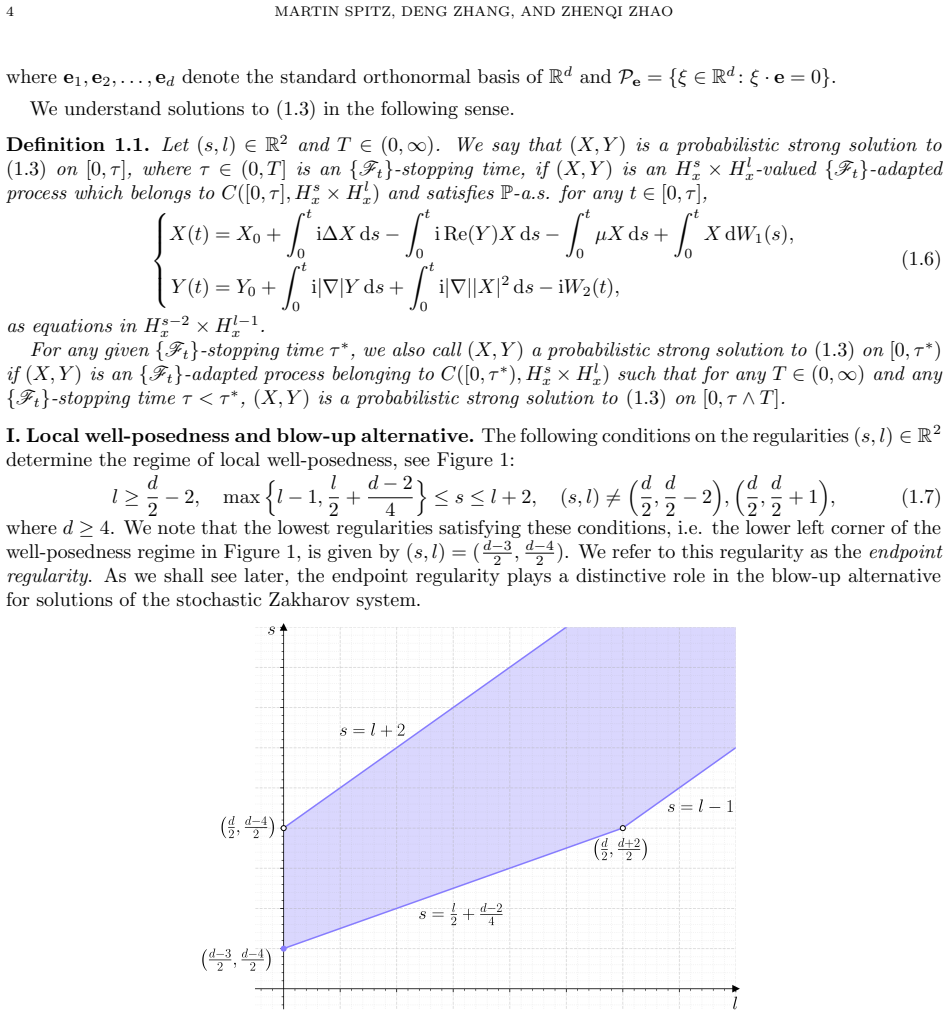
For the stochastic Zakharov system in dimensions d greater than or equal to 4, the local well-posedness theory holds in the complete deterministic regularity regime together with a blow-up alternative at the endpoint regularity. Moreover, any large initial datum evolves into a global scattering solution with high probability once non-conservative noise is added.
What carries the argument
An augmented maximal-function framework that augments adapted Fourier restriction and lateral Strichartz spaces with maximal-function estimates, allowing new trilinear bounds on the stochastic wave nonlinearity by using the temporal regularity of geometric Brownian motions in scaling-subcritical Besov spaces.
Load-bearing premise
The noise must be non-conservative and possess enough temporal regularity in scaling-subcritical Besov spaces for the new trilinear estimates to close.
What would settle it
A concrete large initial datum and choice of non-conservative noise for which the solution blows up or fails to scatter in finite time, or for which the trilinear estimates on the stochastic wave term cannot be closed.
Figures

read the original abstract
In this paper, we develop the well-posedness theory and uncover the noise-regularization effect on scattering for the stochastic Zakharov system in dimensions $d \geq 4$ and beyond the energy space. Our focus is particularly directed at the large data regime, where the global existence and long-time dynamics of the deterministic Zakharov system remain largely open. We prove the local well-posedness of the stochastic system in the full deterministic regularity regime and establish a blow-up alternative at the endpoint regularity, which implies the persistence of regularity in the full well-posedness regime. Furthermore, we prove that for any large initial data, with high probability, non-conservative noise yields global and scattering solutions. Our proof introduces a tailored functional framework. To establish local well-posedness, we employ a refinement of adapted Fourier restriction and lateral Strichartz spaces, which allows us to control both the nonlinear interactions and the critical first-order derivative perturbations arising from rescaling transforms. To achieve the noise-regularization effect, we augment this setting with maximal function spaces. We derive new trilinear estimates for the stochastic wave nonlinearity that are crucial for the global dynamics by fully exploiting the temporal regularity of geometric Brownian motions in scaling-(sub)critical Besov spaces.
Editorial analysis
A structured set of objections, weighed in public.
Referee Report
Summary. The paper develops local well-posedness for the stochastic Zakharov system in d ≥ 4 beyond the energy space via a tailored functional framework that refines adapted Fourier restriction and lateral Strichartz spaces. It establishes a blow-up alternative at endpoint regularity and proves that non-conservative noise, exploiting the temporal regularity of geometric Brownian motion in scaling-(sub)critical Besov spaces, yields global existence and scattering with high probability for arbitrary large initial data, using augmentation by maximal-function spaces and new trilinear estimates on the stochastic wave nonlinearity.
Significance. If the new trilinear estimates close without loss, the result would be significant: it supplies the first high-probability global scattering statement for large-data stochastic Zakharov in d ≥ 4, where the deterministic problem remains open, and introduces a functional setting that combines Strichartz, Besov, and maximal-function norms in a way that may extend to other stochastic dispersive systems.
major comments (1)
- The new trilinear estimates for the stochastic wave nonlinearity (obtained after augmenting the lateral Strichartz setting with maximal-function spaces) are load-bearing for the high-probability global/scattering claim. The manuscript must supply the precise statement of these estimates, including the precise range of Besov indices and the explicit dependence on the temporal regularity parameter of the geometric Brownian motion, so that the reader can verify that no derivative loss or constant blow-up occurs when closing the fixed-point argument for large data.
minor comments (2)
- The introduction should include a short table or paragraph comparing the regularity thresholds obtained here with the best-known deterministic Zakharov results in d ≥ 4.
- Notation for the augmented maximal-function spaces (norms, time-localization, and stochastic integrability) should be collected in a single preliminary subsection for easier reference.
Simulated Author's Rebuttal
We thank the referee for their careful reading of the manuscript and for the constructive major comment. We address it point by point below and will revise the paper accordingly to improve clarity and verifiability.
read point-by-point responses
-
Referee: The new trilinear estimates for the stochastic wave nonlinearity (obtained after augmenting the lateral Strichartz setting with maximal-function spaces) are load-bearing for the high-probability global/scattering claim. The manuscript must supply the precise statement of these estimates, including the precise range of Besov indices and the explicit dependence on the temporal regularity parameter of the geometric Brownian motion, so that the reader can verify that no derivative loss or constant blow-up occurs when closing the fixed-point argument for large data.
Authors: We agree that the precise statement of the new trilinear estimates is necessary for the reader to verify the closure of the fixed-point argument without derivative loss. In the revised manuscript we will add an explicit proposition stating these estimates. The statement will specify the full range of Besov indices in the scaling-(sub)critical regime (including the precise lower and upper bounds relative to the critical index) and the explicit dependence on the temporal regularity parameter of the geometric Brownian motion. We will also include a short remark confirming that the constants remain uniform for large data and that no derivative loss occurs when the estimates are applied to the augmented functional setting. revision: yes
Circularity Check
No circularity in derivation chain
full rationale
The paper establishes local well-posedness and high-probability global scattering for the stochastic Zakharov system via a tailored functional framework combining refined adapted Fourier restriction norms, lateral Strichartz spaces, maximal-function augmentation, and new trilinear estimates that exploit temporal regularity of geometric Brownian motion in Besov spaces. These steps rely on external Strichartz and Besov estimates plus standard properties of the noise, without any reduction of a claimed prediction or theorem to a fitted parameter, self-definition, or load-bearing self-citation chain. The derivation remains self-contained against standard analytic benchmarks.
Axiom & Free-Parameter Ledger
axioms (2)
- standard math Strichartz estimates and Sobolev embeddings hold in dimensions d >= 4 for the wave and Schrödinger propagators
- domain assumption Geometric Brownian motion possesses sufficient temporal regularity in scaling-subcritical Besov spaces
Reference graph
Works this paper leans on
- [1]
- [2]
- [3]
-
[4]
G. Barru´ e, A. de Bouard, and A. Debussche. From stochastic zakharov system to multiplicative sto- chastic nonlinear schr¨ odinger equation.Stochastics and Partial Differential Equations: Analysis and Computations, pages 1–45, 2025
work page 2025
-
[5]
I. Bejenaru, Z. Guo, S. Herr, and K. Nakanishi. Well-posedness and scattering for the Zakharov system in four dimensions.Anal. PDE, 8(8):2029–2055, 2015
work page 2029
-
[6]
I. Bejenaru, A. D. Ionescu, C. E. Kenig, and D. Tataru. Global Schr¨ odinger maps in dimensionsd≥2: small data in the critical Sobolev spaces.Ann. of Math. (2), 173(3):1443–1506, 2011
work page 2011
- [7]
-
[8]
J. Bourgain and J. Colliander. On wellposedness of the Zakharov system.Internat. Math. Res. Notices, 1996(11):515–546, 1996
work page 1996
-
[9]
B. Bringmann, Y. Deng, A. R. Nahmod, and H. Yue. Invariant Gibbs measures for the three dimensional cubic nonlinear wave equation.Invent. Math., 236(3):1133–1411, 2024
work page 2024
-
[10]
Z. Brze´ zniak, B. Ferrario, M. Maurelli, and M. Zanella. Global well posedness and ergodic results in regular sobolev spaces for the nonlinear schr¨ odinger equation with multiplicative noise and arbitrary power of the nonlinearity, 2024
work page 2024
-
[11]
N. Burq and N. Tzvetkov. Random data Cauchy theory for supercritical wave equations. I. Local theory. Invent. Math., 173(3):449–475, 2008
work page 2008
-
[12]
T. Candy. Concentration compactness for the energy critical Zakharov system.Discrete Contin. Dyn. Syst., 44(5):1395–1445, 2024
work page 2024
- [13]
- [14]
-
[15]
J. Colliander, J. Holmer, and N. Tzirakis. Low regularity global well-posedness for the Zakharov and Klein-Gordon-Schr¨ odinger systems.Trans. Amer. Math. Soc., 360(9):4619–4638, 2008
work page 2008
-
[16]
G. Da Prato, F. Flandoli, M. R¨ ockner, and A. Y. Veretennikov. Strong uniqueness for SDEs in Hilbert spaces with nonregular drift.Ann. Probab., 44(3):1985–2023, 2016
work page 1985
-
[17]
A. Debussche and L. Di Menza. Numerical resolution of stochastic focusing NLS equations.Appl. Math. Lett., 15(6):661–669, 2002
work page 2002
-
[18]
A. Debussche and L. Di Menza. Numerical simulation of focusing stochastic nonlinear Schr¨ odinger equations.Phys. D, 162(3-4):131–154, 2002
work page 2002
-
[19]
A. Debussche and Y. Tsutsumi. 1D quintic nonlinear Schr¨ odinger equation with white noise dispersion. J. Math. Pures Appl. (9), 96(4):363–376, 2011
work page 2011
-
[20]
Y. Deng, A. R. Nahmod, and H. Yue. Invariant Gibbs measures and global strong solutions for nonlinear Schr¨ odinger equations in dimension two.Ann. of Math. (2), 200(2):399–486, 2024
work page 2024
-
[21]
F. Flandoli, M. Gubinelli, and E. Priola. Well-posedness of the transport equation by stochastic per- turbation.Invent. Math., 180(1):1–53, 2010
work page 2010
-
[22]
F. Flandoli and D. Luo. High mode transport noise improves vorticity blow-up control in 3D Navier- Stokes equations.Probab. Theory Related Fields, 180(1-2):309–363, 2021
work page 2021
-
[23]
P. Gassiat and B. Gess. Regularization by noise for stochastic hamilton–jacobi equations.Probability Theory and Related Fields, 173(3):1063–1098, 2019
work page 2019
-
[24]
J. Ginibre, Y. Tsutsumi, and G. Velo. On the Cauchy problem for the Zakharov system.J. Funct. Anal., 151(2):384–436, 1997
work page 1997
-
[25]
L. Glangetas and F. Merle. Concentration properties of blow-up solutions and instability results for Zakharov equation in dimension two. II.Comm. Math. Phys., 160(2):349–389, 1994
work page 1994
-
[26]
L. Glangetas and F. Merle. Existence of self-similar blow-up solutions for Zakharov equation in dimen- sion two. I.Comm. Math. Phys., 160(1):173–215, 1994
work page 1994
-
[27]
Z. Guo, S. Lee, K. Nakanishi, and C. Wang. Generalized Strichartz estimates and scattering for 3D Zakharov system.Comm. Math. Phys., 331(1):239–259, 2014. 70 MARTIN SPITZ, DENG ZHANG, AND ZHENQI ZHAO
work page 2014
- [28]
-
[29]
Z. Guo, K. Nakanishi, and S. Wang. Global dynamics below the ground state energy for the Zakharov system in the 3D radial case.Adv. Math., 238:412–441, 2013
work page 2013
-
[30]
Z. Hani, F. Pusateri, and J. Shatah. Scattering for the Zakharov system in 3 dimensions.Comm. Math. Phys., 322(3):731–753, 2013
work page 2013
- [31]
-
[32]
S. Herr, M. R¨ ockner, M. Spitz, and D. Zhang. The three-dimensional stochastic Zakharov system.Ann. Probab., 53(3):848–905, 2025
work page 2025
-
[33]
S. Herr, M. R¨ ockner, and D. Zhang. Scattering for stochastic nonlinear Schr¨ odinger equations.Comm. Math. Phys., 368(2):843–884, 2019
work page 2019
-
[34]
T. Hyt¨ onen, J. van Neerven, M. Veraar, and L. Weis.Analysis in Banach spaces. Vol. III. Harmonic analysis and spectral theory, volume 76 ofErgebnisse der Mathematik und ihrer Grenzgebiete. 3. Folge. A Series of Modern Surveys in Mathematics [Results in Mathematics and Related Areas. 3rd Series. A Series of Modern Surveys in Mathematics]. Springer, Cham,...
work page 2023
-
[35]
A. D. Ionescu and C. E. Kenig. Low-regularity Schr¨ odinger maps. II. Global well-posedness in dimensions d≥3.Comm. Math. Phys., 271(2):523–559, 2007
work page 2007
-
[36]
O. Kallenberg.Foundations of modern probability, volume 99 ofProbability Theory and Stochastic Modelling. Springer, Cham, third edition, [2021]©2021
work page 2021
-
[37]
C. E. Kenig, G. Ponce, and L. Vega. On the Zakharov and Zakharov-Schulman systems.J. Funct. Anal., 127(1):204–234, 1995
work page 1995
-
[38]
J. Krieger and T. Schmid. Finite time blow up for the energy critical Zakharov system I: approximate solutions.arXiv:2407.19971, 2024
-
[39]
J. Krieger and T. Schmid. Finite time blow up for the energy critical Zakharov system II: exact solutions. arXiv:2407.19972, 2024
-
[40]
N. V. Krylov and M. R¨ ockner. Strong solutions of stochastic equations with singular time dependent drift.Probab. Theory Related Fields, 131(2):154–196, 2005
work page 2005
-
[41]
N. Masmoudi and K. Nakanishi. Energy convergence for singular limits of Zakharov type systems. Invent. Math., 172(3):535–583, 2008
work page 2008
-
[42]
F. Merle. Blow-up results of virial type for Zakharov equations.Comm. Math. Phys., 175(2):433–455, 1996
work page 1996
-
[43]
T. Oh, P. Sosoe, and L. Tolomeo. Optimal integrability threshold for Gibbs measures associated with focusing NLS on the torus.Invent. Math., 227(3):1323–1429, 2022
work page 2022
-
[44]
T. Ozawa and Y. Tsutsumi. The nonlinear Schr¨ odinger limit and the initial layer of the Zakharov equations.Differential Integral Equations, 5(4):721–745, 1992
work page 1992
- [45]
-
[46]
S. H. Schochet and M. I. Weinstein. The nonlinear Schr¨ odinger limit of the Zakharov equations governing Langmuir turbulence.Comm. Math. Phys., 106(4):569–580, 1986
work page 1986
-
[47]
M. Spitz. Randomized final-state problem for the Zakharov system in dimension three.Comm. Partial Differential Equations, 47(2):346–377, 2022
work page 2022
- [48]
- [49]
-
[50]
V. E. Zakharov. Collapse of langmuir waves.Sov. Phys. JETP, 35(5):908–914, 1972
work page 1972
-
[51]
D. Zhang. Optimal bilinear control of stochastic nonlinear Schr¨ odinger equations: mass-(sub)critical case.Probab. Theory Related Fields, 178(1-2):69–120, 2020. 71 (Martin Spitz)F akult¨at f ¨ur Mathematik, Universit ¨at Bielefeld, D-33501 Bielefeld, Germany Email address:mspitz@math.uni-bielefeld.de (Deng Zhang)School of Mathematical Sciences, MOE-LSC, ...
work page 2020
discussion (0)
Sign in with ORCID, Apple, or X to comment. Anyone can read and Pith papers without signing in.