Classification and correlation signatures of chiral spin liquids on the pyrochlore lattice
Pith reviewed 2026-05-10 15:54 UTC · model grok-4.3
The pith
Chiral spin liquids on the pyrochlore lattice fall into distinct classes distinguished by the strength of emergent U(1) gauge fields, shown in the geometry and contrast of pinch-point singularities.
A machine-rendered reading of the paper's core claim, the machinery that carries it, and where it could break.
Core claim
We present a systematic classification and variational study of chiral quantum spin liquids on the pyrochlore lattice based on fermionic parton constructions. Focusing on chiral U(1) and Z2 spin-liquid Ansätze, we characterize their symmetry properties, flux structures, and low-energy spinon spectra within a projective symmetry group framework, and incorporate gauge fluctuations through Gutzwiller-projected wave functions studied by variational Monte Carlo. From the equal-time spin structure factor, we develop correlation-based diagnostics that distinguish gauge-dominated Coulomb phases from states with substantial matter-field and short-range contributions. Distinct chiral flux sectors,虽虽虽虽
What carries the argument
Pinch-point singularities in the equal-time spin structure factor, whose geometry and contrast serve as diagnostics for the degree of emergent U(1) gauge-field dominance in each chiral flux sector.
Load-bearing premise
The Gutzwiller-projected fermionic wave functions and variational Monte Carlo sampling accurately capture the low-energy physics and correlation signatures of the target chiral spin-liquid states.
What would settle it
Unbiased simulations such as quantum Monte Carlo or tensor-network methods on the same models that produce spin structure factors lacking the predicted differences in pinch-point contrast and geometry for the corresponding flux sectors would falsify the distinction in gauge dominance.
Figures



read the original abstract
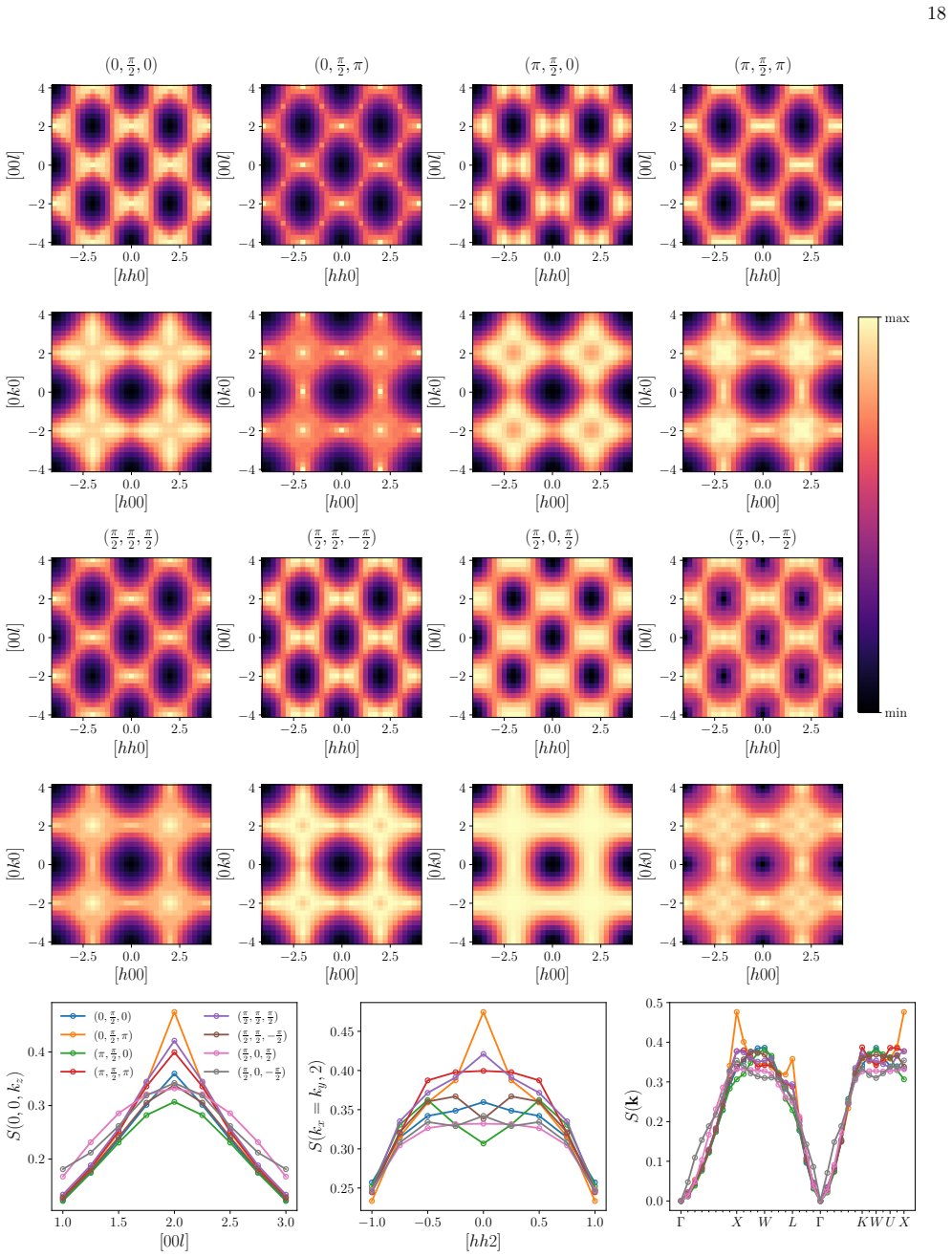
We present a systematic classification and variational study of chiral quantum spin liquids on the pyrochlore lattice based on fermionic parton constructions. Focusing on chiral $\mathrm{U(1)}$ and $\mathbb{Z}_2$ spin-liquid Ans\"atze, we characterize their symmetry properties, flux structures, and low-energy spinon spectra within a projective symmetry group framework, and incorporate gauge fluctuations through Gutzwiller-projected wave functions studied by variational Monte Carlo. From the equal-time spin structure factor, we develop correlation-based diagnostics that distinguish gauge-dominated Coulomb phases from states with substantial matter-field and short-range contributions. Distinct chiral flux sectors, though close in energy, exhibit markedly different degrees of emergent $\mathrm{U(1)}$ gauge-field dominance, reflected in the geometry and contrast of pinch-point singularities. Although these states are not competitive ground states of the nearest-neighbor Heisenberg model, they define a physically meaningful family of proximate chiral phases relevant to extended pyrochlore Hamiltonians.
Editorial analysis
A structured set of objections, weighed in public.
Referee Report
Summary. The paper classifies chiral U(1) and Z2 quantum spin liquids on the pyrochlore lattice via fermionic parton constructions in the projective symmetry group (PSG) framework. It characterizes symmetry properties, flux structures, and spinon spectra for various chiral flux sectors, then incorporates gauge fluctuations by constructing Gutzwiller-projected wave functions and evaluating them with variational Monte Carlo (VMC). From the resulting equal-time spin structure factors, the authors introduce correlation diagnostics based on the geometry and contrast of pinch-point singularities to distinguish gauge-dominated Coulomb phases from those with substantial matter-field or short-range contributions. They report that distinct chiral flux sectors, although close in variational energy, display markedly different degrees of emergent U(1) gauge-field dominance and note that these states are not competitive ground states of the nearest-neighbor Heisenberg model but may be relevant for extended pyrochlore Hamiltonians.
Significance. If the VMC-based diagnostics reliably separate the flux sectors by emergent gauge dominance, the work supplies a concrete, correlation-function-based toolkit for identifying and distinguishing proximate chiral spin-liquid phases on the pyrochlore lattice. The systematic PSG classification and the explicit construction of projected wave functions constitute a useful reference for future studies of extended models or material candidates.
major comments (2)
- [VMC results and correlation diagnostics (inferred from abstract and § on numerical evaluation)] The central claim that distinct chiral flux sectors exhibit markedly different degrees of emergent U(1) gauge-field dominance rests on the geometry and contrast of pinch-point singularities in the equal-time spin structure factor. However, the manuscript provides no quantitative measures (e.g., contrast ratios, integrated intensities, or finite-size scaling) nor error bars from the VMC sampling, rendering the reported differences difficult to assess for robustness. This is load-bearing because the diagnostics are the primary evidence distinguishing the sectors.
- [Gutzwiller projection and VMC methodology] The assumption that Gutzwiller projection and VMC sampling faithfully preserve the mean-field flux sectors' low-energy gauge physics without substantial contamination from matter fields or finite-size effects is not verified against known limits. No comparisons to the unprojected mean-field structure factors, to exact diagonalization on small clusters, or to established U(1) spin-liquid benchmarks are reported, which directly affects the reliability of the pinch-point proxy for gauge dominance.
minor comments (2)
- [Classification section] Notation for the PSG labels and flux sectors could be made more uniform across the classification tables and the numerical sections to aid readability.
- [Introduction or discussion] The abstract states that the states are 'not competitive ground states' of the nearest-neighbor Heisenberg model; a brief quantitative comparison of variational energies to the known Heisenberg ground-state energy per site would strengthen this statement.
Simulated Author's Rebuttal
We thank the referee for their careful reading of our manuscript and for the constructive comments. We appreciate the positive assessment of the work's potential utility. We address each major comment below and describe the revisions we will implement to strengthen the presentation.
read point-by-point responses
-
Referee: [VMC results and correlation diagnostics (inferred from abstract and § on numerical evaluation)] The central claim that distinct chiral flux sectors exhibit markedly different degrees of emergent U(1) gauge-field dominance rests on the geometry and contrast of pinch-point singularities in the equal-time spin structure factor. However, the manuscript provides no quantitative measures (e.g., contrast ratios, integrated intensities, or finite-size scaling) nor error bars from the VMC sampling, rendering the reported differences difficult to assess for robustness. This is load-bearing because the diagnostics are the primary evidence distinguishing the sectors.
Authors: We agree that quantitative measures are needed to allow readers to assess the robustness of the differences in pinch-point features. In the revised manuscript we will add explicit contrast ratios, integrated intensities around the pinch points, and statistical error bars obtained from the VMC sampling. We will also include finite-size scaling analysis for the key diagnostics where the computational cost permits. revision: yes
-
Referee: [Gutzwiller projection and VMC methodology] The assumption that Gutzwiller projection and VMC sampling faithfully preserve the mean-field flux sectors' low-energy gauge physics without substantial contamination from matter fields or finite-size effects is not verified against known limits. No comparisons to the unprojected mean-field structure factors, to exact diagonalization on small clusters, or to established U(1) spin-liquid benchmarks are reported, which directly affects the reliability of the pinch-point proxy for gauge dominance.
Authors: We acknowledge that direct validation against known limits would increase in the methodology. In the revised version we will add comparisons between the Gutzwiller-projected and unprojected mean-field spin structure factors, results from exact diagonalization on small clusters, and benchmarks against established U(1) spin-liquid states on the pyrochlore lattice to demonstrate that the essential gauge physics is preserved. revision: yes
Circularity Check
No circularity: classification and pinch-point diagnostics are independent of input Ansätze
full rationale
The paper classifies chiral U(1) and Z2 spin-liquid Ansätze on the pyrochlore lattice via projective symmetry group analysis of fermionic parton constructions, then evaluates equal-time spin structure factors from Gutzwiller-projected wave functions using variational Monte Carlo. The correlation-based diagnostics for U(1) gauge dominance (geometry and contrast of pinch points) are extracted from these computed structure factors rather than being tautological with the mean-field flux sectors. No step reduces by construction to the inputs; the numerical results supply independent content. Any self-citations are not load-bearing for the central claims, and the derivation remains self-contained against external benchmarks.
Axiom & Free-Parameter Ledger
axioms (2)
- domain assumption Fermionic parton representation faithfully encodes the spin-1/2 Hilbert space when projected
- domain assumption Projective symmetry group analysis correctly labels distinct spin-liquid phases by their flux patterns
Reference graph
Works this paper leans on
-
[1]
Due to three-fold rotation symmetries2, all four tri- angle faces of a tetrahedron must have the same flux (ϕ for up tetrahedron andϕ for down tetra- hedron). Given that the sum of four triangle fluxes must be multiples of 2π, the triangle flux can only beϕ , = 0, πorϕ , =±π/2 (ϕ andϕ are inde- pendent at this point), corresponding to Φ , =∀ in the former...
-
[2]
down” triangle faces, which is opposite to that for the “up
We see from Table I that Φ =π/2 breaks time-reversal symmetry, and can only appear in the classes (IT, S, @T) and (I, ST, @T). Specifi- cally, Φ = Φ =±π/2 can only appear in class (IT, S, @T), while Φ =−Φ =±π/2 can only ap- pear in class (I, ST, @T). 3.ϕ ,ϕ / , andϕ are not all independent; they are constrained by ϕ =ϕ +ϕ −ϕ ,(29) here the minus sign in f...
-
[3]
We can then enumerate all the possible values forϕ , , to obtain the complete set of NN spin- singlet states: (ϕ , ϕ , ϕ ) = (ϕ 1,0,0), (ϕ 1,0, π), (ϕ1, π 2 , π 2 ), (ϕ1, π 2 ,− π 2 ) withϕ 1 = 0,π, or π 2 . The NN spin-singlet states resulting from these general rules are given in Table VI. The U(1) PSG classification correctly produces these states, as ...
-
[4]
[40] and further analyzed in Ref
Monopole flux state and nodal line spin liquids The (0, π/2,0) state corresponds to the monopole flux state introduced in Ref. [40] and further analyzed in Ref. [27]. In this configuration all triangular plaquettes carry the same chiral fluxπ/2, while the hexagon flux vanishes. As a result, each tetrahedron encloses a net 2πgauge flux, which can be interp...
-
[5]
[41], up to unitary transformations (see Appendix A)
Staggered flux state and gappedU(1)spin liquids The (π, π/2,0) state defined here can be identified with the staggered flux (SF) state introduced in Ref. [41], up to unitary transformations (see Appendix A). The feature of this state is that the triangular plaquettes on up and down tetrahedra carry opposite chiral fluxes±π/2, while the hexagon flux vanish...
-
[6]
Energetics We now turn to the variational Monte Carlo (VMC) evaluation of the ground-state energies of the eight U(1) chiral spin-liquidAns¨ atzeintroduced above. The result- ing energies, summarized in Table VIII, are systemati- cally higher than those obtained from state-of-the-art nu- merical approaches such as exact diagonalization, tensor- network me...
-
[7]
Equal-time spin structure factors The equal-time spin structure factor S(q) = 1 N X i,j e−iq·(ri−rj)⟨ˆSi · ˆSj⟩(36) provides a principal probe of magnetic correlations in frustrated quantum magnets and plays a particularly im- portant role in diagnosing Coulomb phases on the py- rochlore lattice. In contrast to magnetically ordered states, which exhibit B...
work page 2048
-
[8]
M. Hermele, M. P. A. Fisher, and L. Balents, Py- rochlore Photons: TheU(1) spin Liquid in aS= 1 2 Three-Dimensional Frustrated Magnet, Phys. Rev. B69, 064404 (2004)
work page 2004
-
[9]
C. L. Henley, Ordering due to Disorder in a Frus- trated Vector Antiferromagnet, Phys. Rev. Lett.62, 2056 (1989)
work page 2056
-
[10]
J. N. Reimers, A. J. Berlinsky, and A.-C. Shi, Mean-Field Approach to Magnetic Ordering in Highly Frustrated Py- rochlores, Phys. Rev. B43, 865 (1991)
work page 1991
-
[11]
B. Canals and C. Lacroix, Pyrochlore Antiferromagnet: A Three-Dimensional Quantum Spin Liquid, Phys. Rev. Lett.80, 2933 (1998)
work page 1998
-
[12]
B. Canals and C. Lacroix, Quantum Spin Liquid: The Heisenberg Antiferromagnet on the Three-Dimensional Pyrochlore Lattice, Phys. Rev. B61, 1149 (2000)
work page 2000
-
[13]
H. Yan, O. Benton, L. D. C. Jaubert, and N. Shannon, Rank–2u(1) spin liquid on the breathing pyrochlore lat- tice, Phys. Rev. Lett.124, 127203 (2020)
work page 2020
-
[14]
D. Lozano-G´ omez, O. Benton, M. J. P. Gingras, and H. Yan, An Atlas of Classical Pyrochlore Spin Liquids (2025), arXiv:2411.03547 [cond-mat.str-el]
-
[15]
V. Kalmeyer and R. B. Laughlin, Equivalence of the resonating-valence-bond and fractional quantum Hall states, Phys. Rev. Lett.59, 2095 (1987)
work page 2095
-
[16]
X. G. Wen, F. Wilczek, and A. Zee, Chiral spin states and superconductivity, Phys. Rev. B39, 11413 (1989)
work page 1989
-
[17]
X. G. Wen, Mean-field theory of spin-liquid states with finite energy gap and topological orders, Phys. Rev. B 44, 2664 (1991)
work page 1991
-
[18]
R. B. Laughlin and Z. Zou, Properties of the chiral-spin- liquid state, Phys. Rev. B41, 664 (1990)
work page 1990
-
[19]
A. Tikofsky, S. Libby, and R. Laughlin, Gauge theory of the three-dimensional chiral spin liquid, Nucl. Phys. B 413, 579 (1994)
work page 1994
- [20]
- [21]
- [22]
-
[23]
J.-C. Domenge, P. Sindzingre, C. Lhuillier, and L. Pierre, Twelve Sublattice Ordered Phase in theJ 1-J2 Model on the Kagom´ e Lattice, Phys. Rev. B72, 024433 (2005)
work page 2005
-
[24]
J.-C. Domenge, C. Lhuillier, L. Messio, L. Pierre, and P. Viot, Chirality andZ 2 vortices in a Heisenberg spin model on the kagome lattice, Phys. Rev. B77, 172413 (2008)
work page 2008
- [25]
- [26]
-
[27]
S.-S. Gong, W. Zhu, L. Balents, and D. N. Sheng, Global phase diagram of competing ordered and quantum spin- liquid phases on the kagome lattice, Phys. Rev. B91, 075112 (2015)
work page 2015
-
[28]
W.-J. Hu, W. Zhu, Y. Zhang, S. Gong, F. Becca, and D. N. Sheng, Variational Monte Carlo study of a chi- ral spin liquid in the extended Heisenberg model on the kagome lattice, Phys. Rev. B91, 041124 (2015)
work page 2015
-
[29]
A. Wietek and A. M. L¨ auchli, Chiral spin liquid and quantum criticality in extendedS= 1 2 Heisenberg mod- els on the triangular lattice, Phys. Rev. B95, 035141 (2017)
work page 2017
- [30]
-
[31]
T. Cookmeyer, J. Motruk, and J. E. Moore, Four-Spin Terms and the Origin of the Chiral Spin Liquid in Mott Insulators on the Triangular Lattice, Phys. Rev. Lett. 127, 087201 (2021)
work page 2021
-
[32]
Y. Liu, W. Hou, X. Han, and J. Zang, Three-Dimensional Dynamics of a Magnetic Hopfion Driven by Spin Transfer Torque, Phys. Rev. Lett.124, 127204 (2020)
work page 2020
-
[33]
C. Naya, D. Schubring, M. Shifman, and Z. Wang, Skyrmions and hopfions in three-dimensional frustrated magnets, Phys. Rev. B106, 094434 (2022)
work page 2022
-
[34]
C. Liu, G. B. Hal´ asz, and L. Balents, Symmetric U(1) andZ 2 spin liquids on the pyrochlore lattice, Phys. Rev. B104, 054401 (2021)
work page 2021
-
[35]
K. C. Sahu and S. Sanyal, U(1) quantum spin liquids in dipolar-octupolar pyrochlore magnets: A fermionic par- ton approach, Phys. Rev. B110, 115144 (2024)
work page 2024
-
[36]
B. Schneider, J. C. Halimeh, and M. Punk, Projective symmetry group classification of chiralZ 2 spin liquids on the pyrochlore lattice: Application to the spin- 1 2 XXZ Heisenberg model, Phys. Rev. B105, 125122 (2022)
work page 2022
- [37]
-
[38]
I. Hagym´ asi, R. Sch¨ afer, R. Moessner, and D. J. Luitz, Possible Inversion Symmetry Breaking in theS= 1/2 Pyrochlore Heisenberg Magnet, Phys. Rev. Lett.126, 117204 (2021)
work page 2021
-
[39]
N. Astrakhantsev, T. Westerhout, A. Tiwari, K. Choo, A. Chen, M. H. Fischer, G. Carleo, and T. Neu- pert, Broken-Symmetry Ground States of the Heisen- berg Model on the Pyrochlore Lattice, Phys. Rev. X11, 041021 (2021)
work page 2021
- [40]
-
[41]
R. Sch¨ afer, B. Placke, O. Benton, and R. Moessner, Abundance of Hard-Hexagon Crystals in the Quan- tum Pyrochlore Antiferromagnet, Phys. Rev. Lett.131, 096702 (2023)
work page 2023
- [42]
-
[43]
R. Cheng and T. Li, Closely competing valence bond crystal orders in the ground state of the spin- 1 2 anti- ferromagnetic Heisenberg model on the pyrochlore lat- tice: a large scale unrestricted variational study (2025), arXiv:2509.13746 [cond-mat.str-el]
-
[44]
C. Liu, G. B. Hal´ asz, and L. Balents, Competing orders in pyrochlore magnets from aZ 2 spin liquid perspective, Phys. Rev. B100, 075125 (2019)
work page 2019
-
[45]
D. B. Litvin, Magnetic group tables, International Union of Crystallography10, 9780955360220001 (2013)
work page 2013
- [46]
-
[47]
F. J. Burnell, S. Chakravarty, and S. L. Sondhi, Monopole Flux State on the Pyrochlore Lattice, Phys. Rev. B79, 144432 (2009)
work page 2009
-
[48]
J. H. Kim and J. H. Han, Chiral Spin States in the Pyrochlore Heisenberg Magnet: Fermionic Mean-Field Theory and Variational Monte Carlo Calculations, Phys. Rev. B78, 180410 (2008)
work page 2008
- [49]
-
[50]
F. Becca and S. Sorella,Quantum Monte Carlo Ap- proaches for Correlated Systems(Cambridge University Press, Cambridge, England, 2017)
work page 2017
-
[51]
V. R. Chandra and J. Sahoo, Spin- 1 2 Heisenberg antifer- romagnet on the pyrochlore lattice: An exact diagonal- ization study, Phys. Rev. B97, 144407 (2018)
work page 2018
-
[52]
P. M¨ uller, A. Lohmann, J. Richter, and O. Derzhko, Thermodynamics of the pyrochlore-lattice quantum Heisenberg antiferromagnet, Phys. Rev. B100, 024424 (2019)
work page 2019
-
[53]
R. Sch¨ afer, I. Hagym´ asi, R. Moessner, and D. J. Luitz, PyrochloreS= 1 2 Heisenberg antiferromagnet at finite temperature, Phys. Rev. B102, 054408 (2020)
work page 2020
-
[54]
O. Derzhko, T. Hutak, T. Krokhmalskii, J. Schnack, and J. Richter, Adapting Planck’s route to investigate the thermodynamics of the spin-half pyrochlore Heisenberg antiferromagnet, Phys. Rev. B101, 174426 (2020)
work page 2020
-
[55]
S. V. Isakov, K. Gregor, R. Moessner, and S. L. Sondhi, Dipolar Spin Correlations in Classical Pyrochlore Mag- nets, Phys. Rev. Lett.93, 167204 (2004)
work page 2004
-
[56]
C. L. Henley, The Coulomb Phase in Frustrated Systems, Annu. Rev. Condens. Matter Phys.1, 179 (2010)
work page 2010
-
[57]
C. Castelnovo, R. Moessner, and S. L. Sondhi, Magnetic monopoles in spin ice, Nature (London)451, 42 (2008)
work page 2008
-
[58]
L. Savary and L. Balents, Quantum spin liquids: a re- view, Rep. Prog. Phys.80, 016502 (2017)
work page 2017
-
[59]
T. Fennell, S. T. Bramwell, D. F. McMorrow, P. Manuel, and A. R. Wildes, Pinch Points and Kasteleyn Transi- tions in Kagome Ice, Nat. Phys.3, 566 (2007)
work page 2007
- [60]
-
[61]
L. Savary and L. Balents, Coulombic Quantum Liquids in Spin-1/2 Pyrochlores, Phys. Rev. Lett.108, 037202 (2012)
work page 2012
-
[62]
Wen, Quantum Orders and Symmetric Spin Liq- uids, Phys
X.-G. Wen, Quantum Orders and Symmetric Spin Liq- uids, Phys. Rev. B65, 165113 (2002)
work page 2002
-
[63]
S. Sachdev and N. Read, Large N Expansion for Frus- trated and Doped Quantum Antiferromagnets, Int. J. Mod. Phys. B05, 219 (1991)
work page 1991
-
[64]
X. G. Wen, Topological Orders in Rigid States, Int. J. Mod. Phys. B04, 239 (1990)
work page 1990
-
[65]
S. H. Lee, C. Broholm, W. Ratcliff, G. Gasparovic, Q. Huang, T. H. Kim, and S. W. Cheong, Emergent ex- citations in a geometrically frustrated magnet, Nature (London)418, 856 (2002)
work page 2002
- [66]
-
[67]
N. Niggemann, Y. Iqbal, and J. Reuther, Quantum Ef- fects on Unconventional Pinch Point Singularities, Phys. Rev. Lett.130, 196601 (2023)
work page 2023
-
[68]
L. Gresista, D. Lozano-G´ omez, M. Vojta, S. Trebst, and Y. Iqbal, Quantum effects on pyrochlore higher-rank U(1) spin liquids: Pinch-line singularities, spin nematics, and connections to oxide materials, Phys. Rev. Res.7, 033109 (2025)
work page 2025
- [69]
-
[70]
P. Kr´ anitz and K. Penc, Rigorous Anderson-type lower bounds on the ground-state energy of the py- rochlore Heisenberg antiferromagnet, Z. Naturforsch. A doi:10.1515/zna-2026-0009
-
[71]
O. I. Motrunich, Variational study of triangular lattice spin-1/2 model with ring exchanges and spin-liquid state, Phys. Rev. B72, 045105 (2005)
work page 2005
-
[72]
Balents, Spin liquids in frustrated magnets, Na- ture (London)464, 199 (2010)
L. Balents, Spin liquids in frustrated magnets, Na- ture (London)464, 199 (2010)
work page 2010
-
[73]
V. Noculak, D. Lozano-G´ omez, J. Oitmaa, R. R. P. Singh, Y. Iqbal, M. J. P. Gingras, and J. Reuther, Classi- cal and quantum phases of the pyrochloreS= 1 2 magnet with Heisenberg and Dzyaloshinskii-Moriya interactions, Phys. Rev. B107, 214414 (2023)
work page 2023
-
[74]
L. Gresista, D. Lozano-G´ omez, M. Vojta, S. Trebst, and Y. Iqbal, Quantum Coulomb Liquids of Different Rank in the Breathing Pyrochlore Antiferromagnet (2026), arXiv:2602.15662 [cond-mat.str-el]
-
[75]
D. Lozano-G´ omez, Y. Iqbal, and M. Vojta, A classi- cal chiral spin liquid from chiral interactions on the py- rochlore lattice, Nat. Commun.15, 10162 (2024)
work page 2024
-
[76]
T. Meng, T. Neupert, M. Greiter, and R. Thomale, Coupled-wire construction of chiral spin liquids, Phys. Rev. B91, 241106 (2015)
work page 2015
-
[77]
R. G. Pereira and S. Bieri, Gapless chiral spin liquid from coupled chains on the kagome lattice, SciPost Phys.4, 004 (2018)
work page 2018
-
[78]
C. L. Kane, R. Mukhopadhyay, and T. C. Lubensky, Fractional Quantum Hall Effect in an Array of Quantum Wires, Phys. Rev. Lett.88, 036401 (2002)
work page 2002
-
[79]
J. C. Y. Teo and C. L. Kane, From Luttinger liquid to non-Abelian quantum Hall states, Phys. Rev. B89, 085101 (2014)
work page 2014
-
[80]
E. Fradkin and S. H. Shenker, Phase diagrams of lattice gauge theories with Higgs fields, Phys. Rev. D19, 3682 (1979)
work page 1979
discussion (0)
Sign in with ORCID, Apple, or X to comment. Anyone can read and Pith papers without signing in.