BLAST: Blockchain-based LLM-powered Agentic Spectrum Trading
Pith reviewed 2026-05-10 15:18 UTC · model grok-4.3
The pith
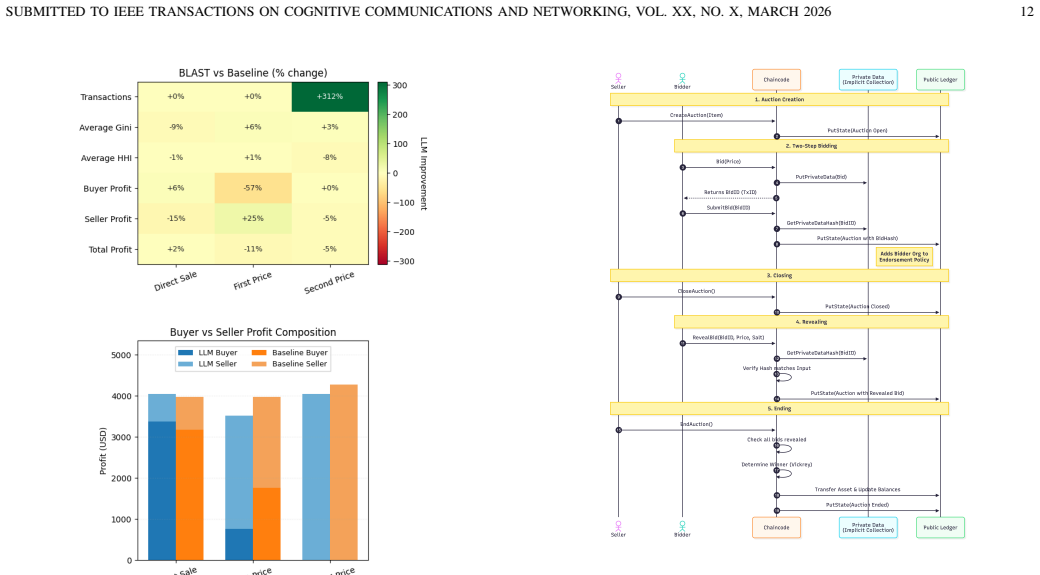
LLM agents on a permissioned blockchain use Vickrey auctions to capture up to 71 percent of theoretical spectrum trading surplus through truthful bidding.
A machine-rendered reading of the paper's core claim, the machinery that carries it, and where it could break.
Core claim
BLAST combines LLM agents that execute the cognitive-radio perceive-plan-act cycle with a permissioned blockchain to create an autonomous spectrum market. When the agents trade under three mechanisms—direct sale, first-price sealed-bid auction, and second-price (Vickrey) sealed-bid auction—the Vickrey format maximizes social welfare and allocative efficiency by reaching up to 71 percent of the theoretical surplus through truthful bidding. LLM agents further outperform non-LLM heuristic agents by raising market competition, lowering wealth and asset concentration, and increasing overall system welfare while keeping sensitive bid values inside private data collections.
What carries the argument
The sequential perceive-plan-act pipeline inside each LLM agent that lets the agent reason about economic value and market dynamics before submitting bids on the blockchain.
If this is right
- The Vickrey mechanism is the best of the three tested rules for turning spectrum into social welfare.
- Replacing heuristic agents with LLM agents measurably increases competition and reduces ownership concentration.
- Sensitive bid information stays private because only hashes are written to the public ledger.
- The same agent architecture can be applied to the three market rules without changing the underlying blockchain privacy layer.
Where Pith is reading between the lines
- If the agents remain reliable, the approach could replace parts of centralized spectrum regulators with automated market clearing.
- The same perceive-plan-act pattern might transfer to other scarce resources such as computing cycles or energy capacity.
- Larger-scale deployments would need to test whether auction outcomes stay stable when dozens of agents interact simultaneously.
Load-bearing premise
LLM agents will keep reasoning strategically about bids and market dynamics without hallucinations or collusion that the tested scenarios did not reveal.
What would settle it
A repeated Vickrey auction run in which the LLM agents begin submitting bids that deviate from their true valuations or produce coordinated outcomes not seen in the original simulations.
Figures


read the original abstract
The management of radio frequency spectrum is undergoing a paradigm shift from static, centralized command-and-control models to dynamic, market-driven approaches. However, the realization of Dynamic Spectrum Management has been hindered by the lack of an automated, trustworthy, and intelligent coordination infrastructure that can operate without a central authority while preserving participant privacy. In this paper, we introduce BLAST (Blockchain-based LLM-powered Agentic Spectrum Trading), a comprehensive framework that integrates Large Language Model (LLM) Agents with a permissioned blockchain infrastructure to create a fully autonomous, private, and secure spectrum trading ecosystem. We propose a novel agent architecture that implements the Cognitive Radio cycle through a sequential decision pipeline (perceive, plan, act) enabling agents to reason strategically about economic value and market dynamics. We evaluate the framework through three distinct market mechanisms: Direct Sale, First-Price Sealed-Bid, and Second-Price (Vickrey) Sealed-Bid auctions. Experimental results demonstrate that the Second-Price (Vickrey) auction is the optimal choice for maximizing social welfare and allocative efficiency, capturing up to 71% of the theoretical surplus by incentivizing truthful bidding. We also compare the proposed model against a baseline non-LLM heuristic agentic model and show that utilizing LLM agents yields significant improvements in market competition, reduced wealth and asset concentration, and increased system welfare. Furthermore, we validate the system's privacy preservation, confirming that sensitive bid values remain isolated in private data collections while only cryptographic hashes are committed to the public ledger.
Editorial analysis
A structured set of objections, weighed in public.
Referee Report
Summary. The paper introduces BLAST, a framework integrating LLM-powered agents with a permissioned blockchain for autonomous, privacy-preserving dynamic spectrum trading. Agents follow a perceive-plan-act pipeline to reason about economic value and market dynamics. The work evaluates three mechanisms—Direct Sale, First-Price Sealed-Bid, and Second-Price (Vickrey) Sealed-Bid auctions—via simulation and claims that the Vickrey auction maximizes social welfare and allocative efficiency by capturing up to 71% of theoretical surplus through truthful bidding incentives. It further reports that LLM agents outperform a non-LLM heuristic baseline in market competition, reduced wealth/asset concentration, and system welfare, while validating privacy via private data collections on the ledger.
Significance. If the empirical results hold under rigorous controls, the work would be significant for dynamic spectrum management by providing a decentralized, agentic alternative to centralized allocation. The integration of LLMs for strategic auction reasoning on blockchain is novel, and the head-to-head comparison of auction formats plus LLM vs. heuristic agents could inform future DSM designs. The privacy mechanism adds practical value for permissioned environments. However, the absence of experimental details limits immediate impact.
major comments (3)
- [Experimental Results] Experimental Results section: The headline claims (Vickrey auction achieving up to 71% surplus capture, plus LLM-driven gains in competition, concentration, and welfare) are stated without any description of simulation parameters, number of runs, random seeds, statistical tests, LLM model/version, temperature, or prompt templates. This directly weakens the optimality conclusion and the attribution of improvements to the LLM agents rather than implementation artifacts.
- [Agent Architecture] Agent Architecture and Evaluation sections: The perceive-plan-act pipeline is asserted to enable reliable strategic reasoning and truthful bidding in Vickrey auctions, yet no robustness checks, failure-rate statistics, consistency metrics across seeds, or mitigation for LLM hallucinations/non-determinism are reported. The 71% surplus figure and cross-mechanism comparisons therefore rest on an unverified assumption that agents produce economically coherent outputs.
- [Market Mechanisms] Market Mechanisms section: The claim that Second-Price is optimal is presented as data-driven from simulation, but without sensitivity analysis to prompt variations, agent population size, or valuation distributions, it is unclear whether the welfare advantage generalizes or is an artifact of the specific experimental conditions.
minor comments (3)
- [Abstract] Abstract: The phrase 'up to 71%' should be accompanied by the precise conditions (e.g., agent count, valuation model) under which it was observed.
- [Privacy Validation] Privacy validation paragraph: More concrete details on the blockchain platform (e.g., Hyperledger Fabric chaincode structure or private collection configuration) would improve reproducibility.
- [System Model] Notation: The distinction between 'theoretical surplus' and realized welfare should be defined explicitly with an equation or reference to the valuation model.
Simulated Author's Rebuttal
We thank the referee for the detailed and constructive feedback. The comments highlight important gaps in experimental transparency and robustness that we agree need to be addressed to strengthen the paper. Below we respond point-by-point to the major comments and indicate the revisions we will make.
read point-by-point responses
-
Referee: [Experimental Results] Experimental Results section: The headline claims (Vickrey auction achieving up to 71% surplus capture, plus LLM-driven gains in competition, concentration, and welfare) are stated without any description of simulation parameters, number of runs, random seeds, statistical tests, LLM model/version, temperature, or prompt templates. This directly weakens the optimality conclusion and the attribution of improvements to the LLM agents rather than implementation artifacts.
Authors: We agree that the Experimental Results section as currently written omits critical implementation details. This limits reproducibility and makes it difficult for readers to assess whether the reported 71% surplus and LLM advantages are robust. In the revised manuscript we will add a dedicated Experimental Setup subsection that specifies: the exact LLM (model name and version), temperature setting, full prompt templates (including system and user messages for perceive/plan/act stages), number of independent runs per configuration, random seeds used for reproducibility, agent population sizes, valuation generation process, and any statistical tests (e.g., t-tests or Wilcoxon rank-sum) applied to the welfare, competition, and concentration metrics. These additions will directly support the optimality claims and the attribution to LLM agents. revision: yes
-
Referee: [Agent Architecture] Agent Architecture and Evaluation sections: The perceive-plan-act pipeline is asserted to enable reliable strategic reasoning and truthful bidding in Vickrey auctions, yet no robustness checks, failure-rate statistics, consistency metrics across seeds, or mitigation for LLM hallucinations/non-determinism are reported. The 71% surplus figure and cross-mechanism comparisons therefore rest on an unverified assumption that agents produce economically coherent outputs.
Authors: The referee is correct that the current manuscript provides no quantitative evidence on the reliability of the perceive-plan-act pipeline or on how non-determinism and hallucinations were handled. Without such checks, the economic coherence of the agents' bids and the resulting 71% surplus figure cannot be fully validated. We will revise the Agent Architecture and Evaluation sections to include a new subsection titled “Agent Reliability and Robustness.” This subsection will report: (i) failure rates (e.g., invalid JSON outputs or incoherent bids) across runs, (ii) consistency metrics (e.g., bid variance for identical valuations across different random seeds), (iii) the mitigation techniques employed (structured output parsing, self-consistency sampling, and post-processing rules), and (iv) any observed hallucination incidents. These additions will allow readers to evaluate the assumption that the agents produce economically coherent outputs. revision: yes
-
Referee: [Market Mechanisms] Market Mechanisms section: The claim that Second-Price is optimal is presented as data-driven from simulation, but without sensitivity analysis to prompt variations, agent population size, or valuation distributions, it is unclear whether the welfare advantage generalizes or is an artifact of the specific experimental conditions.
Authors: We acknowledge that the optimality conclusion for the Vickrey auction rests on a single set of experimental conditions and lacks sensitivity analysis. While the chosen parameters were intended to reflect realistic spectrum-trading scenarios, the absence of variation testing leaves open the possibility that the welfare advantage is configuration-specific. In the revised manuscript we will add a Sensitivity Analysis subsection under Market Mechanisms. This will present results for: (i) alternative prompt phrasings, (ii) agent population sizes ranging from 10 to 100, and (iii) different valuation distributions (uniform, normal, and empirical distributions derived from historical spectrum data). We will report how the relative welfare, efficiency, and concentration metrics change across these conditions and will qualify the optimality claim accordingly. revision: yes
Circularity Check
Empirical simulation framework exhibits no circular derivation chain
full rationale
The paper's core claims rest on simulation experiments comparing auction mechanisms and LLM vs. heuristic agents, with results such as 71% surplus capture presented as observed outcomes rather than closed-form derivations. No equations, parameter fits, or self-citations are invoked in a load-bearing way that reduces the reported welfare or efficiency metrics to the inputs by construction. The evaluation is data-driven from agent interactions in a blockchain setting, remaining independent of the patterns that would trigger circularity flags.
Axiom & Free-Parameter Ledger
Reference graph
Works this paper leans on
-
[1]
A Survey of Dynamic Spectrum Access: Signal Processing and Networking Perspectives,
Q. Zhao and A. Swami, “A Survey of Dynamic Spectrum Access: Signal Processing and Networking Perspectives,” in2007 IEEE International Conference on Acoustics, Speech and Signal Processing - ICASSP ’07, vol. 4, 2007, pp. IV–1349–IV–1352
work page 2007
-
[2]
A Survey on Blockchain for Dynamic Spectrum Sharing,
L. Perera, P. Ranaweera, S. Kusaladharma, S. Wang, and M. Liyanage, “A Survey on Blockchain for Dynamic Spectrum Sharing,”IEEE Open Journal of the Communications Society, vol. 5, pp. 1753–1802, 2024
work page 2024
-
[3]
Blockchain-Enabled Credible Multi-Operator Spectrum Sharing in UA V Communication Systems,
Q. Wang, C. Qian, S. Mia, H. Zhang, H. Zhao, Y . Lu, and H. Zhu, “Blockchain-Enabled Credible Multi-Operator Spectrum Sharing in UA V Communication Systems,”IEEE Transactions on Vehicular Tech- nology, vol. 74, no. 6, pp. 8989–9001, 2025
work page 2025
-
[4]
AGI and LLM-Driven Spectrum Intelligence in Future Wireless Networks,
S. Javaid, N. Khan, A. Alwarafy, and N. Saeed, “AGI and LLM-Driven Spectrum Intelligence in Future Wireless Networks,”IEEE Wireless Communications, pp. 1–10, 2025
work page 2025
-
[5]
S. Zheng, T. Han, Y . Jiang, and X. Ge, “Smart Contract-Based Spec- trum Sharing Transactions for Multi-Operators Wireless Communication Networks,”IEEE Access, vol. 8, pp. 88 547–88 557, 2020
work page 2020
-
[6]
Cognitive Radio for Flexible Mobile Multimedia Communi- cations,
J. Mitola, “Cognitive Radio for Flexible Mobile Multimedia Communi- cations,” in1999 IEEE International Workshop on Mobile Multimedia Communications (MoMuC’99), 1999, pp. 3–10
work page 1999
-
[7]
Cognitive Radio: Brain-Empowered Wireless Communica- tions,
S. Haykin, “Cognitive Radio: Brain-Empowered Wireless Communica- tions,”IEEE Journal on Selected Areas in Communications, vol. 23, no. 2, pp. 201–220, 2005
work page 2005
-
[8]
FCC, “Facilitating Opportunities for Flexible Efficient and Reliable Spectrum Use Employing Cognitive Radio Technologies,” FCC Record Citation: 18 FCC Rcd 26859 (35), Washington, DC: USA, 2003. [Online]. Available: https://www.fcc.gov/document/ facilitating-opportunities-flexible-efficient-and-reliable-spectrum-1 SUBMITTED TO IEEE TRANSACTIONS ON COGNITIV...
work page 2003
-
[9]
TV White Space Availability in Libya,
A. Abognah and O. Basir, “TV White Space Availability in Libya,” in Cognitive Radio Oriented Wireless Networks, M. Weichold, M. Hamdi, M. Z. Shakir, M. Abdallah, G. K. Karagiannidis, and M. Ismail, Eds. Cham: Springer International Publishing, 2015, pp. 593–603
work page 2015
-
[10]
Spectrum Access Sys- tem for the Citizen Broadband Radio Service,
M. M. Sohul, M. Yao, T. Yang, and J. H. Reed, “Spectrum Access Sys- tem for the Citizen Broadband Radio Service,”IEEE Communications Magazine, vol. 53, no. 7, pp. 18–25, 2015
work page 2015
-
[11]
Decentralized Spectrum Access System: Vision, Challenges, and a Blockchain Solution,
Y . Xiao, S. Shi, W. Lou, C. Wang, X. Li, N. Zhang, Y . T. Hou, and J. H. Reed, “Decentralized Spectrum Access System: Vision, Challenges, and a Blockchain Solution,”IEEE Wireless Communications, vol. 29, no. 1, pp. 220–228, 2022
work page 2022
-
[12]
Distributed Spectrum Sharing Using Blockchain: A Hyperledger Fabric Implementation,
A. Abognah and O. Basir, “Distributed Spectrum Sharing Using Blockchain: A Hyperledger Fabric Implementation,” in2022 IEEE 1st Global Emerging Technology Blockchain Forum: Blockchain & Beyond (iGETblockchain), 2022, pp. 1–6
work page 2022
-
[13]
Hyperledger Fabric Documentation,
“Hyperledger Fabric Documentation,” https://hyperledger-fabric. readthedocs.io/en/latest/, (Date last accessed 2025-12-04). [Online]. Available: https://hyperledger-fabric.readthedocs.io/en/latest/
work page 2025
-
[14]
Multi-Agent Reinforcement Learning for Dynamic Spectrum Access,
H. Jiang, T. Wang, and S. Wang, “Multi-Agent Reinforcement Learning for Dynamic Spectrum Access,” inICC 2019 - 2019 IEEE International Conference on Communications (ICC), 2019, pp. 1–6
work page 2019
-
[15]
A. Gao, C. Du, S. X. Ng, and W. Liang, “A Cooperative Spectrum Sensing With Multi-Agent Reinforcement Learning Approach in Cog- nitive Radio Networks,”IEEE Communications Letters, vol. 25, no. 8, pp. 2604–2608, 2021
work page 2021
-
[16]
U. C. Ukpong, O. Idowu-Bismark, E. Adetiba, J. R. Kala, E. Owolabi, O. Oshin, A. Abayomi, and O. E. Dare, “Deep Reinforcement Learning Agents for Dynamic Spectrum Access in Television Whitespace Cognitive Radio Networks,”Scientific African, vol. 27, p. e02523, 2025. [Online]. Available: https: //www.sciencedirect.com/science/article/pii/S2468227624004654
work page 2025
-
[17]
A Multi-Agent Reinforcement Learning Testbed for Cognitive Radio Applications,
S. Vangaru, D. Rosen, D. Green, R. Rodriguez, M. Wiecek, A. Johnson, A. M. Jones, and W. C. Headley, “A Multi-Agent Reinforcement Learning Testbed for Cognitive Radio Applications,” in2025 IEEE 22nd Consumer Communications & Networking Conference (CCNC), 2025, pp. 1–9
work page 2025
-
[18]
S. Chen, Y . Zu, Z. Feng, S. Yang, and M. Li, “RadioLLM: Introducing Large Language Model into Cognitive Radio via Hybrid Prompt and Token Reprogrammings,”arXiv preprint arXiv:2501.17888, 2025
-
[19]
LLM-Empowered Resource Allocation in Wireless Communications Systems,
W. Lee and J. Park, “LLM-Empowered Resource Allocation in Wireless Communications Systems,”IEEE Access, vol. 14, pp. 15 260–15 272, 2026
work page 2026
-
[20]
AI Agents Meet Blockchain: A Survey on Secure and Scalable Collaboration for Multi-Agents,
M. M. Karim, D. H. Van, S. Khan, Q. Qu, and Y . Kholodov, “AI Agents Meet Blockchain: A Survey on Secure and Scalable Collaboration for Multi-Agents,”Future Internet, vol. 17, no. 2, p. 57, 2025
work page 2025
-
[21]
H. Lee, M. Kim, S. Baek, W. Zhou, M. Debbah, and I. Lee, “AI-Driven Decentralized Network Management: Leveraging Multi-Agent Large Language Models for Scalable Optimization,”IEEE Communications Magazine, vol. 63, no. 6, pp. 50–56, 2025
work page 2025
-
[22]
Z. Qu, W. Wang, Z. Yu, B. Sun, Y . Li, and X. Zhang, “LLM Enabled Multi-Agent System for 6G Networks: Framework and Method of Dual- Loop Edge-Terminal Collaboration,”IEEE Communications Magazine, pp. 1–7, 2026
work page 2026
-
[23]
Empowering Future Spectrum Management and Regulation With Large Language Models,
H. Rutagemwa, A. Ghasemi, and P. Guinand, “Empowering Future Spectrum Management and Regulation With Large Language Models,” IEEE Intelligent Systems, vol. 40, no. 4, pp. 46–54, 2025
work page 2025
-
[24]
SpectrumFM: A foundation model for intelligent spectrum management,
F. Zhou, C. Liu, H. Zhang, W. Wu, Q. Wu, D. W. K. Ng, T. Q. S. Quek, and C.-B. Chae, “SpectrumFM: A Foundation Model for Intelligent Spectrum Management,” 2025. [Online]. Available: https://arxiv.org/abs/2505.06256
-
[25]
Counterspeculation, Auctions, and Competitive Sealed Tenders,
W. Vickrey, “Counterspeculation, Auctions, and Competitive Sealed Tenders,”The Journal of Finance, vol. 16, no. 1, pp. 8–37, 1961
work page 1961
-
[26]
Decentralized Spectrum Sensing in Cognitive Radio Networks via Federated Learning and Blockchain,
A. Abognah and O. Basir, “Decentralized Spectrum Sensing in Cognitive Radio Networks via Federated Learning and Blockchain,” in2025 International Libyan Conference for Information and Communications Technologies (ILCICT), 2025
work page 2025
-
[27]
A Survey on Dynamic Spec- trum Access Techniques in Cognitive Radio,
A. Garhwal, R. Bhatt, and S. Garhwal, “A Survey on Dynamic Spec- trum Access Techniques in Cognitive Radio,”International Journal of Computer Applications, vol. 48, no. 12, pp. 20–25, 2012
work page 2012
-
[28]
RFRL Gym: A Reinforcement Learning Testbed for Cognitive Radio Applications,
D. Rosen, I. Rochez, C. McIrvin, J. Lee, K. D’Alessandro, M. Wiecek, N. Hoang, R. Saffarini, S. Philips, V . Jones, W. Ivey, Z. Harris-Smart, Z. Harris-Smart, Z. Chin, A. Johnson, A. M. Jones, and W. C. Headley, “RFRL Gym: A Reinforcement Learning Testbed for Cognitive Radio Applications,” in2023 International Conference on Machine Learning and Applicatio...
work page 2023
-
[29]
D. Cuellar, M. Sallal, and C. Williams, “BSM-6G: Blockchain-Based Dynamic Spectrum Management for 6G Networks: Addressing Inter- operability and Scalability,”IEEE Access, vol. 12, pp. 59 643–59 664, 2024
work page 2024
-
[30]
G. Femenias, M. F. Hinarejos, F. Riera-Palou, J.-L. Ferrer-Gomila, and A. Jaume-Barcel ´o, “A Multi-Leader Multi-Follower Stackelberg Game for Dynamic Spectrum Sharing in a Blockchain Enabled Cell-Free Massive MIMO Scenario,”IEEE Open Journal of the Communications Society, 2025
work page 2025
-
[31]
FastFabric: Scaling Hyperledger Fabric to 20,000 Transactions per Second,
C. Gorenflo, S. Lee, L. Golab, and S. Keshav, “FastFabric: Scaling Hyperledger Fabric to 20,000 Transactions per Second,” in2019 IEEE International Conference on Blockchain and Cryptocurrency (ICBC), 2019, pp. 455–463
work page 2019
-
[32]
Large Language Models for Wireless Networks: An Overview from the Prompt Engineering Perspective,
H. Zhou, C. Hu, D. Yuan, Y . Yuan, D. Wu, X. Chen, H. Tabassum, and X. Liu, “Large Language Models for Wireless Networks: An Overview from the Prompt Engineering Perspective,”IEEE Wireless Communications, vol. 32, no. 4, pp. 98–106, 2025
work page 2025
-
[33]
H. M. Ali Zeeshan, A. Ahmad, S. Ali Hassan, M. Sohaib Jamal Solaija, and S. Hussain Chauhdary, “LLM-Enhanced Dynamic Spectrum Management for Integrated Non-Terrestrial and Terrestrial Networks: A Multi-Objective Optimization Approach,”Mobile Networks and Applications, Jan 2026. [Online]. Available: https://doi.org/10.1007/ s11036-026-02490-z
work page 2026
-
[34]
arXiv preprint arXiv:2411.05990 , year=
W. Hua, O. Liu, L. Li, A. Amayuelas, J. Chen, L. Jiang, M. Jin, L. Fan, F. Sun, W. Wang, and Others, “Game-Theoretic LLM Agent Workflow for Negotiation Games,”arXiv preprint arXiv:2411.05990, 2024
-
[35]
N. Lor `e and B. Heydari, “Strategic behavior of large language models and the role of game structure versus contextual framing,” Scientific Reports, vol. 14, no. 1, p. 18490, 2024. [Online]. Available: https://doi.org/10.1038/s41598-024-69032-z
-
[36]
LLM strategic reasoning: Agentic study through behavioral game theory,
J. Jia, Z. Yuan, J. Pan, P. E. McNamara, and D. Chen, “LLM strategic reasoning: Agentic study through behavioral game theory,” in The Thirty-ninth Annual Conference on Neural Information Processing Systems, 2025. [Online]. Available: https://openreview.net/forum?id= XQrGTggLvT
work page 2025
-
[37]
arXiv:2407.04467 [cs.AI] https://arxiv.org/abs/2407.04467
N. Herr, F. Acero, R. Raileanu, M. P ´erez-Ortiz, and Z. Li, “Are Large Language Models Strategic Decision Makers? A Study of Performance and Bias in Two-Player Non-Zero-Sum Games,” vol. abs/2407.04467,
-
[38]
arXiv:2407.04467 [cs.AI] https://arxiv.org/abs/2407.04467
[Online]. Available: https://doi.org/10.48550/arXiv.2407.04467
-
[39]
Autoflow: Automated workflow generation for large language model agents
Z. Li, S. Xu, K. Mei, W. Hua, B. Rama, O. Raheja, H. Wang, H. Zhu, and Y . Zhang, “AutoFlow: Automated Workflow Generation for Large Language Model Agents,” vol. abs/2407.12821, 2024. [Online]. Available: https://doi.org/10.48550/arXiv.2407.12821
-
[40]
Auction-Based Resource Allocation in Cognitive Radio Systems,
E. Hossain, D. Niyato, P. Wang, and Y . Zhang, “Auction-Based Resource Allocation in Cognitive Radio Systems,” inIEEE Communications Magazine, 2012, pp. 109–120
work page 2012
-
[41]
Auction-Based Spectrum Sharing,
J. Huang, R. A. Berry, and M. L. Honig, “Auction-Based Spectrum Sharing,”ACM/Springer Mobile Networks and Applications Journal (MONET), vol. 11, no. 3, pp. 405–418, 2006
work page 2006
-
[42]
Google Agent Development Kit (ADK),
“Google Agent Development Kit (ADK),” https://docs.cloud. google.com/agent-builder/agent-development-kit/overview, (Date last accessed 2025-12-04). [Online]. Available: https://docs.cloud.google. com/agent-builder/agent-development-kit/overview
work page 2025
discussion (0)
Sign in with ORCID, Apple, or X to comment. Anyone can read and Pith papers without signing in.