Enumerations and Bijections for Stanley Polyominoes
Pith reviewed 2026-05-10 15:02 UTC · model grok-4.3
The pith
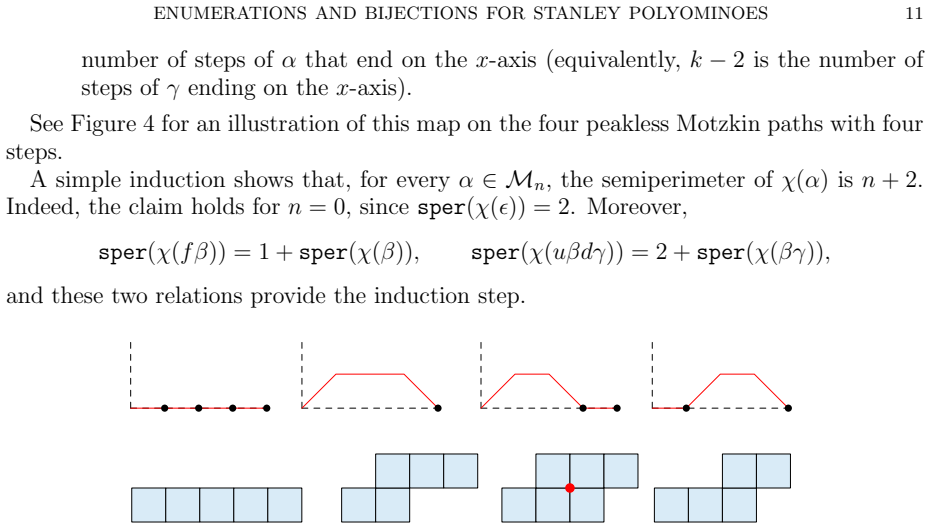
Stanley polyominoes have generating functions for area and semiperimeter plus explicit bijections to Dyck paths, skew diagrams, and peakless Motzkin paths.
A machine-rendered reading of the paper's core claim, the machinery that carries it, and where it could break.
Core claim
Stanley polyominoes, defined by the strict rightward shift condition on successive rows, are placed in bijection with Dyck paths, skew Ferrer diagrams, and peakless Motzkin paths. From these correspondences the authors obtain ordinary generating functions that track the number of columns and rows, the area, the semiperimeter, and the counts of interior points and edges. The same machinery yields a bijection between parallelogram polyominoes of area n and coin fountains with n coins on even-numbered rows and n-k coins on odd-numbered rows, thereby settling a previously open question.
What carries the argument
The explicit bijections that map the row-strict geometry of Stanley polyominoes onto Dyck paths, skew Ferrer diagrams, and peakless Motzkin paths, together with the algebraic extraction of the corresponding generating functions.
If this is right
- The number of Stanley polyominoes of any given area or semiperimeter is given by the appropriate coefficient in the derived generating functions.
- Any known enumeration or statistic on Dyck paths or peakless Motzkin paths transfers directly to a corresponding count or statistic on Stanley polyominoes.
- Parallelogram polyominoes of area n stand in explicit bijection with the specified family of coin fountains.
- Statistics such as the number of interior points or edges admit combinatorial interpretations via the path or diagram side of each bijection.
Where Pith is reading between the lines
- The same row-strict restriction may admit similar bijections for other natural statistics or for related families such as directed column-convex polyominoes.
- The coin-fountain bijection suggests that geometric properties of parallelogram polyominoes can be reinterpreted as coin-arrangement constraints without reference to the polyominoes themselves.
- The generating functions may be refined further by adding variables for additional geometric features that are preserved by the bijections.
Load-bearing premise
The bijections and generating-function derivations are constructed without error from the row-strict definition and the standard definitions of the target objects.
What would settle it
A concrete mismatch, for any fixed small n, between the coefficient of x^n in one of the derived generating functions and the number of Stanley polyominoes of area n (or semiperimeter n) obtained by exhaustive enumeration would falsify the claims.
Figures




read the original abstract
Stanley polyominoes are a subclass of parallelogram polyominoes in which each row begins strictly to the right of the beginning of the previous row and ends strictly to the right of the end of the previous row. In this paper, we derive generating functions for Stanley polyominoes based on the numbers of columns and rows, area, semiperimeter, and numbers of interior points and edges. We also establish combinatorial connections through bijections with other combinatorial structures such as Dyck paths, skew Ferrer diagrams, and peakless Motzkin paths. As a byproduct, we answer the open question of finding a bijection between parallelogram polyominoes of area $n$ and coin fountains with $n$ coins in the even-numbered rows and $n-k$ coins in the odd-numbered rows.
Editorial analysis
A structured set of objections, weighed in public.
Referee Report
Summary. The paper defines Stanley polyominoes as a row-strict subclass of parallelogram polyominoes (each row begins and ends strictly to the right of the preceding row) and derives generating functions for these objects tracked by the number of columns and rows, area, semiperimeter, interior points, and edges. It constructs explicit bijections with Dyck paths, skew Ferrers diagrams, and peakless Motzkin paths, and as a byproduct supplies a bijection between parallelogram polyominoes of area n and coin fountains having n coins in even-numbered rows and n-k coins in odd-numbered rows.
Significance. If the recursive decompositions, generating-function derivations, and bijective constructions hold, the work supplies new enumerative tools for a natural subclass of polyominoes and resolves an open combinatorial question. The explicit, invertible mappings to classical path and diagram objects allow transfer of known results and statistics, strengthening the combinatorial understanding of these structures.
minor comments (2)
- [Section 3] The initial conditions and base cases for the recursive decompositions used to obtain the generating functions are stated only implicitly; an explicit listing (e.g., for the empty or single-row cases) would improve readability.
- [Section 5] Figure 4, which illustrates the composite bijection to coin fountains, would benefit from an additional panel or caption step that verifies preservation of the area statistic.
Simulated Author's Rebuttal
We thank the referee for their positive summary of our manuscript on Stanley polyominoes and for recommending minor revision. No specific major comments appear in the report.
Circularity Check
No significant circularity; derivations are explicit and self-contained
full rationale
The paper constructs generating functions and bijections directly from the given row-strict definition of Stanley polyominoes via recursive decompositions and invertible mappings to Dyck paths, skew Ferrers diagrams, and peakless Motzkin paths. These steps preserve the tracked statistics (area, semiperimeter, interior points/edges) by explicit construction and verification of bijectivity, without reducing to fitted parameters, self-referential equations, or load-bearing self-citations. The composite bijection for the coin-fountain question is built from the established maps and resolves the open problem independently. No step equates a claimed result to its inputs by definition or prior self-work.
Axiom & Free-Parameter Ledger
Reference graph
Works this paper leans on
-
[1]
P. Bala. Fountains of coins and skew Ferrers diagrams. (2019),https://oeis.org/A161492
work page 2019
-
[2]
C. Banderier, M. Bousquet-M´ elou, A. Denise, P. Flajolet, D. Gardy, and D. Gouyou-Beauchamps. Generating functions for generating trees.Discrete Math.246(2002), 29–55
work page 2002
- [3]
-
[4]
A. Blecher, C. Brennan, A. Knopfmacher, and T. Mansour. The perimeter of words.Discrete Math. 340(10) (2017), 2456–2465
work page 2017
-
[5]
A. Blecher, C. Brennan, and A. Knopfmacher. The site-perimeter of compositions.Discrete Math. Appl.32(2) (2022), 75-–89
work page 2022
-
[6]
M. Bousquet-M´ elou. Une bijection entre les polyominos convexes dirig´ es et les mots de Dyck bilat` eres. RAIRO Theor. Inform. Appl.26(3) (1992), 205–219
work page 1992
-
[7]
Bousquet-M´ elou.q-´Enum´ eration de polyominos convexes.J
M. Bousquet-M´ elou.q-´Enum´ eration de polyominos convexes.J. Combin. Theory Ser. A64(2) (1993), 265–288
work page 1993
-
[8]
M. Bousquet-M´ elou and A. Rechnitzer. The site-perimeter of bargraphs.Adv. Appl. Math.31(2003), 86–112
work page 2003
- [9]
-
[10]
M.P. Delest and X. Viennot. Algebraic languages and polyominoes enumeration.Theoret. Comput. Sci.34(1984), 169–206
work page 1984
- [11]
-
[12]
M.P. Delest and J.M. Fedou. Attribute grammars are useful for combinatorics.Theoret. Comput. Sci. 98(1) (1992), 65–76
work page 1992
-
[13]
M.P. Delest and J.M. Fedou. Enumeration of skew ferrer diagrams.S´ em. Lothar. Combin.23B23d (1993), 51–66
work page 1993
-
[14]
E. Deutsch. Dyck path enumeration.Discrete Math.204(1999), 167–202
work page 1999
-
[15]
E. Duchi. Polyominoes, permutominoes and permutations.Habilitation ` a diriger des recherches, https://www.irif.fr/∼duchi/hdrDuchi.pdf, (2018)
work page 2018
- [16]
- [17]
-
[18]
T. Mansour and A. Sh. Shabani. Enumerations on bargraphs.Discrete Math. Lett.2(2019), 65–94
work page 2019
-
[19]
A. J. Guttmann (Ed.).Polygons, Polyominoes and Polycubes. Lecture Notes in Physics 775. Springer, Heidelberg, Germany, 2009
work page 2009
-
[20]
OEIS Foundation Inc., The On-Line Encyclopedia of Integer Sequences,http://oeis.org/
- [21]
-
[22]
R.P. Stanley.Catalan Numbers. Cambridge University Press, 2015
work page 2015
- [23]
-
[24]
H.S. Wilf.Generatingfunctionology. 3rd ed., A K Peters/CRC Press, 2005. 24 J-L. BARIL, A. BLECHER, AND J.L. RAM ´IREZ LIB, Universit´e Bourgogne Europe, B.P. 47 870, 21078, Dijon Cedex, France Email address:barjl@u-bourgogne.fr The John Knopfmacher Centre for Applicable Analysis and Number Theory, School of Mathematics, University of the Witwatersrand, Pr...
work page 2005
discussion (0)
Sign in with ORCID, Apple, or X to comment. Anyone can read and Pith papers without signing in.