Recognition: unknown
Mobility-edge-embedded Hofstadter butterfly from a tilt-induced quasiperiodic potential
Pith reviewed 2026-05-10 14:02 UTC · model grok-4.3
The pith
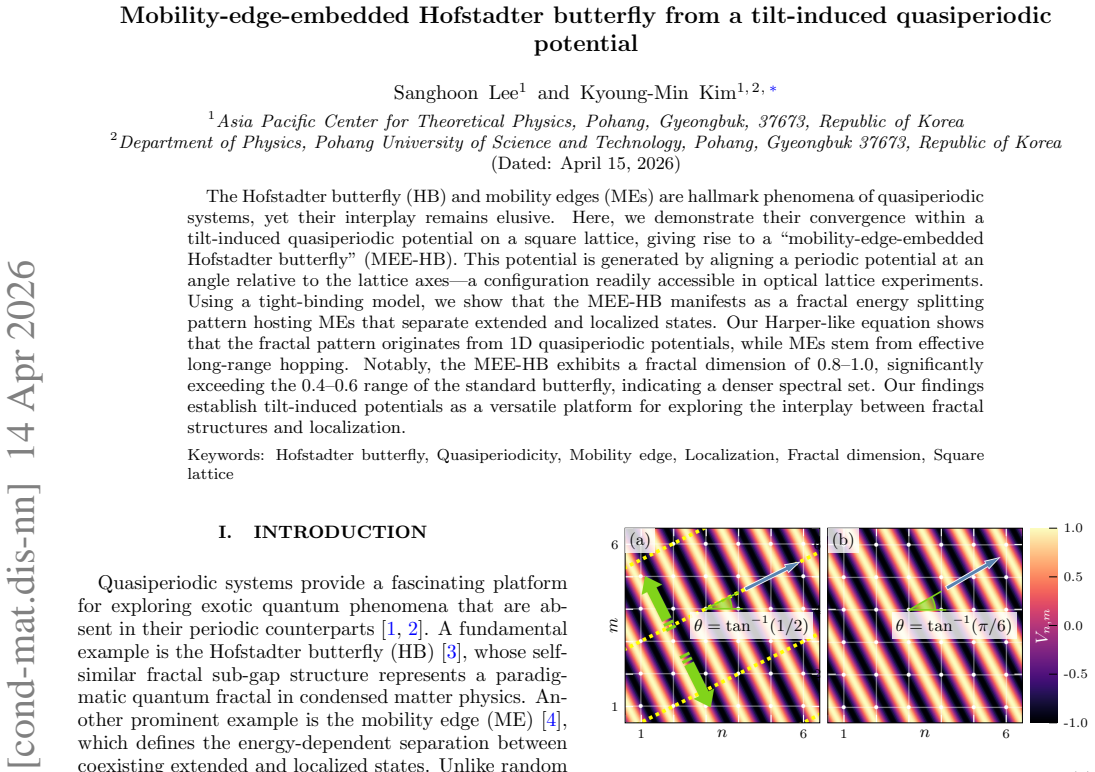
Aligning a periodic potential at an angle to a square lattice produces a Hofstadter butterfly whose fractal spectrum contains mobility edges separating extended and localized states.
A machine-rendered reading of the paper's core claim, the machinery that carries it, and where it could break.
Core claim
The mobility-edge-embedded Hofstadter butterfly arises as a fractal energy splitting pattern that simultaneously hosts mobility edges; the fractal character traces to effective one-dimensional quasiperiodic potentials while the mobility edges originate in the long-range hopping generated by the tilted potential. The structure is obtained from a tight-binding Hamiltonian on the square lattice and is characterized by a fractal dimension between 0.8 and 1.0.
What carries the argument
The tilt-induced quasiperiodic potential, generated by rotating a periodic potential relative to the square-lattice axes, which produces an effective Harper-like equation containing both quasiperiodic on-site terms and long-range hopping.
If this is right
- The fractal splitting pattern in the spectrum originates from the one-dimensional quasiperiodic components of the effective potential.
- Mobility edges appear because the tilt generates long-range hopping terms absent in the standard nearest-neighbor Hofstadter model.
- The fractal dimension of the spectrum is 0.8-1.0, producing a denser set of bands than the conventional Hofstadter butterfly.
- The entire construction is experimentally accessible by aligning an external periodic potential at an angle in an optical-lattice setup.
Where Pith is reading between the lines
- Varying the tilt angle could provide experimental control over the position of mobility edges and the density of the fractal spectrum.
- The long-range hopping mechanism may generalize to other lattice geometries and produce mobility edges in additional quasiperiodic models.
- Transport measurements in the optical-lattice realization could reveal how the higher fractal dimension alters scaling of conductivity or diffusion constants.
Load-bearing premise
The tight-binding model and the derived Harper-like equation capture the dominant physics, with higher-order hopping and lattice imperfections remaining negligible.
What would settle it
Spectroscopic measurement of the energy spectrum in an optical lattice with a controllable tilt angle between the periodic potential and the lattice axes, checking whether the observed fractal dimension lies between 0.8 and 1.0 and whether wave-function localization changes abruptly across specific energy values.
Figures


read the original abstract
The Hofstadter butterfly (HB) and mobility edges (MEs) are hallmark phenomena of quasiperiodic systems, yet their interplay remains elusive. Here, we demonstrate their convergence within a tilt-induced quasiperiodic potential on a square lattice, giving rise to a ``mobility-edge-embedded Hofstadter butterfly'' (MEE-HB). This potential is generated by aligning a periodic potential at an angle relative to the lattice axes--a configuration readily accessible in optical lattice experiments. Using a tight-binding model, we show that the MEE-HB manifests as a fractal energy splitting pattern hosting MEs that separate extended and localized states. Our Harper-like equation shows that the fractal pattern originates from 1D quasiperiodic potentials, while MEs stem from effective long-range hopping. Notably, the MEE-HB exhibits a fractal dimension of 0.8--1.0, significantly exceeding the 0.4--0.6 range of the standard butterfly, indicating a denser spectral set. Our findings establish tilt-induced potentials as a versatile platform for exploring the interplay between fractal structures and localization.
Editorial analysis
A structured set of objections, weighed in public.
Referee Report
Summary. The paper claims that aligning a periodic potential at an angle to the axes of a square lattice generates a tilt-induced quasiperiodic potential. A tight-binding model on this lattice reduces to a Harper-like equation whose spectrum is a fractal 'mobility-edge-embedded Hofstadter butterfly' (MEE-HB). The fractal structure is attributed to the one-dimensional quasiperiodic component while mobility edges separating extended and localized states are attributed to effective long-range hopping. The MEE-HB is reported to possess a fractal dimension of 0.8–1.0, substantially larger than the 0.4–0.6 range of the conventional Hofstadter butterfly, and the construction is asserted to be directly realizable in optical-lattice experiments.
Significance. If the central numerical and analytic results hold, the work supplies an experimentally accessible platform that simultaneously hosts both a fractal Hofstadter spectrum and mobility edges. The reported increase in fractal dimension suggests a denser spectral set that could be used to explore the interplay between localization and fractal band structures in a controlled setting.
major comments (1)
- [Abstract / Model derivation] The abstract states that the MEE-HB 'manifests as a fractal energy splitting pattern hosting MEs' and that 'the fractal pattern originates from 1D quasiperiodic potentials, while MEs stem from effective long-range hopping.' Without the explicit form of the derived Harper-like equation or the numerical protocol used to extract the fractal dimension (0.8–1.0), it is impossible to verify that the long-range terms are the sole origin of the mobility edges rather than an artifact of the truncation or boundary conditions. The central claim therefore rests on an unshown derivation and diagnostic.
minor comments (2)
- [Introduction / Model] The phrase 'tilt-induced quasiperiodic potential' is used without a precise definition of the tilt angle or the resulting incommensurability parameter; a short paragraph or equation defining these quantities would improve reproducibility.
- [Numerical methods] The manuscript should state the system sizes and disorder realizations employed for the localization diagnostics (e.g., inverse participation ratio or level statistics) that identify the mobility edges.
Simulated Author's Rebuttal
We thank the referee for their careful reading and constructive feedback. We agree that greater explicitness in the model derivation and numerical diagnostics will strengthen the manuscript and allow independent verification of the origin of the mobility edges. We address the comment below and will revise accordingly.
read point-by-point responses
-
Referee: [Abstract / Model derivation] The abstract states that the MEE-HB 'manifests as a fractal energy splitting pattern hosting MEs' and that 'the fractal pattern originates from 1D quasiperiodic potentials, while MEs stem from effective long-range hopping.' Without the explicit form of the derived Harper-like equation or the numerical protocol used to extract the fractal dimension (0.8–1.0), it is impossible to verify that the long-range terms are the sole origin of the mobility edges rather than an artifact of the truncation or boundary conditions. The central claim therefore rests on an unshown derivation and diagnostic.
Authors: We thank the referee for identifying this presentational gap. The tight-binding Hamiltonian with the tilt-induced potential is reduced to the Harper-like equation in Section II (starting from the 2D lattice model and projecting onto the effective 1D chain with angle-dependent hopping). The long-range terms arise directly from the non-aligned periodic potential and are retained without truncation in the main calculations. The fractal dimension is obtained via box-counting on the sorted energy eigenvalues, with finite-size scaling (system sizes up to 10^4 sites) and convergence checks against truncation cutoff and boundary conditions, as described in the Methods and Appendix. To make verification immediate, the revised manuscript will (i) display the full Harper-like equation in the main text immediately after the model introduction, (ii) add a dedicated paragraph on the numerical protocol including explicit checks that mobility edges disappear when long-range terms are artificially suppressed, and (iii) include representative spectra for different truncation ranges. These additions directly address the concern that the mobility edges could be numerical artifacts. revision: yes
Circularity Check
No significant circularity detected
full rationale
The paper's derivation begins with a standard tight-binding Hamiltonian on a square lattice subject to a tilt-induced quasiperiodic potential, reduces it to a Harper-like equation, and then attributes the fractal spectrum to the 1D quasiperiodic component and mobility edges to the resulting long-range hopping terms. These attributions follow directly from the structure of the derived equation rather than from any fitted parameter renamed as a prediction, self-definition, or load-bearing self-citation. No uniqueness theorem, ansatz smuggling, or renaming of known results is invoked in a way that collapses the central claim back onto its inputs by construction. The MEE-HB fractal dimension and separation of extended/localized states are presented as numerical and analytical consequences of the model, rendering the chain self-contained.
Axiom & Free-Parameter Ledger
Reference graph
Works this paper leans on
-
[1]
tilt-induced quasiperiodic model (TQM)
reveals that the fractal dimension of the MEE-HB spectrum (0.8–1.0) significantly exceeds that of the stan- dard HB (0.4–0.6), serving as a hallmark characteristic of the system (Sec. V). Finally, we discuss experimental realizations in optical lattices (Sec. VI) and highlight the advantages of this tilt-induced approach over alternative configurations (S...
-
[2]
fractal dimension,
over the tilt-angle rangeθ∈[0, π/4]. We visual- ize the spectra in the (θ, E) plane through a density of states (DOS) obtained by Lorentzian broadening of the discrete eigenvalues, with the spectral weight normalized by the total number of states. Figure 3(a) illustrates the evolution of the resulting DOS map for a weak potential strength (λ= 1) in the (θ...
-
[3]
5(d), we used the dual representation of the effective Harper-like model with a larger system size 6400 to improve spectral resolution
For the fractal-dimension analysis in Fig. 5(d), we used the dual representation of the effective Harper-like model with a larger system size 6400 to improve spectral resolution. A more detailed analysis of theν-dependence is provided in Supplementary Note 3. C. Box counting method To obtain the fractal dimension shown in Fig. 5, we applied a box-counting...
2026
-
[4]
Sokoloff, Unusual band structure, wave functions and electrical conductance in crystals with incommensurate periodic potentials, Phys
J. Sokoloff, Unusual band structure, wave functions and electrical conductance in crystals with incommensurate periodic potentials, Phys. Rep.126, 189 (1985)
1985
-
[5]
Maci´ a, The role of aperiodic order in science and tech- nology, Rep
E. Maci´ a, The role of aperiodic order in science and tech- nology, Rep. Prog. Phys.69, 397 (2005)
2005
-
[7]
Das Sarma, S
S. Das Sarma, S. He, and X. C. Xie, Mobility edge in a model one-dimensional potential, Phys. Rev. Lett.61, 2144 (1988)
1988
-
[8]
S. S. Kondov, W. R. McGehee, J. J. Zirbel, and B. De- Marco, Three-dimensional anderson localization of ultra- cold matter, Science334, 66 (2011)
2011
-
[9]
Y. E. Kraus, Z. Ringel, and O. Zilberberg, Four- dimensional quantum hall effect in a two-dimensional quasicrystal, Phys. Rev. Lett.111, 226401 (2013)
2013
-
[10]
Sun, C.-A
J. Sun, C.-A. Li, Q. Guo, W. Zhang, S. Feng, X. Zhang, H. Guo, and B. Trauzettel, Non-hermitian quantum frac- tals, Phys. Rev. B110, L201103 (2024)
2024
-
[11]
L. Du, Q. Chen, A. D. Barr, A. R. Barr, and G. A. Fiete, Floquet hofstadter butterfly on the kagome and triangu- lar lattices, Phys. Rev. B98, 245145 (2018)
2018
-
[12]
Koshino, H
M. Koshino, H. Aoki, K. Kuroki, S. Kagoshima, and T. Osada, Hofstadter butterfly and integer quantum hall effect in three dimensions, Phys. Rev. Lett.86, 1062 (2001)
2001
- [13]
-
[14]
L. Wang, Z. Wang, J. Liu, and S. Chen, Exact multiple complex mobility edges and quantum state engineering in coupled one-dimensional quasicrystals, Phys. Rev. B 112, 104207 (2025)
2025
-
[15]
Ganeshan, J
S. Ganeshan, J. H. Pixley, and S. Das Sarma, Nearest neighbor tight binding models with an exact mobility edge in one dimension, Phys. Rev. Lett.114, 146601 (2015)
2015
-
[16]
Y. E. Kraus, Y. Lahini, Z. Ringel, M. Verbin, and O. Zil- berberg, Topological states and adiabatic pumping in quasicrystals, Phys. Rev. Lett.109, 106402 (2012)
2012
-
[17]
Aidelsburger, M
M. Aidelsburger, M. Atala, M. Lohse, J. T. Barreiro, B. Paredes, and I. Bloch, Realization of the hofstadter hamiltonian with ultracold atoms in optical lattices, Phys. Rev. Lett.111, 185301 (2013)
2013
-
[19]
F. A. An, K. Padavi´ c, S. Scherg, A. Janot, and B. Gad- way, Interactions and mobility edges: Observing the generalized aubry–andr´ e model, Phys. Rev. Lett.126, 040603 (2021)
2021
-
[20]
H. P. L¨ uschen, S. Scherg, T. Kohlert, M. Schreiber, P. Bordia, X. Li, S. Das Sarma, and I. Bloch, Single- particle mobility edge in a one-dimensional quasiperiodic optical lattice, Phys. Rev. Lett.120, 160404 (2018)
2018
-
[21]
F. A. An, K. Padavi´ c, E. J. Meier, S. Hegde, S. Gane- shan, J. H. Pixley, S. Vishveshwara, and B. Gadway, In- teractions and mobility edges: Observing the generalized aubry-andr´ e model, Phys. Rev. Lett.126, 040603 (2021)
2021
-
[22]
C. R. Dean, L. Wang, P. Maher, C. Forsythe, F. Ghahari, Y. Gao, J. Katoch, M. Ishigami, P. Moon, M. Koshino, T. Taniguchi, K. Watanabe, K. L. Shepard, J. Hone, and P. Kim, Hofstadter’s butterfly and the fractal quantum hall effect in moir´ e superlattices, Nature497, 598 (2013)
2013
-
[23]
L. A. Ponomarenko, R. V. Gorbachev, G. L. Yu, D. C. Elias, R. Jalil, A. A. Patel, A. Mishchenko, A. S. Mayorov, C. R. Woods, J. R. Wallbank, M. Mucha- Kruczynski, B. A. Piot, M. Potemski, I. V. Grigorieva, K. S. Novoselov, F. Guinea, V. I. Fal’ko, and A. K. Geim, Cloning of dirac fermions in graphene superlattices, Na- ture497, 594 (2013)
2013
-
[24]
B. Hunt, J. D. Sanchez-Yamagishi, A. F. Young, M. Yankowitz, B. J. LeRoy, K. Watanabe, T. Taniguchi, P. Moon, M. Koshino, P. Jarillo-Herrero, and R. C. Ashoori, Massive dirac fermions and hofstadter butter- fly in a van der waals heterostructure, Science340, 1427 (2013)
2013
-
[25]
K. P. Nuckolls, M. G. Scheer, D. Wong, M. Oh, R. L. Lee, J. Herzog-Arbeitman, K. Watanabe, T. Taniguchi, B. Lian, and A. Yazdani, Spectroscopy of the fractal hof- stadter energy spectrum, Nature639, 60 (2025)
2025
-
[26]
L. S. Liebovitch and T. Toth, A fast algorithm to deter- mine fractal dimensions by box counting, Phys. Lett. A 141, 386 (1989)
1989
-
[27]
Pradhan, Hofstadter butterfly in the falicov–kimball model on some finite 2d lattices, J
S. Pradhan, Hofstadter butterfly in the falicov–kimball model on some finite 2d lattices, J. Phys. Condens. Mat- ter28, 505502 (2016)
2016
-
[28]
L. Li, M. Abram, A. Prem, and S. Haas, Hofstadter butterflies in topological insulators, inRecent Topics on Topology - From Classical to Modern Applications, edited by P. Bracken (IntechOpen, London, 2024) Chap. 1
2024
-
[29]
Biddle and S
J. Biddle and S. Das Sarma, Predicted mobility edges in one-dimensional incommensurate optical lattices: An ex- actly solvable model of anderson localization, Phys. Rev. Lett.104, 070601 (2010)
2010
-
[31]
Biddle, D
J. Biddle, D. J. Priour, B. Wang, and S. Das Sarma, Lo- calization in one-dimensional lattices with non-nearest- neighbor hopping: Generalized anderson and aubry- andr´ e models, Phys. Rev. B83, 075105 (2011)
2011
-
[32]
Aubry and G
S. Aubry and G. Andr´ e, Analyticity breaking and ander- son localization in incommensurate lattices, inAnn. Isr. 12 Phys. Soc., Vol. 3 (1980) p. 18
1980
-
[33]
C. M. Soukoulis and E. N. Economou, Localization in one-dimensional lattices in the presence of incommensu- rate potentials, Phys. Rev. Lett.48, 1043 (1982)
1982
-
[34]
X. Li, X. Li, and S. Das Sarma, Mobility edges in one-dimensional bichromatic incommensurate potentials, Phys. Rev. B96, 085119 (2017)
2017
-
[35]
Li and S
X. Li and S. Das Sarma, Mobility edge and intermediate phase in one-dimensional incommensurate lattice poten- tials, Phys. Rev. B101, 064203 (2020)
2020
-
[36]
Vicsek,Fractal Growth Phenomena(World Scientific, 1992)
T. Vicsek,Fractal Growth Phenomena(World Scientific, 1992)
1992
-
[37]
Falconer,Fractal Geometry: Mathematical Founda- tions and Applications, 3rd ed
K. Falconer,Fractal Geometry: Mathematical Founda- tions and Applications, 3rd ed. (Wiley, 2014)
2014
-
[38]
D. R. Hofstadter, Energy levels and wave functions of bloch electrons in rational and irrational magnetic fields, Phys. Rev. B14, 2239 (1976)
1976
-
[39]
Wilkinson and E
M. Wilkinson and E. J. Austin, Spectral dimension and dynamics for harper’s equation, Phys. Rev. B50, 1420 (1994)
1994
-
[40]
Lohse, C
M. Lohse, C. Schweizer, H. M. Price, O. Zilberberg, and I. Bloch, Exploring 4d quantum hall physics with a 2d topological charge pump, Nature553, 55 (2018)
2018
-
[41]
Viebahn, M
K. Viebahn, M. Sbroscia, E. Carter, J.-C. Yu, and U. Schneider, Matter-wave diffraction from a quasicrys- talline optical lattice, Phys. Rev. Lett.122, 110404 (2019)
2019
-
[42]
Biddle, B
J. Biddle, B. Wang, D. J. Priour, and S. Das Sarma, Localization in one-dimensional incommensurate lattices beyond the aubry-andr´ e model, Phys. Rev. A80, 021603 (2009)
2009
-
[43]
Avila, S
A. Avila, S. Jitomirskaya, and C. A. Marx, Spectral the- ory of extended harper’s model and a question by erd˝ os and szekeres, Invent. math.210, 283 (2017)
2017
-
[44]
Jotzu, M
G. Jotzu, M. Messer, R. Desbuquois, M. Lebrat, T. Uehlinger, D. Greif, and T. Esslinger, Experimental realization of the topological haldane model with ultra- cold fermions, Nature515, 237 (2014)
2014
-
[45]
Miyake, G
H. Miyake, G. A. Siviloglou, C. J. Kennedy, W. C. Bur- ton, and W. Ketterle, Realizing the harper hamiltonian with laser-assisted tunneling in optical lattices, Phys. Rev. Lett.111, 185302 (2013)
2013
-
[46]
Dalibard, F
J. Dalibard, F. Gerbier, G. Juzeli¯ unas, and P. ¨Ohberg, Colloquium: Artificial gauge potentials for neutral atoms, Rev. Mod. Phys.83, 1523 (2011)
2011
-
[47]
Tarruell, D
L. Tarruell, D. Greif, T. Uehlinger, G. Jotzu, and T. Esslinger, Creating, moving and merging dirac points with a fermi gas in a tunable honeycomb lattice, Nature 483, 302 (2012)
2012
discussion (0)
Sign in with ORCID, Apple, or X to comment. Anyone can read and Pith papers without signing in.