Nonlinear Energy Transfer Analysis in Developing Plasma Turbulence
Pith reviewed 2026-05-10 14:26 UTC · model grok-4.3
The pith
Nonlinear interactions transfer energy from Rayleigh-Taylor modes to low-frequency drift-wave modes in plasma turbulence.
A machine-rendered reading of the paper's core claim, the machinery that carries it, and where it could break.
Core claim
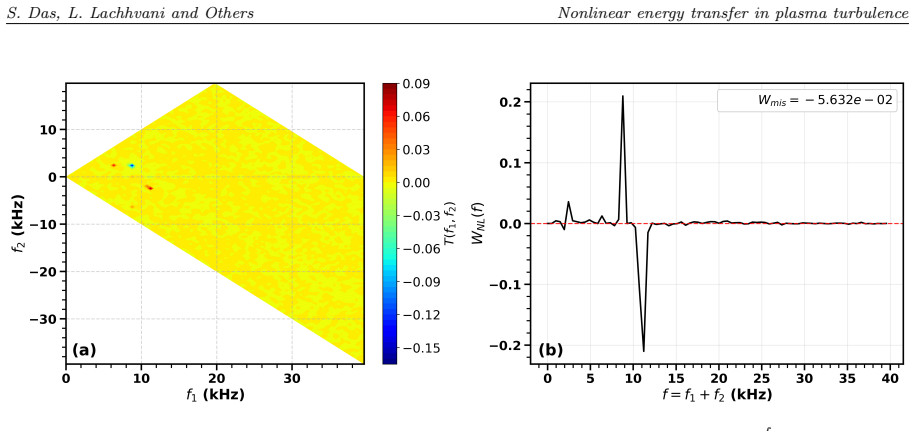
Energy transfer analysis at different radial locations using the Ritz and Kim methods reveals the transfer of energy from RT modes to a comparatively low-frequency DW mode through quadratic coupling processes, demonstrating the capability of the methods to quantify spectral energy transport in the plasma turbulence.
What carries the argument
The Ritz and Kim methods, which compute nonlinear energy transfer rates among frequency components of a fluctuating field based on quadratic coupling in single-field turbulence models.
If this is right
- The Ritz and Kim methods quantify spectral energy transport when applied to developing plasma turbulence.
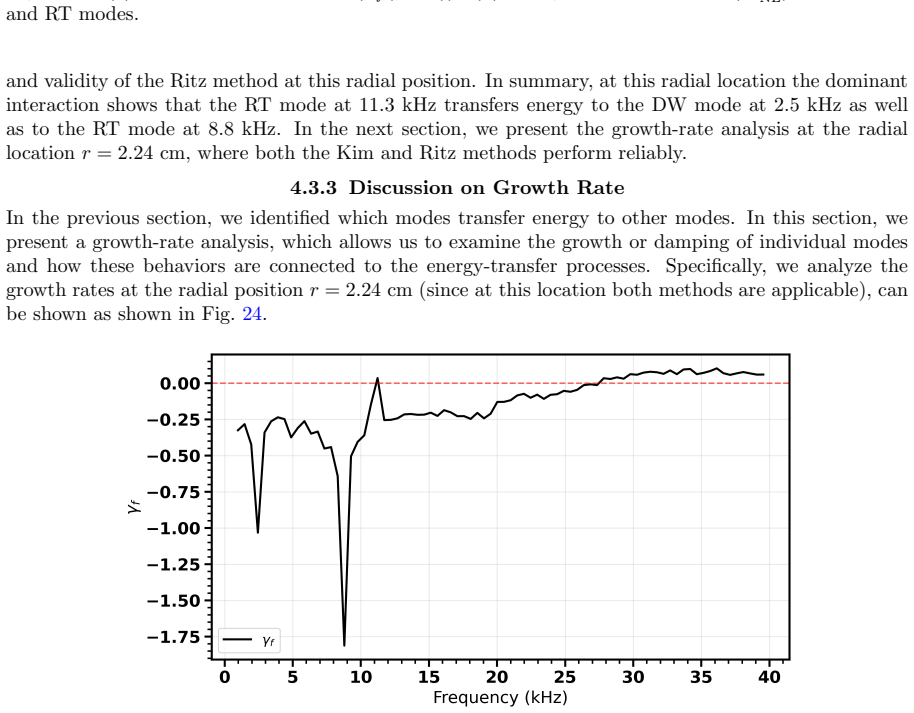
- Energy moves from higher-frequency RT modes to lower-frequency DW mode at multiple radial locations in the experiment.
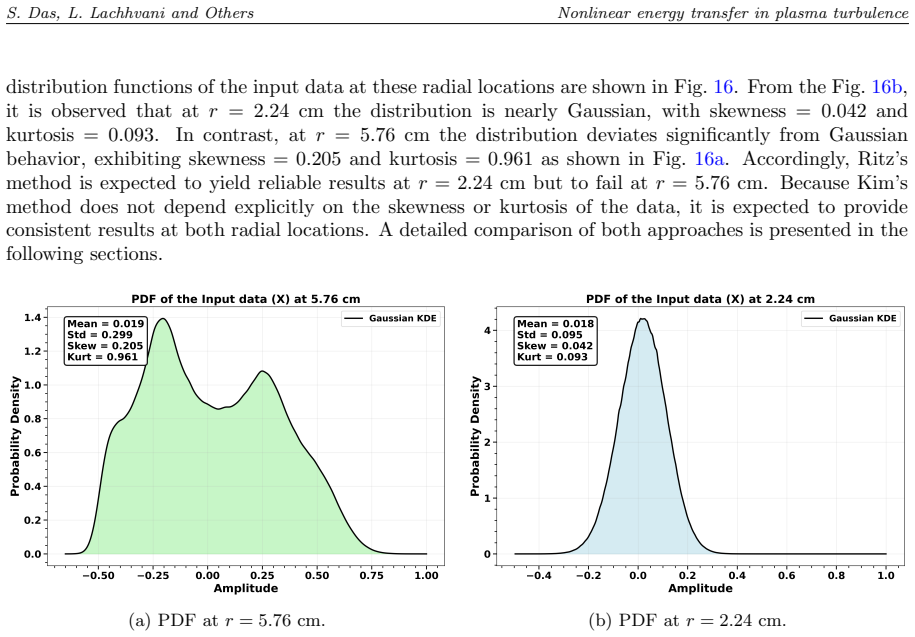
- Method validity requires checking higher-order moments and spatial stationarity of the measured fluctuations.
Where Pith is reading between the lines
- The approach could be used to track how instabilities saturate in other plasma confinement experiments.
- It offers a direct test for whether reduced turbulence models correctly reproduce quadratic energy cascades.
- Similar spectral transfer diagnostics might apply to fluid or atmospheric turbulence where quadratic interactions dominate.
Load-bearing premise
The data must possess spatial stationarity and statistical properties such as sufficiently high kurtosis for the quadratic coupling calculations to apply reliably.
What would settle it
Applying the methods to data lacking nonlinear interactions, or to stationary data with low kurtosis, would produce zero or inconsistent transfer rates between the RT and DW modes.
Figures









read the original abstract
Energy transfer among various spectral components of fluctuating physical parameters in plasma occurs due to the nonlinear interactions, but these effects are typically not captured by the traditional linear spectral methods. Plasma density fluctuations measured in the Inverse Mirror Plasma Experimental Device (IMPED) have signatures of nonlinear mode interactions among various instability modes, i.e. Rayleigh-Taylor (RT) and Drift-Wave (DW) modes. In this paper, the energy transfer among these modes as a result of nonlinear wave interactions (through the quadratic coupling processes) have been investigated in detail. The existing computational methods for single field turbulence model such as Ritz method and Kim method have been explored to understand the turbulence dynamics. Both methods are applied and validated in simulation as well as experimental data from IMPED for developing plasma turbulence. We find that the validity and applicability of the methods depend on the statistical nature of the data, particularly higher-order moments such as kurtosis, and on spatial stationarity. Energy transfer analysis at different radial locations using these methods reveals the transfer of energy from RT modes to a comparatively low-frequency DW mode, demonstrating the capability of the method to quantify spectral energy transport in the plasma turbulence.
Editorial analysis
A structured set of objections, weighed in public.
Referee Report
Summary. The paper applies the Ritz and Kim quadratic-coupling methods (from single-field turbulence theory) to density fluctuation measurements in the IMPED device to quantify nonlinear energy transfer among Rayleigh-Taylor (RT) and drift-wave (DW) modes in developing plasma turbulence. Both methods are validated on simulations and on the experimental data; the central result is directional energy transfer from RT modes to a lower-frequency DW mode at multiple radial locations. The abstract explicitly conditions applicability on data kurtosis and spatial stationarity.
Significance. If the stationarity and statistical assumptions are satisfied, the work supplies a concrete, quantitative example of spectral energy transport in a laboratory plasma, extending existing methods to a developing-turbulence regime. The dual validation on simulation and experiment is a positive feature.
major comments (2)
- [Abstract / Results] Abstract and Results section: the manuscript states that 'the validity and applicability of the methods depend on the statistical nature of the data, particularly higher-order moments such as kurtosis, and on spatial stationarity,' yet reports neither measured kurtosis values nor any stationarity tests (e.g., time-series segmentation or cross-spectral consistency checks) for the IMPED density time series at the different radial locations. Because the directional energy-transfer claim rests on the quantitative applicability of the Ritz/Kim estimators, this omission is load-bearing.
- [Methods / Validation] Methods / Validation section: while the abstract asserts that both methods 'were validated on simulations and experiment,' the text provides no explicit equations for the transfer-rate estimators, no error-propagation formulas, and no data-selection criteria (e.g., stationarity windows or kurtosis thresholds) used to accept or reject individual time series. Without these, the experimental transfer directions cannot be independently verified.
minor comments (1)
- [Methods] Notation for the quadratic-coupling coefficients and the definition of the energy-transfer direction (sign convention) should be stated once in a dedicated subsection for clarity.
Simulated Author's Rebuttal
We thank the referee for the careful and constructive review. The comments correctly identify gaps in the presentation of statistical validation and methodological details that are important for assessing the applicability of the Ritz and Kim methods. We address each point below and have revised the manuscript to incorporate the requested information.
read point-by-point responses
-
Referee: [Abstract / Results] Abstract and Results section: the manuscript states that 'the validity and applicability of the methods depend on the statistical nature of the data, particularly higher-order moments such as kurtosis, and on spatial stationarity,' yet reports neither measured kurtosis values nor any stationarity tests (e.g., time-series segmentation or cross-spectral consistency checks) for the IMPED density time series at the different radial locations. Because the directional energy-transfer claim rests on the quantitative applicability of the Ritz/Kim estimators, this omission is load-bearing.
Authors: We agree that the specific kurtosis values and stationarity test results should have been reported to allow readers to evaluate the applicability of the methods. Although the abstract notes the dependence on these factors, the numerical values and test outcomes were omitted from the original text. In the revised manuscript we have added a dedicated paragraph in the Results section that reports the measured kurtosis for the density fluctuations at each radial location (all values lie within the range consistent with the method assumptions) together with the outcomes of stationarity tests performed by segmenting the time series and verifying cross-spectral consistency. These additions directly support the directional energy-transfer conclusions. revision: yes
-
Referee: [Methods / Validation] Methods / Validation section: while the abstract asserts that both methods 'were validated on simulations and experiment,' the text provides no explicit equations for the transfer-rate estimators, no error-propagation formulas, and no data-selection criteria (e.g., stationarity windows or kurtosis thresholds) used to accept or reject individual time series. Without these, the experimental transfer directions cannot be independently verified.
Authors: We acknowledge that the original submission did not include the explicit mathematical expressions for the Ritz and Kim transfer-rate estimators, the associated error-propagation formulas, or the precise data-selection criteria. This omission limits independent verification. The revised Methods section now contains the full equations for the quadratic-coupling estimators, the derivation of the error estimates, and the quantitative thresholds (kurtosis bounds and stationarity-window lengths) applied to accept or reject time series. The validation subsections for both the simulations and the IMPED data have been expanded to reference these criteria explicitly. revision: yes
Circularity Check
No circularity: established methods applied to independent experimental data
full rationale
The paper applies the pre-existing Ritz and Kim methods (described as established computational techniques for single-field turbulence) to compute quadratic-coupling energy transfers from measured density fluctuations in the IMPED device. The reported directional transfer from RT modes to low-frequency DW modes is obtained directly as the output of these methods on the time-series data, after separate validation on simulations. No step in the provided derivation reduces by construction to a fitted parameter, self-definition, or renaming of the input data; the central claim does not depend on a load-bearing self-citation chain or imported uniqueness theorem from the authors' prior work. The analysis remains self-contained as an application to external measurements.
Axiom & Free-Parameter Ledger
axioms (2)
- domain assumption Nonlinear interactions occur through quadratic coupling processes among spectral components
- domain assumption Data statistics (kurtosis) and spatial stationarity determine method applicability
Reference graph
Works this paper leans on
-
[1]
W. Horton. Drift waves and transport in magnetized plasmas.Reviews of Modern Physics, 71(3):735–778, 1999. 30 S. Das, L. Lachhvani and Others Nonlinear energy transfer in plasma turbulence
work page 1999
-
[2]
C. M. Ritz, E. J. Powers, and R. D. Bengtson. Experimental measurement of nonlinear energy transfer in a turbulent plasma.Phys. Fluids B: Plasma Phys., 1(1):153–159, 1989
work page 1989
-
[3]
D. E. Smith, E. J. Powers, and G. S. Caldwell. Fast-fourier-transform spectral-analysis techniques as a plasma fluctuation diagnostic tool.IEEE Transactions on Plasma Science, PS-2:261–272, 1974
work page 1974
-
[4]
D. E. Smith, E. J. Powers, and G. S. Caldwell. Nonlinear three-wave interactions in plasma turbu- lence.IEEE Transactions on Plasma Science, PS-2:261–267, 1974
work page 1974
-
[5]
D. E. Smith and E. J. Powers. Experimental investigation of nonlinear wave interactions in a turbulent plasma.Physics of Fluids, 16:1373–1380, 1973
work page 1973
-
[6]
S. Elgar and R. T. Guza. Observations of bispectra of ocean surface gravity waves.Journal of Fluid Mechanics, 161:425–448, 1985
work page 1985
-
[7]
Young C. Kim and Edward J. Powers. Digital bispectral analysis and its applications to nonlinear wave interactions.IEEE Trans. Plasma Sci., PS-7(2):120–131, 1979
work page 1979
-
[8]
R. W. Miksad, F. L. Jones, and E. J. Powers. Energy transfer in drift-wave instabilities.Physics of Fluids, 26:1402–1410, 1983
work page 1983
-
[9]
Y. C. Kim, J. M. Beall, E. J. Powers, and R. W. Miksad. Bispectrum and nonlinear wave coupling. Physics of Fluids, 23:258–263, 1980
work page 1980
-
[10]
Ch. P. Ritz and E. J. Powers. Estimation of nonlinear transfer functions for fully developed turbu- lence.Physica D: Nonlinear Phenomena, 20(2-3):320–334, 1986
work page 1986
-
[11]
Ch. P. Ritz, E. J. Powers, R. W. Miksad, and R. S. Solis. Nonlinear spectral dynamics of a transitioning flow.Physics of Fluids, 31(12):3577–3588, 1988
work page 1988
-
[12]
Yu-Hang Shen, Jia-Yin Li, Tian Li, and Jia Li. An improved method for bispectral analysis of nonlinear wave interaction system.Physica Scripta, 95(5):055202, 2020
work page 2020
-
[13]
J. S. Kim, R. D. Durst, R. J. Fonck, E. Fernandez, A. Ware, and P. W. Terry. Technique for the experimental estimation of nonlinear energy transfer in fully developed turbulence.Physics of Plasmas, 3(11):3998–4009, 1996
work page 1996
-
[14]
K. I. Kim, E. J. Powers, C. P. Ritz, R. W. Miksad, and F. J. Fischer. Bispectral analysis of nonlinear drift oscillations of moored vessels.IEEE Journal of Oceanic Engineering, OE-12(4):568–575, 1987
work page 1987
-
[15]
J. Anderson, E-j Kim, B. Hnat, and T. Rafiq. Elucidating plasma dynamics in hasegawa-wakatani turbulence by information geometry.Physics of Plasmas, 27(2):022307, 2020
work page 2020
-
[16]
Plasma edge turbulence.Physical Review Letters, 50(9):682, 1983
Akira Hasegawa and Masahiro Wakatani. Plasma edge turbulence.Physical Review Letters, 50(9):682, 1983
work page 1983
-
[17]
Nicholas A. Krall and Alvin W. Trivelpiece.Principles of Plasma Physics. McGraw-Hill, New York, 1973
work page 1973
-
[18]
P. W. Terry and P. H. Diamond. Resistivity-gradient-driven turbulence.Physics of Fluids, 28:1419– 1430, 1985
work page 1985
-
[19]
D. E. Smith, E. J. Powers, and G. S. Caldwell. Fast-fourier-transform spectral-analysis techniques as a plasma fluctuation diagnostic tool.IEEE Transactions on Plasma Science, PS-2:261–270, December 1974
work page 1974
-
[20]
C. L. Nikias and A. P. Petropulu.Higher-Order Spectra Analysis: A Nonlinear Signal Processing Framework. Prentice Hall, Englewood Cliffs, New Jersey, 1993
work page 1993
-
[21]
Akira Hasegawa and Kunioki Mima. Pseudo-three-dimensional turbulence in magnetized nonuniform plasma.Physical Fluids, 21(1):87–92, 1978
work page 1978
-
[22]
M. H. Freilich and R. T. Guza. Nonlinear wave interactions in ocean surface gravity waves.Philo- sophical Transactions of the Royal Society of London. Series A, 311:1–26, 1984. 31 S. Das, L. Lachhvani and Others Nonlinear energy transfer in plasma turbulence
work page 1984
-
[23]
A. Hasegawa, C. G. Maclennan, and Y. Kodama. Nonlinear behavior and turbulence spectra of drift waves.Physics of Fluids, 22:2122–2129, 1979
work page 1979
-
[24]
M. D. Millionshchikov. On the theory of homogeneous isotropic turbulence.Doklady Akademii Nauk SSSR, 32:611–614, 1941
work page 1941
-
[25]
P. W. Terry, P. H. Diamond, K. C. Shaing, L. Garcia, and B. A. Carreras. The spectrum of resistivity gradient driven turbulence. Technical Report IFSR-174, Institute for Fusion Studies, Austin, Texas, 1986
work page 1986
- [26]
-
[27]
Julius S. Bendat and Allan G. Piersol.Random Data: Analysis and Measurement Procedures. Wiley, 4th edition, 2010
work page 2010
-
[28]
Murray R. Spiegel and Larry J. Stephens.Schaum’s Outline of Statistics. McGraw-Hill Education, 6th edition, 2018
work page 2018
-
[29]
Sayak Bose, PK Chattopadhyay, J Ghosh, S Sengupta, YC Saxena, and R Pal. Inverse mirror plasma experimental device (imped)–a magnetized linear plasma device for wave studies.Journal of Plasma Physics, 81(2):345810203, 2015
work page 2015
-
[30]
Sayak Bose, Manjit Kaur, PK Chattopadhyay, J Ghosh, and YC Saxena. Inverse mirror plasma experimental device—a new magnetized linear plasma device with wide operating range.Review of Scientific Instruments, 86(6), 2015
work page 2015
-
[31]
Rosh Roy, Tanmay Karmakar, Lavkesh Lachhvani, Prabal Chattopadhyay, Abhijit Sen, and Sayak Bose. An experimental study of the existence regions and non-linear interactions of drift wave and kelvin–helmholtz instabilities in a linear magnetized plasma.Physics of Plasmas, 32(2), 2025
work page 2025
-
[32]
Rosh Roy, Tanmay Karmakar, Lavkesh Lachhvani, Bhoomi Khodiyar, Prabal Chattopadhyay, and Abhijit Sen. An experimental study of the rayleigh–taylor and kelvin–helmholtz instabilities, and their nonlinear interactions in a linear magnetized plasma column.Physics of Plasmas, 32(12), 2025
work page 2025
-
[33]
On the transition to drift turbulence in a magnetized plasma column.Physics of Plasmas, 12(5), 2005
MJ Burin, GR Tynan, GY Antar, NA Crocker, and C Holland. On the transition to drift turbulence in a magnetized plasma column.Physics of Plasmas, 12(5), 2005
work page 2005
-
[34]
M. Xu, G. R. Tynan, C. Holland, Z. Yan, S. H. Muller, and J. H. Yu. Study of nonlinear spectral energy transfer in frequency domain.Physics of Plasmas, 16(4):042312, 2009
work page 2009
-
[35]
M. Xu, G. R. Tynan, C. Holland, Z. Yan, S. H. Muller, and J. H. Yu. Fourier-domain study of drift turbulence driven sheared flow in a laboratory plasma.Physics of Plasmas, 17(3):032311, 2010
work page 2010
-
[36]
P. Manz, M. Ramisch, U. Stroth, V. Naulin, and B. D. Scott. Bispectral experimental estimation of the nonlinear energy transfer in two-dimensional plasma turbulence.Plasma Physics and Controlled Fusion, 50(3):035008, 2008
work page 2008
-
[37]
S.-I. Itoh, K. Itoh, Y. Nagashima, and Y. Kosuga. On the application of cross bispectrum and cross bicoherence.Plasma and Fusion Research, 12:1101003, 2017. 32
work page 2017
discussion (0)
Sign in with ORCID, Apple, or X to comment. Anyone can read and Pith papers without signing in.