Solar Orbiter observations of solar energetic electron events associated with hard microflares
Pith reviewed 2026-05-10 14:24 UTC · model grok-4.3
The pith
Hard microflares accelerate electrons efficiently and launch them as solar energetic electrons on open sunspot field lines.
A machine-rendered reading of the paper's core claim, the machinery that carries it, and where it could break.
Core claim
HMFs produce prompt SEEs with hard spectra, demonstrating efficient electron acceleration without requiring large flare energy release. Their magnetic configuration, involving open field lines from the sunspot, suggests they may be an important contributor to filling the heliosphere with energetic particles.
What carries the argument
Joint HXR spectroscopy of HMFs with STIX and in-situ electron spectral analysis with EPD, tied together by timing coincidence and magnetic connectivity estimates.
Load-bearing premise
The eight events are correctly paired with their in-situ electrons through timing and connectivity, and interplanetary transport does not substantially soften the observed electron spectra relative to the flare-accelerated population.
What would settle it
An HMF with clear magnetic connectivity whose velocity-dispersion injection time misses the hard X-ray peak or whose in-situ electron spectrum is much softer than the HXR photon index predicts.
Figures
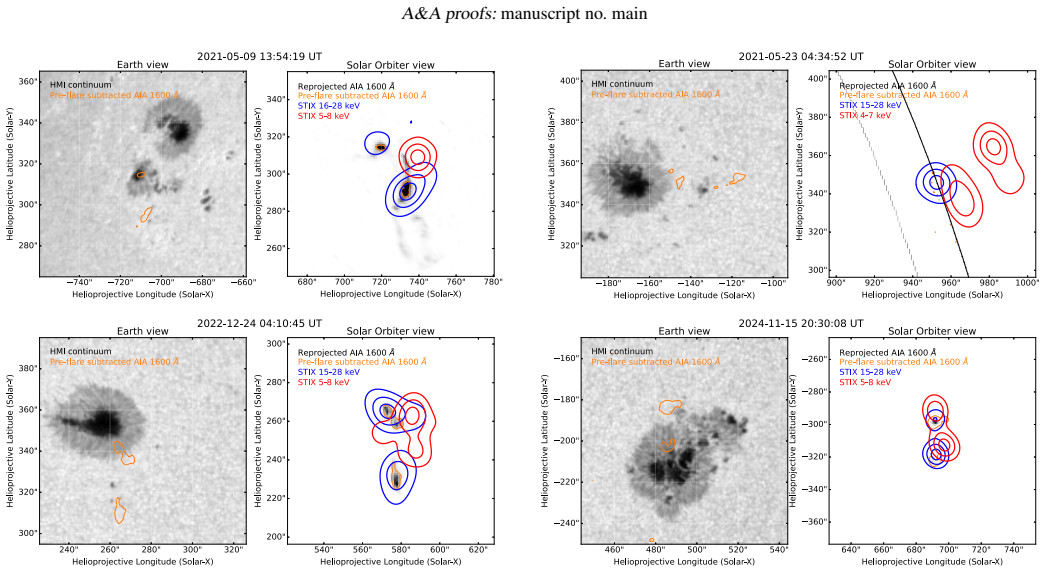


read the original abstract
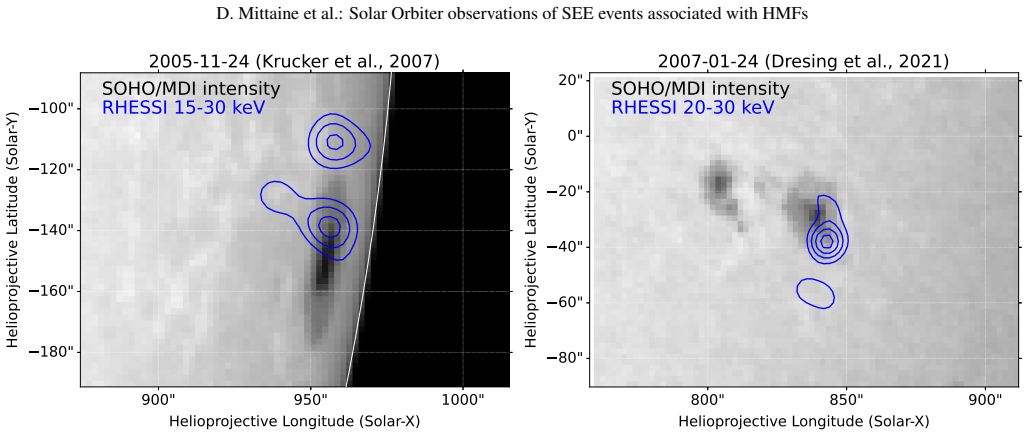
Generally, large solar flares accelerate electrons to high energies more efficiently than microflares. However, some microflares, known as hard microflares (HMFs), also produce high-energy electrons, as indicated by their flat hard X-ray (HXR) spectra. These events are typically associated with footpoints located in or at the edge of sunspots. The mechanisms behind this efficient acceleration, and their connection to solar energetic electrons (SEEs), remain unclear. We compare, for the first time, HXR spectra of HMFs with in-situ electron spectra of associated SEEs using Solar Orbiter STIX and EPD observations. This provides insight into acceleration processes and the transport of high-energy electrons into interplanetary space. We identify eight HMFs observed jointly by Solar Orbiter and Earth-based instruments that are associated with SEEs, confirmed through timing and magnetic connectivity analysis. Each event is studied using HXR spectroscopy, SEE velocity-dispersion analysis, and in-situ electron spectral analysis. Seven of eight events show consistent timing between flare HXR emission and inferred electron injection, as well as good agreement with magnetic connectivity estimates. The known correlation between HXR photon and in-situ electron spectral indices extends to HMFs, which occupy the hard end of the distribution, even compared to larger flares. We conclude that HMFs produce prompt SEEs with hard spectra, demonstrating efficient electron acceleration without requiring large flare energy release. Their magnetic configuration, involving open field lines from the sunspot, suggests they may be an important contributor to filling the heliosphere with energetic particles.
Editorial analysis
A structured set of objections, weighed in public.
Referee Report
Summary. The manuscript reports Solar Orbiter STIX and EPD observations of eight hard microflares (HMFs) jointly detected with Earth-based instruments and associated with solar energetic electron events (SEEs). It finds that seven of the eight events exhibit consistent timing between HXR peaks and velocity-dispersion-derived injection times, plus good agreement with magnetic connectivity estimates. The known correlation between HXR photon and in-situ electron spectral indices is shown to extend to these HMFs, which occupy the hard end of the distribution. The authors conclude that HMFs produce prompt SEEs with hard spectra via efficient acceleration, without needing large flare energy release, and that their sunspot-associated open field lines may make them important contributors to heliospheric energetic particles.
Significance. If the event associations and spectral results hold after uncertainty quantification, the work provides the first direct comparison of HMF HXR spectra with associated in-situ SEE spectra. It strengthens evidence that small-scale events can accelerate electrons to high energies efficiently and extends the spectral-index correlation into a harder regime, with potential implications for models of particle escape along open fields from sunspots and the overall contribution of microflares to heliospheric particle populations.
major comments (2)
- [Event identification and association] Event identification section: The claim of seven-of-eight events showing 'consistent timing' and 'good agreement' with connectivity rests on timing coincidence and magnetic connectivity estimates, but the manuscript provides no quantified uncertainties (e.g., 1-sigma widths on EPD velocity-dispersion injection times, footpoint uncertainties from PFSS source-surface height or active-region extrapolations). Without these or a control test against random coincidences, the robustness of the association rate cannot be evaluated and directly affects the 'prompt SEEs' and 'hard spectra' conclusions.
- [Spectral analysis] Spectral analysis and results: The extension of the HXR-electron spectral index correlation to HMFs is a central result, yet details on spectral fitting procedures, error propagation, and any selection biases (e.g., restricting to events with clear SEE detections) are not reported. This leaves open whether the placement of HMFs at the hard end of the distribution is representative or influenced by the association criteria.
minor comments (2)
- [Abstract] Abstract: Specify the energy ranges over which the HXR and electron spectral indices are measured to allow direct comparison with prior flare studies.
- [Figures] Figures: Include explicit statements in figure captions about the fitting methods, energy ranges, and how uncertainties are displayed in the spectral plots and timing diagrams.
Simulated Author's Rebuttal
We thank the referee for their thorough review and constructive feedback on our manuscript. We have carefully considered the major comments and provide point-by-point responses below. Where appropriate, we have revised the manuscript to incorporate additional details on uncertainties and analysis methods to strengthen the presentation of our results.
read point-by-point responses
-
Referee: [Event identification and association] Event identification section: The claim of seven-of-eight events showing 'consistent timing' and 'good agreement' with connectivity rests on timing coincidence and magnetic connectivity estimates, but the manuscript provides no quantified uncertainties (e.g., 1-sigma widths on EPD velocity-dispersion injection times, footpoint uncertainties from PFSS source-surface height or active-region extrapolations). Without these or a control test against random coincidences, the robustness of the association rate cannot be evaluated and directly affects the 'prompt SEEs' and 'hard spectra' conclusions.
Authors: We agree that providing quantified uncertainties would improve the evaluation of the event associations. In the revised version, we have included 1-sigma error bars on the velocity dispersion analysis for the injection times from the EPD data. For magnetic connectivity, we have added estimates of uncertainties arising from the choice of source surface height in the PFSS model and variations in active region extrapolations. While a formal control test for random coincidences was not included originally, the specific timing matches (within minutes of expected delays) and connectivity to the observed active regions make chance associations unlikely. We have added a brief discussion quantifying the expected number of random matches based on the timing window and event rate. These revisions support our conclusion of prompt SEEs associated with the HMFs. revision: yes
-
Referee: [Spectral analysis] Spectral analysis and results: The extension of the HXR-electron spectral index correlation to HMFs is a central result, yet details on spectral fitting procedures, error propagation, and any selection biases (e.g., restricting to events with clear SEE detections) are not reported. This leaves open whether the placement of HMFs at the hard end of the distribution is representative or influenced by the association criteria.
Authors: We acknowledge the need for more transparency in the spectral analysis. The revised manuscript now includes a dedicated subsection detailing the spectral fitting procedures for both STIX HXR spectra (using thermal plus non-thermal power-law models) and EPD in-situ electron spectra (power-law fits in the relevant energy range). Error propagation is described, accounting for Poisson statistics, background subtraction, and instrumental uncertainties. Regarding selection biases, the events were identified based on joint observations by Solar Orbiter and Earth-based instruments with SEE detections, but the spectral hardness was not a selection criterion; all detected HMFs were included. We have clarified that the sample is representative of HMFs with associated SEEs, and their position at the hard end extends the known correlation without bias from the association. This addresses the concern and reinforces the central result. revision: yes
Circularity Check
No circularity: purely observational analysis with standard techniques
full rationale
The paper reports direct Solar Orbiter STIX and EPD measurements of eight hard microflares and associated in-situ electrons. Event identification uses timing coincidence between HXR peaks and velocity-dispersion injection times plus magnetic connectivity estimates; spectral indices are compared via standard HXR and electron spectroscopy. These steps apply established methods to new data without any mathematical derivation, parameter fitting that defines the target quantity, or load-bearing self-citation. The extension of the known HXR-electron index correlation is an empirical observation, not a constructed prediction. The analysis chain is therefore self-contained and externally falsifiable.
Axiom & Free-Parameter Ledger
axioms (1)
- domain assumption Standard assumptions of solar flare electron acceleration and interplanetary transport physics
Reference graph
Works this paper leans on
-
[1]
Arnold, H., Drake, J. F., Swisdak, M., et al. 2021, Phys. Rev. Lett., 126, 135101
work page 2021
-
[2]
P., van Driel-Gesztelyi, L., et al
Baker, D., Rouillard, A. P., van Driel-Gesztelyi, L., et al. 2009, Annales Geo- physicae, 27, 3883
work page 2009
- [3]
-
[4]
Battaglia, A. F. & Krucker, S. 2025, A&A, 694, A58
work page 2025
-
[5]
Battaglia, A. F., Krucker, S., Veronig, A. M., et al. 2024, A&A, 691, A172
work page 2024
-
[6]
F., Saqri, J., Massa, P., et al
Battaglia, A. F., Saqri, J., Massa, P., et al. 2021, A&A, 656, A4
work page 2021
- [7]
-
[8]
Benz, A. O. 2017, Living Reviews in Solar Physics, 14, 59
work page 2017
-
[9]
Brown, J. C. 1971, Solar Physics, 18, 489–502
work page 1971
-
[10]
Domingo, V ., Fleck, B., & Poland, A. I. 1995, Solar Physics, 162, 1
work page 1995
-
[11]
Dresing, N., Effenberger, F., Gómez-Herrero, R., et al. 2020, ApJ, 889, 143
work page 2020
-
[12]
Dresing, N., Warmuth, A., Effenberger, F., et al. 2021, A&A, 654, A92
work page 2021
-
[13]
Fedeli, A., Dresing, N., Gieseler, J., et al. 2026, A&A, 706, A107
work page 2026
-
[14]
Fletcher, L., Dennis, B. R., Hudson, H. S., et al. 2011, Space Sci. Rev., 159, 19
work page 2011
-
[15]
Freeland, S. L. & Handy, B. N. 1998, Solar Physics, 182, 497
work page 1998
-
[16]
Gary, D. E., Chen, B., Dennis, B. R., et al. 2018, ApJ, 863, 83 Article number, page 13 A&A proofs:manuscript no. main
work page 2018
-
[17]
Gieseler, J., Dresing, N., Palmroos, C., et al. 2023, Frontiers in Astronomy and Space Sciences, 9, 384 Gómez-Herrero, R., Pacheco, D., Kollhoff, A., et al. 2021, A&A, 656, L3
work page 2023
-
[18]
G., Christe, S., Krucker, S., et al
Hannah, I. G., Christe, S., Krucker, S., et al. 2008, ApJ, 677, 704
work page 2008
-
[19]
Holman, G. D., Aschwanden, M. J., Aurass, H., et al. 2011, A&A, 136, 107
work page 2011
-
[20]
S., O’Brien, H., Carrasco Blazquez, I., et al
Horbury, T. S., O’Brien, H., Carrasco Blazquez, I., et al. 2020, A&A, 642, 11
work page 2020
-
[21]
Hurford, G. J., Krucker, S., Lin, R. P., et al. 2006, ApJ, 644, L93 Högbom, J. A. 1974, Astronomy and Astrophysics Supplement, 15, 417
work page 2006
-
[22]
Kaiser, M. L., Kucera, T. A., Davila, J. M., et al. 2008, Space Sci. Rev., 136, 5
work page 2008
-
[23]
Kistler, F., Janitzek, N. P., Bischof, L., et al. 2025, Solar Orbiter Flare Link - Au- tomated Linkage between Solar Flares and Energetic Particle Events,https: //flaretool.pmodwrc.ch/#so-flink-solar-orbiter-flare-link
work page 2025
-
[24]
Kontar, E. P. & Reid, H. A. 2009, The Astrophysical Journal Letters, 695, 4
work page 2009
-
[25]
Krucker, S., Hurford, G. J., Grimm, O., et al. 2020, A&A, 642, A15
work page 2020
-
[26]
P., Christe, S., Glesener, L., & Lin, R
Krucker, S., Kontar, E. P., Christe, S., Glesener, L., & Lin, R. P. 2011, ApJ, 742, 82
work page 2011
-
[27]
Krucker, S., Kontar, E. P., Christe, S., & Lin, R. P. 2007, ApJ, 663, L109
work page 2007
- [28]
- [29]
-
[30]
Lario, D., Balmaceda, L. A., Gómez-Herrero, R., et al. 2024, ApJ, 975, 84
work page 2024
- [31]
-
[32]
Lin, R. P., Anderson, K. A., Ashford, S., et al. 1995, Space Sci. Rev., 71, 125
work page 1995
-
[33]
Lin, R. P., Dennis, B. R., Hurford, G. J., et al. 2002, Sol. Phys., 210, 3
work page 2002
-
[34]
Lin, R. P., Dennis, B. R., Hurford, G. J., et al. 2002, Solar Physics, 210, 3
work page 2002
-
[35]
Lorfing, C. Y ., Reid, H. A. S., Gómez-Herrero, R., et al. 2023, A&A, 959, 11
work page 2023
-
[36]
Mason, G. M., Kouloumvakos, A., Ho, G. C., et al. 2025, ApJ, 992, 24
work page 2025
-
[37]
1994, Nature, 371, 495 Müller, D., St
Masuda, S., Kosugi, T., Hara, H., Tsuneta, S., & Ogawara, Y . 1994, Nature, 371, 495 Müller, D., St. Cyr, O. C., Zouganelis, I., et al. 2020, A&A, 642, A1 Müller-Mellin, R., Böttcher, S., Falenski, J., et al. 2008, Space Sci. Rev., 136, 363
work page 1994
-
[38]
Ogilvie, K. W. & Desch, M. D. 1997, Advances in Space Research, 20, 559
work page 1997
-
[39]
J., Bruno, R., Livi, S., et al
Owen, C. J., Bruno, R., Livi, S., et al. 2020, A&A, 642, 36
work page 2020
-
[40]
Paassilta, M., Papaioannou, A., Dresing, N., et al. 2018, Solar Physics, 293, 53
work page 2018
-
[41]
2022, Frontiers in Astronomy and Space Sciences, 9, id.395
Palmroos, C., Gieseler, J., Dresing, N., et al. 2022, Frontiers in Astronomy and Space Sciences, 9, id.395
work page 2022
-
[42]
Parker, E. N. 1973, ApJ, 180, 247
work page 1973
-
[43]
Reid, H. A. & Kontar, E. P. 2010, A&A, 721, 864
work page 2010
-
[44]
Reid, H. A. & Kontar, E. P. 2013, Solar Physics, 285, 217 Rodríguez-García, L., Gómez-Herrero, R., Dresing, N., et al. 2025, A&A, 694, A64 Rodríguez-García, L., Gómez-Herrero, R., Dresing, N., et al. 2023, A&A, 670, A51 Rodríguez-García, L., Gómez-Herrero, R., Zouganelis, I., et al. 2021, A&A, 653, A137 Rodríguez-Pacheco, J., Wimmer-Schweingruber, R. F., ...
work page 2013
-
[45]
Rouillard, A. P., Pinto, R. F., V ourlidas, A., et al. 2020, A&A, 642, 32
work page 2020
-
[46]
Saqri, J., Veronig, A. M., Battaglia, A. F., et al. 2024, A&A, 683, A41
work page 2024
-
[47]
Scherrer, P. H., Bogart, R. S., Bush, R. I., et al. 1995, Sol. Phys., 162, 129
work page 1995
-
[48]
Schwartz, R. A., Csillaghy, A., Tolbert, A. K., et al. 2002, Solar Physics, 210, 165–191
work page 2002
- [49]
-
[50]
D., Dresing, N., Kollhoff, A., & Brüdern, M
Strauss, R. D., Dresing, N., Kollhoff, A., & Brüdern, M. 2020, ApJ, 897, 24
work page 2020
-
[51]
2013, Journal of Space Weather and Space Climate, 3, A12
Vainio, R., Valtonen, E., Heber, B., et al. 2013, Journal of Space Weather and Space Climate, 3, A12
work page 2013
-
[52]
Wang, L., Lin, R. P., Krucker, S., & Mason, G. M. 2012, ApJ, 759, 69
work page 2012
-
[53]
Wang, W., Battaglia, A. F., Krucker, S., & Wang, L. 2023, ApJ, 950, 118
work page 2023
- [54]
- [55]
-
[56]
Warmuth, A., Schuller, F., Gómez-Herrero, R., et al. 2025, A&A, 701, 27
work page 2025
-
[57]
F., Berger, L., Kollhoff, A., et al
Wimmer-Schweingruber, R. F., Berger, L., Kollhoff, A., et al. 2023, A&A, 678, 11
work page 2023
-
[58]
Wimmer-Schweingruber, R. F., Janitzek, N. P., Pacheco, D., et al. 2021, A&A, 656, 17 Article number, page 14 D. Mittaine et al.: Solar Orbiter observations of SEE events associated with HMFs Appendix A: VDA analysis: SERPENTINE tool and EPT-viewing selection A.1. VDA method Under the standard VDA assumptions described in Section 3.2, electrons of differen...
work page 2021
discussion (0)
Sign in with ORCID, Apple, or X to comment. Anyone can read and Pith papers without signing in.