A robust iterative scheme for the slightly compressible Darcy-Forchheimer equations
Pith reviewed 2026-05-10 14:04 UTC · model grok-4.3
The pith
New iterative linearization scheme solves nonlinear Darcy-Forchheimer systems with discrete convergence
A machine-rendered reading of the paper's core claim, the machinery that carries it, and where it could break.
Core claim
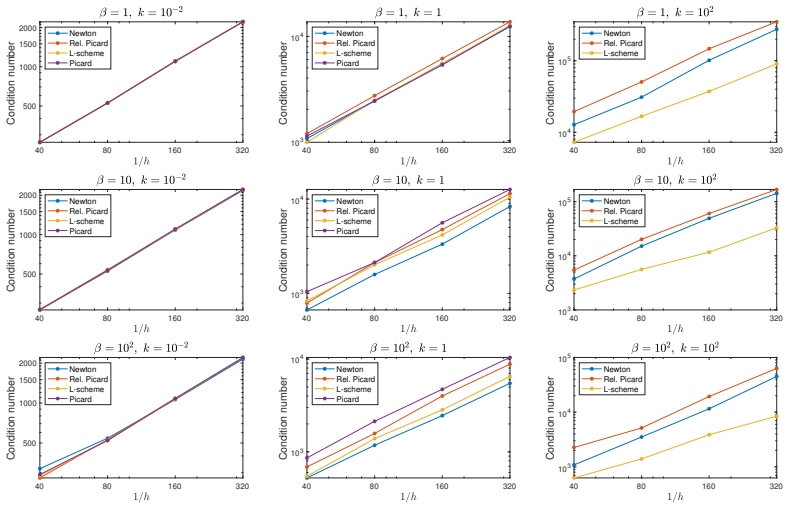
The central claim is that the proposed iterative linearization scheme converges for the discrete nonlinear systems obtained from the slightly compressible Darcy-Forchheimer model and remains competitive and robust in regimes with strong nonlinear effects, as confirmed by direct comparison with standard solvers and additional tests with discontinuous permeability.
What carries the argument
The general iterative linearization scheme that repeatedly solves a linearized version of the nonlinear algebraic system at each time step until a convergence criterion is met.
Load-bearing premise
The iterative scheme converges for the chosen discretization and range of problem parameters without explicit general conditions on the Forchheimer coefficient, compressibility, or mesh size.
What would settle it
A numerical test with a large Forchheimer coefficient or fine mesh in which the iterations fail to converge or produce a solution that deviates from a reference solution obtained by a different method.
Figures


read the original abstract
We study the slightly compressible Darcy-Forchheimer equations modeling gas flow in porous media, particularly in applications related to combustion processes. The equations are discretized in time using the backward Euler method and in space via a mixed finite element scheme. As a result, a nonlinear algebraic system is obtained at each time step. We propose and analyze a general iterative linearization scheme for the efficient solution of such systems and study its convergence properties at the discrete level. The performance and robustness of the scheme are assessed through a series of numerical experiments. The method is compared with standard iterative solvers, and further tested on problems with discontinuous permeability fields. The results demonstrate its reliability and competitiveness in regimes characterized by strong nonlinear effects.
Editorial analysis
A structured set of objections, weighed in public.
Referee Report
Summary. The paper studies the slightly compressible Darcy-Forchheimer equations modeling gas flow in porous media. The equations are discretized in time using the backward Euler method and in space via a mixed finite element scheme, leading to a nonlinear algebraic system at each time step. A general iterative linearization scheme is proposed and analyzed for convergence at the discrete level under explicit conditions on the time-step size, mesh size, Forchheimer coefficient, and compressibility parameter. Numerical experiments assess performance and robustness, including comparisons with standard solvers and tests on discontinuous permeability fields.
Significance. This work offers a robust iterative method for efficiently solving the nonlinear systems arising in modeling gas flow through porous media with Forchheimer effects. The discrete convergence analysis with explicit parameter conditions, supported by numerical evidence of reliability in strong nonlinearity regimes, represents a useful advance. Strengths include the fixed-point based proof and validation on challenging cases like discontinuous permeability.
major comments (2)
- [the theorem following the fixed-point argument] The theorem following the fixed-point argument: the derived conditions on the time-step size, mesh size, Forchheimer coefficient, and compressibility parameter guarantee contraction; however, it is unclear if these conditions are optimal or if the scheme can be shown to converge without the smallness assumptions on the data, which would strengthen the robustness claim for arbitrary parameters.
- [Numerical experiments] Numerical experiments section: the robustness is assessed through a series of tests, but without reporting the specific values of the parameters (e.g., the range of Forchheimer coefficient used) in relation to the theoretical bounds from the convergence theorem, it is difficult to fully assess if the tests operate within or at the boundary of the guaranteed convergence region.
minor comments (3)
- [Abstract] The abstract mentions studying convergence at the discrete level but does not preview the explicit conditions derived; including a brief mention would better inform readers of the analysis strength.
- [Numerical experiments] The description of the comparison with standard iterative solvers could be expanded to include specific iteration counts or CPU times in a table for clearer competitiveness assessment.
- [References] Ensure all cited works on Darcy-Forchheimer discretizations are up to date, particularly recent works on iterative methods for nonlinear flows.
Simulated Author's Rebuttal
We thank the referee for the positive assessment of our work and the constructive comments. We address the major comments point by point below.
read point-by-point responses
-
Referee: The theorem following the fixed-point argument: the derived conditions on the time-step size, mesh size, Forchheimer coefficient, and compressibility parameter guarantee contraction; however, it is unclear if these conditions are optimal or if the scheme can be shown to converge without the smallness assumptions on the data, which would strengthen the robustness claim for arbitrary parameters.
Authors: The convergence theorem is established via a contraction mapping argument applied to the iterative scheme at the discrete level. This approach inherently produces sufficient conditions on the time-step size, mesh size, Forchheimer coefficient, and compressibility parameter to ensure the contraction constant is strictly less than one. We do not claim these conditions are optimal, nor do we provide a proof of convergence that removes the smallness assumptions. Such an extension would require a different analytical technique (for instance, exploiting monotonicity or other fixed-point results without contraction), which lies outside the scope of the present manuscript. We have added a remark immediately following the theorem to clarify the nature of the assumptions and to note that convergence for arbitrary parameters remains an open question for future study. revision: partial
-
Referee: Numerical experiments section: the robustness is assessed through a series of tests, but without reporting the specific values of the parameters (e.g., the range of Forchheimer coefficient used) in relation to the theoretical bounds from the convergence theorem, it is difficult to fully assess if the tests operate within or at the boundary of the guaranteed convergence region.
Authors: We agree that explicitly relating the numerical parameters to the theoretical bounds improves the assessment of the experiments. In the revised manuscript we have augmented the numerical experiments section with a table and accompanying discussion that lists the specific values (and ranges) of the Forchheimer coefficient, time-step sizes, mesh sizes, and compressibility parameter employed in each test. These values are compared directly against the explicit bounds furnished by the convergence theorem, confirming that all reported experiments lie inside the region where convergence is guaranteed while still exercising the scheme in strongly nonlinear regimes. revision: yes
Circularity Check
No significant circularity detected
full rationale
The paper discretizes the slightly compressible Darcy-Forchheimer equations via backward Euler in time and mixed finite elements in space to obtain a nonlinear algebraic system at each time step. It then defines an iterative linearization scheme independently of the target solution and establishes its convergence at the discrete level through a fixed-point argument that yields explicit contraction conditions on the time-step size, mesh size, Forchheimer coefficient, and compressibility parameter. These conditions are derived mathematically rather than fitted to data or obtained via self-referential definitions. Numerical experiments serve only to validate performance and robustness, including on discontinuous permeability fields, and do not underpin the convergence claims. No load-bearing self-citations, ansatz smuggling, or renaming of known results appear in the derivation chain, rendering the analysis self-contained against external benchmarks.
Axiom & Free-Parameter Ledger
axioms (1)
- domain assumption The nonlinear algebraic system obtained after discretization admits a unique solution for the chosen time step and mesh.
Reference graph
Works this paper leans on
-
[1]
V . Girault, M. F. Wheeler, Numerical discretization of a Darcy-Forchheimer model, Numer. Math. 110 (2) (2008) 161–198
work page 2008
- [2]
- [3]
-
[4]
T. T. Kieu, Analysis of expanded mixed finite element methods for the generalized Forchheimer flows of slightly compressible fluids, Numer. Methods Partial Differ. Equ. 32 (1) (2015) 60–85
work page 2015
-
[5]
H. Rui, H. Pan, A block-centered finite difference method for slightly compressible Darcy-Forchheimer flow in porous media, J. Sci. Comput. 73 (1) (2017) 70–92
work page 2017
-
[6]
M. A. Mujeebu, M. Z. Abdullah, M. Z. A. Bakar, A. A. Mohamad, R. M. N. Muhad, M. K. Abdullah, Combustion in porous media and its applications – A comprehensive survey, J. Environ. Manag. 90 (8) (2009) 2287–2312
work page 2009
-
[7]
Fabrie, Regularity of the solution of Darcy-Forchheimer’s equation, Nonlinear Anal
P. Fabrie, Regularity of the solution of Darcy-Forchheimer’s equation, Nonlinear Anal. 13 (9) (1989) 1025–1049
work page 1989
-
[8]
Amirat, Écoulements en milieu poreux n’obéissant pas à la loi de Darcy, ESAIM Math
Y . Amirat, Écoulements en milieu poreux n’obéissant pas à la loi de Darcy, ESAIM Math. Model. Numer. Anal. 25 (3) (1991) 273–306
work page 1991
-
[9]
P. Knabner, G. Summ, Solvability of the mixed formulation for Darcy-Forchheimer flow in porous media (2016). arXiv:1608.08829
-
[10]
J. Douglas, Jr., P. J. Paes-Leme, T. Giorgi, Generalized Forchheimer flow in porous media, in: Lions, J.-L., Baiocchi, C. (eds.), Boundary Value Problems for Partial Differential Equations and Applications, V ol. 29 of RMA Res. Notes Appl. Math., Masson, Paris, 1993, pp. 99–111
work page 1993
-
[11]
M. Y . Kim, E. J. Park, Fully discrete mixed finite element approximations for non-Darcy flows in porous media, Comput. Math. Appl. 38 (11-12) (1999) 113–129
work page 1999
-
[12]
R. E. Ewing, R. D. Lazarov, S. L. Lyons, D. V . Papavassilou, J. Pasciak, G. Qin, Numerical well model for non-Darcy flow through isotropic porous media, Comput. Geosci. 3 (3-4) (1999) 184–204
work page 1999
-
[13]
G. Summ, Lösbarkeit un Diskretisierung der gemischten Formulierung für Darcy-Forchheimer-Fluss in porösen Medien, Ph.D. thesis, Friedrich-Alexander-Universität Erlangen-Nürnberg (2001)
work page 2001
-
[14]
E. J. Park, Mixed finite element methods for generalized Forchheimer flow in porous media, Numer. Methods Partial Differ. Equ. 21 (2) (2005) 213–228. 13
work page 2005
-
[15]
D. H. Peaceman, H. H. Rachford, The numerical solution of parabolic and elliptic differential equations, J. Soc. Ind. Appl. Math. 3 (1) (1955) 28–41
work page 1955
-
[16]
H. Pan, H. Rui, Mixed element method for two-dimensional Darcy-Forchheimer model, J. Sci. Comput. 52 (3) (2012) 563–587
work page 2012
-
[17]
H. Rui, H. Pan, A block-centered finite difference method for the Darcy-Forchheimer model, SIAM J. Numer. Anal. 50 (5) (2012) 2612–2631
work page 2012
- [18]
-
[19]
T. Arbogast, M. F. Wheeler, I. Yotov, Mixed finite elements for elliptic problems with tensor coefficients as cell-centered finite differences, SIAM J. Numer. Anal. 34 (2) (1997) 828–852
work page 1997
-
[20]
W. Xu, D. Liang, H. Rui, A multipoint flux mixed finite element method for the compressible Darcy-Forchheimer models, Appl. Math. Comput. 315 (2017) 259–277
work page 2017
-
[21]
J. W. Both, J. M. Nordbotten, F. A. Radu, Free energy diminishing discretization of Darcy-Forchheimer flow in poroelastic media, in: Klöfkorn, R., Keilegavlen, E., Radu, F. A., Fuhrmann, J. (eds.), Finite V olumes for Complex Applications IX - Methods, Theoretical Aspects, Examples, V ol. 323 of Springer Proc. Math. Stat., Springer, Cham, 2020, pp. 203–211
work page 2020
- [22]
-
[23]
P. Knabner, J. E. Roberts, Mathematical analysis of a discrete fracture model coupling Darcy flow in the matrix with Darcy-Forchheimer flow in the fracture, ESAIM Math. Model. Numer. Anal. 48 (5) (2014) 1451–1472
work page 2014
-
[24]
N. Frih, J. E. Roberts, A. Saada, Un modèle Darcy-Forchheimer pour un écoulement dans un milieu poreux fracturé, ARIMA 5 (2006) 129–143
work page 2006
-
[25]
N. Frih, J. E. Roberts, A. Saada, Modeling fractures as interfaces: a model for Forchheimer fractures, Comput. Geosci. 12 (1) (2008) 91–104
work page 2008
-
[26]
A. Arrarás, F. Gaspar, L. Portero, C. Rodrigo, Geometric multigrid methods for Darcy-Forchheimer flow in fractured porous media, Comput. Math. Appl. 78 (9) (2019) 3139–3151
work page 2019
- [27]
-
[28]
H. Rui, W. Liu, A two-grid block-centered finite difference method for Darcy-Forchheimer flow in porous media, SIAM J. Numer. Anal. 53 (4) (2015) 1941–1962
work page 2015
-
[29]
F. List, F. A. Radu, A study on iterative methods for solving Richards’ equation, Comput. Geosci. 20 (2016) 341–353
work page 2016
-
[30]
I. S. Pop, F. A. Radu, P. Knabner, Mixed finite elements for the Richards’ equation: linearization procedure, J. Comput. Appl. Math. 168 (1-2) (2004) 365–373
work page 2004
-
[31]
R. Al Dbaissy, T. Sayah, Iterative scheme for the Darcy-Forchheimer problem with pressure boundary condition, WSEAS Transactions on Heat and Mass Transfer 19 (2024) 94–106
work page 2024
- [32]
-
[33]
J. Douglas, J. E. Roberts, Numerical methods for a model for compressible miscible displacement in porous media, Math. Comput. 41 (164) (1983) 441–459. 14
work page 1983
-
[34]
D. Ruth, H. Ma, On the derivation of the Forchheimer equation by means of the averaging theorem, Transp. Porous Med. 7 (3) (1992) 255–264
work page 1992
-
[35]
T. Kieu, Existence of a solution for generalized Forchheimer flow in porous media with minimal regularity conditions, J. Math. Phys. 61 (1) (2020)
work page 2020
-
[36]
H. Li, H. Rui, Parameter-robust mixed element method for poroelasticity with Darcy-Forchheimer flow, Numer. Methods Partial Differ. Equ. 39 (5) (2023) 3634–3656
work page 2023
-
[37]
P. Kumar, C. Rodrigo, F. J. Gaspar, C. W. Oosterlee, On local Fourier analysis of multigrid methods for PDEs with jumping and random coefficients, SIAM J. Sci. Comput. 41 (3) (2019) A1385–A1413. Appendix A. In this appendix, we consider a simplified Darcy-Forchheimer model in which the densityρis assumed to be constant. For simplicity, we assume thatρ=1. ...
work page 2019
discussion (0)
Sign in with ORCID, Apple, or X to comment. Anyone can read and Pith papers without signing in.