Requiem for a belt: A spatial and kinematical reinterpretation of Gould's Belt in light of Gaia
Pith reviewed 2026-05-10 14:17 UTC · model grok-4.3
The pith
Gould's Belt is not a coherent expanding ring but a transient alignment of a few young cluster families.
A machine-rendered reading of the paper's core claim, the machinery that carries it, and where it could break.
Core claim
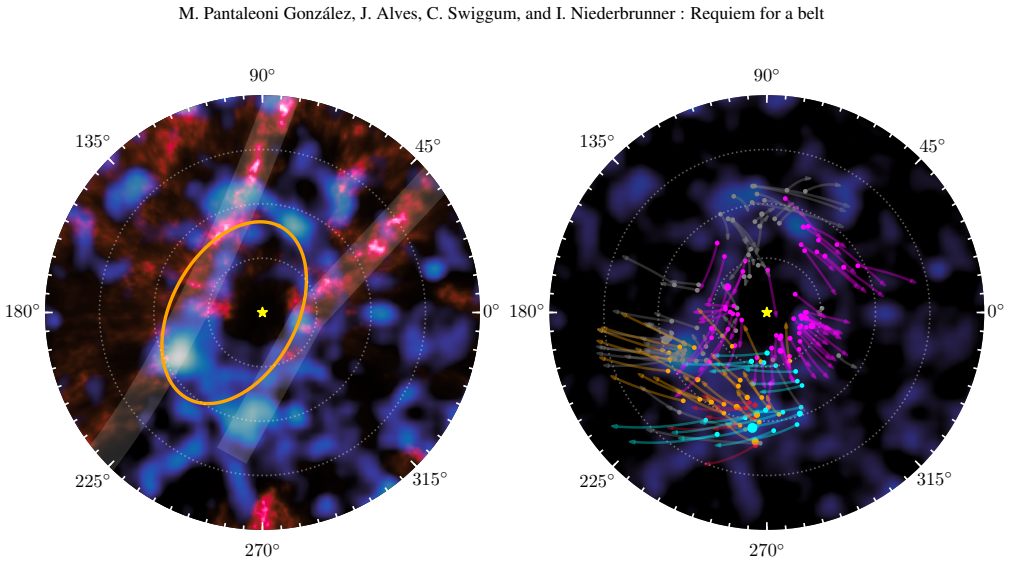
We reassess the long-standing idea of Gould's Belt using Gaia DR3 for a sample of young massive stars and nearby young clusters. The structure surrounding the Sun, often interpreted as an inclined, expanding, and rotating ring, emerges in our analysis as a transient alignment of a few cluster families rather than an individual, coherent dynamical feature. By combining the ALS III catalog of OB stars with a homogeneous sample of clusters younger than 70 Myr, and by tracing their motions in a realistic Galactic potential, we show that neither the spatial distribution nor the kinematics form a unified system. The inferred expansion, rotation, and bulk motion of the Belt can be reproduced by the
What carries the argument
The superposition of the positions and velocities of the alpha Per, Cr135, M6, and gamma Vel cluster families together with the vertical oscillations of the Radcliffe Wave, which together generate the apparent ring geometry, expansion, and rotation without requiring a single coherent dynamical entity.
If this is right
- The apparent expansion, rotation, and bulk motion of the Belt are fully reproduced by the overlapping velocities of the four cluster families.
- The classic inclined geometry is largely produced by the oscillatory pattern of the Radcliffe Wave.
- Solar reflex motion and earlier assumptions about the local standard of rest amplify the perceived dynamical signals.
- Gould's Belt should be treated as a 3D asterism shaped by local star-formation history, observational biases, and projection rather than as a unified physical structure.
Where Pith is reading between the lines
- Similar apparent rings or shells in other parts of the disk may also turn out to be line-of-sight alignments once comparable cluster catalogs become available.
- Models of how star formation propagates through the solar neighborhood will need to incorporate the separate dynamical histories of these cluster families rather than a single expanding ring.
- High-precision age and velocity data for additional young clusters could test whether any residual kinematic coherence remains once the four families are subtracted.
Load-bearing premise
The chosen sample of young massive stars and clusters younger than 70 million years, plus the specific grouping into the four named cluster families, fully accounts for the observed spatial and kinematic features without significant missing components or selection biases.
What would settle it
A kinematic study that isolates a common expansion or rotation signature among the young stars in the Belt region that cannot be reproduced by adding the measured motions of the alpha Per, Cr135, M6, and gamma Vel families would falsify the claim.
Figures


read the original abstract
We reassess the long-standing idea of Gould's Belt using Gaia DR3 for a sample of young massive stars and nearby young clusters. The structure surrounding the Sun, often interpreted as an inclined, expanding, and rotating ring, emerges in our analysis as a transient alignment of a few cluster families rather than an individual, coherent dynamical feature. By combining the ALS III catalog of OB stars with a homogeneous sample of clusters younger than 70 Myr, and by tracing their motions in a realistic Galactic potential, we show that neither the spatial distribution nor the kinematics form a unified system. The inferred expansion, rotation, and bulk motion of the Belt can be reproduced by the superposition of the $\alpha$Per, Cr135, M6, and $\gamma$Vel cluster families and are further amplified by solar reflex motion and historical assumptions about the local standard of rest (LSR). The classic inclined geometry is largely explained by the oscillatory pattern of the Radcliffe Wave, which contributes a major arc of the supposed ring. Taken together, these results indicate that Gould's Belt is not a physical structure but a 3D asterism shaped by a complex local star formation history, observational biases, and projection effects.
Editorial analysis
A structured set of objections, weighed in public.
Referee Report
Summary. The paper uses Gaia DR3 astrometry for a sample of young massive stars from the ALS III catalog combined with clusters younger than 70 Myr to argue that Gould's Belt is not a coherent inclined, expanding, and rotating dynamical structure. Instead, its apparent spatial and kinematic features arise as a transient superposition of four cluster families (α Per, Cr 135, M6, and γ Vel), further shaped by solar reflex motion, LSR assumptions, and the oscillatory pattern of the Radcliffe Wave.
Significance. If the central reinterpretation holds, the result would substantially revise understanding of local Galactic structure by replacing a long-standing coherent ring model with a picture of fragmented, short-lived alignments driven by recent star-formation history and projection effects. The work draws on modern high-precision data and a realistic Galactic potential, offering a falsifiable alternative that could influence models of disk dynamics and young stellar populations.
major comments (3)
- [Abstract and cluster-family section] Abstract and methods on family identification: the four families (α Per, Cr 135, M6, γ Vel) are presented as reproducing the Belt's expansion, rotation, and bulk motion, yet the manuscript provides no explicit clustering algorithm, distance/velocity thresholds, or membership probabilities; without these, it is impossible to assess whether the families were defined independently of the Belt features or tuned post hoc to match them.
- [Kinematics analysis] Kinematics reproduction section: the claim that superposition of the four families plus solar reflex and LSR choice fully accounts for observed motions requires quantitative residuals (e.g., velocity-field maps or χ² statistics after subtraction); the current description lacks error budgets, completeness corrections for the ALS III + cluster sample, or tests for systematic residuals that might indicate a remaining coherent component.
- [Sample selection] Age cutoff and sample definition: the <70 Myr boundary and combination of catalogs are central to excluding older members of a possible longer-lived structure, but no justification or sensitivity test is shown for this cutoff; a direct comparison of kinematics inside versus outside the cutoff (or with relaxed age limits) is needed to confirm that no coherent signal persists.
minor comments (3)
- [Methods] Clarify the precise LSR velocity vector adopted and its uncertainty propagation in the potential integration.
- [Figures] Add explicit legends, error bars, and coordinate-system definitions to all spatial and velocity figures for reproducibility.
- [Discussion] Include a short discussion of possible selection biases in the ALS III catalog at the low-mass or high-extinction end.
Simulated Author's Rebuttal
We thank the referee for their constructive comments, which have prompted us to clarify our methodology and strengthen the quantitative support for our conclusions. We address each major point below.
read point-by-point responses
-
Referee: [Abstract and cluster-family section] Abstract and methods on family identification: the four families (α Per, Cr 135, M6, γ Vel) are presented as reproducing the Belt's expansion, rotation, and bulk motion, yet the manuscript provides no explicit clustering algorithm, distance/velocity thresholds, or membership probabilities; without these, it is impossible to assess whether the families were defined independently of the Belt features or tuned post hoc to match them.
Authors: The four families correspond to well-documented young clusters and associations already identified in the literature and recovered directly from our combined ALS III + cluster catalog within 500 pc. Selection was based on spatial coincidence with the Belt's locus, ages below 70 Myr, and Gaia DR3 kinematics consistent with the local velocity field; no new clustering algorithm was applied. We have revised the methods section to list the explicit distance, velocity, and age criteria used for family assignment, together with the resulting membership lists and a brief description of how probabilities were estimated from the astrometric uncertainties. revision: yes
-
Referee: [Kinematics analysis] Kinematics reproduction section: the claim that superposition of the four families plus solar reflex and LSR choice fully accounts for observed motions requires quantitative residuals (e.g., velocity-field maps or χ² statistics after subtraction); the current description lacks error budgets, completeness corrections for the ALS III + cluster sample, or tests for systematic residuals that might indicate a remaining coherent component.
Authors: We agree that a quantitative demonstration is required. In the revised manuscript we have added residual velocity maps in Galactic Cartesian coordinates after subtracting the four-family superposition (including solar reflex motion), together with χ² statistics and an explicit error budget that propagates Gaia DR3 uncertainties. Completeness is discussed with reference to the magnitude limit of the ALS III catalog, and we show that no statistically significant coherent residual pattern remains once the superposition is removed. revision: yes
-
Referee: [Sample selection] Age cutoff and sample definition: the <70 Myr boundary and combination of catalogs are central to excluding older members of a possible longer-lived structure, but no justification or sensitivity test is shown for this cutoff; a direct comparison of kinematics inside versus outside the cutoff (or with relaxed age limits) is needed to confirm that no coherent signal persists.
Authors: The 70 Myr limit was adopted because it matches the dispersal timescale of unbound young stellar groups in the solar neighborhood while retaining all populations that contribute to the observed Belt-like alignment. We have added a dedicated paragraph justifying this choice on dynamical grounds and performed the requested sensitivity tests using 50 Myr and 100 Myr cutoffs. In both cases the superposition of the four families continues to reproduce the observed spatial and kinematic features, with no emergent coherent ring-like signal when older stars are included. revision: yes
Circularity Check
No significant circularity detected
full rationale
The paper's central derivation uses external Gaia DR3 catalogs of OB stars and clusters, applies a standard Galactic potential to integrate orbits, and identifies four cluster families whose superposition is shown to account for the observed spatial-kinematic signatures. This is a data-driven reinterpretation rather than a self-definitional loop, fitted-input prediction, or load-bearing self-citation chain. No equations or steps reduce the target result to the inputs by construction; the age cut and family selection are presented as analysis choices whose explanatory power is tested against the data, not presupposed. The derivation remains self-contained against external benchmarks.
Axiom & Free-Parameter Ledger
free parameters (2)
- Cluster age cutoff
- Local standard of rest velocity
axioms (2)
- domain assumption The Galactic potential used for orbit integration is sufficiently realistic for the local volume and time scales involved.
- domain assumption The Radcliffe Wave is an independent oscillatory pattern that contributes an arc to the apparent ring geometry.
Reference graph
Works this paper leans on
-
[1]
2019, Astronomy and Astrophysics, 625, L10
Abuter, R., Amorim, A., Bauböck, M., et al. 2019, Astronomy and Astrophysics, 625, L10
work page 2019
-
[2]
J., Elias, F., & Cabrera-Caño, J
Alfaro, E. J., Elias, F., & Cabrera-Caño, J. 2009, Astrophysics and Space Sci- ence, 324, 141
work page 2009
-
[3]
J., Jiménez, M., Sánchez-Gil, M
Alfaro, E. J., Jiménez, M., Sánchez-Gil, M. C., et al. 2022, The Astrophysical Journal, 937, 114
work page 2022
- [4]
-
[5]
Arunima, A., Krumholz, M. R., Ireland, M. J., Zhang, C., & Buder, S. 2025, Evolution of action-space coherence in a Milky Way-like simulation
work page 2025
-
[6]
Aumer, M. & Binney, J. J. 2009, Monthly Notices of the Royal Astronomical Society, 397, 1286
work page 2009
-
[7]
Bekki, K. 2009, Monthly Notices of the Royal Astronomical Society, 398, L36 Benítez, N., Maíz-Apellániz, J., & Canelles, M. 2002, Phys. Rev. Lett., 88, 081101 Berghöfer, T. W. & Breitschwerdt, D. 2002, Astronomy and Astrophysics, 390, 299
work page 2009
-
[8]
1961, Bulletin of the Astronomical Institutes of the Netherlands, 15, 265
Blaauw, A. 1961, Bulletin of the Astronomical Institutes of the Netherlands, 15, 265
work page 1961
-
[9]
Bobylev, V . V . 2006, Astronomy Letters, 32, 816
work page 2006
-
[10]
Bobylev, V . V . 2016, Astronomy Letters, 42, 544
work page 2016
-
[11]
Bobylev, V . V . & Bajkova, A. T. 2015, Baltic Astronomy, 24, 51
work page 2015
-
[12]
Bobylev, V . V . & Bajkova, A. T. 2020, Astrophysical Bulletin, 75, 267
work page 2020
-
[13]
Bobylev, V . V . & Bajkova, A. T. 2022, Astronomy Reports, 66, 269
work page 2022
-
[14]
Bobylev, V . V ., Ikhsanov, N. R., & Bajkova, A. T. 2025, Astronomy Reports, 69, 786
work page 2025
- [15]
-
[16]
2015, The Astrophysical Journal Supplement Series, 216, 29
Bovy, J. 2015, The Astrophysical Journal Supplement Series, 216, 29
work page 2015
-
[17]
Cantat-Gaudin, T. & Brandt, T. D. 2021, Astronomy and Astrophysics, 649, A124
work page 2021
-
[18]
Clube, S. V . M. 1967, Monthly Notices of the Royal Astronomical Society, 137, 189
work page 1967
- [19]
-
[20]
Comeron, F., Torra, J., & Gomez, A. E. 1992, Astrophysics and Space Science, 187, 187 de Zeeuw, P. T., Hoogerwerf, R., de Bruijne, J. H. J., Brown, A. G. A., & Blaauw, A. 1999, The Astronomical Journal, 117, 354
work page 1992
-
[21]
Dehnen, W. & Binney, J. J. 1998, Monthly Notices of the Royal Astronomical Society, 298, 387
work page 1998
-
[22]
2019, Research in Astronomy and Astrophysics, 19, 068
Ding, P.-J., Zhu, Z., & Liu, J.-C. 2019, Research in Astronomy and Astrophysics, 19, 068
work page 2019
-
[23]
A., Loinard, L., Ortiz-León, G
Dzib, S. A., Loinard, L., Ortiz-León, G. N., Rodríguez, L. F., & Galli, P. A. B. 2018, The Astrophysical Journal, 867, 151 Article number, page 8 of 9 M. Pantaleoni González, J. Alves, C. Swiggum, and I. Niederbrunner : Requiem for a belt
work page 2018
-
[24]
2024, Astronomy and Astrophysics, 685, A82
Edenhofer, G., Zucker, C., Frank, P., et al. 2024, Astronomy and Astrophysics, 685, A82
work page 2024
-
[25]
2025, The Open Journal of Astrophysics, 8, 62
El-Badry, K. 2025, The Open Journal of Astrophysics, 8, 62
work page 2025
-
[26]
Elias, F., Alfaro, E. J., & Cabrera-Caño, J. 2009, Monthly Notices of the Royal Astronomical Society, 397, 2
work page 2009
-
[27]
2014, Monthly Notices of the Royal Astronomical Society, 444, L6
Francis, C. 2014, Monthly Notices of the Royal Astronomical Society, 444, L6
work page 2014
-
[28]
2013, Astronomy and Astrophysics, 557, A92
Golubov, O., Just, A., Bienaymé, O., et al. 2013, Astronomy and Astrophysics, 557, A92
work page 2013
-
[29]
Gontcharov, G. A., Mosenkov, A. V ., Savchenko, S. S., et al. 2022, Astronomy Letters, 48, 578
work page 2022
-
[30]
M., Schlafly, E., Zucker, C., Speagle, J
Green, G. M., Schlafly, E., Zucker, C., Speagle, J. S., & Finkbeiner, D. 2019, The Astrophysical Journal, 887, 93
work page 2019
-
[31]
Guillout, P., Sterzik, M. F., Schmitt, J. H. M. M., Motch, C., & Neuhaeuser, R. 1998, Astronomy and Astrophysics, 337, 113
work page 1998
-
[32]
Hubble, E. P. 1922, The Astrophysical Journal, 56, 162
work page 1922
-
[33]
Hunt, E. L. & Reffert, S. 2023, Astronomy and Astrophysics, 673, A114
work page 2023
-
[34]
Kerr, F. J. & Lynden-Bell, D. 1986, Monthly Notices of the Royal Astronomical Society, 221, 1023
work page 1986
-
[35]
Kerr, R., Kraus, A. L., Krolikowski, D., Bouma, L. G., & Farias, J. P. 2024, The Astrophysical Journal, 975, 99
work page 2024
-
[36]
Kerr, R., Kraus, A. L., & Rizzuto, A. C. 2023, The Astrophysical Journal, 954, 134
work page 2023
-
[37]
Konietzka, R., Goodman, A. A., Zucker, C., et al. 2024, Nature, 628, 62
work page 2024
-
[38]
Kormann, L. A., Alves, J., Soler, J. D., et al. 2025, The Superclouds of the Local Milky Way
work page 2025
-
[39]
Kuhn, M. A., Benjamin, R. A., Zucker, C., et al. 2021, Astronomy and Astro- physics, 651, L10
work page 2021
- [40]
-
[41]
Leike, R. H., Glatzle, M., & Enßlin, T. A. 2020, Astronomy and Astrophysics, 639, A138
work page 2020
-
[42]
Lesh, J. R. 1968, The Astrophysical Journal Supplement Series, 17, 371
work page 1968
-
[43]
Lindblad, P. O. 1967, Bulletin of the Astronomical Institutes of the Netherlands, 19, 34
work page 1967
-
[44]
Lindblad, P. O. 2000, Astronomy and Astrophysics, 363, 154
work page 2000
-
[45]
O., Grape, K., Sandqvist, A., & Schober, J
Lindblad, P. O., Grape, K., Sandqvist, A., & Schober, J. 1973, Astronomy and Astrophysics, 24, 309
work page 1973
-
[46]
O., Palous, J., Loden, K., & Lindegren, L
Lindblad, P. O., Palous, J., Loden, K., & Lindegren, L. 1997, in Hipparcos - Venice 1997, V ol. 402, 507–512
work page 1997
-
[47]
Luri, X., Brown, A. G. A., Sarro, L. M., et al. 2018, Astronomy and Astrophysics, 616, A9
work page 2018
-
[48]
Lutz, T. E. & Kelker, D. H. 1973, Publications of the Astronomical Society of the Pacific, 85, 573 Maíz Apellániz, J. 2022, Astronomy and Astrophysics, 657, A130 Maíz Apellániz, J., Negueruela, I., & Caballero, J. A. 2026, in Encyclopedia of
work page 1973
-
[49]
2 (eprint: arXiv:2410.07301), 43–84 Maíz Apellániz, J., Pantaleoni González, M., & Barbá, R
Astrophysics, V ol. 2 (eprint: arXiv:2410.07301), 43–84 Maíz Apellániz, J., Pantaleoni González, M., & Barbá, R. H. 2021, Astronomy and Astrophysics, 649, A13
-
[50]
Malmquist, K. G. 1922, Meddelanden fran Lunds Astronomiska Observatorium Serie I, 100, 1
work page 1922
-
[51]
Malmquist, K. G. 1925, Meddelanden fran Lunds Astronomiska Observatorium Serie I, 106, 1
work page 1925
-
[52]
1974, Astronomy and Astrophysics, 32, 321
Mayor, M. 1974, Astronomy and Astrophysics, 32, 321
work page 1974
-
[53]
2021, The Astronomical Journal, 162, 282
McBride, A., Lingg, R., Kounkel, M., Covey, K., & Hutchinson, B. 2021, The Astronomical Journal, 162, 282
work page 2021
-
[54]
Moreno, E., Alfaro, E. J., & Franco, J. 1999, The Astrophysical Journal, 522, 276
work page 1999
-
[55]
Newcomb, S. 1904, On the Position of the Galactic and Other Principal Planes Toward Which the Stars Tend to Crowd (Carnegie Institution)
work page 1904
-
[56]
Olano, C. A. 1982, Astronomy and Astrophysics, 112, 195
work page 1982
-
[57]
Olano, C. A. 2001, The Astronomical Journal, 121, 295 O’Neill, T. J., Zucker, C., Goodman, A. A., & Edenhofer, G. 2024, The Astro- physical Journal, 973, 136 Palouš, J. & Ehlerová, S. 2017, in Handbook of Supernovae, 2301
work page 2001
-
[58]
Pannekoek, A. 1929, Koninklijke Nederlandsche Akademie van Wetenschappen Proceedings, 32, 2 Pantaleoni González, M., Maíz Apellániz, J., Barbá, R. H., & Reed, B. C. 2021, Monthly Notices of the Royal Astronomical Society, 504, 2968 Pantaleoni González, M., Maíz Apellániz, J., Barbá, R. H., et al. 2025, Monthly Notices of the Royal Astronomical Society, 543, 63
work page 1929
-
[59]
Perrot, C. A. & Grenier, I. A. 2003, Astronomy and Astrophysics, 404, 519
work page 2003
-
[60]
Piskunov, A. E., Kharchenko, N. V ., Röser, S., Schilbach, E., & Scholz, R.-D. 2006, Astronomy and Astrophysics, 445, 545
work page 2006
-
[61]
2021, Astronomy and Astro- physics, 651, A104 Pöppel, W
Poggio, E., Drimmel, R., Cantat-Gaudin, T., et al. 2021, Astronomy and Astro- physics, 651, A104 Pöppel, W. 1997, Fundamentals of Cosmic Physics, 18, 1 Pöppel, W. G. L. 2001, in From Darkness to Light: Origin and Evolution of Young Stellar Clusters, V ol. 243, 667
work page 2021
-
[62]
Prusti, T., de Bruijne, J. H. J., Brown, A. G. A., et al. 2016, Astronomy and Astrophysics, 595, A1
work page 2016
-
[63]
Quintana, A. L., Wright, N. J., Kormann, L. A., et al. 2025, A new Gaia census of OB associations within 1 kpc Ratzenböck, S., Großschedl, J. E., Alves, J., et al. 2023, A&A, 678, A71
work page 2025
-
[64]
Reid, M. J., Menten, K. M., Brunthaler, A., et al. 2019, The Astrophysical Jour- nal, 885, 131 Schönrich, R., Binney, J., & Dehnen, W. 2010, Monthly Notices of the Royal Astronomical Society, 403, 1829
work page 2019
-
[65]
1918, Contributions from the Mount Wilson Observatory/Carnegie Institution of Washington, 157, 1
Shapley, H. 1918, Contributions from the Mount Wilson Observatory/Carnegie Institution of Washington, 157, 1
work page 1918
-
[66]
Shapley, H. & Cannon, A. J. 1924, Proceedings of the American Academy of Arts and Sciences, 59, 213
work page 1924
-
[67]
2003, Monthly Notices of the Royal Astronomical Society, 338, 891
Smith, H. 2003, Monthly Notices of the Royal Astronomical Society, 338, 891
work page 2003
- [68]
- [69]
-
[70]
Swiggum, C., Alves, J., Benjamin, R., et al. 2024, Nature, 631, 49
work page 2024
-
[71]
2025, Astronomy and Astrophysics, 699, L5
Swiggum, C., Alves, J., & D’Onghia, E. 2025, Astronomy and Astrophysics, 699, L5
work page 2025
-
[72]
2018, Astronomy and Astrophysics, 614, A63
Sysoliatina, K., Just, A., Golubov, O., et al. 2018, Astronomy and Astrophysics, 614, A63
work page 2018
-
[73]
Taylor, D. K., Dickman, R. L., & Scoville, N. Z. 1987, The Astrophysical Jour- nal, 315, 104
work page 1987
-
[74]
2000, Kinematics of young stars
Torra, J., Fernández, D., & Figueras, F. 2000, Kinematics of young stars. I. Local irregularities
work page 2000
-
[75]
Vallenari, A., Brown, A. G. A., Prusti, T., et al. 2023, Astronomy and Astro- physics, 674, A1 van den Bergh, S. 1966, The Astronomical Journal, 71, 990
work page 2023
-
[76]
Vergely, J. L., Lallement, R., & Cox, N. L. J. 2022, Astronomy and Astrophysics, 664, A174
work page 2022
-
[77]
Weiler, M. 2025, Computing magnitudes, colours, distances, and absolute mag- nitudes at any signal-to-noise level
work page 2025
-
[78]
Westin, T. N. G. 1985, Astronomy and Astrophysics Supplement Series, 60, 99
work page 1985
-
[79]
Wright, N. J. 2020, New Astronomy Reviews, 90, 101549
work page 2020
-
[80]
Zari, E., Hashemi, H., Brown, A. G. A., Jardine, K., & de Zeeuw, P. T. 2018, Astronomy and Astrophysics, 620, A172
work page 2018
discussion (0)
Sign in with ORCID, Apple, or X to comment. Anyone can read and Pith papers without signing in.