Recognition: unknown
Charged kaon electric polarizability from four-point functions in lattice QCD
Pith reviewed 2026-05-10 13:18 UTC · model grok-4.3
The pith
Lattice QCD extracts the charged kaon electric polarizability as (0.988 ± 0.534) × 10^{-4} fm³ by separating Born and non-Born terms in four-point functions.
A machine-rendered reading of the paper's core claim, the machinery that carries it, and where it could break.
Core claim
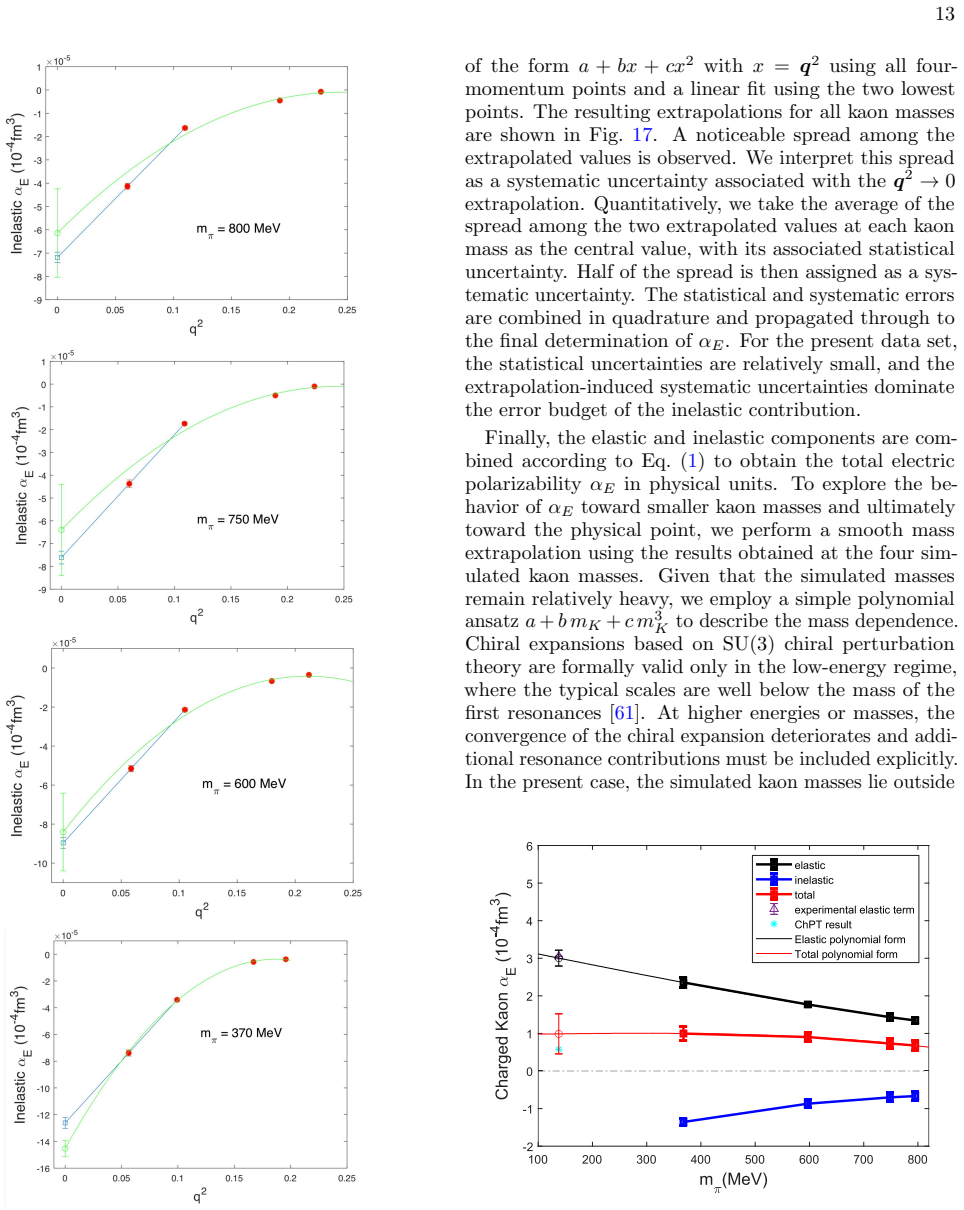
The authors establish that the four-point function framework applies to the charged kaon on 500 quenched Wilson 24³×48 configurations, separating the polarizability into an elastic Born piece fixed by the charge radius extracted from the kaon electromagnetic form factor and an inelastic non-Born piece obtained from the time-integrated difference of four-point correlation functions, producing α_E = (0.988 ± 0.534) × 10^{-4} fm³ together with ⟨r_E²⟩ = 0.3303 ± 0.0028 fm² after extrapolation to the physical pion mass.
What carries the argument
The time-integrated difference of four-point correlation functions, which isolates the inelastic non-Born contribution once the elastic Born term is subtracted using the charge radius from the electromagnetic form factor.
If this is right
- The four-point function method works for computing the polarizability of strange mesons such as the charged kaon.
- The study extends earlier four-point function polarizability calculations to include the kaon.
- These results establish a basis for future lattice work that incorporates dynamical fermions and higher statistics.
- Improved control over systematic uncertainties becomes possible in subsequent applications of this framework.
Where Pith is reading between the lines
- The numerical value supplies a concrete target that effective theories of strange-meson structure can be compared against.
- Future inclusion of dynamical quarks and disconnected diagrams may shift the extracted non-Born term by an amount comparable to the present statistical uncertainty.
- The same separation technique can be tested on other charged mesons to map how polarizability depends on quark mass and flavor content.
Load-bearing premise
The quenched approximation together with connected diagrams only is enough to capture the full four-point function contribution to the polarizability, and the separation of Born and non-Born terms remains valid after extrapolation to the physical pion mass.
What would settle it
An independent lattice calculation on dynamical fermion ensembles or a direct experimental measurement that produces a charged kaon electric polarizability lying well outside the reported interval of (0.988 ± 0.534) × 10^{-4} fm³.
Figures




read the original abstract
We present a lattice QCD calculation of the electric polarizability of the charged kaon using a four-point function approach, which is the Euclidean analog of low-energy Compton scattering. In the case of the charged kaon, the polarizability is separated into an elastic (Born) term, determined from the charge radius extracted via the kaon electromagnetic form factor, and an inelastic (non-Born) term obtained from the time-integrated difference of four-point correlation functions. Our study employs 500 configurations of Wilson quenched $24^3\times 48$ lattices, and we compute connected diagrams as a proof of principle. From this analysis, we obtain values for the charged kaon electric polarizability of $\alpha_E = (0.988 \pm 0.534) \times 10^{-4}\;\mathrm{fm}^3$ as well as $\langle r_E^2\rangle =0.3303\pm 0.0028\;\mathrm{fm}^2$ for the squared kaon charge radius, after extrapolation to the physical pion mass. The study demonstrates the applicability of the four-point function framework to strange mesons, extends previous four-point function polarizability studies, and provides a foundation for future calculations with increased statistics, dynamical fermions, and improved control of systematic uncertainties.
Editorial analysis
A structured set of objections, weighed in public.
Referee Report
Summary. The manuscript reports a quenched lattice QCD computation of the charged kaon's electric polarizability using four-point correlation functions on a single 24³×48 Wilson ensemble with 500 configurations. It separates the polarizability into a Born term obtained from the electromagnetic form factor (yielding ⟨r_E²⟩ = 0.3303 ± 0.0028 fm²) and a non-Born term from the time-integrated four-point difference, performs a pion-mass extrapolation, and quotes α_E = (0.988 ± 0.534) × 10^{-4} fm³ as a proof-of-principle result using only connected diagrams.
Significance. If the statistical precision can be improved and the quenched plus connected-only systematics validated, the work would usefully demonstrate the four-point function method for strange mesons and supply a baseline for future dynamical-fermion calculations of meson polarizabilities. At present the >50% relative error on α_E restricts its immediate phenomenological value, but the explicit separation of Born and inelastic contributions and the extension to the kaon constitute a modest technical advance over prior four-point studies.
major comments (2)
- [Abstract and Results] Abstract and Results section: the central value α_E = 0.988 × 10^{-4} fm³ carries a statistical uncertainty of 0.534 × 10^{-4} fm³ (>50% relative error), rendering the result consistent with zero within ~1.8σ and preventing any quantitative comparison to chiral perturbation theory or experiment.
- [Methods and Discussion] Methods and Discussion: the entire analysis is performed in the quenched approximation with only connected diagrams on a single ensemble. No estimate is provided for the size of omitted disconnected contributions or for the difference between quenched and full-QCD chiral logarithms that enter the polarizability, both of which become relevant upon extrapolation to the physical pion mass.
minor comments (1)
- [Abstract] Abstract: the pion-mass extrapolation is mentioned but neither the number of valence quark masses employed nor the functional form of the fit (e.g., linear, chiral-log) is stated, making it impossible to judge the reliability of the quoted physical-point values.
Simulated Author's Rebuttal
We thank the referee for the thorough review and valuable feedback on our manuscript. We address the major comments point by point below, agreeing with the assessment of the statistical limitations while defending the scope of this proof-of-principle study.
read point-by-point responses
-
Referee: Abstract and Results section: the central value α_E = 0.988 × 10^{-4} fm³ carries a statistical uncertainty of 0.534 × 10^{-4} fm³ (>50% relative error), rendering the result consistent with zero within ~1.8σ and preventing any quantitative comparison to chiral perturbation theory or experiment.
Authors: We fully agree that the large statistical uncertainty on the polarizability, exceeding 50% relative error, means the result is consistent with zero at about 1.8σ and does not allow for quantitative phenomenological comparisons at this stage. This arises from the computational demands of evaluating the four-point functions with only 500 configurations on a single ensemble. The manuscript positions this as a proof-of-principle demonstration of the method for the charged kaon. To address this, we have revised the abstract and the results section to more prominently emphasize the preliminary nature of the result, the size of the uncertainty, and the necessity for future work with higher statistics to achieve meaningful comparisons with chiral perturbation theory or experiment. revision: yes
-
Referee: Methods and Discussion: the entire analysis is performed in the quenched approximation with only connected diagrams on a single ensemble. No estimate is provided for the size of omitted disconnected contributions or for the difference between quenched and full-QCD chiral logarithms that enter the polarizability, both of which become relevant upon extrapolation to the physical pion mass.
Authors: The analysis is performed in the quenched approximation using only connected diagrams on a single ensemble, which is clearly stated throughout the manuscript. We acknowledge that no quantitative estimates are provided for the omitted disconnected contributions or the effects of quenching on the chiral logarithms relevant to the polarizability. Such estimates would require additional extensive computations, including the evaluation of disconnected diagrams and simulations with dynamical fermions, which are beyond the scope of this initial study. In the revised manuscript, we have expanded the discussion section to explicitly note these limitations and to stress that the current results serve as a baseline for future full-QCD calculations with improved control over systematics. revision: partial
- Providing numerical estimates for the size of disconnected contributions and quenching effects without performing the required additional lattice calculations.
Circularity Check
No significant circularity in the derivation chain
full rationale
The paper computes the squared charge radius from the kaon electromagnetic form factor and extracts the inelastic contribution directly from the time-integrated difference of four-point correlation functions on the same quenched ensembles. The total electric polarizability is then formed as their sum after chiral extrapolation to the physical pion mass. This separation follows the standard Born plus non-Born decomposition of the Compton amplitude and does not reduce the reported α_E value to a tautology or to a fitted parameter by construction; both pieces are independent lattice observables. The quenched approximation and connected-diagram restriction are explicit methodological choices whose systematic impact is acknowledged but does not create a self-referential loop. No load-bearing self-citations, uniqueness theorems, or ansatze imported from prior work are invoked to force the central result.
Axiom & Free-Parameter Ledger
free parameters (1)
- pion-mass extrapolation parameters
axioms (2)
- domain assumption Quenched approximation suffices for the connected four-point function contribution to kaon polarizability
- domain assumption Connected diagrams alone capture the leading physics of the four-point function for this observable
Reference graph
Works this paper leans on
-
[1]
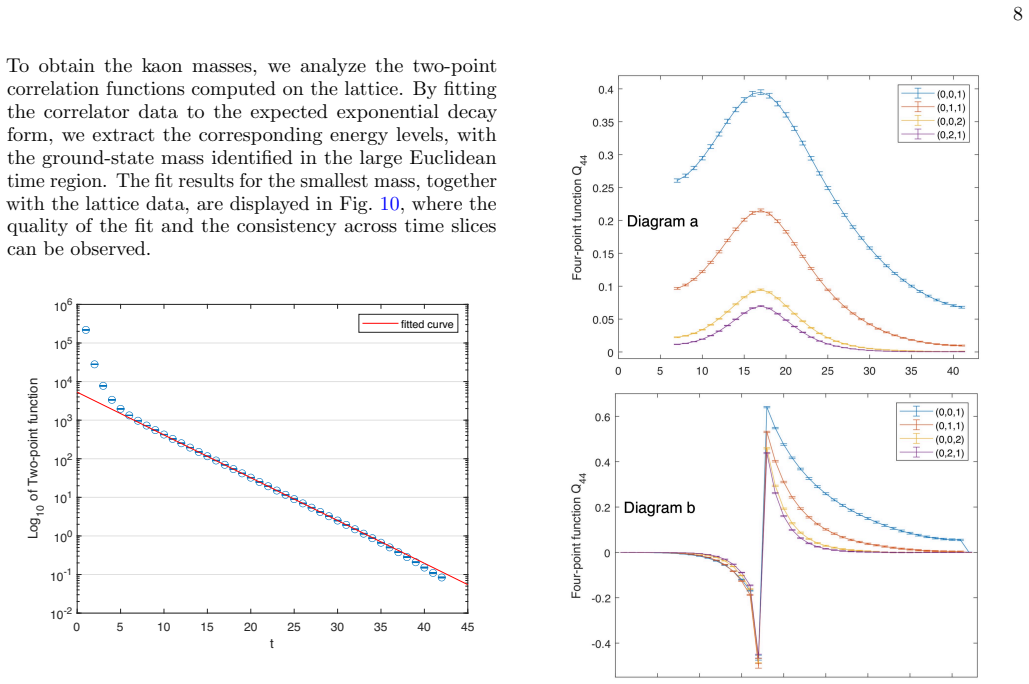
a” comes from a quark wall source at t0. The quark line labeled “ b
Diagram (a) Diagram (a) has a current insertion on each quark line, as shown in Fig. 3. By following the trace of the a b a bt2 t1t3 t0 FIG. 3. Diagram (a) shown in terms of quark propagators. The quark line labeled “ a” comes from a quark wall source at t0. The quark line labeled “ b” comes from a quark wall source att 3. t₃ t₂ t₁ t₀ µ₄ µ₄ FIG. 4. Diagra...
-
[2]
a” comes from a quark wall source at t0. This line propagates to t3 to produce a summed point SST propagator labeled as “ c
Diagram (b) By following the trace of the loop in diagram (b) in Fig. 5 in the clockwise direction, the interaction amplitude is (Ref. [34]): D(b) 44 (x2, t2, t1) = X x1x ,x3 T r[γ5Sw(t3, t0)γ5Sw(t0, t1+µ4)(1+γ4)U † 4(t1+µ4, t1) × S(t1, t2 +µ 4)(1 +γ 4)U † 4(t2 +µ 4, t2)S(t2, t3) −S(t1, t2)(1−γ 4)U4(t2, t2 +µ 4)S(t2 +µ 4, t3) −γ 5Sw(t3, t0)γ5Sw(t0, t1)(1−...
-
[3]
Diagram (c) a c e at2 t1t3 t0 FIG. 7. Diagram (c) shown in terms of quark propagators. As in diagram (b), the quark line “ a” comes from a quark wall source at t0. This line propagates to t3 to produce a summed point SST source labeled as “ c” and shown as a line with black dots. The quark line “ c” is then used as the SST source at t1 to produce a conser...
-
[4]
A Study of Hadron Electric Polarizability in Quenched Lattice QCD,
H. R. Fiebig, W. Wilcox, and R. M. Woloshyn, “A Study of Hadron Electric Polarizability in Quenched Lattice QCD,” Nucl. Phys. B324, 47–66 (1989)
1989
-
[5]
Finite volume effects on the electric polarizability of neu- tral hadrons in lattice QCD,
M. Lujan, A. Alexandru, W. Freeman, and F. X. Lee, “Finite volume effects on the electric polarizability of neu- tral hadrons in lattice QCD,” Phys. Rev.D94, 074506 (2016), arXiv:1606.07928 [hep-lat]
-
[6]
Electric polarizability of neutral hadrons from dynamical lattice QCD ensembles,
Michael Lujan, Andrei Alexandru, Walter Freeman, and Frank Lee, “Electric polarizability of neutral hadrons from dynamical lattice QCD ensembles,” Phys. Rev.D89, 074506 (2014), arXiv:1402.3025 [hep-lat]
-
[7]
Sea quark contributions to the electric polarizability of hadrons,
Walter Freeman, Andrei Alexandru, Michael Lujan, and Frank X. Lee, “Sea quark contributions to the electric polarizability of hadrons,” Phys. Rev. D90, 054507 (2014), arXiv:1407.2687 [hep-lat]
-
[8]
Update on the Sea Contributions to Hadron Electric Polarizabilities through Reweighting,
Walter Freeman, Andrei Alexandru, Frank X. Lee, and Mike Lujan, “Update on the Sea Contributions to Hadron Electric Polarizabilities through Reweighting,” in31st International Symposium on Lattice Field Theory(2013) arXiv:1310.4426 [hep-lat]
-
[9]
Hadrons in Strong Electric and Magnetic Fields,
Brian C. Tiburzi, “Hadrons in Strong Electric and Magnetic Fields,” Nucl. Phys.A814, 74–108 (2008), arXiv:0808.3965 [hep-ph]
-
[10]
Lattice QCD in Background Fields,
William Detmold, Brian C. Tiburzi, and Andre Walker- Loud, “Lattice QCD in Background Fields,”Proceed- ings, 10th Workshop on Non-Perturbative Quantum Chro- modynamics : Paris, France, June 8-12, 2009, (2009), arXiv:0908.3626 [hep-lat]
-
[11]
The Background field method on the lattice,
Andrei Alexandru and Frank X. Lee, “The Background field method on the lattice,” PoSLA TTICE2008, 145 (2008), arXiv:0810.2833 [hep-lat]
-
[12]
Magnetic polarizability of hadrons from lattice QCD in the background field method,
Frank X. Lee, Leming Zhou, Walter Wilcox, and Joseph C. Christensen, “Magnetic polarizability of hadrons from lattice QCD in the background field method,” Phys. Rev. D73, 034503 (2006), arXiv:hep-lat/0509065
-
[13]
Baryon magnetic moments in the background field method,
F. X. Lee, R. Kelly, L. Zhou, and W. Wilcox, “Baryon magnetic moments in the background field method,” Phys. Lett. B627, 71–76 (2005), arXiv:hep-lat/0509067
-
[14]
Neutron electric polarizability from unquenched lattice QCD using the background field ap- proach,
Michael Engelhardt, “Neutron electric polarizability from unquenched lattice QCD using the background field ap- proach,” Phys. Rev. D76, 114502 (2007), arXiv:0706.3919 [hep-lat]
-
[15]
Magnetic polarizability of the nucleon using a Lapla- cian mode projection,
Ryan Bignell, Waseem Kamleh, and Derek Leinweber, “Magnetic polarizability of the nucleon using a Lapla- cian mode projection,” Phys. Rev. D101, 094502 (2020), arXiv:2002.07915 [hep-lat]
-
[16]
Octet Baryons in Large Magnetic Fields,
Amol Deshmukh and Brian C. Tiburzi, “Octet Baryons in Large Magnetic Fields,” Phys. Rev. D97, 014006 (2018), arXiv:1709.04997 [hep-ph]
-
[17]
Meson masses in electromagnetic fields with Wilson fermions
Gunnar S. Bali, Bastian B. Brandt, Gergely Endr˝ odi, and Benjamin Gl¨ aßle, “Meson masses in electromagnetic fields with Wilson fermions,” Phys. Rev. D97, 034505 (2018), arXiv:1707.05600 [hep-lat]
work page Pith review arXiv 2018
-
[18]
F. Bruckmann, G. Endrodi, M. Giordano, S. D. Katz, T. G. Kovacs, F. Pittler, and J. Wellnhofer, “Lan- dau levels in QCD,” Phys. Rev. D96, 074506 (2017), arXiv:1705.10210 [hep-lat]
-
[19]
Assumpta Parreno, Martin J. Savage, Brian C. Tiburzi, Jonas Wilhelm, Emmanuel Chang, William Detmold, and Kostas Orginos, “Octet baryon magnetic moments from lattice QCD: Approaching experiment from a three- flavor symmetric point,” Phys. Rev. D95, 114513 (2017), arXiv:1609.03985 [hep-lat]
-
[20]
Magnetic polarizability of pion,
E. V. Luschevskaya, O. E. Solovjeva, and O. V. Teryaev, “Magnetic polarizability of pion,” Phys. Lett. B761, 393– 398 (2016), arXiv:1511.09316 [hep-lat]
-
[21]
Magnetic structure of light nuclei from lattice QCD,
Emmanuel Chang, William Detmold, Kostas Orginos, Assumpta Parreno, Martin J. Savage, Brian C. Tiburzi, and Silas R. Beane (NPLQCD), “Magnetic structure of light nuclei from lattice QCD,” Phys. Rev. D92, 114502 (2015), arXiv:1506.05518 [hep-lat]
-
[22]
W. Detmold, B. C. Tiburzi, and A. Walker-Loud, “Ex- tracting Nucleon Magnetic Moments and Electric Polariz- abilities from Lattice QCD in Background Electric Fields,” Phys. Rev.D81, 054502 (2010), arXiv:1001.1131 [hep-lat]
-
[23]
Implementation of general background electromagnetic fields on a periodic hypercubic lattice,
Zohreh Davoudi and William Detmold, “Implementation of general background electromagnetic fields on a periodic hypercubic lattice,” Phys. Rev. D92, 074506 (2015), arXiv:1507.01908 [hep-lat]
-
[24]
Exploration of the electric spin polarizability of the neutron in lattice QCD,
Michael Engelhardt, “Exploration of the electric spin polarizability of the neutron in lattice QCD,” PoSLA T- TICE2011, 153 (2011), arXiv:1111.3686 [hep-lat]
-
[25]
Spin Polarizabilities on the Lattice,
Frank X. Lee and Andrei Alexandru, “Spin Polarizabilities on the Lattice,”Proceedings, 29th International Sympo- sium on Lattice field theory (Lattice 2011): Squaw Valley, Lake Tahoe, USA, July 10-16, 2011, PoSLA TTICE2011, 317 (2011), arXiv:1111.4425 [hep-lat]
-
[26]
Electromagnetic and spin polarisabilities in lattice QCD,
W. Detmold, B. C. Tiburzi, and Andre Walker-Loud, “Electromagnetic and spin polarisabilities in lattice QCD,” Phys. Rev.D73, 114505 (2006), arXiv:hep-lat/0603026 [hep-lat]
-
[27]
Pion magnetic polarisability using the background field method,
Ryan Bignell, Waseem Kamleh, and Derek Leinweber, “Pion magnetic polarisability using the background field method,” Physics Letters B811, 135853 (2020)
2020
-
[28]
Chiral extrapolation of the charged-pion magnetic polarizability with Pad´ e approximant,
Fangcheng He, Derek B. Leinweber, Anthony W. Thomas, and Ping Wang, “Chiral extrapolation of the charged-pion magnetic polarizability with Pad´ e approximant,” (2021), arXiv:2104.09963 [nucl-th]
-
[29]
Extracting Electric Polarizabilities from Lattice QCD,
William Detmold, Brian C. Tiburzi, and Andre Walker- Loud, “Extracting Electric Polarizabilities from Lattice QCD,” Phys. Rev. D79, 094505 (2009), arXiv:0904.1586 [hep-lat]
-
[30]
Charged pion electric polarizability from lattice qcd,
Hossein Niyazi, Andrei Alexandru, Frank X. Lee, and Michael Lujan, “Charged pion electric polarizability from lattice qcd,” (2021), arXiv:2105.06906 [hep-lat]
-
[31]
Towards the nu- cleon hadronic tensor from lattice QCD,
Jian Liang, Terrence Draper, Keh-Fei Liu, Alexander 16 Rothkopf, and Yi-Bo Yang (XQCD), “Towards the nu- cleon hadronic tensor from lattice QCD,” Phys. Rev. D 101, 114503 (2020), arXiv:1906.05312 [hep-ph]
-
[32]
Pdfs and neutrino-nucleon scattering from hadronic tensor,
Jian Liang and Keh-Fei Liu, “Pdfs and neutrino-nucleon scattering from hadronic tensor,” Proceedings of 37th International Symposium on Lattice Field Theory — PoS(LATTICE2019) (2020), 10.22323/1.363.0046
-
[33]
Lattice study on πk scattering with moving wall source,
Ziwen Fu, “Lattice study on πk scattering with moving wall source,” Phys. Rev. D85, 074501 (2012)
2012
-
[34]
Hadron deformation from lattice qcd,
C. Alexandrou, “Hadron deformation from lattice qcd,” Nuclear Physics B - Proceedings Supplements128, 1–8 (2004)
2004
-
[35]
Two-current correlations in the pion on the lattice,
Gunnar S. Bali, Peter C. Bruns, Luca Castagnini, Markus Diehl, Jonathan R. Gaunt, Benjamin Gl¨ aßle, Andreas Sch¨ afer, Andr´ e Sternbeck, and Christian Zim- mermann, “Two-current correlations in the pion on the lattice,” Journal of High Energy Physics2018(2018), 10.1007/jhep12(2018)061
-
[36]
Double parton distributions in the nucleon from lattice qcd,
Gunnar S. Bali, Markus Diehl, Benjamin Gl¨ aßle, Andreas Sch¨ afer, and Christian Zimmermann, “Double parton distributions in the nucleon from lattice qcd,” (2021), arXiv:2106.03451 [hep-lat]
-
[37]
Charged pion electric polarizability from four-point functions in lattice QCD,
Frank X. Lee, Andrei Alexandru, Chris Culver, and Walter Wilcox, “Charged pion electric polarizability from four-point functions in lattice QCD,” Phys. Rev. D108, 014512 (2023), arXiv:2301.05200
-
[38]
Magnetic polarizability of a charged pion from four-point functions in lattice qcd,
Frank X. Lee, Walter Wilcox, Andrei Alexandru, and Chris Culver, “Magnetic polarizability of a charged pion from four-point functions in lattice qcd,” Phys. Rev. D 108, 054510 (2023)
2023
-
[39]
Neutral pion polarizabil- ities from four-point functions in lattice qcd,
Frank X. Lee, Walter Wilcox, Andrei Alexandru, Chris Culver, and Shayan Nadeem, “Neutral pion polarizabil- ities from four-point functions in lattice qcd,” Nuclear Physics B1008, 116701 (2024)
2024
-
[40]
Pion and kaon polariz- abilities in the quark confinement model,
M. A. Ivanov and T. Mizutani, “Pion and kaon polariz- abilities in the quark confinement model,” Phys. Rev. D 45, 1580–1601 (1992)
1992
-
[41]
Pion polarizabilities at finite temperature,
A. E. Dorokhov, M. K. Volkov, J. Hufner, S. P. Kle- vansky, and P. Rehberg, “Pion polarizabilities at finite temperature,” Z. Phys. C75, 127–135 (1997)
1997
-
[42]
Electromagnetic polarizabilities of pseudoscalar goldstone bosons,
V´ eronique Bernard and D. Vautherin, “Electromagnetic polarizabilities of pseudoscalar goldstone bosons,” Phys. Rev. D40, 1615–1627 (1989)
1989
-
[43]
Pion electromagnetic polarizability and chiral models,
V´ eronique Bernard, Brigitte Hiller, and Wolfram Weise, “Pion electromagnetic polarizability and chiral models,” Physics Letters B205, 16–21 (1988)
1988
-
[44]
Theoretical aspects of the polarizability of the nucleon,
A. I. L’vov, “Theoretical aspects of the polarizability of the nucleon,” Int. J. Mod. Phys. A8, 5267–5303 (1993)
1993
-
[45]
Generalized dipole polarizabilities and the spatial structure of hadrons,
A. I. L’vov, S. Scherer, B. Pasquini, C. Unkmeir, and D. Drechsel, “Generalized dipole polarizabilities and the spatial structure of hadrons,” Phys. Rev. C64, 015203 (2001)
2001
-
[46]
Reply to “com- ment on ‘polarizability of the pion: No conflict between dispersion theory and chiral perturbation theory
B. Pasquini, D. Drechsel, and S. Scherer, “Reply to “com- ment on ‘polarizability of the pion: No conflict between dispersion theory and chiral perturbation theory”’,” Phys. Rev. C81, 029802 (2010)
2010
-
[47]
Dipole polarizabili- ties of charged pions,
L. V. Fil’kov and V. L. Kashevarov, “Dipole polarizabili- ties of charged pions,” Physics of Particles and Nuclei48, 117–123 (2017)
2017
-
[48]
Compton Scatter- ing off Pions and Electromagnetic Polarizabilities,
Murray Moinester and Stefan Scherer, “Compton Scatter- ing off Pions and Electromagnetic Polarizabilities,” Int. J. Mod. Phys. A34, 1930008 (2019), arXiv:1905.05640 [hep-ph]
-
[49]
Predictive pow- ers of chiral perturbation theory in Compton scatter- ing off protons,
Vadim Lensky and Vladimir Pascalutsa, “Predictive pow- ers of chiral perturbation theory in Compton scatter- ing off protons,” Eur. Phys. J. C65, 195–209 (2010), arXiv:0907.0451 [hep-ph]
-
[50]
Nucleon Polarizabilities and Comp- ton Scattering as a Playground for Chiral Perturbation Theory,
Franziska Hagelstein, “Nucleon Polarizabilities and Comp- ton Scattering as a Playground for Chiral Perturbation Theory,” Symmetry12, 1407 (2020), arXiv:2006.16124 [nucl-th]
-
[51]
J. A. McGovern, D. R. Phillips, and H. W. Griesshammer, “Compton scattering from the proton in an effective field theory with explicit Delta degrees of freedom,” Eur. Phys. J. A49, 12 (2013), arXiv:1210.4104 [nucl-th]
-
[52]
H. W. Griesshammer, J. A. McGovern, D. R. Phillips, and G. Feldman, “Using effective field theory to analyse low-energy Compton scattering data from protons and light nuclei,” Prog. Part. Nucl. Phys.67, 841–897 (2012), arXiv:1203.6834 [nucl-th]
-
[53]
Pion polarizability 2022 status re- port,
Murray Moinester, “Pion polarizability 2022 status re- port,” (2022), arXiv:2205.09954 [hep-ph]
-
[54]
Elec- tric Polarizability of Charged Kaons from Lattice QCD Four-Point Functions,
Shayan Nadeem, Walter Wilcox, and Frank X. Lee, “Elec- tric Polarizability of Charged Kaons from Lattice QCD Four-Point Functions,” PoSLA TTICE2024, 309 (2025), arXiv:2501.12933 [hep-lat]
-
[55]
Towards charged hadron polarizabilities from four-point functions in lattice qcd,
Walter Wilcox and Frank X. Lee, “Towards charged hadron polarizabilities from four-point functions in lattice qcd,” Phys. Rev. D104, 034506 (2021)
2021
-
[56]
Impossibility of spontaneously breaking local symmetries,
S. Elitzur, “Impossibility of spontaneously breaking local symmetries,” Phys. Rev. D12, 3978–3982 (1975)
1975
-
[57]
Structure func- tions, form-factors, and lattice QCD,
Walter Wilcox and B. Anderson-Pugh, “Structure func- tions, form-factors, and lattice QCD,” Nucl. Phys. B Proc. Suppl.34, 393–395 (1994), arXiv:hep-lat/9312034
-
[58]
Lang,Quantum chromodynamics on the lattice, Vol
Christof Gattringer and Christian B. Lang,Quantum chromodynamics on the lattice, Vol. 788 (Springer, Berlin, 2010)
2010
-
[59]
Lat- tice gauge theory: A challenge in large-scale computing,
K. H. M¨ utter, Burkhard Bunk, and Klaus Schilling, “Lat- tice gauge theory: A challenge in large-scale computing,” (1986)
1986
-
[60]
ϵ beyond the naive mass spectrum,
G.W. Kilcup, S.R. Sharpe, R. Gupta, G. Guralnik, A. Pa- tel, and T. Warnock, “ ϵ beyond the naive mass spectrum,” Physics Letters B164, 347–355 (1985)
1985
-
[61]
β=6.0 quenched wilson fermions,
Simone Cabasino, Francesco Marzano, Jarda Pech, Fed- erico Rapuano, Renata Sarno, Gian Marco Todesco, Walter Tross, Nicola Cabibbo, Marco Guagnelli, Enzo Marinari, Pier Paolucci, Giorgio Parisi, Gaetano Salina, Maria Paola Lombardo, Raffaele Tripiccione, and Et- tore Remiddi, “β=6.0 quenched wilson fermions,” Physics Letters B258, 195–201 (1991)
1991
-
[62]
Extraction of the proton radius from electron-proton scattering data,
Gabriel Lee, John R. Arrington, and Richard J. Hill, “Extraction of the proton radius from electron-proton scattering data,” Phys. Rev. D92, 013013 (2015), arXiv:1505.01489
-
[63]
Review of Particle Physics,
R. L. Workmanet al.(Particle Data Group), “Review of Particle Physics,” PTEP2022, 083C01 (2022)
2022
-
[64]
η′ →ηππ de- cays in unitarized resonance chiral theory,
Sergi Gonz` alez-Sol´ ıs and Emilie Passemar, “η′ →ηππ de- cays in unitarized resonance chiral theory,” The European Physical Journal C78, 758 (2018)
2018
-
[65]
Electric Polarizability of Charged Pions from nHYP Four-Point Functions,
Benjamin Luke, Sudip Shiwakoti, Shayan Nadeem, Andrei Alexandru, Walter Wilcox, and Frank X. Lee, “Electric Polarizability of Charged Pions from nHYP Four-Point Functions,” (2026), arXiv:2603.15231 [hep-lat]
discussion (0)
Sign in with ORCID, Apple, or X to comment. Anyone can read and Pith papers without signing in.