Digital Twin for Real-Time Security Assessment and Flexibility Activation in the Bornholm Distribution System
Pith reviewed 2026-05-10 14:17 UTC · model grok-4.3
The pith
A digital twin for the Bornholm distribution network assesses security in real time and activates flexibility to correct voltage violations.
A machine-rendered reading of the paper's core claim, the machinery that carries it, and where it could break.
Core claim
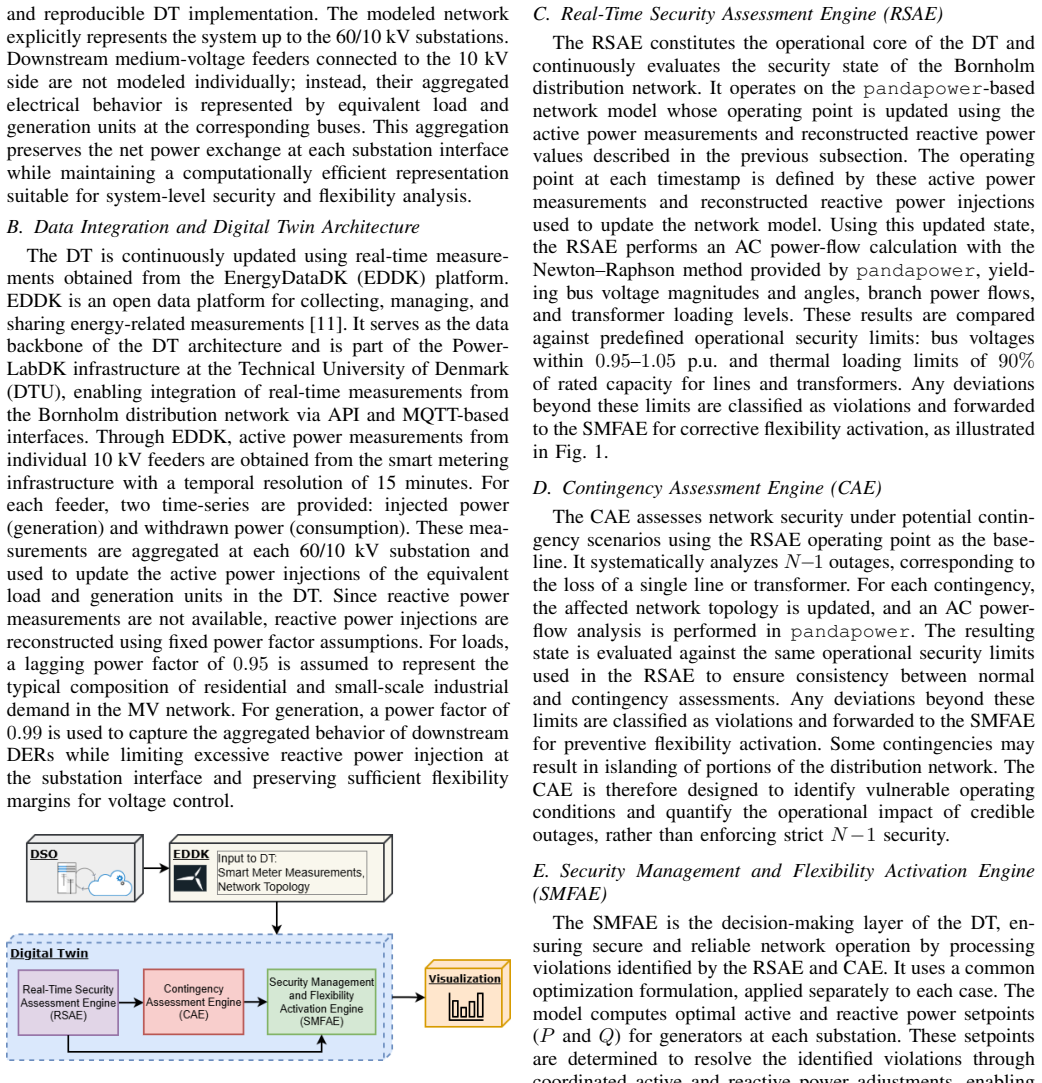
The digital twin integrates network topology and smart meter measurements to perform security assessment under normal operation and N-1 contingencies, and determines corrective and preventive flexibility actions using an optimization-based approach; the resulting coordinated active and reactive power control removes the voltage-magnitude violations that load variation and contingencies otherwise produce.
What carries the argument
The real-time Digital Twin that fuses topology data with smart-meter measurements and solves an optimization problem to select and dispatch flexibility actions.
Load-bearing premise
The digital twin model matches the actual behavior of the Bornholm network and the optimization finishes fast enough to issue corrective actions before violations become critical.
What would settle it
A period of live operation in which the twin reports no violation or successful mitigation yet voltage or thermal limits are actually breached in the Bornholm system.
Figures

read the original abstract
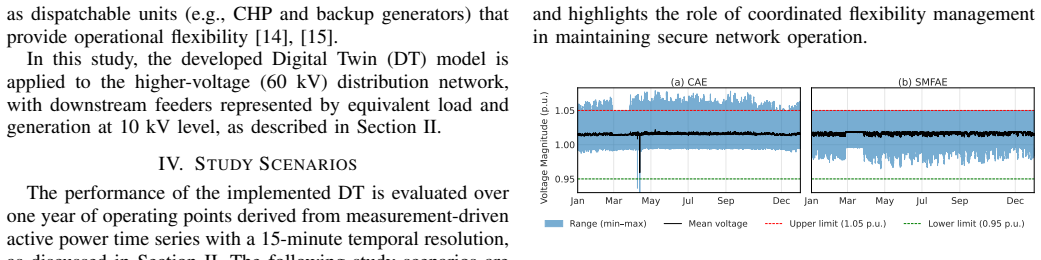
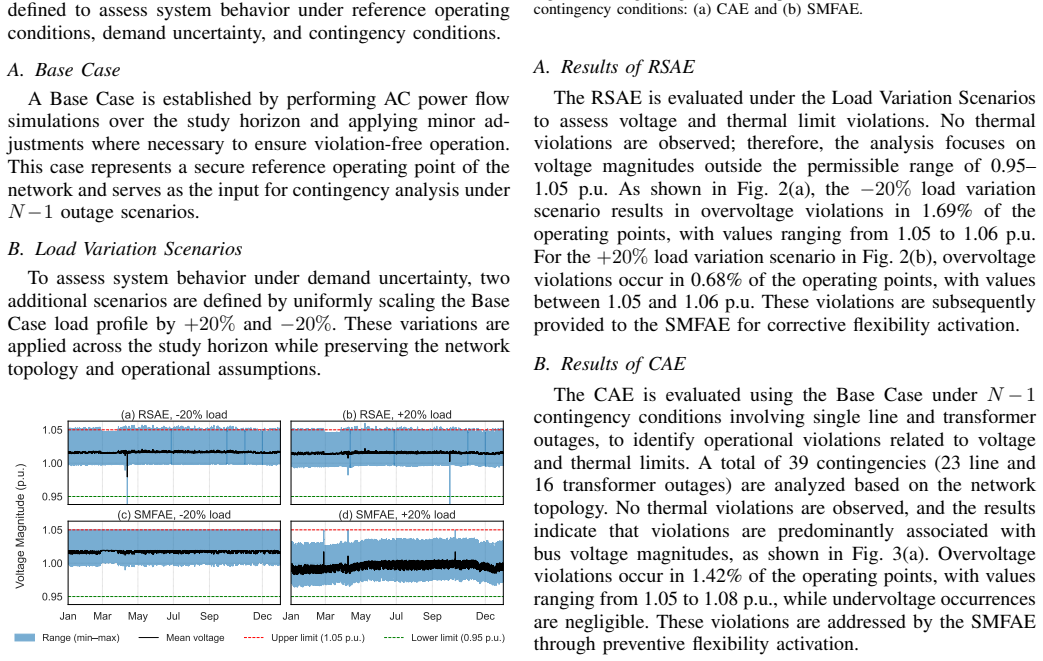
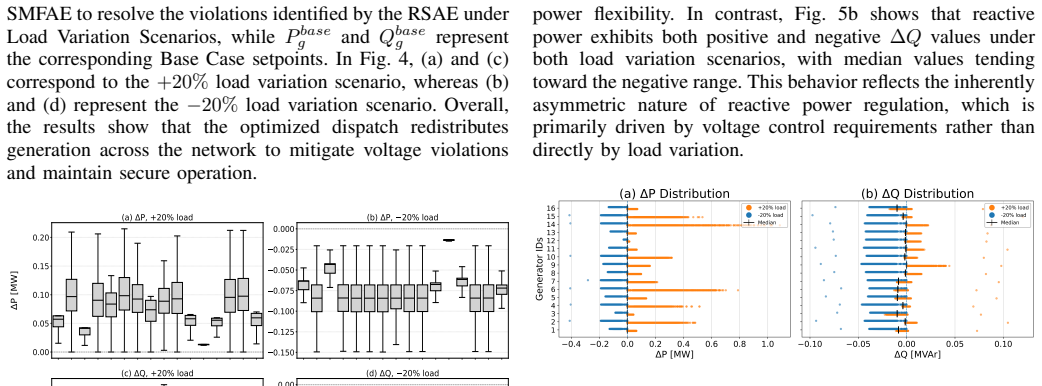
The increasing penetration of distributed energy resources (DERs) is transforming distribution networks into actively managed systems, introducing challenges related to voltage regulation, thermal loading limits, and operational security. This paper presents the development and implementation of a real-time Digital Twin (DT) for security assessment and coordinated flexibility activation in active distribution networks, demonstrated on the Bornholm Island system using real measurement data. The implemented DT integrates network topology and smart meter measurements to perform security assessment under normal operation and N-1 contingencies, and to determine corrective and preventive flexibility actions using an optimization-based approach. Results show that load variation and contingency scenarios introduce operational limit violations, primarily driven by voltage magnitude constraints. The implemented flexibility strategy effectively mitigates these violations through coordinated active and reactive power control, enhancing system security and operational efficiency. The findings highlight the potential of DT-based approaches for reliable and flexible operation of future distribution networks.
Editorial analysis
A structured set of objections, weighed in public.
Referee Report
Summary. The paper presents the development and implementation of a real-time Digital Twin (DT) for the Bornholm Island distribution system. It integrates network topology and smart meter measurements to perform security assessment under normal operation and N-1 contingencies, and determines corrective and preventive flexibility actions via an optimization-based approach using coordinated active and reactive power control. Results indicate that load variation and contingency scenarios cause operational limit violations (primarily voltage magnitude constraints), which are effectively mitigated by the flexibility strategy to enhance system security.
Significance. If the implementation and validation details hold, this provides a practical real-world demonstration of DT technology for active distribution networks with high DER penetration. The use of actual smart meter data from Bornholm and the focus on both security assessment and flexibility activation represent a concrete step toward operational tools for future grids, with potential to improve reliability and efficiency under variable conditions.
major comments (1)
- [Results] Results section: the claim that the flexibility strategy 'effectively mitigates' violations is central to the paper but is supported only by qualitative statements in the abstract and summary; no quantitative metrics (e.g., pre/post violation counts, voltage deviation reductions, computation times for the optimization, or sensitivity to model mismatch) are provided, undermining assessment of practical effectiveness and real-time feasibility.
minor comments (2)
- [Abstract] Abstract: lacks any numerical outcomes or error measures, which would better convey the strength of the reported mitigation.
- [Methods] Methods: the optimization formulation (objective, constraints, and handling of N-1 cases) should be stated explicitly with equations to allow reproducibility; current description is high-level.
Simulated Author's Rebuttal
We thank the referee for the positive assessment of our work and the recommendation for minor revision. We address the single major comment point by point below.
read point-by-point responses
-
Referee: [Results] Results section: the claim that the flexibility strategy 'effectively mitigates' violations is central to the paper but is supported only by qualitative statements in the abstract and summary; no quantitative metrics (e.g., pre/post violation counts, voltage deviation reductions, computation times for the optimization, or sensitivity to model mismatch) are provided, undermining assessment of practical effectiveness and real-time feasibility.
Authors: We agree that the Results section currently relies primarily on visual evidence from voltage profile figures to demonstrate mitigation, accompanied by qualitative statements. While these figures show clear before-and-after improvements under the tested load variation and N-1 scenarios, the absence of explicit numerical metrics limits a precise evaluation of effectiveness and computational feasibility. In the revised manuscript we will add quantitative metrics, including pre- and post-activation counts of voltage magnitude violations, reductions in maximum and average voltage deviations, and measured computation times for the optimization solver across scenarios. We will also include a short discussion of robustness to model mismatch, drawing on the calibration process with real smart-meter data from Bornholm. These additions will be placed in the Results section and supported by a new table for clarity. revision: yes
Circularity Check
No significant circularity: implementation results, not derivations
full rationale
The paper presents an implementation of a digital twin that integrates network topology with smart-meter data to run security assessment (normal and N-1) and an optimization-based flexibility scheme on the Bornholm network. All central claims rest on reported outcomes from this implementation rather than any mathematical derivation, fitted parameters renamed as predictions, or self-referential equations. No load-bearing steps reduce by construction to the paper's own inputs; the work is self-contained as an applied demonstration whose validity is externally falsifiable via the real measurements and system behavior described.
Axiom & Free-Parameter Ledger
Reference graph
Works this paper leans on
-
[1]
A. H. Javed, P. H. Nguyen, J. Morren, and J. G. H. Slootweg, ”Review of operational challenges and solutions for DER integration with distribu- tion networks,” in Proc. 2021 56th Int. Universities Power Engineering Conf. (UPEC), 2021, pp. 1–6
work page 2021
-
[2]
H. Sun, Q. Guo, J. Qi, V . Ajjarapu, R. Bravo, J. Chow, Z. Li, R. Moghe, E. Nasr-Azadani, and U. Tamrakar, ”Review of challenges and research opportunities for voltage control in smart grids,” IEEE Trans. Power Syst., vol. 34, no. 4, pp. 2790–2801, 2019
work page 2019
- [3]
-
[4]
S. Karagiannopoulos, P. Aristidou, and G. Hug, ”Hybrid approach for planning and operating active distribution grids,” IET Gener. Transm. Distrib., vol. 11, no. 3, pp. 685–695, 2017
work page 2017
-
[5]
W. Zomerdijk, P. Palensky, T. AlSkaif, and P. P. Vergara, ”On future power system digital twins: a vision towards a standard architecture,” Digital Twins and Applications, vol. 1, no. 2, pp. 103–117, 2024
work page 2024
-
[6]
M. M. Thwe, A. Stefanov, V . S. Rajkumar, and P. Palensky, ”Digital twins for power systems: review of current practices, requirements, enabling technologies, data federation and challenges,” IEEE Access, 2025
work page 2025
-
[7]
Z. Song, C. M. Hackl, A. Anand, A. Thommessen, J. Petzschmann, O. Kamel, R. Braunbehrens, A. Kaifel, C. Roos, and S. Hauptmann, ”Digital twins for the future power system: an overview and a future perspective,” Sustainability, vol. 15, no. 6, p. 5259, 2023
work page 2023
-
[8]
Yan, ”Analysis of digital twin implementation technologies for power distribution systems,” in Proc
A. Yan, ”Analysis of digital twin implementation technologies for power distribution systems,” in Proc. 2024 IEEE Int. Conf. Power Syst. Technol. (PowerCon), 2024, pp. 1–5
work page 2024
-
[9]
T. Bragatto, M. A. Bucarelli, F. Carere, M. Cresta, F. M. Gatta, A. Geri, M. Maccioni, M. Paulucci, P. Poursoltan, and F. Santori, ”Near real-time analysis of active distribution networks in a digital twin framework: a real case study,” Sustain. Energy, Grids Netw., vol. 35, p. 101128, 2023
work page 2023
-
[10]
L. Thurner, A. Scheidler, F. Sch ¨afer, J.-H. Menke, J. Dollichon, F. Meier, S. Meinecke, and M. Braun, ”pandapower—an open-source Python tool for convenient modeling, analysis, and optimization of electric power systems,” IEEE Trans. Power Syst., vol. 33, no. 6, pp. 6510–6521, 2018
work page 2018
- [11]
-
[12]
W. E. Hart, J.-P. Watson, and D. L. Woodruff, ”Pyomo: modeling and solving mathematical programs in Python,” Math. Program. Comput., vol. 3, no. 3, pp. 219–260, 2011
work page 2011
-
[13]
A. W ¨achter and L. T. Biegler, ”On the implementation of an interior- point filter line-search algorithm for large-scale nonlinear programming,” Math. Program., vol. 106, no. 1, pp. 25–57, 2006
work page 2006
-
[14]
PowerLabDK, ”Smart community Bornholm: test and demonstration of smart grid and other technologies under realistic and stressed conditions,” Tech. Univ. Denmark, 2022. [Online]. Available: https://wind.dtu.dk/- /media/sites/powerlabdk/facilities/bornholm/pdf/smart-community- bornholm-1-pager.pdf
work page 2022
-
[15]
T. Gabderakhmanova, et al., ”Demonstrations of DC microgrid and virtual power plant technologies on the Danish island of Bornholm,” in Proc. 2020 55th Int. Univ. Power Eng. Conf. (UPEC), 2020, pp. 1–6
work page 2020
discussion (0)
Sign in with ORCID, Apple, or X to comment. Anyone can read and Pith papers without signing in.