Optimizing thermal convection by phase-locking circulation to wall oscillations
Pith reviewed 2026-05-10 12:31 UTC · model grok-4.3
The pith
Phase-locking large-scale circulation reversals to bottom-plate oscillations maximizes heat transport in Rayleigh-Bénard convection.
A machine-rendered reading of the paper's core claim, the machinery that carries it, and where it could break.
Core claim
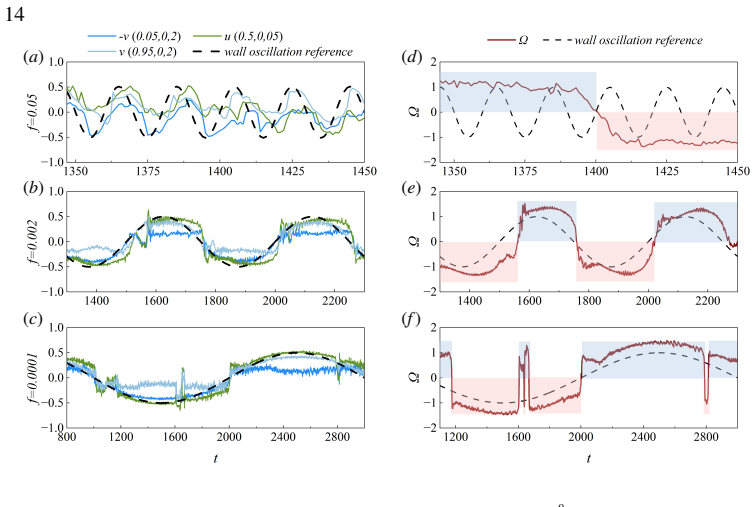
At the optimal oscillation frequency the intrinsic response time of the large-scale circulation, measured by the sign recovery of volume-averaged angular momentum, locks exactly to the wall oscillation period. This produces perfectly synchronized reversals that sustain a single-roll mode throughout each cycle and yield more than 60 percent higher Nusselt number than the uncontrolled case. Off-optimum frequencies produce either incomplete reversals or a double-roll structure, both of which reduce heat-transfer efficiency. The locking relation remains unchanged across the entire investigated Rayleigh-number range.
What carries the argument
The phase-locking between the large-scale circulation response time (sign-recovery of volume-averaged angular momentum) and the imposed wall oscillation period.
If this is right
- Synchronized reversals maintain a dominant single-roll mode that carries heat plumes efficiently.
- Frequencies above optimum produce incomplete reversals and lower heat transport.
- Frequencies below optimum generate double-roll structures that reduce efficiency.
- The same phase-locking relation governs the optimum across Rayleigh numbers from 5 million to 100 million.
Where Pith is reading between the lines
- If the same angular-momentum sign-recovery locking appears in three-dimensional runs, the control strategy would apply directly to laboratory convection cells.
- Measuring the time for angular momentum to change sign could serve as a real-time diagnostic for tuning oscillation frequency in active control systems.
- The mechanism may generalize to other buoyancy-driven flows where a large-scale circulation can be forced to reverse at a prescribed interval.
Load-bearing premise
Two-dimensional simulations capture the essential turbulent dynamics without artifacts from the chosen grid, time step, or specific Prandtl and Rayleigh numbers.
What would settle it
A three-dimensional experiment or simulation in which the Nusselt-number maximum does not occur at the frequency where large-scale-circulation sign-recovery time equals the oscillation period.
Figures



read the original abstract
This study numerically investigates two-dimensional Rayleigh-Benard convection subjected to horizontal oscillation of the bottom plate, with Prandtl number Pr=4.3, Rayleigh numbers Ra ranging from 5e6 to 1e8, and oscillation frequencies f between 0.0001 and 0.5. The imposed oscillation breaks the up-down symmetry of the classical system, inducing a strong frequency-dependent response in global heat transport, with the maximum Nusselt number enhancement exceeding 60% compared to the uncontrolled case. Central to this control efficiency is a phase-locking mechanism: at the optimal frequency, the intrinsic response time of the large-scale circulation (LSC), quantified by the sign-recovery of volume-averaged angular momentum, locks precisely to the wall oscillation period, enabling perfectly synchronized LSC reversals. Deviations from this optimal condition lead to a marked mismatch; the LSC response time becomes substantially longer when frequency exceeds the optimum and significantly shorter when frequency falls below it. In contrast, boundary layer velocities simply follow the wall oscillations and fail to distinguish control efficiency. Fourier mode analysis reveals that at the optimal frequency, a single-roll mode remains dominant throughout the cycle, facilitating efficient plume transport, whereas higher frequencies yield incomplete reversals and lower frequencies produce a double-roll structure that diminishes heat-transfer efficiency. This frequency-locking mechanism is shown to persist for optimal controls across the entire investigated Rayleigh number range, thus offering robust insight for active control strategies in thermally driven turbulent flows.
Editorial analysis
A structured set of objections, weighed in public.
Referee Report
Summary. The manuscript reports two-dimensional direct numerical simulations of Rayleigh-Bénard convection (Pr = 4.3, Ra = 5×10^6 to 10^8) with horizontal oscillations imposed on the bottom plate. It claims that an optimal oscillation frequency produces phase-locking between the large-scale circulation (LSC) and the wall motion, quantified by the sign-recovery time of volume-averaged angular momentum matching the oscillation period; this yields perfectly synchronized LSC reversals, single-roll dominance, and >60% Nusselt-number enhancement relative to the uncontrolled case. The locking and enhancement are reported to persist across the full Ra range examined, with deviations from the optimal frequency producing mismatched response times, incomplete reversals, or double-roll states that reduce heat transport.
Significance. If the reported frequency-locking mechanism holds under scrutiny, the work identifies a concrete, frequency-tunable route to active control of turbulent heat transport that exploits the intrinsic LSC response time rather than boundary-layer forcing alone. The persistence across Ra and the supporting Fourier-mode diagnostics constitute a clear, falsifiable prediction for future experiments or higher-dimensional simulations.
major comments (2)
- [Abstract and §3] Abstract and §3 (results): the central quantitative claim of 'maximum Nusselt number enhancement exceeding 60%' and the assertion of 'precise' phase-locking rest on forward DNS without any reported grid-resolution study, time-step convergence test, or error bars on Nu or the angular-momentum sign-recovery time. Because these quantities are load-bearing for both the 60% figure and the optimality of the locking frequency, their absence leaves the magnitude and robustness of the effect unverified.
- [Abstract and §4] Abstract and §4 (discussion): the phase-locking mechanism and the single-roll dominance that supposedly enable the Nu gain are demonstrated only in two-dimensional geometry. In three-dimensional Rayleigh-Bénard convection the LSC is a toroidal structure whose reversals are typically triggered by azimuthal plume clustering or corner-flow instabilities; the horizontal wall oscillation may therefore couple differently, rendering the reported 60% gain and the 'robust insight for active control' potentially specific to the 2D single-roll topology.
minor comments (2)
- [Abstract] Abstract: the oscillation frequency range '0.0001 and 0.5' is given without explicit nondimensionalization (e.g., in units of the free-fall frequency), which should be stated for immediate readability.
- [Abstract] Abstract: the statement that 'boundary layer velocities simply follow the wall oscillations' is presented without a quantitative metric or comparison figure; a brief definition or reference to the relevant diagnostic would clarify the contrast with the LSC response time.
Simulated Author's Rebuttal
We thank the referee for the constructive summary and recommendation. We respond point-by-point to the major comments below.
read point-by-point responses
-
Referee: [Abstract and §3] Abstract and §3 (results): the central quantitative claim of 'maximum Nusselt number enhancement exceeding 60%' and the assertion of 'precise' phase-locking rest on forward DNS without any reported grid-resolution study, time-step convergence test, or error bars on Nu or the angular-momentum sign-recovery time. Because these quantities are load-bearing for both the 60% figure and the optimality of the locking frequency, their absence leaves the magnitude and robustness of the effect unverified.
Authors: We agree that explicit documentation of numerical convergence is required to support the central quantitative claims. Although the simulations satisfied standard resolution criteria for the Ra range (sufficient grid points to resolve thermal and viscous boundary layers, CFL-compliant time steps), these checks were not reported. In the revised manuscript we will add a dedicated subsection (or appendix) presenting grid-resolution and time-step convergence tests together with uncertainty estimates (standard deviations across multiple cycles) for both the Nusselt number and the angular-momentum sign-recovery time. This addition will directly substantiate the reported >60% enhancement and the precision of the optimal locking frequency. revision: yes
-
Referee: [Abstract and §4] Abstract and §4 (discussion): the phase-locking mechanism and the single-roll dominance that supposedly enable the Nu gain are demonstrated only in two-dimensional geometry. In three-dimensional Rayleigh-Bénard convection the LSC is a toroidal structure whose reversals are typically triggered by azimuthal plume clustering or corner-flow instabilities; the horizontal wall oscillation may therefore couple differently, rendering the reported 60% gain and the 'robust insight for active control' potentially specific to the 2D single-roll topology.
Authors: We acknowledge that the LSC topology and reversal triggers differ between 2D and 3D. The present study is performed in 2D precisely to isolate the phase-locking mechanism without the additional azimuthal degrees of freedom present in 3D. We will expand the discussion section to state this limitation explicitly, to note that the reported frequency-locking insight is demonstrated for the 2D single-roll state, and to suggest that analogous frequency-tuned control may be tested in 3D experiments or simulations. Performing the corresponding 3D DNS lies outside the scope of the current work. revision: partial
- Quantitative verification of the reported Nusselt-number enhancement and phase-locking mechanism in three-dimensional Rayleigh-Bénard convection.
Circularity Check
No circularity: results are forward numerical observations
full rationale
The paper conducts direct numerical simulations of the 2D Navier-Stokes equations for Rayleigh-Bénard convection with imposed horizontal wall oscillations. The optimal frequency is identified empirically by maximizing the global Nusselt number across scanned frequencies; the phase-locking is then reported as an observed emergent feature at that frequency, quantified via sign recovery of volume-averaged angular momentum. No quantity is defined in terms of itself, no fitted parameter is repurposed as a prediction of closely related data, and no load-bearing step reduces to a self-citation or imported ansatz. The derivation chain consists entirely of forward integration and post-processing diagnostics, remaining self-contained against external benchmarks.
Axiom & Free-Parameter Ledger
axioms (1)
- standard math The incompressible Navier-Stokes equations with Boussinesq approximation govern the fluid motion.
Reference graph
Works this paper leans on
-
[1]
Doering, Charles R2020 Turning up the heat in turbulent thermal convection.Proc. Natl. Acad. Sci. 117(18), 9671–9673. Gao, Zhen- Yuan, Tao, Xin, Huang, Shi-Di, Bao, Yun & Xie, Yi-Chao2024Flowstatetransitioninduced by emergence of orbiting satellite eddies in two-dimensional turbulent rayleigh–bénard convection. Journal of Fluid Mechanics997, A54. Gatti, D...
work page 2025
-
[2]
Iyer, Kartik P , Scheel, Janet D, Schumacher, Jörg & Sreenivasan, Katepalli R2020 Classical 1/3 scaling of convection holds up to ra= 1015.Proceedings of the National Academy of Sciences 117(14), 7594–7598. Jiren, M., Yousif, M. Z., Lee, J. S. & Lim, H.-C.2024 Optimizing heat transfer and convective cell dynamicsin2drayleigh–bénardconvection:Theeffectofva...
work page 2024
-
[3]
Novi, L., von Hardenberg, J., Hughes, D
Ni, Rui, Huang, Shi-Di & Xia, Ke-Qing2015Reversalsofthelarge-scalecirculationinquasi-2drayleigh– bénard convection.Journal of Fluid Mechanics778, R5. Novi, L., von Hardenberg, J., Hughes, D. W ., Provenzale, A. & Spiegel, E. A.2019 Rapidly rotating rayleigh–bénard convection with a tilted axis.Physical Review E99(5), 053116. Pan, Xiaomin & Choi, Jung-Il20...
work page 2019
discussion (0)
Sign in with ORCID, Apple, or X to comment. Anyone can read and Pith papers without signing in.