The ground ytterbium doublet in h-YbMnO3 and the related low-temperature peculiarities of the compound
Pith reviewed 2026-05-10 12:34 UTC · model grok-4.3
The pith
The splitting of the Yb ground-state doublet in h-YbMnO3 is produced by the ordered Mn subsystem and accounts for the low-temperature Schottky anomaly.
A machine-rendered reading of the paper's core claim, the machinery that carries it, and where it could break.
Core claim
The splitting D0(T) of the Yb3+ ground Kramers doublet at the 4b site follows the temperature dependence of the manganese magnetic moment below TN = 87 K. This shows that the ytterbium subsystem is magnetized by the molecular field of the ordered Mn subsystem. The same D0(T) function yields a Yb(4b) magnetic moment whose temperature behavior matches neutron data and whose contribution to the heat capacity fully accounts for the Schottky anomaly in CP(T). Excitation of the upper component of the split doublet is important for low-temperature dynamics, and the authors propose that energy gain in the ytterbium system plays a central role in the sequence of phase transitions.
What carries the argument
Temperature-dependent splitting D0(T) of the Yb3+ ground Kramers doublet at the 4b site, used as a direct reporter of the Mn molecular field.
If this is right
- The Yb(4b) magnetic moment calculated from D0(T) reproduces the neutron scattering results.
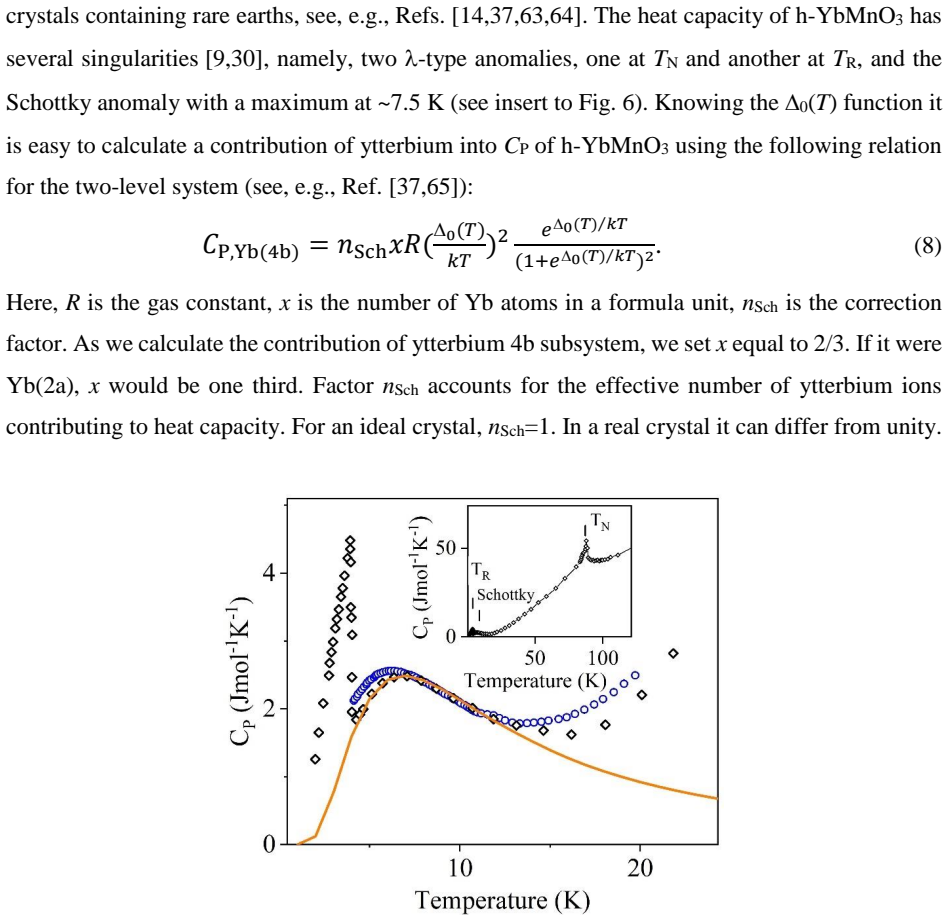
- The Yb(4b) Schottky contribution accounts for the entire low-temperature anomaly in the measured heat capacity.
- Excitation of the upper Zeeman component of the split ground doublet contributes substantially to the low-temperature dynamics.
- Phase-transition energetics in h-YbMnO3 are dominated by the gain in the ytterbium magnetic system.
Where Pith is reading between the lines
- Similar optical tracking of rare-earth doublet splittings could be applied to map molecular fields in other hexagonal RMnO3 compounds.
- Because the Yb magnetization is tied to the Mn order, it may couple back to the lattice and affect the ferroelectric transition or magnetoelectric response at low temperature.
- The proposed scenario suggests that the sequence of magnetic transitions would change if the Yb ions were replaced by a non-magnetic rare earth.
Load-bearing premise
The observed temperature variation of the doublet splitting is caused only by the exchange field from the ordered manganese moments, with negligible influence from temperature-dependent crystal-field effects or other interactions.
What would settle it
A direct measurement of the Mn moment and the Yb doublet splitting that shows clear mismatch below 87 K after all known crystal-field temperature dependences have been subtracted.
Figures


read the original abstract
We have performed detailed temperature-dependent study of optical f-f transitions of the Yb3+ ions in h-YbMnO3 by means of Fourier-transform spectroscopy. The splitting of the ground Kramers doublet as a function of temperature, D0(T), for the Yb3+ ion at 4b site was determined. The D0(T) function follows the dynamics of the manganese magnetic moment below TN = 87 K, indicating, that the ytterbium subsystem is magnetized by the magnetic field generated by an ordered manganese subsystem, which is consistent with the results of previous studies. Excitation of the upper component of the split ground doublet plays a significant role in low-temperature dynamics of the h-YbMnO3 crystal. Using the D0(T) function we calculated the temperature behavior of the of the Yb(4b) magnetic moment: it is in clear agreement with the neutron data [Phys. Rev. B 98, 134413, 2018]. The calculated contribution of Yb(4b) to heat capacity definitely explains the origin of the Schottky anomaly in the CP(T) dependence. A scenario for phase transitions in h-YbMnO3 is proposed in which the energy gain in the ytterbium system plays a key role.
Editorial analysis
A structured set of objections, weighed in public.
Referee Report
Summary. The manuscript reports a temperature-dependent Fourier-transform infrared spectroscopy study of f-f optical transitions in hexagonal YbMnO3. The authors extract the splitting D0(T) of the Yb3+ ground Kramers doublet at the 4b site from the spectra and show that D0(T) tracks the Mn magnetic moment below TN = 87 K. From this they derive the temperature-dependent Yb(4b) moment (in agreement with neutron data) and compute the Yb(4b) Schottky contribution to the heat capacity, which they state accounts for the observed low-T anomaly. A scenario for the phase transitions is proposed in which the Yb energy gain is central.
Significance. If the central assumption is validated, the work supplies direct spectroscopic evidence that the ordered Mn subsystem magnetizes the Yb(4b) ions via an effective molecular field, together with a parameter-free calculation that quantitatively links this splitting to both the neutron-derived moment and the calorimetric Schottky term. This strengthens the microscopic picture of Mn-Yb coupling in hexagonal manganites and offers a falsifiable link between optical, neutron, and thermodynamic data.
major comments (2)
- [§3 (Results, D0(T) extraction)] §3 (Results, D0(T) extraction): The claim that D0(T) below TN arises exclusively from the Mn exchange field (and therefore that the Yb subsystem is magnetized by the Mn-generated field) rests on an untested assumption. No data or analysis above TN is presented to establish whether D0(T) is constant in the paramagnetic regime, nor is any estimate or comparison to a non-magnetic isostructural analog (e.g., h-LuMnO3) provided to bound possible lattice-contraction contributions to the crystal-field parameters. This assumption is load-bearing for the subsequent moment and heat-capacity calculations.
- [§4 (Discussion, heat-capacity calculation)] §4 (Discussion, heat-capacity calculation): The assertion that the Yb(4b) Schottky term 'definitely explains' the CP(T) anomaly requires a quantitative overlay of the calculated curve on the experimental data (with residuals or error bands) rather than a qualitative statement. Without this, it remains unclear whether the Yb contribution fully accounts for the anomaly or leaves room for additional terms.
minor comments (2)
- [Abstract] The abstract refers to 'the related low-temperature peculiarities' without enumerating them; a short list would improve readability.
- [Throughout manuscript and figures] Notation for the 4b site and for the splitting D0(T) should be introduced once and used consistently; several figures would benefit from explicit labeling of the assigned transitions and the background-subtraction procedure.
Simulated Author's Rebuttal
We thank the referee for the careful reading of our manuscript and the constructive comments. We respond to each major comment below, indicating where revisions will be made.
read point-by-point responses
-
Referee: §3 (Results, D0(T) extraction): The claim that D0(T) below TN arises exclusively from the Mn exchange field (and therefore that the Yb subsystem is magnetized by the Mn-generated field) rests on an untested assumption. No data or analysis above TN is presented to establish whether D0(T) is constant in the paramagnetic regime, nor is any estimate or comparison to a non-magnetic isostructural analog (e.g., h-LuMnO3) provided to bound possible lattice-contraction contributions to the crystal-field parameters. This assumption is load-bearing for the subsequent moment and heat-capacity calculations.
Authors: We agree that an explicit demonstration of D0(T) above TN would strengthen the case. Our analysis centers on the regime below TN, where the extracted D0(T) closely follows the independently measured Mn magnetic moment (which drops to zero at TN). This direct correlation with the magnetic order parameter, rather than a smooth lattice-driven variation, is the primary evidence for the exchange-field origin. Lattice-contraction effects on crystal-field parameters are expected to be gradual and continuous through TN, inconsistent with the observed onset and tracking. In the revised manuscript we will add a dedicated paragraph discussing possible lattice contributions, citing the smooth temperature dependence expected from thermal expansion data on related compounds, and explicitly noting the absence of above-TN spectra in the present dataset as a limitation. We will also reference available crystal-field parameters for h-LuMnO3 to provide a rough bound. This constitutes a partial revision: we maintain that the existing correlation and consistency with neutron and calorimetric results support the interpretation, while incorporating the referee’s suggested caveats. revision: partial
-
Referee: §4 (Discussion, heat-capacity calculation): The assertion that the Yb(4b) Schottky term 'definitely explains' the CP(T) anomaly requires a quantitative overlay of the calculated curve on the experimental data (with residuals or error bands) rather than a qualitative statement. Without this, it remains unclear whether the Yb contribution fully accounts for the anomaly or leaves room for additional terms.
Authors: We accept the point that a qualitative statement is insufficient. In the revised manuscript we will include a new figure (or panel) that overlays the calculated Yb(4b) Schottky heat-capacity contribution—derived directly from the measured D0(T)—on published experimental CP(T) data for h-YbMnO3. The figure will display residuals and, where possible, error bands propagated from the uncertainty in D0(T). This will allow a transparent assessment of the agreement and any residual contributions. revision: yes
Circularity Check
No significant circularity in the derivation chain
full rationale
The paper determines D0(T) directly from measured positions of optical f-f transitions in Fourier-transform spectra. This experimental function is inserted into standard mean-field relations to compute the Yb(4b) moment versus temperature and the associated Schottky term in heat capacity; the resulting curves are compared to independent neutron-diffraction and calorimetric datasets rather than being fitted to them. No equation or claim reduces the final results to the optical inputs by algebraic identity, no self-citation supplies a load-bearing uniqueness theorem or ansatz, and the statement that D0(T) tracks the Mn moment is an empirical shape comparison, not a tautological prediction. The derivation therefore remains self-contained against external benchmarks.
Axiom & Free-Parameter Ledger
axioms (2)
- standard math Yb3+ (4f13) is a Kramers ion whose ground state is a doublet that splits linearly in an effective magnetic field
- domain assumption Below TN the Mn magnetic order produces a uniform effective field at the Yb(4b) site that dominates any temperature-dependent crystal-field variation
Reference graph
Works this paper leans on
-
[1]
C. N. R. Rao and B. Raveau, editors , Colossal Magnetoresistance, Charge Ordering and Related Properties of Manganese Oxides (World Scientific, Singapore, 1998)
work page 1998
-
[2]
L. M. Rodriguez -Martinez and J. P. Attfield, Cation disorder and size effects in magnetoresistive manganese oxide perovskites, Phys. Rev. B 54, R15622 (1996). doi: 10.1103/PhysRevB.54.R15622
-
[3]
E. Dagotto, Brief Introduction to Giant Magnetoresistance (GMR) , in Nanoscale Phase Separation and Colossal Magnetoresistance , Vol. 136 (Springer Berlin Heidelberg, Berlin, Heidelberg, 2003), pp. 395–405. doi: 10.1007/978-3-662-05244-0_21
-
[4]
S. Lee et al., Giant magneto-elastic coupling in multiferroic hexagonal manganites, Nature 451, 805 (2008). doi: 10.1038/nature06507
-
[5]
M. Fiebig, Th. Lottermoser, M. K. Kneip, and M. Bayer, Correlations between magnetic and electrical orderings in multiferroic manganites (invited), Journal of Applied Physics 99, 08E302 (2006). doi: 10.1063/1.2172198
-
[6]
M. Lilienblum, T. Lottermoser, S. Manz, S. M. Selbach , A. Cano, and M. Fiebig, Ferroelectricity in the multiferroic hexagonal manganites, Nature Phys 11, 1070 (2015). doi: 10.1038/nphys3468
-
[7]
G. Qiang, Y. Fang, X. Lu, S. Cao, and J. Zhang, Ferroelectricity and magnetoelectric coupling in h-YbMnO3: Spin reo rientation and defect effect, Applied Physics Letters 108, 022906 (2016). doi: 10.1063/1.4939916
-
[8]
S.-W. Cheong and M. Mostovoy, Multiferroics: a magnetic twist for ferroelectricity, Nature Mater 6, 13 (2007). doi: 10.1038/nmat1804
-
[9]
B. Lorenz, Hexagonal manganites: Strong coupling of ferroelectricity and magnetic orders, Physical Sciences Reviews 4, (2019). doi: 10.1515/psr-2019-0014
-
[10]
A. Pimenov, A. M. Shuvaev, A. A. Mukhin, and A. Loidl, Electromagnons in multiferroic manganites, J. Phys.: Condens . Matter 20, 434209 (2008). doi: 0.1088/0953- 8984/20/43/434209
work page 2008
-
[11]
D. Fröhlich, St. Leute, V. V. Pavlov, R. V. Pisarev, and K. Kohn, Determination of the magnetic structure of hexagonal manganites RMnO3 (R=Sc, Y, Ho, Er, Tm, Yb) by second- harmonic spectroscopy, Journal of Applied Physics 85, 4762 (1999). doi: 10.1063/1.370473
-
[12]
B. Lorenz, Hexagonal Manganites (RMnO3): Class (I) Multiferroics with Strong Coupling of Magnetism and Ferroelectricity, ISRN Condensed Matter Physics 2013, 1 (2013). doi: 10.1155/2013/497073
-
[13]
M. A. Kashchenko and S. A. Klimin, Manifestation of a series of phase transitions in IR spectra of a multiferroic TbMnO 3, Opt. Spectrosc. 116, 836 (2014). doi: 10.1134/S0030400X14060101
-
[14]
M. A. Kashchenko, S. A. Klimin, A. M. Balbashov, and M. N. Popova, Probing Dy 3+ magnetic moments in multiferroic perovskite DyMnO 3 by optical spectroscopy, Phys ica Status Solidi RRL 10, 462 (2016). doi: 10.1002/pssr.201600076
-
[15]
N. Sharma et al., AFM‐Based Functional Tomography – To Mill or Not to Mill, that is the Question!, Adv Materials Inter 12, 2400813 (2025). doi: 10.1002/admi.202400813
-
[16]
R. Dragland, C. Salazar Mejía, I. Hansen, Y. Hamasaki, E. A. C. Panduro, Y. Ehara, T. Gottschall, D. Meier, and J. Schultheiß, Relation between 4 f-magnetism and the low - temperature magnetocaloric effect in multiferroic hexagonal manganites, Commun Mater 6, 95 (2025). doi: 10.1038/s43246-025-00813-3
-
[17]
R. M. Eremina, T. P. Gavrilova, I. I. Fazlizhanov, I. V. Yatsyk, D. V. Mamedov, A. A. Sukhanov, V. I. Chichkov, N. V. Andreev, H.-A. Krug Von Hidda, and A. Loidl, Oscillation of the multiferroic/ferroelectric GdMnO3/SrTiO3 and YbMnO3/SrTiO3 interfaces in the EPR spectrum, Low Temperature Physics 41, 43 (2015). doi: 10.1063/1.4906316
-
[18]
Z. Shan, S. Xin, G. Xing, L. Chunxiao, H. Pei, L. Yunying, L. Xiaowei, Z. Junyan, and L. Yong, Ho doping-induced ferroelectric polarization enhances UV photodetector performance of YbMnO3, J Mater Sci: Mater Electron 36, 26 (2025). doi: 10.1007/s10854-024-14094-y
-
[19]
T. Katsufuji et al., Crystal structure and magnetic properties of hexagonal RMnO 3 (R = Y, Lu, and Sc) and the effe ct of doping, Phys. Rev. B 66, 134434 (2002). doi: 10.1103/PhysRevB.66.134434
-
[20]
E. F. Bertaut and M. Mercier, Structure magnetique de MnYO3, Physics Letters 5, 27 (1963). doi: 10.1016/S0375-9601(63)80014-6
-
[21]
D. G. Tomuta, S. Ramakrishnan, G. J. Nieuw enhuys, and J. A. Mydosh, The magnetic susceptibility, specific heat and dielectric constant of hexagonal YMnO 3, LuMnO 3 and ScMnO3, J. Phys.: Condens. Matter 13, 4543 (2001). doi: 10.1088/0953-8984/13/20/315
-
[22]
J. Park, J.-G. Park, G. S. Jeon, H.-Y. Choi, C. Lee, W. Jo, R. Bewley, K. A. McEwen, and T. G. Perring, Magnetic ordering and spin -liquid state of YMnO 3, Phys. Rev. B 68, 104426 (2003). doi: 10.1103/PhysRevB.68.104426
-
[23]
T. Katsufuji, S. Mori, M. Masaki, Y. Moritomo, N. Yamamoto, and H. Takagi, Dielectric and magnetic anomalies and spin frustration in hexagonal RMnO3 (R = Y, Yb, and Lu), Phys. Rev. B 64, 104419 (2001). doi: 10.1103/PhysRevB.64.104419
-
[24]
J. Fontcuberta, M. Gospodinov, and V. Skumryev, Magnetic response of YbMnO 3 single crystal, Journal of Applied Physics 103, 07B722 (2008). doi: 10.1063/1.2836403
-
[25]
F. Yen, C. Dela Cruz, B. Lorenz, E. Galstyan, Y. Y. Sun, M. Gospodinov, and C. W. Chu, Magnetic phase diagrams of multiferroic hexagonal RMnO3 (R = Er, Yb, Tm, and Ho), J. Mater. Res. 22, 2163 (2007). doi: 10.1557/jmr.2007.0271
-
[26]
X. Fabrèges, I. Mirebeau, P. Bonville, S. Petit, G. Lebras -Jasmin, A. Forget, G. André, and S. Pailhès, Magnetic order in YbMnO 3 studied by neutron diffraction and Mössbauer spectroscopy, Phys. Rev. B 78, 214422 (2008). doi: 10.1103/PhysRevB.78.214422
-
[27]
R. M. Eremina, T. P. Gavrilova, I. V. Yatsyk, R. B. Zaripov, A. A. Sukhanov, V. A. Shustov, N. M. Lyadov, V. I. Chichkov, and N. V. Andreev, Magnetic Resonance Investigations of h- YbMnO3, Appl Magn Reson 47, 869 (2016). doi: 10.1007/s00723-016-0798-0
-
[28]
H. Sugie, N. Iwata, and K. Kohn, Magnetic Ordering of Rare Earth Ions and Magnetic - Electric Interaction of Hexagonal RMnO3 (R=Ho, Er, Yb or Lu), J. Phys. Soc. Jpn. 71, 1558 (2002). doi: 10.1143/JPSJ.71.1558
-
[29]
D. R. Inchara, K. Singh, M. Sangole, M. S. Murari, and M. D. Daivajna, Influence of ionic radius on structural, optical and multiferroic properties of RMnO 3 [R= Y, Er, Yb] hexamanganites, Physica B: Condensed Matter 714, 417496 (2 025). doi: 10.1016/j.physb.2025.417496
-
[30]
N. Abramov, V. Chichkov, S. E. Lofland, and Y. M. Mukovskii, Low-temperature properties of Ca-doped YbMnO3 multiferroic single crystals, Journal of Applied Physics 109, 07D912 (2011). doi: 10.1063/1.3556961
-
[31]
S. Chattopadhyay, V. Simonet, V. Skumryev, A. A. Mukhin, V. Yu. Ivanov, M. I. Aroyo, D. Z. Dimitrov, M. Gospodinov, and E. Ressouche, Single -crystal neutron diffraction study of hexagonal multiferroic YbMnO 3 under a magnetic field, Phys. Rev. B 98, 134413 (2018). doi: 10.1103/PhysRevB.98.134413
-
[32]
H. Fukumura, N. Hasuike, H. Harima, K. Kisoda, K. Fukae, T. Takahashi, T. Yoshimura, and N. Fujimura, Spin -coupled phonons in multiferroic YbMnO 3 epitaxial films by Raman scattering, J. Phys.: Conf. Ser. 92, 012126 (2007). doi: 10.1088/1742-6596/92/1/012126
-
[33]
M. Diviš, J. Hölsä, M. Lastusaari, A. P. Litvinchuk, and V. Nekvasil, Crystal field effect in YbMnO3, Journal of Alloys and Compounds 451, 662 (2008). doi: 10.1016/j.jallcom.2007.04.187
-
[34]
R. Basistyy, T. N. Stanislavchuk, A. A. Sirenko, A. P. Litvinchuk, M. Kotelyanskii, G. L. Carr, N. Lee, X. Wang, and S. -W. Cheong, Infrared -active optical phonons and magnetic excitations in the hexagonal manganites RMnO3 ( R = Ho , Er, Tm, Yb, and Lu), Phys. Rev. B 90, 024307 (2014). doi: 10.1103/PhysRevB.90.024307
-
[35]
H. A. Salama, C. J. Voyer, D. H. Ryan, and G. A. Stewart, Magnetic order of the rare earth sublattice in h -YbMnO3, Journal of Applied Physics 105, 07E110 (2009). doi: 10.1063/1.3068011
-
[36]
E. C. Standard, T. Stanislavchuk, A. A. Sirenko, N. Lee, and S. -W. Cheong, Magnons and crystal-field transitions in hexagonal RMnO3 (R = Er, Tm, Yb, Lu) single crystals, Phys. Rev. B 85, 144422 (2012). doi: 10.1103/PhysRevB.85.144422
-
[37]
S. A. Klimin, A. S. Galkin, and M. N. Popova, Ho 3+ crystal-field levels, magnetic ordering, and magnetoelastic coupling in the chain nickelate Ho 2BaNiO5, Journal of Alloys and Compounds 625, 193 (2015). doi: 10.1016/j.jallcom.2014.11.129
-
[38]
S. A. Klimin, Magne tic g factor and magnetic anisotropy of Dy 3+ ion in Dy 2BaNiO5 determined from optical spectra of f-f transitions, MRSej 26, (2024). doi: 10.26907/mrsej- 24205
-
[39]
S. A. Klimin, E. S. Kuznetsova, and P. S. Berdonosov, Crystal -Field Levels of Sm 3+ Ion in Low-Dimensional Magnetic Cu 3Sm(SeO3)2O2Cl, Opt. Spectrosc. 131, 535 (2023) . doi: 10.1134/S0030400X23050089
-
[40]
S. Klimin, P. Berdonosov, and E. Kuznetsova, Magnetic Ordering and Interplay between the Magnetic and Charge Subsystems in New Francisite‐Analog Cu 3Dy(SeO3)2O2Cl as Studied by the Spectroscopy of Kramers Doublets, Phys. Status Solidi RRL 17, 2200460 (2023). doi: 10.1002/pssr.202200460
-
[41]
S. A. Klimin, P. S. Berdonosov, and E. S. Kuznetsova, Quasi-doublets of non-Kramers Ho3+ ion and magnetic ordering of holmiumfrancisite -analog Cu 3Ho(SeO3)2O2Cl, Low Temperature Physics 47, 1022 (2021). doi: 10.1063/10.0007075
-
[42]
M. M. Markina, B. V. Mill, S. A. Klimin, M. N. Popova, and A. N. Vasiliev, Thermodynamic and optical properties of new langasites Pr 3CrGe3Be2O14 and Pr 3AlGe3Be2O14, Journal of Alloys and Compounds 898, 162766 (2022). doi: 10.1016/j.jallcom.2021.162766
-
[43]
S. A. Klimin, B. V. Mill, and M. N. Popova, Crystal -field levels of Nd3+ in a new langasite compound Nd 3CrGe3Be2O14, Journal of Rare Earths 37, 1250 (2019). doi: 10.1016/j.jre.2018.12.011
-
[44]
M. M. Markina, K. V. Zakharov, P. S. Berdonosov, V. A. Dolgikh, E. S. Kuznetsova, S. A. Klimin, O. B. Yumashev, and A. N. Vasiliev, Thermodynamic properties and rare -earth spectroscopy of Cu 3Nd(SeO3)2O2X (X = Cl, Br), Journal of Magnetism and Magnetic Materials 492, 165721 (2019). doi: 10.1016/j.jmmm.2019.165721
-
[45]
T. Choi, Y. Horibe, H. T. Yi, Y. J. Choi, W. Wu, and S. -W. Cheong, Insulating interlocked ferroelectric and structural antiphase domain walls in multiferroic YMnO 3, Nature Mater 9, 253 (2010). doi: 10.1038/nmat2632
-
[46]
H. L. Yakel Jnr, W. C. Koehler, E. F. Bertaut, and E. F. Forrat, On the crystal structure of the manganese(III) trioxides of the heavy lanthanides and yttrium, Acta Cryst 16, 957 (1963). doi: 10.1107/S0365110X63002589
-
[47]
Venevtsev Y.N., Gagulin V.V., Sea rch for new high -temperature Seignettomagnets with enhanced magnetoelectric interaction: Developments and prospects, Inorganic Materials (Translated from Neorganicheskie Materialy) 31, (1995) 797
work page 1995
-
[48]
B. B. Van Aken, A. Meetsma, and T. T. M. Palstra, Hex agonal YbMnO 3 revisited, Acta Crystallogr E Struct Rep Online 57, i87 (2001). doi: 10.1107/S1600536801015094
-
[49]
K. Uusi-Esko, J. Malm, N. Imamura, H. Yamauchi, and M. Karppinen, Characterization of RMnO3 (R=Sc, Y, Dy -Lu): High -pressure synthesized metastable perovskites and their hexagonal precursor phases, Materials Chemistry and Physics 112, 1029 (2008). doi: 10.1016/j.matchemphys.2008.07.009
-
[50]
M. Isobe, N. Kimizuka, M. Nakamura, and T. Mohri, Structure of YbMnO3, Acta Crystallogr C Cryst Struct Commun 47, 423 (1991). doi: 10.1107/S0108270190007995
-
[51]
T. C. Ozawa and S. J. Kang, Balls & Sticks : easy-to-use structure visualization and animation program, J Appl Crystallogr 37, 679 (2004). doi: 10.1107/S0021889804015456
-
[52]
B. Z. Malkin, A. R. Zakirov, M. N. Popova, S. A. Klimin, E. P. Chukalina, E. Antic-Fidancev, Ph. Goldner, P. Aschehoug, and G. Dhalenne, Optical spectroscopy of Yb 2Ti2O7 and Y2Ti2 O7: Yb 3+ and crystal-field parameters in rare -earth titanate pyrochlores, Phys. Rev. B 70, 075112 (2004). doi: 10.1103/PhysRevB.70.075112
-
[53]
E. A. Dobretsova et al., Hydrothermal Synthesis of Yb 3+ : LuLiF4 Microcrystals and Laser Refrigeration of Yb 3+ : LuLiF 4 /Silicon‐Nitride Composite Nanostructures, Laser & Photonics Reviews 15, 2100019 (2021). doi: 10.1002/lpor.202100019
-
[54]
S. A. Klimin, P. Loiseau, D. Caurant, and M. N. Popova, Spectroscopic study of GdVO 4: Yb+Er crystals, Quantum Electron. 50, 259 (2020). doi: 10.1070/QEL17254
-
[55]
M. M. Markina et al., Interplay of rare -earth and transition -metal subsystems in Cu3Yb(SeO3)2O2Cl, Phys. Rev. B 96, 134422 (2017). doi: 10.1103/PhysRevB.96.134422
-
[56]
S. A. Klimin, Stark Structure of the Yb3+ Ion Levels in (YbxY1–x)2Ti2O7 and the Crystal Field in Rare-Earth Titanates with a Pyrochlore Structure, Phys. Solid State 47, 1425 (2005). doi: 10.1134/1.2014481
-
[57]
D. V. Pominova et al., Achieving high NIR-to-NIR conversion efficiency by optimization of Tm3+ content in Na(Gd,Yb)F4 : Tm upconversion luminophores, Laser Phys. Lett. 17, 125701 (2020). doi: 10.1088/1612-202X/abbede
-
[58]
S. Han, R. Deng, X. Xie, and X. Liu, Enhancing Lumi nescence in Lanthanide‐Doped Upconversion Nanoparticles, Angew Chem Int Ed 53, 11702 (2014). doi: 10.1002/anie.201403408
-
[59]
L. J. De Jongh and A. R. Miedema, Experiments on simple magnetic model systems, Advances in Physics 23, 1 (1974). doi: 10.1080/00018739700101558
-
[60]
K. N. Boldyrev , V. M. Burlakov, I. A. Gudim, S. Yu. Gavrilkin, and M. N. Popova, Regulation of the phase transition temperature and hysteresis width by changing the composition of Eu 1–xLaxFe3(BO3)4 solid solution, Phys. Rev. Materials 5, 094414 (2021). doi: 10.1103/PhysRevMaterials.5.094414
-
[61]
T. Yokoo, S. Raymond, A. Zheludev, S. Maslov, E. Ressouche, I. Zaliznyak, R. Erwin, M. Nakamura, and J. Akimitsu, Magnetic ordering, spin waves, and Haldane -gap excitations in (NdxY1−x)2BaNiO5 linear-chain mixed-spin antiferromagnets, Phys. Rev. B 58, 14424 (1998). doi: 10.1103/PhysRevB.58.14424
-
[62]
G. G. Chepurko, Z. A. Kazei, D. A. Kudrjavtsev, R. Z. Levitin, B. V. Mill, M. N. Popova, and V. V. Snegirev, Magnetic and spectral studies o f Er 2BaNiO5 and other rare earth nickelates, Physics Letters A 157, 81 (1991). doi: 10.1016/0375-9601(91)90413-3
-
[63]
M. M. Markina, B. V. Mill, G. Pristáš, M. Marcin, S. A. Klimin, K. N. Boldyrev, and M. N. Popova, La3CrGe3Be2O14 and Nd3CrGe3Be2O14: New magnetic compounds of the langasite family, Journal of Alloys and Compounds 779, 380 (2019). doi: 10.1016/j.jallcom.2018.11.227
-
[64]
N. Ghosh, U. K. Rößler, K. Nenkov, C. Hucho, H. L. Bhat, and K. -H. Müller, Low temperature transport and specific heat studies of Nd 1−xPbxMnO3 single crystals, J. Phys.: Condens. Matter 20, 395219 (2008). doi: 10.1088/0953-8984/20/39/395219
-
[65]
E. S. R. Gopal, Specific Heats at Low Temperatures (Springer US, Boston, MA, 1966)
work page 1966
-
[66]
S. A. Klimin, A. S. Galki n, and M. N. Popova, Magnetic structures of the rare -earth chain nickelates R2BaNiO5 as studied by the optical spectroscopy of the Er probe, Physics Letters A 376, 1861 (2012). doi: 10.1016/j.physleta.2012.03.013
-
[67]
S. A. Klimin, A. B. Kuzmenko, M. N. Popova, B. Z. Malkin, and I. V. Telegina, Infrared study of lattice and magnetic dynamics in a spin-chain compound Gd2BaNiO5, Phys. Rev. B 82, 174425 (2010). doi: 10.1103/PhysRevB.82.174425
-
[68]
M. N. Popova, S. A. Klimin, R. Troć, and Z. Bukowski, Magnetic phase transitions and magnetic structures of In2Cu2O5 and Sc2Cu2O5, Solid State Communications 102, 71 (1997). doi: 10.1016/S0038-1098(96)00700-4
discussion (0)
Sign in with ORCID, Apple, or X to comment. Anyone can read and Pith papers without signing in.