Fractional lower-order covariance-based measures for cyclostationary time series with heavy-tailed distributions: application to dependence testing and model order identification
Pith reviewed 2026-05-10 13:15 UTC · model grok-4.3
The pith
Fractional lower-order covariance yields robust dependence measures for cyclostationary processes with infinite variance.
A machine-rendered reading of the paper's core claim, the machinery that carries it, and where it could break.
Core claim
Fractional lower-order covariance can replace ordinary covariance to construct the periodic fractional lower-order autocorrelation function and periodic fractional lower-order partial autocorrelation function; these generalizations remain well-defined for infinite-variance cyclostationary processes and enable both dependence testing through a portmanteau statistic and order selection for periodic AR and MA models.
What carries the argument
Fractional lower-order covariance (FLOC) with tunable order parameter, inserted in place of covariance to produce the periodic fractional lower-order autocorrelation function (peFLOACF) and its partial counterpart (peFLOPACF).
If this is right
- A portmanteau test based on peFLOACF can assess serial dependence in cyclostationary series without requiring finite variance.
- The peFLOPACF supplies a criterion for selecting the order of periodic autoregressive and moving average models that have heavy tails.
- The same measures can be applied directly to observed data sets that combine periodicity with heavy tails, such as pollutant concentration records.
Where Pith is reading between the lines
- The approach may extend to other non-stationary time series with infinite variance beyond the strictly cyclostationary case.
- Data-driven tuning of the fractional order in FLOC could further stabilize performance across varying tail indices.
- Analogous covariance replacements might prove useful in related contexts such as long-range dependence or multivariate periodic processes.
Load-bearing premise
The fractional lower-order covariance with a suitable order parameter captures the linear dependence structure of infinite-variance cyclostationary processes without systematic distortion from the choice of order or the periodic extension.
What would settle it
If the peFLOACF-based portmanteau test applied to simulated infinite-variance cyclostationary series shows type-I error rates far from the nominal level or fails to detect known dependence, the proposed measures would be unreliable.
Figures




read the original abstract
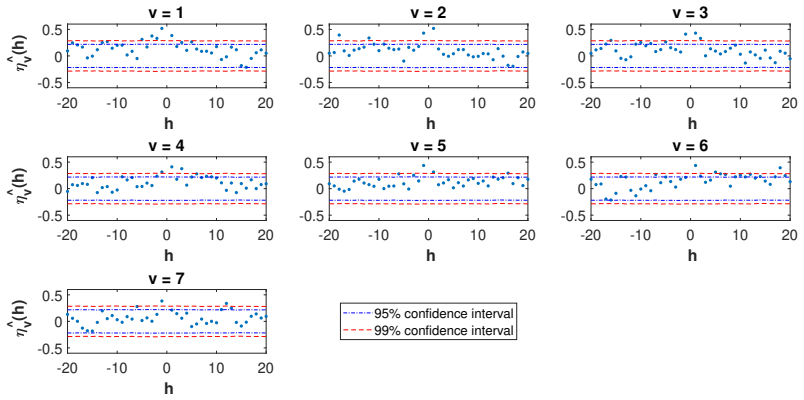
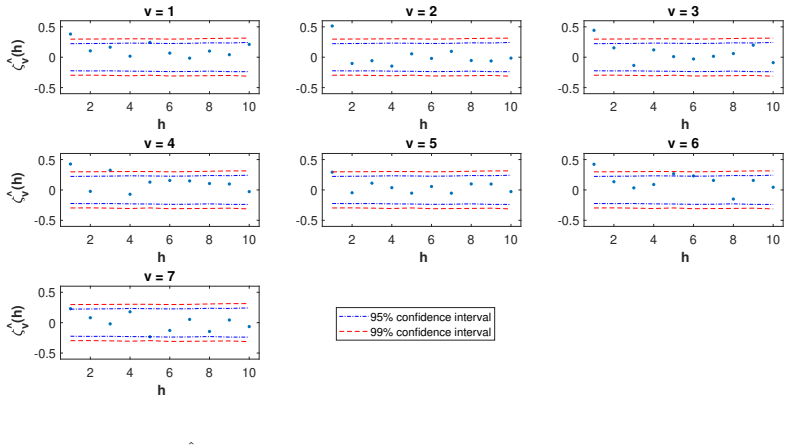
This article introduces new methods for the analysis of cyclostationary time series with infinite variance. Traditional cyclostationary analysis, based on periodically correlated (PC) processes, relies on the autocovariance function (ACVF). However, the ACVF is not suitable for data exhibiting a heavy-tailed distribution, particularly with infinite variance. Thus, we propose a novel framework for the analysis of cyclostationary time series with heavy-tailed distribution, utilizing the fractional lower-order covariance (FLOC) as an alternative to covariance. This leads to the introduction of two new autodependence measures: the periodic fractional lower-order autocorrelation function (peFLOACF) and the periodic fractional lower-order partial autocorrelation function (peFLOPACF). These measures generalize the classical periodic autocorrelation function (peACF) and periodic partial autocorrelation function (pePACF), offering robust tools for analyzing infinite-variance processes. Two practical applications of the proposed measures are explored: a portmanteau test for testing dependence in cyclostationary series and a method for order identification in periodic autoregressive (PAR) and periodic moving average (PMA) models with infinite variance. Both applications demonstrate the potential of new tools, with simulations validating their efficiency. The methodology is further illustrated through the analysis of real-world air pollution data, which showcases its practical utility. The results indicate that the proposed measures based on FLOC provide reliable and efficient techniques for analyzing cyclostationary processes with heavy-tailed distributions.
Editorial analysis
A structured set of objections, weighed in public.
Referee Report
Summary. The manuscript introduces the periodic fractional lower-order autocorrelation function (peFLOACF) and periodic fractional lower-order partial autocorrelation function (peFLOPACF) as robust alternatives to the classical peACF and pePACF for cyclostationary time series with heavy-tailed distributions and infinite variance. These are constructed from the fractional lower-order covariance (FLOC) and applied to a portmanteau test for serial dependence and to order selection for periodic autoregressive (PAR) and periodic moving average (PMA) models. The claims are supported by simulation experiments and an empirical illustration on air-pollution data.
Significance. If the peFLOACF and peFLOPACF are consistent for the underlying dependence structure and the associated portmanteau test and order-identification procedures maintain correct size and reasonable power when variance is infinite, the work would supply practical tools for a class of processes where standard second-order cyclostationary methods fail. The real-data example indicates immediate applicability in environmental monitoring.
major comments (2)
- [Section 2] Definition of peFLOACF/peFLOPACF (Section 2): the FLOC requires a fractional order p satisfying 0 < p < α, where α is the unknown stability index of the heavy-tailed marginals. The manuscript must state explicitly how p is chosen in practice (data-driven rule, fixed default, or cross-validation) and must demonstrate, either theoretically or via additional simulations, that the portmanteau test and PAR/PMA order selectors remain reliable under p-misspecification; without such evidence the central claim that the new measures “provide reliable and efficient techniques” is not yet substantiated.
- [Section 4] Simulation study for the portmanteau test (Section 4): the abstract asserts validation, yet the reported results do not include (i) the precise rule used to select p in each Monte Carlo replication, (ii) the number of replications, or (iii) variability measures (standard errors or box-plots) on empirical rejection rates. These omissions prevent assessment of whether the test controls size under the strongest heavy-tail regimes.
minor comments (2)
- [Abstract] Abstract: the phrase “simulations validating their efficiency” should be replaced by a concise statement of the simulation design (models, sample sizes, metrics) so that readers can judge the scope of the validation from the abstract alone.
- [Section 2] Notation: ensure that the periodic extension operators and the lag indices are introduced with a single consistent notation before they appear in the definitions of peFLOACF and peFLOPACF.
Simulated Author's Rebuttal
We thank the referee for the constructive comments on our manuscript. We address each major comment below and outline the revisions we will implement to strengthen the paper.
read point-by-point responses
-
Referee: [Section 2] Definition of peFLOACF/peFLOPACF (Section 2): the FLOC requires a fractional order p satisfying 0 < p < α, where α is the unknown stability index of the heavy-tailed marginals. The manuscript must state explicitly how p is chosen in practice (data-driven rule, fixed default, or cross-validation) and must demonstrate, either theoretically or via additional simulations, that the portmanteau test and PAR/PMA order selectors remain reliable under p-misspecification; without such evidence the central claim that the new measures “provide reliable and efficient techniques” is not yet substantiated.
Authors: We agree that explicit guidance on selecting p is essential and was insufficiently addressed. In the revised manuscript we will add a dedicated subsection specifying a practical default rule (p = 0.5 when α is unknown) together with an optional data-driven procedure based on a preliminary estimate of α. We will also include new Monte Carlo experiments that systematically vary p around the true α/2 and report the resulting size and power of the portmanteau test as well as the accuracy of the PAR/PMA order selectors. These additions will directly substantiate the robustness claim. revision: yes
-
Referee: [Section 4] Simulation study for the portmanteau test (Section 4): the abstract asserts validation, yet the reported results do not include (i) the precise rule used to select p in each Monte Carlo replication, (ii) the number of replications, or (iii) variability measures (standard errors or box-plots) on empirical rejection rates. These omissions prevent assessment of whether the test controls size under the strongest heavy-tail regimes.
Authors: We acknowledge these reporting omissions. The revised Section 4 will explicitly state the p-selection rule applied in every replication, report that 1000 Monte Carlo replications were used, and add standard-error bands (or box-plots) around all empirical rejection rates. These changes will allow readers to evaluate size control under heavy tails. revision: yes
Circularity Check
No circularity: measures extend external FLOC framework without self-referential reduction
full rationale
The derivation introduces peFLOACF and peFLOPACF by replacing the classical autocovariance with FLOC (an established robust measure for infinite-variance processes drawn from prior literature). No equation equates the new periodic measures to a fitted parameter, a self-definition, or a renamed input; the portmanteau test and PAR/PMA order selection are direct extensions whose validity is checked via simulation rather than by construction. Any self-citations present are non-load-bearing background references to the FLOC definition itself and do not close the central claim. The paper remains self-contained against external benchmarks.
Axiom & Free-Parameter Ledger
free parameters (1)
- fractional order in FLOC
axioms (1)
- domain assumption Fractional lower-order covariance is a valid and consistent replacement for autocovariance when second moments are infinite
Reference graph
Works this paper leans on
-
[1]
L. I. Gudzenko, On periodically nonstationary processe s, Radiotekhnika i Elektronika 4 (1959) 1062– 1064
work page 1959
-
[2]
E. G. Gladyshev, Periodically correlated random sequen ces, Sov. Math. 2 (1961) 385–388
work page 1961
-
[3]
Antoni, Cyclic spectral analysis of rolling-element bearing signals: facts and fictions, J
J. Antoni, Cyclic spectral analysis of rolling-element bearing signals: facts and fictions, J. Sound Vib. 304 (3) (2007) 497–529
work page 2007
-
[4]
Antoni, Cyclic spectral analysis in practice, Mech
J. Antoni, Cyclic spectral analysis in practice, Mech. S yst. Signal Process. 21 (2) (2007) 597–630
work page 2007
-
[5]
K. Feng, W. A. Smith, P. Borghesani, R. B. Randall, Z. Peng , Use of cyclostationary properties of vibration signals to identify gear wear mechanisms and trac k wear evolution, Mech. Syst. Signal Process. 150 (2021) 107258
work page 2021
-
[6]
G. Yu, C. Li, J. Zhang, A new statistical modeling and dete ction method for rolling element bearing faults based on alpha–stable distribution, Mech. Syst. Sig nal Process. 41 (1) (2013) 155–175
work page 2013
-
[7]
W. A. Gardner (Ed.), Cyclostationarity in Communicatio ns and Signal Processing, IEEE Press, 1994
work page 1994
- [8]
-
[9]
E. Broszkiewicz-Suwaj, A. Makagon, R. Weron, A. Wyłomań ska, On detecting and modeling periodic correlation in financial data, Physica A 336 (1-2) (2004) 196 –205
work page 2004
-
[10]
A. V. Vecchia, Periodic autoregressive-moving averag e (PARMA) modeling with applications to water resources, J. Am. Water Resour. Assoc. 21 (5) (1985) 721–730
work page 1985
-
[11]
M. S. Mondal, S. A. Wasimi, Generating and forecasting m onthly flows of the Ganges river with PAR model, J. Hydrol. 323 (2006) 41–56
work page 2006
-
[12]
F. Treistman, M. E. P. Maceira, J. M. Damázio, C. B. Cruz, Periodic time series model with annual component applied to operation planning of hydrothermal sy stems, in: 2020 International Conference on Probabilistic Methods Applied to Power Systems (PMAPS), 2020, pp. 1–6. 23
work page 2020
-
[13]
M. Nkongolo, J. P. van Deventer, S. M. Kasongo, The appli cation of cyclostationary malware detection using Boruta and PCA, in: Computer Networks and Inventive Co mmunication Technologies: Proceed- ings of Fifth ICCNCT 2022, 2022, pp. 547–562
work page 2022
-
[14]
C. C. Solci, V. A. Reisen, A. J. Q. Sarnaglia, P. Bondon, E mpirical study of robust estimation methods for PAR models with application to the air quality area, Comm un. Stat. Theory Methods 49 (1) (2020) 152–168
work page 2020
-
[15]
A. J. Q. Sarnaglia, V. A. Reisen, P. Bondon, C. Lévy-Ledu c, M-regression spectral estimator for periodic ARMA models. An empirical investigation, Stoch. Environ. R es. Risk Assess. 35 (3) (2021) 653–664
work page 2021
-
[16]
H. L. Hurd, A. Miamee, Periodically Correlated Random S equences: Spectral Theory and Practice, Wiley, 2007
work page 2007
-
[17]
A. Napolitano, Generalizations of Cyclostationary Si gnal Processing: Spectral Analysis and Applica- tions, Wiley-IEEE Press, 2012
work page 2012
-
[18]
A. Napolitano, Cyclostationary Processes and Time Ser ies: Theory, Applications, and Generalizations, Academic Press, 2019
work page 2019
-
[19]
G. Samorodnitsky, M. S. Taqqu, Stable Non-Gaussian Ran dom Processes: Stochastic Models with Infinite Variance, Chapman and Hall, 1994
work page 1994
-
[20]
A. Janicki, A. Weron, Simulation and Chaotic Behavior o f Stable Stochastic Processes, Marcel Dekker, 1994
work page 1994
-
[21]
J. P. Nolan, Univariate Stable Distributions: Models f or Heavy Tailed Data, Springer, 2020
work page 2020
-
[22]
G. Żak, A. Wyłomańska, R. Zimroz, Periodically impulsi ve behavior detection in noisy observation based on generalized fractional order dependency map, Appl . Acoust. 144 (2019) 31–39
work page 2019
-
[23]
J. H. McCulloch, 13 financial applications of stable dis tributions, Handb. Stat. 14 (1996) 393–425
work page 1996
-
[24]
Takayasu, Stable distribution and Lévy process in fr actal turbulence, Prog
H. Takayasu, Stable distribution and Lévy process in fr actal turbulence, Prog. Theor. Phys. 72 (3) (1984) 471––479
work page 1984
-
[25]
C. L. Nikias, M. Shao, Signal Processing with Alpha-sta ble Distributions and Applications, Wiley- Interscience, 1995
work page 1995
-
[26]
S. Leglaive, U. Şimşekli, A. Liutkus, L. Girin, R. Horau d, Speech enhancement with variational au- toencoders and alpha-stable distributions, in: ICASSP 201 9 - 2019 IEEE International Conference on Acoustics, Speech and Signal Processing (ICASSP), 2019, pp . 541–545
work page 2019
-
[27]
Y. Gao, X. Min, W. Zhu, X.-P. Zhang, G. Zhai, Image qualit y score distribution prediction via alpha stable model, IEEE Trans. Circuits Syst. Video Technol. 33 ( 6) (2023) 2656–2671
work page 2023
-
[28]
N. H. Nguyen, K. Doğançay, W. Wang, Adaptive estimation and sparse sampling for graph signals in alpha-stable noise, Digit. Signal Process. 105 (2020) 1027 82
work page 2020
-
[29]
X. Yuan, J. Li, E. E. Kuruoglu, Robustness enhancement i n neural networks with alpha-stable training noise, Digit. Signal Process. 156 (2025) 104778
work page 2025
-
[30]
P. Kruczek, R. Zimroz, J. Antoni, A. Wyłomańska, Genera lized spectral coherence for cyclostationary signals with α − stable distribution, Mech. Syst. Signal Process. 159 (2021 ) 107737
work page 2021
-
[31]
P. Kruczek, R. Zimroz, A. Wyłomańska, How to detect the c yclostationarity in heavy-tailed distributed signals, Signal Process. 172 (2020) 1–16. 24
work page 2020
-
[32]
X. Ma, C. L. Nikias, Joint estimation of time delay and fr equency delay in impulsive noise using fractional lower order statistics, IEEE Trans. Signal Proc ess. 44 (11) (1996) 2669–2687
work page 1996
-
[33]
Y. Bian, B. Mercer, PolInSAR statistical analysis and c oherence optimization using fractional lower order statistics, IEEE Geosci. Remote Sens. Lett. 7 (2) (201 0) 314–318
-
[34]
P. Feng, L. Zhang, D. Meng, X. Pi, An active noise control algorithm based on fractional lower order covariance with on-line characteristics estimation, Mech . Syst. Signal Process. 186 (2023) 109835
work page 2023
-
[35]
Z. Chen, X. Geng, F. Yin, A harmonic suppression method b ased on fractional lower order statistics for power system, IEEE Trans. Ind. Electron. 63 (2016) 3745– 3755
work page 2016
-
[36]
Y. Liu, T. Qiu, H. Sheng, Time-difference-of-arrival es timation algorithms for cyclostationary signals in impulsive noise, Signal Process. 92 (9) (2012) 2238–2247
work page 2012
-
[37]
Y. Liu, T. Qiu, J. Li, Joint estimation of time difference of arrival and frequency difference of arrival for cyclostationary signals under impulsive noise, Digit. Signal Process. 46 (2015) 68–80
work page 2015
-
[38]
Y. Liu, Y. Zhang, T. Qiu, J. Gao, S. Na, Improved time diffe rence of arrival estimation algorithms for cyclostationary signals in α -stable impulsive noise, Digit. Signal Process. 76 (2018) 9 4–105
work page 2018
-
[39]
X. Zhao, L. Li, X. Jing, A fast direction-of-arrival est imation based on the fractional lower order cyclic correlation, in: 2010 International Conference on Advance d Intelligence and Awarenss Internet (AIAI 2010), 2010, pp. 255–258
work page 2010
-
[40]
S. Ma, C. Zhao, Y. Wang, Fractional low order cyclostati onary spectrum sensing based on eigenvalue matrix in alpha-stable distribution noise, in: 2010 First I nternational Conference on Pervasive Com- puting, Signal Processing and Applications, 2010, pp. 500– 503
work page 2010
-
[41]
W. Żuławiński, P. Kruczek, A. Wyłomańska, Alternative dependency measures-based approach for estimation of the α − stable periodic autoregressive model, Commun. Stat. Simul . Comput. 53 (3) (2024) 1188–1215
work page 2024
-
[42]
W. Żuławiński, A. Wyłomańska, R. Zimroz, Yule-Walker- based approaches for estimation of noise- corrupted periodic autoregressive model - finite- and infini te-variance cases, in: 2023 31st European Signal Processing Conference (EUSIPCO), 2023, pp. 1978–19 82
work page 2023
-
[43]
W. Żuławiński, A. Wyłomańska, Errors-in-variables-b ased methodology of estimation and testing for infinite-variance periodic autoregressive models with add itive noise, in: 2024 32nd European Signal Processing Conference (EUSIPCO), 2024, pp. 1087–1091
work page 2024
-
[44]
P. Giri, S. Sundar, A. Wyłomańska, Fractional lower-or der covariance (FLOC)-based estimation for multidimensional PAR(1) model with α -stable noise, Int. J. Adv. Eng. Sci. Appl. Math. 13 (2021) 215–235
work page 2021
-
[45]
A. I. McLeod, Diagnostic checking of periodic autoregr ession models with application, J. Time Ser. Anal. 15 (2) (1994) 221–233
work page 1994
-
[46]
G. E. P. Box, D. A. Pierce, Distribution of residual auto correlations in autoregressive-integrated moving average time series models, J. Am. Stat. Assoc. 65 (1970) 150 9–1526
work page 1970
-
[47]
G. M. Ljung, G. E. P. Box, On a measure of lack of fit in time s eries models, Biometrika 65 (1978) 297–303
work page 1978
-
[48]
R. H. Jones, W. M. Brelsford, Time series with periodic s tructure, Biometrika 54 (1967) 403–407
work page 1967
-
[49]
K. W. Hipel, A. I. McLeod, Time Series Modeling of Water R esources and Environmental Systems, Elsevier, 1994. 25
work page 1994
-
[50]
T. A. Ula, A. A. Smadi, Identification of periodic moving -average models, Commun. Stat. Theory Methods 32 (2003) 2465–2475
work page 2003
-
[51]
G. E. P. Box, G. M. Jenkins, G. C. Reinsel, G. M. Ljung, Tim e Series Analysis: Forecasting and Control, 5th Edition, Wiley, 2015
work page 2015
-
[52]
J. Nowicka-Zagrajek, A. Wyłomańska, The dependence st ructure for PARMA models with alpha-stable innovations, Acta Phys. Pol. B 37 (1) (2006) 3071–3081
work page 2006
-
[53]
P. Kruczek, A. Wyłomańska, M. Teuerle, J. Gajda, The mod ified Yule-Walker method for α -stable time series models, Physica A 469 (2017) 588–603
work page 2017
-
[54]
C. M. Gallagher, Detecting dependence in heavy-tailed time series using portmanteau-type dependence tests, Int. Math. Forum 1 (2006) 455–469
work page 2006
-
[55]
Rosadi, Testing for independence in heavy-tailed ti me series using the codifference function, Comput
D. Rosadi, Testing for independence in heavy-tailed ti me series using the codifference function, Comput. Stat. Data Anal. 53 (2009) 4516–4529
work page 2009
-
[56]
N. Balakrishna, G. Hareesh, Stable autoregressive mod els and signal estimation, Commun. Stat. Theory Methods 41 (2012) 1969–1988
work page 2012
-
[57]
C. M. Gallagher, Order identification for Gaussian movi ng averages using the covariation, J. Stat. Comput. Simul. 72 (2002) 279–283
work page 2002
-
[58]
P. Kruczek, W. Żuławiński, P. Pagacz, A. Wyłomańska, Fr actional lower order covariance based- estimator for Ornstein-Uhlenbeck process with stable dist ribution, Math. Appl. (Warsaw) 47 (2) (2019) 269–292
work page 2019
-
[59]
G. N. Boshnakov, Recursive computation of the paramete rs of periodic autoregressive moving-average processes, J. Time Ser. Anal. 17 (4) (1995) 333–349
work page 1995
-
[60]
W. Żuławiński, A. Wyłomańska, Empirical study of perio dic autoregressive models with additive noise – estimation and testing, Commun. Stat. Simul. Comput. (202 3). doi:10.1080/03610918.2023.2286217
-
[61]
I. A. Koutrovelis, Regression-type estimation of the p arameters of stable laws, J. Am. Stat. Assoc. 75 (1980) 918–928. 26
work page 1980
discussion (0)
Sign in with ORCID, Apple, or X to comment. Anyone can read and Pith papers without signing in.