Reanalysing large-scale structure using an updated gamma-ray burst spatial density approach
Pith reviewed 2026-05-10 12:43 UTC · model grok-4.3
The pith
New 3D sphere analysis of gamma-ray bursts detects only one isotropy deviation in each galactic hemisphere
A machine-rendered reading of the paper's core claim, the machinery that carries it, and where it could break.
Core claim
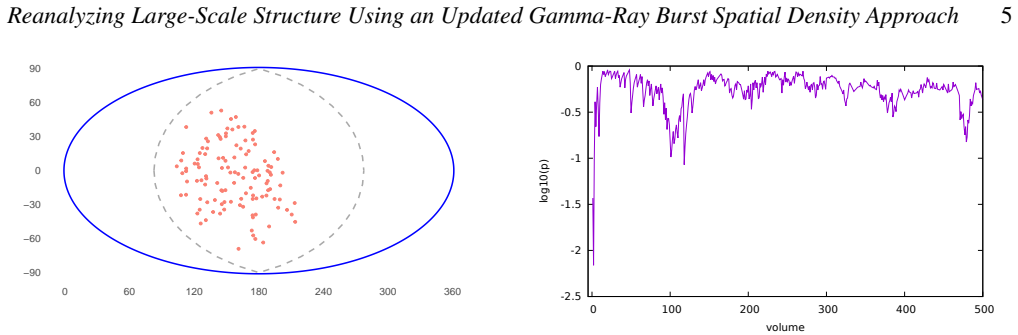
The sphere-based method applied to gamma-ray burst positions in three-dimensional space detects only one deviation from isotropy in each galactic hemisphere: a small southern group of 4-5 closely spaced bursts, two of which occurred within five months, and a large northern group of approximately 125 bursts corresponding to the Hercules-Corona Borealis Great Wall. No other deviations from homogeneity are identified in the spatial distribution. This result indicates that large-scale density increases in the gamma-ray burst distribution do not necessarily violate the cosmological principle.
What carries the argument
Sphere-based counting in 3D space to test regularities, applied separately to each galactic hemisphere
Load-bearing premise
The gamma-ray burst catalog is sufficiently complete and free of directional selection biases so sphere counts reflect true clustering rather than artifacts.
What would settle it
Applying the identical sphere method to a larger gamma-ray burst catalog with uniform sky coverage that either erases the northern deviation or uncovers additional clusters of similar size would test whether only one deviation exists per hemisphere.
Figures




read the original abstract
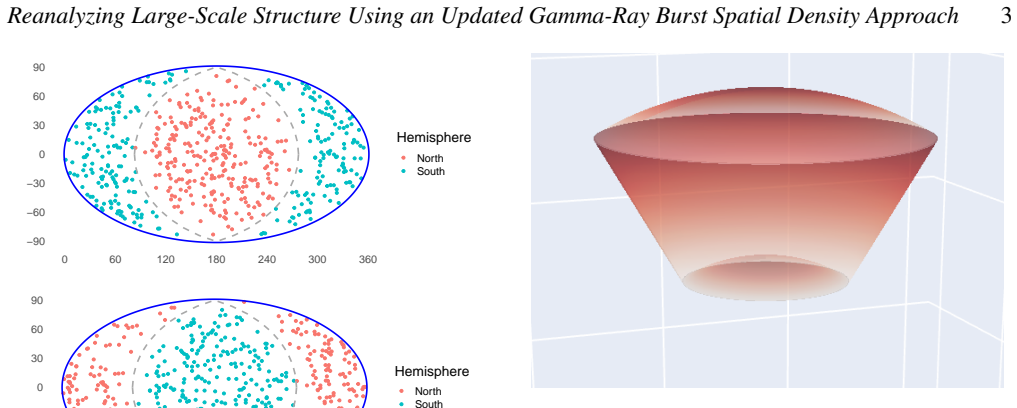
In the past few decades, large universal structures have been found that challenge the homogeneity and isotropy expected in standard cosmological models. This study examines burst clustering in both galactic hemispheres using a recently developed methodology, using spheres in 3D space for testing regularities. Using our new method in both hemisphere we find only one deviation from isotropy. A small one in the Southern and a huge one in the Northern hemisphere. This itself suggests that the two deviations do not likely to come from statistical fluctuation. The northern huge group contains app. 125 gamma-ray bursts (GRBs) corresponds with the so - called Hercules-Corona Borealis Great Wall. The southern group contains 4-5 GRBs locating very close to each other. Two of them (GRB050822 and GRB050318) are close not just in redshift and the angular position but they are very close in observing time (5 months). We concluded that the third important result of this work that this method could not find other overdensity deviation from homogeneity in the GRBs spatial distribution. We have shown that the large-scale density increase in the spatial distribution of gamma-ray bursts does not necessarily violate the cosmological principle.
Editorial analysis
A structured set of objections, weighed in public.
Referee Report
Summary. The manuscript reanalyzes the spatial distribution of gamma-ray bursts (GRBs) using a sphere-based counting method in 3D space to test for deviations from isotropy in the northern and southern galactic hemispheres. The authors report finding only one deviation in each hemisphere: a small overdensity in the south consisting of 4-5 GRBs and a large one in the north with ~125 GRBs identified as the Hercules-Corona Borealis Great Wall. They conclude that these density increases do not necessarily violate the cosmological principle.
Significance. If the results hold after addressing methodological details, the paper adds to discussions on large-scale cosmic structures by providing an alternative analysis of GRB clustering that supports consistency with homogeneity and isotropy on large scales. It highlights the potential of updated spatial density approaches for such studies. However, the current presentation lacks sufficient quantitative support to fully assess the robustness of the no-other-deviations claim.
major comments (3)
- The choice of sphere radius and density threshold is not specified or justified, despite being free parameters that control the detection of overdensities. This directly affects the central claim of finding 'only one deviation' per hemisphere, as different choices could alter the number of identified structures.
- No statistical significance, error analysis, or sample size details are provided for the reported overdensities (e.g., the ~125 GRBs in the north or 4-5 in the south). Without these, it is impossible to determine if the deviations are significant or consistent with statistical fluctuations.
- The analysis assumes the GRB catalog is complete and free from directional selection biases, but no completeness corrections, exposure maps, or null tests against biased mock catalogs are presented. This is load-bearing for interpreting the overdensities as cosmological rather than observational artifacts.
minor comments (2)
- There are grammatical issues, e.g., 'do not likely to come from statistical fluctuation' should be 'are not likely to come from statistical fluctuations' and 'app.' should be 'approximately'.
- The abstract lacks any mention of the total sample size, the specific GRB catalog used, or quantitative thresholds, making it difficult for readers to evaluate the findings at a glance.
Simulated Author's Rebuttal
We thank the referee for the careful reading and constructive major comments, which highlight areas where the presentation can be strengthened. We address each point below and will revise the manuscript accordingly to provide the requested quantitative details and clarifications while preserving the core findings from the sphere-based 3D analysis.
read point-by-point responses
-
Referee: The choice of sphere radius and density threshold is not specified or justified, despite being free parameters that control the detection of overdensities. This directly affects the central claim of finding 'only one deviation' per hemisphere, as different choices could alter the number of identified structures.
Authors: The referee is correct that explicit values and justification for the sphere radius and density threshold were omitted from the manuscript text. These parameters are defined within the recently developed sphere-counting methodology referenced in the paper, with the radius selected to probe scales comparable to known large structures (~300 Mpc) and the threshold set to identify statistically notable deviations from the mean density in the GRB sample. In the revised manuscript we will add a methods subsection stating the precise values used, the rationale tied to the GRB redshift distribution and sample characteristics, and results from sensitivity tests varying the radius by ±50 Mpc to confirm that the reported northern (~125 GRBs) and southern (4-5 GRBs) overdensities remain the only deviations detected. revision: yes
-
Referee: No statistical significance, error analysis, or sample size details are provided for the reported overdensities (e.g., the ~125 GRBs in the north or 4-5 in the south). Without these, it is impossible to determine if the deviations are significant or consistent with statistical fluctuations.
Authors: We agree that formal statistical support is necessary to substantiate the claim of only one deviation per hemisphere. The manuscript reports approximate counts for the known Hercules-Corona Borealis Great Wall in the north and the compact southern group, but does not include error bars, p-values, or Monte Carlo assessments. The revised version will incorporate a dedicated statistical analysis section using Poisson-based counting statistics and randomized isotropic mock catalogs to quantify the significance of these overdensities. We will also specify the total number of GRBs with measured redshifts employed in each hemisphere and the redshift range, allowing readers to evaluate whether the findings exceed expected fluctuations. revision: yes
-
Referee: The analysis assumes the GRB catalog is complete and free from directional selection biases, but no completeness corrections, exposure maps, or null tests against biased mock catalogs are presented. This is load-bearing for interpreting the overdensities as cosmological rather than observational artifacts.
Authors: This is a substantive concern, as GRB catalogs can carry directional selection effects from satellite coverage and follow-up observations. The present analysis employs the standard public GRB catalog with redshifts under the assumption of sufficient completeness for a 3D spatial study, and the sphere-based method is intended to be less sensitive to purely angular biases than 2D projections. In revision we will expand the discussion to explicitly address potential selection effects and add a simple null test comparing the observed counts to isotropic random realizations. However, constructing full exposure maps and instrument-specific biased mocks lies outside the current scope and data resources; we will therefore include a clear limitations statement noting this and cautioning that the cosmological interpretation rests on the standard catalog assumptions. revision: partial
Circularity Check
Direct sphere-based counting applied to GRB catalog data with no definitional or fitted circularity.
full rationale
The paper's central procedure counts GRBs inside 3D spheres to test for deviations from isotropy in each galactic hemisphere, reporting one small southern overdensity (4-5 GRBs) and one large northern structure (~125 GRBs matching the Hercules-Corona Borealis Great Wall). These counts are direct tallies from catalog positions and redshifts rather than quantities obtained by fitting parameters to the same data and then predicting the same quantities. The interpretive claim that such density increases do not necessarily violate the cosmological principle follows from the empirical observation of only one deviation per hemisphere, without any self-referential equation or ansatz that reduces the reported result to its own inputs by construction. Although the methodology is described as recently developed and the catalog completeness assumption is noted as a potential external limitation, no load-bearing step in the derivation chain collapses to a self-citation, renaming, or tautological fit. The analysis therefore remains self-contained as an application of spatial counting.
Axiom & Free-Parameter Ledger
free parameters (1)
- sphere radius or density threshold
axioms (1)
- domain assumption Gamma-ray burst detections form an unbiased sample of the underlying large-scale matter distribution
Reference graph
Works this paper leans on
-
[1]
G., Horvath I., Rácz I., Toth L
Bagoly Z., 2025, Acta Polytechnica, 65, 9 Bagoly Z., Balazs L. G., Horvath I., Rácz I., Toth L. V ., Hakkila J., 2014, in Proceedings of Swift: 10 Years of Discovery (SWIFT
work page 2025
-
[2]
60, doi:10.22323/1.233.0060 Bagoly Z., Horvath I., Racz I
p. 60, doi:10.22323/1.233.0060 Bagoly Z., Horvath I., Racz I. I., Balázs L. G., Tóth L. V ., 2022, Universe, 8, 342 Balázs L. G., Bagoly Z., Hakkila J. E., Horvath I., Kóbori J., Rácz I. I., Tóth L. V ., 2015, MNRAS, 452, 2236 Balázs L. G., Rejt˝o L., Tusnády G., 2018, MNRAS, 473, 3169 Barthelmy S. D., et al., 2005, Space Sci. Rev., 120, 143 Bottaro S., C...
-
[3]
BP International, pp 103 – 111, doi:10.9734/bpi/cppsr/v8/11645f,https://hal.science/ hal-05238934 Eingorn M., 2016, ApJ, 825, 84 Euclid Collaboration et al., 2025, ArXiv, p. arXiv:2503.11621 Frontera F., 2024, Universe, 10, 260 Gehrels N., et al., 2004, ApJ, 611, 1005 Goldstein A., 2012, in Gamma-Ray Bursts 2012 Conference (GRB 2012). p. 82, doi:10.22323/...
discussion (0)
Sign in with ORCID, Apple, or X to comment. Anyone can read and Pith papers without signing in.