Recognition: unknown
Optical depth to reionization in a Universe with multiple inhomogeneous domains
Pith reviewed 2026-05-10 12:38 UTC · model grok-4.3
The pith
A multi-domain backreaction model fitted to supernova data yields a reionization optical depth closer to observations than the standard cosmological model.
A machine-rendered reading of the paper's core claim, the machinery that carries it, and where it could break.
Core claim
In a backreaction model consisting of multiple inhomogeneous domains characterized by a set of parameters, fitting those parameters to PantheonPlus+SH0ES supernova data produces τ_reion = 0.0581^{+0.0105}_{-0.0096} (68% confidence), which matches observational estimates more closely than the standard cosmological model while modestly reducing the Hubble tension.
What carries the argument
The Buchert averaging formalism applied to a spacetime model of multiple inhomogeneous domains, with parameters constrained by supernova luminosity distances to evaluate the optical depth to reionization.
If this is right
- The calculated optical depth to reionization aligns more closely with current observations than the standard model prediction.
- The model produces a modest reduction in the Hubble tension.
- These outcomes are achieved without invoking exotic or non-standard physics.
Where Pith is reading between the lines
- Inhomogeneity effects captured through averaging may simultaneously address discrepancies in both early-universe and late-universe observables.
- More precise future CMB polarization measurements could test the specific ionization history implied by the fitted domain parameters.
- The same multi-domain fitting approach could be applied to other observables sensitive to averaging, such as baryon acoustic oscillation scales.
Load-bearing premise
The backreaction parameters fitted to supernova luminosity distances alone correctly determine the reionization optical depth without additional free functions or adjustments to the ionization history.
What would settle it
A future precise measurement of τ_reion from CMB polarization data that lies well outside the 0.048-0.069 range, while the supernova constraints on the model parameters stay unchanged.
Figures


read the original abstract
We study the optical depth to reionization in a cosmological setting that includes backreaction from matter inhomogeneities, using the Buchert averaging formalism. We construct a spacetime model consisting of multiple inhomogeneous domains, hereafter referred to as the backreaction model, characterized by a set of parameters. We first examine how these parameters influence the computation of the optical depth to reionization, $\tau_{reion}$. Next, we carry out a Markov Chain Monte Carlo (MCMC) analysis based on the PantheonPlus+SH0ES Type Ia supernova sample to infer the best-fit values of the model parameters, and then use these to evaluate $\tau_{reion}$. We obtain $\tau_{reion} = 0.0581^{+0.0105}_{-0.0096}$ (68$\%$ confidence limits). This result indicates that, when PantheonPlus+SH0ES data are used to constrain the model parameters, our backreaction model yields a value of $\tau_{reion}$ that aligns more closely with observational estimates than the value predicted by the standard cosmological model. We further demonstrate that the backreaction model leads to a modest reduction of the Hubble tension, while avoiding the need for exotic or non-standard physics.
Editorial analysis
A structured set of objections, weighed in public.
Referee Report
Summary. The paper constructs a multi-domain backreaction model using the Buchert averaging formalism, fits its parameters via MCMC to the PantheonPlus+SH0ES Type Ia supernova sample, and reports that the resulting effective expansion history yields τ_reion = 0.0581^{+0.0105}_{-0.0096} (68% CL), closer to observational estimates than the standard ΛCDM value while also modestly reducing the Hubble tension.
Significance. If the low-redshift domain parameters remain valid when extrapolated to reionization epochs and the ionization history requires no additional corrections, the result would offer a purely gravitational explanation for the observed optical depth without exotic physics. The numerical MCMC analysis on real supernova data and the explicit parameter-to-τ_reion mapping are strengths that make the claim falsifiable in principle.
major comments (2)
- [MCMC analysis and τ_reion computation] The central claim requires that the best-fit domain parameters (obtained from luminosity distances at z ≲ 2.5) produce a modified H(z) that can be inserted into the standard optical-depth integral at z ~ 10–20. No evolution check or consistency test of the multi-domain construction is provided when the averaged scale factor is integrated backward to reionization redshifts (see the MCMC analysis and τ_reion evaluation steps described after the parameter-influence examination).
- [optical depth to reionization calculation] The optical depth is computed with an unchanged ionization history x_e(z) while only H(z) is modified by the backreaction parameters. The manuscript does not demonstrate that inhomogeneity-induced corrections to n_e or x_e remain negligible at reionization epochs, which is load-bearing for interpreting the reported τ_reion as a direct consequence of the fitted model.
minor comments (2)
- [abstract and methods] The abstract states that the model parameters are first examined for their influence on τ_reion before the MCMC step; a brief equation or flowchart showing the explicit mapping from domain parameters to the integrand of τ_reion would improve clarity.
- [results] The reported confidence limits on τ_reion are given to four decimal places; it would be useful to state whether these uncertainties propagate only from the supernova fit or also include any modeling assumptions about the ionization history.
Simulated Author's Rebuttal
We thank the referee for the careful and constructive review of our manuscript. The comments highlight important aspects of the extrapolation and assumptions in our analysis, which we address point by point below. We propose targeted revisions to strengthen the presentation and justification of our results.
read point-by-point responses
-
Referee: [MCMC analysis and τ_reion computation] The central claim requires that the best-fit domain parameters (obtained from luminosity distances at z ≲ 2.5) produce a modified H(z) that can be inserted into the standard optical-depth integral at z ~ 10–20. No evolution check or consistency test of the multi-domain construction is provided when the averaged scale factor is integrated backward to reionization redshifts (see the MCMC analysis and τ_reion evaluation steps described after the parameter-influence examination).
Authors: The Buchert-averaged multi-domain model yields effective equations for the domain scale factor a_D that are intended to describe the averaged cosmology across epochs. The parameters are constrained at low redshift but govern the evolution at all z via the averaged Friedmann-like equations. We acknowledge that an explicit consistency check of the backward integration was not included in the original manuscript. In the revised version, we will add a dedicated subsection (or appendix) that numerically integrates the averaged scale factor from z = 0 to z ≈ 20 using the MCMC best-fit parameters, confirming that the effective H(z) remains smooth, positive, and free of unphysical features such as divergences or violations of the effective energy conditions. This will directly support the insertion of the modified H(z) into the optical-depth integral. revision: yes
-
Referee: [optical depth to reionization calculation] The optical depth is computed with an unchanged ionization history x_e(z) while only H(z) is modified by the backreaction parameters. The manuscript does not demonstrate that inhomogeneity-induced corrections to n_e or x_e remain negligible at reionization epochs, which is load-bearing for interpreting the reported τ_reion as a direct consequence of the fitted model.
Authors: Our calculation modifies only the expansion history H(z) while retaining the standard x_e(z) parametrization used in Planck analyses. This follows from the effective nature of the backreaction model, which primarily alters global averaged dynamics rather than local microphysical ionization processes. We agree that the manuscript would benefit from an explicit statement of this assumption and an order-of-magnitude estimate of possible corrections. In the revision, we will add a paragraph discussing that the constrained backreaction parameters induce only percent-level shifts in the effective matter density; under the assumption of spatially averaged ionization, this implies sub-percent corrections to n_e at reionization redshifts. We will also note the limitation that a full coupling to radiative-transfer simulations lies outside the present scope, while emphasizing that the reported τ_reion difference arises principally from the modified H(z). revision: yes
Circularity Check
SN-fitted backreaction parameters determine the reported τ_reion value
specific steps
-
fitted input called prediction
[Abstract]
"we carry out a Markov Chain Monte Carlo (MCMC) analysis based on the PantheonPlus+SH0ES Type Ia supernova sample to infer the best-fit values of the model parameters, and then use these to evaluate τ_reion. We obtain τ_reion = 0.0581^{+0.0105}_{-0.0096} (68% confidence limits). This result indicates that, when PantheonPlus+SH0ES data are used to constrain the model parameters, our backreaction model yields a value of τ_reion that aligns more closely with observational estimates than the value predicted by the standard cosmological model."
The model parameters are fitted solely to supernova distance data that fix the effective expansion history; τ_reion is then computed directly from that same fitted history via the unchanged ionization integral. The reported numerical value and its claimed improvement are therefore outputs of the SN fit rather than an independent first-principles result.
full rationale
The paper constrains its multi-domain model exclusively via MCMC on low-z PantheonPlus+SH0ES luminosity distances, then inserts the resulting H(z) into the standard optical-depth integral. This produces a τ_reion value that is statistically determined by the SN fit rather than derived independently; the claim of closer alignment with observations therefore inherits the fit's assumptions without separate high-z validation. No self-definitional equations or load-bearing self-citations appear, keeping the circularity moderate.
Axiom & Free-Parameter Ledger
free parameters (1)
- domain parameters
axioms (1)
- domain assumption Buchert averaging formalism correctly captures backreaction effects on the optical depth integral
Reference graph
Works this paper leans on
-
[1]
lensing”) and external data “ext
ΛCDM model: The ΛCDM model is the current standard framework of cosmology. It assumes a homogeneous and isotropic Universe described by the FLRW metric, with dynamics governed by General Relativity. The energy budget consists of radiation, baryonic matter, cold dark matter, and a cosmological constant Λ that drives late-time acceleration. The Hubble param...
2018
-
[2]
M is the fiducial absolute magnitude of an SN Ia.δ µ−bias is the bias correction derived from simulations needed to account for selection effects and other issues in discovery
in this analysis. M is the fiducial absolute magnitude of an SN Ia.δ µ−bias is the bias correction derived from simulations needed to account for selection effects and other issues in discovery. In this analysis, we have also included M(Eq. 41), the fiducial magnitude of SN Ia, as one of the parameters. The parametersMandH 0 are degenerate when analyzing ...
-
[3]
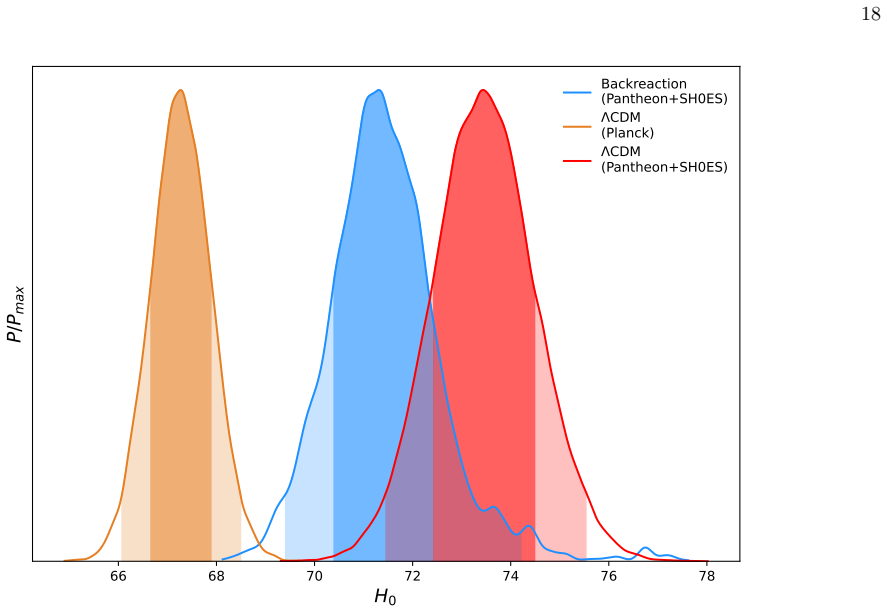
for the Planck PR3 dataset and the ΛCDM cosmological model, whereH0 is calculated using the TT, TE,EE+lowE method. (ii) is reported in [14] for ΛCDM model using PantheonPlus+SH0ES dataset. (iii) is calculated here in this study for our backreaction model and PantheonPlus+SH0ES dataset. These quantities were then plotted in Fig. 8. In Fig. 8, the tension b...
-
[4]
Planck Collaboration, Aghanim, N., Akrami, Y.,et al., A&A641, A6 (2020)
2020
-
[5]
Scolnic, D
D. Scolnic, D. Brout, A. Carr,et al., The Astrophysical Journal938, 113 (2022)
2022
-
[6]
Suzukiet al., The Astrophysical Journal746, 85 (2012)
N. Suzukiet al., The Astrophysical Journal746, 85 (2012)
2012
-
[7]
Perivolaropoulos and F
L. Perivolaropoulos and F. Skara, New Astronomy Reviews95, 101659 (2022). 19
2022
-
[8]
A. Del Popolo and M. Le Delliou, Galaxies5, 10.3390/galaxies5010017 (2017)
-
[9]
Abdalla, G
E. Abdalla, G. F. Abell´ an, A. Aboubrahim,et al., Journal of High Energy Astrophysics34, 49 (2022)
2022
-
[10]
Di Valentino, Universe8(2022) no.8, 399 doi:10.3390/universe8080399
E. Di Valentino, Universe8, 10.3390/universe8080399 (2022)
-
[11]
Di Valentino, J
E. Di Valentino, J. L. Said, A. Riess,et al., Physics of the Dark Universe49, 101965 (2025)
2025
-
[12]
Perivolaropoulos and F
L. Perivolaropoulos and F. Skara, New Astronomy Reviews95, 101659 (2022)
2022
-
[13]
Di Valentino, O
E. Di Valentino, O. Mena, S. Pan,et al., Classical and Quantum Gravity38, 153001 (2021)
2021
-
[14]
J.-P. Hu and F.-Y. Wang, Universe9, 10.3390/universe9020094 (2023)
-
[15]
J. L. Cervantes-Cota, S. Galindo-Uribarri, and G. F. Smoot, Universe9, 10.3390/universe9120501 (2023)
-
[16]
Verde, N
L. Verde, N. Sch¨ oneberg, and H. Gil-Mar´ ın, Annual Review of Astronomy and Astrophysics62, 287 (2024)
2024
-
[17]
Brout, D
D. Brout, D. Scolnic, B. Popovic,et al., The Astrophysical Journal938, 110 (2022)
2022
-
[18]
A. G. Riess, W. Yuan, L. M. Macri,et al., The Astrophysical Journal Letters934, L7 (2022)
2022
-
[19]
F. S. Labini, N. L. Vasilyev, L. Pietronero, and Y. V. Baryshev, Europhysics Letters86, 49001 (2009)
2009
-
[20]
T. Buchert, A. A. Coley, H. Kleinert,et al., International Journal of Modern Physics D25, 1630007 (2016), https://doi.org/10.1142/S021827181630007X
-
[21]
Sylos Labini and L
F. Sylos Labini and L. Pietronero, Journal of Statistical Mechanics: Theory and Experiment2010, P11029 (2010)
2010
-
[22]
F. S. Labini, Classical and Quantum Gravity28, 164003 (2011)
2011
-
[23]
A. O. Verevkin, Y. L. Bukhmastova, and Y. V. Baryshev, Astronomy Reports55, 324 (2011)
2011
-
[24]
Kumar Aluri, P
P. Kumar Aluri, P. Cea, P. Chingangbam,et al., Classical and Quantum Gravity40, 094001 (2023)
2023
-
[25]
Wiegand, T
A. Wiegand, T. Buchert, and M. Ostermann, Monthly Notices of the Royal Astronomical Society443, 241 (2014)
2014
-
[26]
A. M. Lopez, R. G. Clowes, and G. M. Williger, Monthly Notices of the Royal Astronomical Society516, 1557 (2022)
2022
- [27]
- [28]
-
[29]
T. Sawala and M. Teeriaho, The giant arc – filament of figment? (2025), arXiv:2505.11072 [astro-ph.CO]
-
[30]
Wiegand and T
A. Wiegand and T. Buchert, Phys. Rev. D82, 023523 (2010)
2010
-
[31]
R¨ as¨ anen, Journal of Cosmology and Astroparticle Physics2006(11), 003
S. R¨ as¨ anen, Journal of Cosmology and Astroparticle Physics2006(11), 003
-
[32]
G. F. R. Ellis, Relativistic cosmology: Its nature, aims and problems, inGeneral Relativity and Gravitation: Invited Papers and Discussion Reports of the 10th International Conference on General Relativity and Gravitation, Padua, July 3–8, 1983, edited by B. Bertotti, F. de Felice, and A. Pascolini (Springer Netherlands, Dordrecht, 1984) pp. 215–288
1983
-
[33]
Futamase, Phys
T. Futamase, Phys. Rev. Lett.61, 2175 (1988)
1988
-
[34]
R. M. Zalaletdinov, General Relativity and Gravitation24, 1015 (1992)
1992
-
[35]
R. M. Zalaletdinov, General Relativity and Gravitation25, 673 (1993)
1993
-
[36]
Gasperini, G
M. Gasperini, G. Marozzi, F. Nugier, and G. Veneziano, Journal of Cosmology and Astroparticle Physics2011(07), 008
-
[37]
Buchert, General Relativity and Gravitation32, 105 (2000)
T. Buchert, General Relativity and Gravitation32, 105 (2000)
2000
-
[38]
Buchert, General Relativity and Gravitation33, 1381 (2001)
T. Buchert, General Relativity and Gravitation33, 1381 (2001)
2001
-
[39]
A. A. Coley, N. Pelavas, and R. M. Zalaletdinov, Phys. Rev. Lett.95, 151102 (2005)
2005
-
[40]
Korzy´ nski, Classical and Quantum Gravity27, 105015 (2010)
M. Korzy´ nski, Classical and Quantum Gravity27, 105015 (2010)
2010
-
[41]
Clifton, K
T. Clifton, K. Rosquist, and R. Tavakol, Phys. Rev. D86, 043506 (2012)
2012
-
[42]
Skarke, Phys
H. Skarke, Phys. Rev. D89, 043506 (2014)
2014
-
[43]
Buchert, M
T. Buchert, M. Carfora, G. F. R. Ellis,et al., Classical and Quantum Gravity32, 215021 (2015)
2015
-
[44]
Buchert, A
T. Buchert, A. A. Coley, H. Kleinert,et al., International Journal of Modern Physics D25, 1630007 (2016)
2016
-
[45]
R¨ as¨ anen, Journal of Cosmology and Astroparticle Physics2004(02), 003
S. R¨ as¨ anen, Journal of Cosmology and Astroparticle Physics2004(02), 003
-
[46]
D. L. Wiltshire, Dark energy without dark energy, inDark Matter in Astroparticle and Particle Physics, pp. 565–596
-
[47]
E. W. Kolb, S. Matarrese, and A. Riotto, New Journal of Physics8, 322 (2006)
2006
-
[48]
Koksbang, Journal of Cosmology and Astroparticle Physics2019(10), 036
S. Koksbang, Journal of Cosmology and Astroparticle Physics2019(10), 036
-
[49]
S. M. Koksbang, Monthly Notices of the Royal Astronomical Society: Letters498, L135 (2020)
2020
-
[50]
S. M. Koksbang, Phys. Rev. Lett.126, 231101 (2021)
2021
-
[51]
R¨ as¨ anen, Journal of Cosmology and Astroparticle Physics2008(04), 026
S. R¨ as¨ anen, Journal of Cosmology and Astroparticle Physics2008(04), 026
-
[52]
Bose and A
N. Bose and A. S. Majumdar, Monthly Notices of the Royal Astronomical Society: Letters418, L45 (2011)
2011
-
[53]
Bose and A
N. Bose and A. S. Majumdar, General Relativity and Gravitation45, 1971 (2013)
1971
-
[54]
Ali and A
A. Ali and A. Majumdar, Journal of Cosmology and Astroparticle Physics2017(01), 054
-
[55]
S. S. Pandey, A. Sarkar, A. Ali, and A. Majumdar, Journal of Cosmology and Astroparticle Physics2022(06), 021
-
[56]
S. S. Pandey, A. Sarkar, A. Ali, and A. S. Majumdar, The European Physical Journal C83, 435 (2023)
2023
-
[57]
Koksbang and S
S. Koksbang and S. Hannestad, Journal of Cosmology and Astroparticle Physics2016(01), 009
-
[58]
S. M. Koksbang, Phys. Rev. D106, 063514 (2022)
2022
-
[60]
S. M. Koksbang, Phys. Rev. Lett.130, 201003 (2023)
2023
-
[61]
S. M. Koksbang, Phys. Rev. D107, 103522 (2023)
2023
-
[62]
S. S. Pandey, A. Halder, and A. S. Majumdar, Phys. Rev. D110, 043531 (2024)
2024
-
[63]
Mukherjee, S
S. Mukherjee, S. S. Pandey, and A. S. Majumdar, Phys. Rev. D112, 063520 (2025)
2025
-
[64]
Extended Dark Energy analysis using DESI DR2 BAO measurements
K. Lodha, R. Calderon, W. L. Matthewson,et al., Extended dark energy analysis using desi dr2 bao measurements (2025), arXiv:2503.14743 [astro-ph.CO]. 20
work page internal anchor Pith review arXiv 2025
-
[65]
Son, Y.-W
J. Son, Y.-W. Lee, C. Chung,et al., Monthly Notices of the Royal Astronomical Society544, 975 (2025), https://academic.oup.com/mnras/article-pdf/544/1/975/65175128/staf1685.pdf
2025
-
[66]
Halder, S
A. Halder, S. S. Pandey, and A. Majumdar, Journal of Cosmology and Astroparticle Physics2023(08), 064
-
[67]
Giani, R
L. Giani, R. von Marttens, and R. Camilleri, Phys. Rev. Lett.135, 071004 (2025)
2025
-
[68]
R¨ as¨ anen, Journal of Cosmology and Astroparticle Physics2009(02), 011
S. R¨ as¨ anen, Journal of Cosmology and Astroparticle Physics2009(02), 011
-
[69]
R¨ as¨ anen, Journal of Cosmology and Astroparticle Physics2010(03), 018
S. R¨ as¨ anen, Journal of Cosmology and Astroparticle Physics2010(03), 018
-
[70]
S. M. Koksbang, Classical and Quantum Gravity36, 185004 (2019)
2019
-
[71]
Koksbang, Journal of Cosmology and Astroparticle Physics2020(11), 061
S. Koksbang, Journal of Cosmology and Astroparticle Physics2020(11), 061
-
[72]
Kasai and T
M. Kasai and T. Futamase, Progress of Theoretical and Experimental Physics2019, 073E01 (2019), https://academic.oup.com/ptep/article-pdf/2019/7/073E01/28914425/ptz066.pdf
2019
-
[73]
H. J. Macpherson, P. D. Lasky, and D. J. Price, The Astrophysical Journal Letters865, L4 (2018)
2018
-
[74]
Miura and T
T. Miura and T. Tanaka, Journal of Cosmology and Astroparticle Physics2024(05), 126
-
[75]
San Mart´ ın and C
M. San Mart´ ın and C. Rubio, Annals of Physics458, 169444 (2023)
2023
-
[76]
Bolejko, Phys
K. Bolejko, Phys. Rev. D97, 103529 (2018)
2018
-
[77]
Heinesen and T
A. Heinesen and T. Buchert, Classical and Quantum Gravity37, 164001 (2020)
2020
-
[78]
Ben-Dayan, R
I. Ben-Dayan, R. Durrer, G. Marozzi, and D. J. Schwarz, Phys. Rev. Lett.112, 221301 (2014)
2014
-
[79]
L. M. Griffiths, D. Barbosa, and A. R. Liddle, Monthly Notices of the Royal Astronomical Society308, 854 (1999), https://academic.oup.com/mnras/article-pdf/308/3/854/2962118/308-3-854.pdf
1999
-
[80]
Wolz, Kevin, Krachmalnicoff, Nicoletta, and Pagano, Luca, A&A676, A30 (2023)
2023
-
[81]
Pagano, L., Delouis, J.-M., Mottet, S.,et al., A&A635, A99 (2020)
2020
discussion (0)
Sign in with ORCID, Apple, or X to comment. Anyone can read and Pith papers without signing in.