Radiative cooling effects on black hole hot accretion flows around the sub-Bondi radius
Pith reviewed 2026-05-10 12:37 UTC · model grok-4.3
The pith
Radiative cooling suppresses winds and reduces accretion in black hole hot flows at sub-Bondi radii.
A machine-rendered reading of the paper's core claim, the machinery that carries it, and where it could break.
Core claim
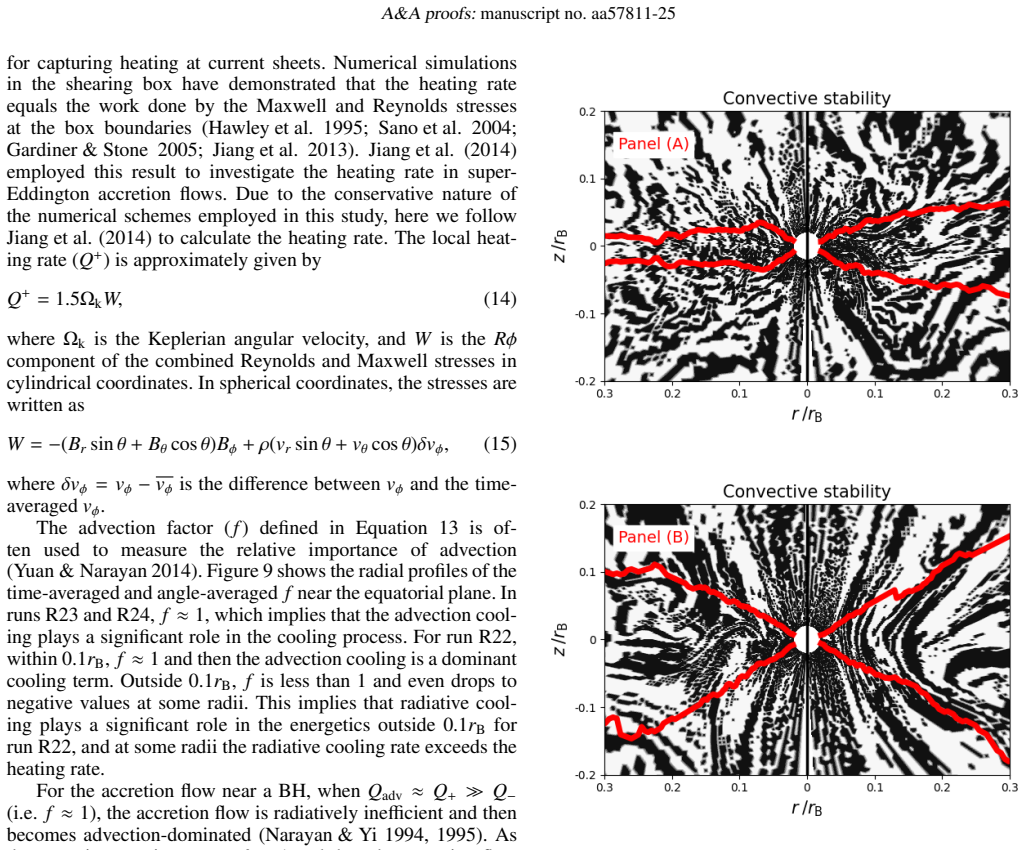
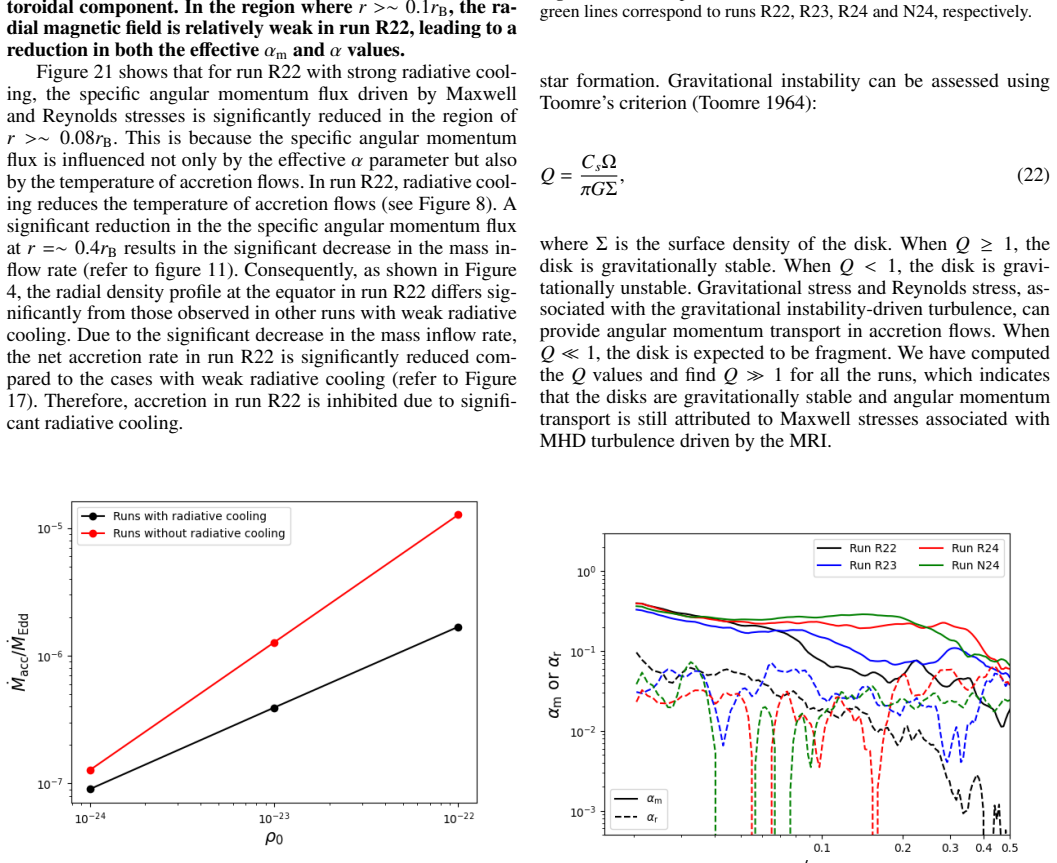
Two-dimensional MHD simulations show that radiative cooling strengthens as mass accretion rate rises, reducing disk thickness while keeping the accretion flows marginally stable in convective stability, with roughly 55-62 percent of the disk satisfying the Hoiland criterion. In weak-cooling runs winds account for most of the inward decrease in mass inflow rate, but in strong-cooling runs wind mass outflow drops sharply and the decrease is instead carried by turbulence driven by magnetorotational instability and convection. The central result is that radiative cooling has the potential to suppress accretion processes and reduce the power of winds.
What carries the argument
Two-dimensional magnetohydrodynamic simulations that include an approximate radiative cooling function and compare weak versus strong cooling regimes by measuring mass inflow and outflow rates together with disk thickness.
If this is right
- Winds dominate the inward decrease of mass inflow rate only when radiative cooling remains weak.
- Strong radiative cooling sharply reduces the mass outflow rate carried by winds.
- Turbulence from magnetorotational instability and convection becomes the main cause of the radial drop in mass inflow rate once cooling is strong.
- Disk thickness decreases steadily as radiative cooling intensifies.
- The accretion flows remain marginally convectively stable across the full range of cooling strengths examined.
Where Pith is reading between the lines
- Accretion models that omit radiative cooling at these radii are likely to overestimate wind power and its feedback effects on the host galaxy or cluster gas.
- The marginal convective stability found here may change once three-dimensional geometry allows additional modes of instability.
- Observational searches for wind signatures in X-ray binaries or low-luminosity AGN should expect weaker outflows at higher mass supply rates near the Bondi radius.
Load-bearing premise
That two-dimensional MHD simulations with an approximate cooling function accurately represent the three-dimensional, radiatively coupled flow structure at sub-Bondi radii.
What would settle it
Three-dimensional MHD simulations with self-consistent radiative transfer that measure wind mass outflow rates and the radial profile of mass inflow rate at the same accretion rates and radii; if the three-dimensional runs show much stronger winds or different stability fractions than the two-dimensional results, the reported suppression effect does not hold.
Figures






read the original abstract
It is difficult to implement numerical simulations on a region extending from the vicinity of a black hole to the Bondi radius. Most previous numerical simulations have primarily concentrated on the region close to the black hole. They found that strong winds can be generated in the hot accretion flows near the black hole, and that radiative cooling significantly affects the strength of these winds. However, the effects of radiative cooling on the production and properties of winds around the Bondi radius remain unclear. In this paper, we perform two-dimensional magnetohydrodynamic simulations to study the impact of radiative cooling on the dynamics and wind production in hot accretion flows around the sub-Bondi radius. As the increase of mass accretion rate, radiative cooling gradually becomes strong, resulting in a reduction in the thickness of the accretion disk (defined as the accretion flows within the density scale height). Based on the H{\o}iland criterion, we find that within the accretion disk, the region of convective stability accounts for $\sim$ 55 - 62 %, and therefore the accretion flows are marginally stable in convective stability. In the runs with weak radiative cooling, the winds play a significant role in the inward decrease of the mass inflow rate. In the runs with strong radiative cooling, the mass outflow rate of winds is significantly reduced and then the inward decrease of the mass inflow rate is mainly attributed to turbulence driven by magnetorotational instability and convection. Radiative cooling has the potential to suppress accretion processes and reduce the power of winds.
Editorial analysis
A structured set of objections, weighed in public.
Referee Report
Summary. The manuscript presents two-dimensional MHD simulations of hot accretion flows around black holes at sub-Bondi radii. It reports that increasing the mass accretion rate strengthens radiative cooling, which reduces disk thickness (defined within the density scale height). The flows are found to be marginally convectively stable according to the Hóiland criterion, with 55-62% of the disk region convectively stable. In weak-cooling runs, winds dominate the inward decline of mass inflow rate; in strong-cooling runs, this decline is instead driven primarily by MRI and convection-induced turbulence. The central conclusion is that radiative cooling suppresses accretion and reduces wind power.
Significance. If the trends hold, the work fills a gap in understanding cooling effects at larger radii than typically simulated, with implications for black-hole feeding and wind feedback models. The controlled 2D runs with varying accretion rate to tune cooling strength provide a clean isolation of effects and direct outputs from time-dependent simulations, which is a methodological strength.
major comments (3)
- [§2] §2 (numerical methods): The cooling function is described only as 'approximate' with no explicit functional form, normalization, or coupling details to local density/temperature. This is load-bearing for the weak-vs-strong cooling distinction that drives the reported shift from wind-dominated to turbulence-dominated mass-flux decline.
- [Results section] Results section (mass inflow/outflow analysis): No resolution studies, convergence tests, or error bars are reported on the mass inflow/outflow rates or the 55-62% convective-stability fraction. The central claims rest on quantitative trends from these unvalidated simulation outputs.
- [Discussion] Discussion of convective stability and winds: The Hóiland criterion is applied only to time-averaged 2D data, with no assessment of how fully developed 3D MRI turbulence or altered convective cell aspect ratios would affect outflow rates and the claimed wind suppression. This dimensionality limitation directly impacts the headline result on reduced wind power.
minor comments (2)
- [Abstract] Abstract: The phrasing 'marginally stable in convective stability' is imprecise and should be clarified.
- The manuscript would benefit from explicit statements of the cooling-function implementation and any parameter values used for the 'weak' and 'strong' regimes to aid reproducibility.
Simulated Author's Rebuttal
We thank the referee for the constructive and detailed comments. We address each major point below and have revised the manuscript to improve clarity and address the concerns raised.
read point-by-point responses
-
Referee: §2 (numerical methods): The cooling function is described only as 'approximate' with no explicit functional form, normalization, or coupling details to local density/temperature. This is load-bearing for the weak-vs-strong cooling distinction that drives the reported shift from wind-dominated to turbulence-dominated mass-flux decline.
Authors: We agree that the cooling function description requires greater specificity. In the revised manuscript we will explicitly provide the functional form of the cooling rate (an approximation to bremsstrahlung cooling), its normalization constant, and the precise manner in which it is coupled to the local density and temperature in §2. This addition will clarify the distinction between the weak- and strong-cooling regimes and the resulting change in mass-flux behavior. revision: yes
-
Referee: Results section (mass inflow/outflow analysis): No resolution studies, convergence tests, or error bars are reported on the mass inflow/outflow rates or the 55-62% convective-stability fraction. The central claims rest on quantitative trends from these unvalidated simulation outputs.
Authors: We acknowledge the absence of explicit convergence tests and error bars. While the simulations were performed at resolutions standard for 2D MHD accretion studies, we will add a dedicated paragraph on numerical resolution in the revised results section. We will also report error bars on the mass inflow/outflow rates and the convective-stability fraction, derived from the temporal standard deviation during the quasi-steady phase of each run. These additions will better support the quantitative trends presented. revision: partial
-
Referee: Discussion of convective stability and winds: The Hóiland criterion is applied only to time-averaged 2D data, with no assessment of how fully developed 3D MRI turbulence or altered convective cell aspect ratios would affect outflow rates and the claimed wind suppression. This dimensionality limitation directly impacts the headline result on reduced wind power.
Authors: We recognize the inherent limitations of two-dimensional simulations. The application of the Hóiland criterion to time-averaged 2D data indicates marginal convective stability, but fully developed 3D MRI turbulence could alter convective cell aspect ratios and outflow rates. In the revised discussion we will expand the caveats on dimensionality, note that the qualitative suppression of wind power with increasing cooling remains robust within the 2D framework, and discuss how 3D effects might quantitatively modify the results while remaining consistent with the controlled parameter study performed here. revision: partial
- A full quantitative assessment of how fully developed 3D MRI turbulence and altered convective cell aspect ratios affect outflow rates and wind suppression would require new three-dimensional simulations, which are beyond the scope of the present revision.
Circularity Check
No circularity: results are direct simulation outputs with no fitted predictions or self-referential derivations
full rationale
The paper reports outcomes from 2D MHD simulations of hot accretion flows with an approximate radiative cooling function. Claims about disk thickness reduction, convective stability fractions (55-62% via Hoiland criterion), wind power suppression, and shifts in mass inflow decline mechanisms are presented as direct numerical results rather than analytic derivations or predictions. No equations, parameter fits, or self-citations are shown that reduce the central claims to inputs by construction. The derivation chain is therefore self-contained as a set of time-dependent simulation experiments.
Axiom & Free-Parameter Ledger
free parameters (2)
- mass accretion rate
- cooling function normalization
axioms (2)
- standard math Ideal MHD equations govern the flow
- domain assumption Radiative cooling can be approximated by a local cooling function
Reference graph
Works this paper leans on
-
[1]
A., Chen, X., Kato, S., Lasota, J.-P., & Regev, O
Abramowicz, M. A., Chen, X., Kato, S., Lasota, J.-P., & Regev, O. 1995, ApJ, 438, L37
work page 1995
- [2]
-
[3]
Balbus, S. A. & Hawley, J. F. 1998, in American Institute of Physics Conference
work page 1998
- [4]
-
[5]
Begelman, M. C. 2012, MNRAS, 420, 2912
work page 2012
-
[6]
Begelman, M. C. & Meier, D. L. 1982, ApJ, 253, 873
work page 1982
-
[7]
Blandford, R. D. & Payne, D. G. 1982, MNRAS, 199, 883
work page 1982
- [8]
- [9]
- [10]
-
[11]
Emsellem, E., Cappellari, M., Krajnovi´c, D., et al. 2011, MNRAS, 414, 888
work page 2011
-
[12]
Fragile, P. C. & Meier, D. L. 2009, ApJ, 693, 771
work page 2009
- [13]
-
[14]
Gardiner, T. A. & Stone, J. M. 2005, in American Institute of Physics Confer- ence Series, V ol. 784, Magnetic Fields in the Universe: From Laboratory and Stars to Primordial Structures., ed. E. M. de Gouveia dal Pino, G. Lugones, & A. Lazarian (AIP), 475–488
work page 2005
-
[15]
Han, J. L. 2017, ARA&A, 55, 111
work page 2017
-
[16]
Hawley, J. F. & Balbus, S. A. 2002, ApJ, 573, 738
work page 2002
- [17]
- [18]
-
[19]
Hawley, J. F., Guan, X., & Krolik, J. H. 2011, ApJ, 738, 84
work page 2011
-
[20]
Hawley, J. F., Richers, S. A., Guan, X., & Krolik, J. H. 2013, ApJ, 772, 102
work page 2013
-
[21]
Ho, L. C. 2008, ARA&A, 46, 475
work page 2008
- [22]
-
[23]
Igumenshchev, I. V . & Abramowicz, M. A. 1999, MNRAS, 303, 309
work page 1999
-
[24]
Igumenshchev, I. V . & Abramowicz, M. A. 2000, ApJS, 130, 463
work page 2000
-
[25]
Inayoshi, K., Ichikawa, K., Ostriker, J. P., & Kuiper, R. 2019, MNRAS, 486, 5377
work page 2019
-
[26]
Inayoshi, K., Ostriker, J. P., Haiman, Z., & Kuiper, R. 2018, MNRAS, 476, 1412
work page 2018
- [27]
- [28]
- [29]
- [30]
- [31]
- [32]
-
[33]
Mignone, A., Bodo, G., Massaglia, S., et al. 2007, ApJS, 170, 228
work page 2007
- [34]
-
[35]
Mosallanezhad, A., Bu, D.-F., ˇCemelji´c, M., et al. 2022, ApJ, 939, 12
work page 2022
-
[36]
Narayan, R., Igumenshchev, I. V ., & Abramowicz, M. A. 2000, ApJ, 539, 798
work page 2000
-
[37]
Narayan, R., S˛ adowski, A., Penna, R. F., & Kulkarni, A. K. 2012, MNRAS, 426, 3241
work page 2012
-
[38]
Narayan, R. & Yi, I. 1994, ApJ, 428, L13
work page 1994
-
[39]
Narayan, R. & Yi, I. 1995, ApJ, 444, 231 Paczy´nsky, B. & Wiita, P. J. 1980, A&A, 88, 23
work page 1995
-
[40]
F., Kulkarni, A., & Narayan, R
Penna, R. F., Kulkarni, A., & Narayan, R. 2013, A&A, 559, A116
work page 2013
-
[41]
Rees, M. J., Begelman, M. C., Blandford, R. D., & Phinney, E. S. 1982, Nature, 295, 17
work page 1982
-
[42]
Sano, T., Inutsuka, S.-i., Turner, N. J., & Stone, J. M. 2004, ApJ, 605, 321
work page 2004
-
[43]
Stone, J. M. & Pringle, J. E. 2001, MNRAS, 322, 461
work page 2001
-
[44]
Stone, J. M., Pringle, J. E., & Begelman, M. C. 1999, MNRAS, 310, 1002
work page 1999
-
[45]
Tchekhovskoy, A., Narayan, R., & McKinney, J. C. 2011, MNRAS, 418, L79
work page 2011
- [46]
-
[47]
Wang, Q. D., Nowak, M. A., Markoff, S. B., et al. 2013, Science, 341, 981
work page 2013
- [48]
- [49]
- [50]
- [51]
-
[52]
Yuan, F. & Li, M. 2011, ApJ, 737, 23
work page 2011
- [53]
- [54]
discussion (0)
Sign in with ORCID, Apple, or X to comment. Anyone can read and Pith papers without signing in.