Edge-Side Residual Timing and Frequency Control for Software-Defined Ground Stations in 5G NTN Uplinks
Pith reviewed 2026-05-10 11:50 UTC · model grok-4.3
The pith
An edge-side residual timing and frequency loop at the software-defined ground station can maintain the 5G NTN uplink in an NR-feasible regime after UE-side geometric pre-compensation under LEO dynamics.
A machine-rendered reading of the paper's core claim, the machinery that carries it, and where it could break.
Core claim
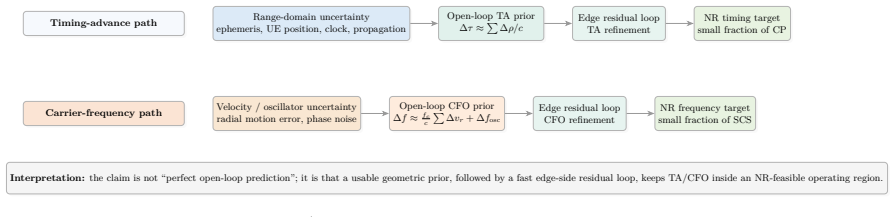
Once UE-side geometric pre-compensation supplies a coarse timing and frequency prior, an edge-side residual TA and CFO control loop at the software-defined ground station can keep the uplink inside an NR-feasible operating region under rapid LEO dynamics. Hardware-in-the-loop runs show mean RTT falling from 70.51 ms to 32.84 ms, artifact goodput rising from 80 Mbps to 196 Mbps, residual TA P95 held at 0.49 µs, and residual CFO P95 kept between 76 Hz and 77 Hz across four ground-station locations, all under the assumptions retained in the March 2026 HIL artifact.
What carries the argument
The edge-side residual timing-advance and carrier-frequency-offset control loop, which operates at the software-defined ground station after the UE has applied its geometric pre-compensation.
If this is right
- The SDGS uplink remains inside a more stable NR-feasible operating regime than the reference configuration without the edge loop.
- Mean round-trip time drops by roughly half in the steady-state tracking interval.
- Artifact-level goodput more than doubles within the retained Layer-3 transport mapping.
- Residual timing and frequency errors stay bounded across different ground-station locations.
Where Pith is reading between the lines
- The architecture could be combined with existing 5G base-station hardware to support mixed terrestrial and non-terrestrial traffic on the same edge platform.
- Real-time adaptation of the residual-loop gains might further tighten error bounds when LEO dynamics change rapidly.
- The same edge placement could be tested for downlink synchronization or for joint timing-frequency-power control.
- Absence of a cloud-loop benchmark leaves open whether the latency and goodput gains are unique to the edge location or would appear under any low-latency controller.
Load-bearing premise
The March 2026 hardware-in-the-loop setup accurately reproduces real LEO satellite dynamics and the user equipment's geometric pre-compensation supplies a sufficiently accurate coarse prior.
What would settle it
A field measurement on an actual LEO pass in which residual TA exceeds 0.5 µs or residual CFO exceeds 80 Hz while the edge loop is active would falsify the claim that the loop keeps the uplink inside an NR-feasible regime.
Figures

read the original abstract
This paper studies a ground-segment implementation problem in 5G non-terrestrial networks (NTN): once UE-side geometric pre-compensation has produced a coarse timing/frequency prior, can an edge-side residual loop keep the uplink inside an NR-feasible operating region under rapid LEO dynamics? We examine this question with a software-defined ground station (SDGS) design that keeps the coarse prior at the UE and closes the residual timing-advance (TA) / carrier-frequency-offset (CFO) loop at the ground-station edge. This paper takes a systems-and-control view rather than proposing a full-stack intelligent architecture. Its evidence base consists of a March 2026 hardware-in-the-loop (HIL) campaign and a companion uncertainty analysis. The HIL campaign includes same-window reference runs collected on the same platform with edge residual control disabled, but it does not include a cloud-loop benchmark. The placement claim is therefore architectural and control-oriented rather than a head-to-head cloud-versus-edge proof. In the Shenzhen steady-state tracking interval, the edge-controlled mode lowers mean RTT from 70.51 +/- 2.34 ms to 32.84 +/- 2.56 ms and, within the retained Layer-3 transport mapping, improves artifact-level goodput from 80.14 +/- 0.14 Mbps to 196.04 +/- 1.87 Mbps relative to that reference configuration. Across four ground-station locations, the closed-loop controller keeps residual TA P95 at 0.49 us and residual CFO P95 within 76-77 Hz. Together with the uncertainty analysis, these observations support a bounded claim: an edge-side residual timing/frequency loop can keep the SDGS uplink in a more stable NR-feasible operating regime under the assumptions retained in the current HIL artifact.
Editorial analysis
A structured set of objections, weighed in public.
Referee Report
Summary. The paper claims that, after UE-side geometric pre-compensation supplies a coarse timing/frequency prior, an edge-side residual TA/CFO control loop at a software-defined ground station can keep the 5G NTN uplink inside an NR-feasible operating regime under LEO dynamics. Evidence comes from a March 2026 HIL campaign with same-window disabled-control references, reporting RTT reduction from 70.51 ± 2.34 ms to 32.84 ± 2.56 ms, goodput increase to 196.04 ± 1.87 Mbps, residual TA P95 of 0.49 µs, and CFO P95 of 76-77 Hz across four locations, plus an uncertainty analysis; the claim is explicitly scoped to the retained HIL assumptions and is architectural rather than a cloud-versus-edge proof.
Significance. If the HIL results generalize, the work supplies concrete, statistically reported evidence that edge-side residual control can stabilize NTN uplinks with lower latency and higher goodput than a no-control baseline. Strengths include the use of same-window reference runs on the same platform, reporting of means, standard deviations, and P95 values, and the companion uncertainty analysis; these elements make the quantitative claims more credible and directly usable for ground-station design in 5G NTN.
major comments (2)
- [HIL campaign section] HIL campaign section: the bounded central claim rests on unstated modeling assumptions about how the March 2026 HIL setup reproduces LEO dynamics (Doppler, propagation delay variation, satellite motion). These assumptions must be explicitly enumerated and justified, because they directly determine whether the observed residual bounds (TA P95 0.49 µs, CFO P95 76-77 Hz) remain NR-feasible outside the artifact.
- [Abstract and placement discussion] Abstract and placement discussion: while the paper correctly notes the absence of a cloud-loop benchmark and scopes the claim as architectural, the preference for edge-side placement would be more convincing if the manuscript added a short qualitative analysis of cloud-loop latency implications (e.g., round-trip control delay under typical NTN backhaul), even without new experiments.
minor comments (2)
- [Results tables/figures] Results tables/figures: the goodput numbers are reported “within the retained Layer-3 transport mapping”; a one-sentence clarification of what that mapping is and why it does not alter the interpretation of the edge-control gains would improve readability.
- [Notation consistency] Notation consistency: ensure that SDGS, TA, CFO, and NR-feasible are defined at first use and used uniformly; a small glossary or acronym table would help readers from adjacent fields.
Simulated Author's Rebuttal
We thank the referee for the constructive comments, which help clarify the scope and strengthen the presentation of our HIL results. We address each major comment below and will revise the manuscript accordingly.
read point-by-point responses
-
Referee: [HIL campaign section] HIL campaign section: the bounded central claim rests on unstated modeling assumptions about how the March 2026 HIL setup reproduces LEO dynamics (Doppler, propagation delay variation, satellite motion). These assumptions must be explicitly enumerated and justified, because they directly determine whether the observed residual bounds (TA P95 0.49 µs, CFO P95 76-77 Hz) remain NR-feasible outside the artifact.
Authors: We agree that the modeling assumptions underlying the HIL campaign must be made explicit. In the revised manuscript we will add a dedicated subsection within the HIL campaign section that enumerates and justifies the assumptions on Doppler shift, propagation delay variation, and satellite motion. Each assumption will be tied to the hardware constraints of the March 2026 setup and to the bounded claim, thereby clarifying the conditions under which the reported residual TA and CFO bounds remain NR-feasible. revision: yes
-
Referee: [Abstract and placement discussion] Abstract and placement discussion: while the paper correctly notes the absence of a cloud-loop benchmark and scopes the claim as architectural, the preference for edge-side placement would be more convincing if the manuscript added a short qualitative analysis of cloud-loop latency implications (e.g., round-trip control delay under typical NTN backhaul), even without new experiments.
Authors: We accept the suggestion. Although the manuscript already scopes the claim as architectural, we will add a short qualitative paragraph in the abstract and placement discussion section that analyzes cloud-loop latency implications, using representative NTN backhaul round-trip delays drawn from the literature. This addition will strengthen the rationale for edge-side placement without requiring additional experiments. revision: yes
Circularity Check
No significant circularity; claims rest on direct HIL measurements
full rationale
The paper's central claims are scoped to experimental observations from a March 2026 HIL campaign that directly compares same-window runs with edge residual control enabled versus disabled. Reported metrics (RTT reduction from 70.51 ms to 32.84 ms, goodput increase to 196 Mbps, residual TA P95 at 0.49 us, CFO P95 76-77 Hz) are raw measurement outputs, not quantities derived from parameters fitted to the same data or from equations that reduce to inputs by construction. No self-citation load-bearing steps, ansatz smuggling, or renaming of known results appear in the provided abstract or described evidence base. The paper explicitly notes the absence of a cloud-loop benchmark and bounds its claim to the retained HIL assumptions, avoiding any circular reduction.
Axiom & Free-Parameter Ledger
axioms (1)
- domain assumption UE-side geometric pre-compensation supplies a usable coarse timing/frequency prior for the residual loop
Reference graph
Works this paper leans on
-
[1]
NR; Physical layer procedures for data,
3GPP, “NR; Physical layer procedures for data,” 3GPP TS 38.214 (Release 16)
-
[2]
NR; Physical channels and modulation,
3GPP, “NR; Physical channels and modulation,” 3GPP TS 38.211
-
[3]
Network Functions Virtualisation (NFV); Management and Orchestration,
ETSI, “Network Functions Virtualisation (NFV); Management and Orchestration,” ETSI GS NFV-MAN 001 V1.1.1 (2014-12). 13
work page 2014
-
[4]
The OpenSpace Family of Virtualized Satellite Ground Solutions,
Kratos Defense & Security Solutions, “The OpenSpace Family of Virtualized Satellite Ground Solutions,” White Paper. Available:https://www.kratosspace.com/-/media/k/pdf/s/sy/ os-020-the-openspace-family-of-virtualized-satellite-ground-solutions.pdf
-
[5]
AWS Ground Station: Ingest and Process Data from Orbiting Satellites,
Amazon Web Services, “AWS Ground Station: Ingest and Process Data from Orbiting Satellites,” AWS News Blog, Nov. 27, 2018
work page 2018
-
[6]
Starlink, “Improving Starlink’s Latency,” technical note, 2024. Available:https://starlink.com/ public-files/StarlinkLatency.pdf
work page 2024
-
[7]
Starlink, “Specifications,” official service specifications page, accessed Mar. 27, 2026. Available:https: //www.starlink.com/legal/documents/DOC-1470-99699-90
work page 2026
- [8]
-
[9]
Analyzing Packet Loss in Starlink,
WirelessMoves, “Analyzing Packet Loss in Starlink,” blog post, July 12, 2024. Available:https: //blog.wirelessmoves.com/2024/07/analyzing-packet-loss-in-starlink.html
work page 2024
-
[10]
11-Day Starlink Ping Measurements Dataset (Palo Alto, US, May 2024),
L. Borgianni, “11-Day Starlink Ping Measurements Dataset (Palo Alto, US, May 2024),” Zenodo dataset, Mar. 7, 2025, doi: 10.5281/zenodo.14987305
-
[11]
J. Proakis and M. Salehi,Digital Communications, 5th ed., McGraw-Hill, 2007
work page 2007
-
[12]
Doppler Estimation and Compensation Techniques in LoRa Direct-to-Satellite Commu- nications,
J. Farhatet al., “Doppler Estimation and Compensation Techniques in LoRa Direct-to-Satellite Commu- nications,”IEEE Open Journal of the Communications Society, 2025
work page 2025
-
[13]
Multi-constellation software-defined receiver for Doppler positioning with LEO satellites,
F. Farhangian and R. Landry Jr, “Multi-constellation software-defined receiver for Doppler positioning with LEO satellites,”Sensors, vol. 20, no. 20, p. 5866, 2020
work page 2020
-
[14]
T. Ngo, B. Kelley, and R. Paul, “Deep learning for signal processing with predictions of channel profile, Doppler shift and signal-to-noise ratio,”Authorea Preprints, 2023
work page 2023
-
[15]
SateLight: A Satellite Application Update Framework for Satellite Computing,
J. Wenet al., “SateLight: A Satellite Application Update Framework for Satellite Computing,”arXiv preprint arXiv:2509.12809, 2025
-
[16]
Deep Reinforcement Learning-Based Resource Allocation Method for Heterogeneous Satellite Networks,
M. Wanget al., “Deep Reinforcement Learning-Based Resource Allocation Method for Heterogeneous Satellite Networks,” in2025 IEEE CloudCom, pp. 1–7, 2025
work page 2025
-
[17]
Timing Advance Estimation in Low Earth Orbit Satellite Networks,
J. Zhu, Y. Sun, and M. Peng, “Timing Advance Estimation in Low Earth Orbit Satellite Networks,” arXiv:2404.08960, 2024
-
[18]
NB-IoT via LEO satellites: An efficient resource allocation strategy for uplink data transmission,
O. Kodheliet al., “NB-IoT via LEO satellites: An efficient resource allocation strategy for uplink data transmission,”arXiv:2107.01067, 2021
-
[19]
AI-Native Open RAN for Non-Terrestrial Networks: An Overview,
J. Denget al., “AI-Native Open RAN for Non-Terrestrial Networks: An Overview,”arXiv:2507.11935, 2025
-
[20]
AI-Open-RAN for Non-Terrestrial Networks,
T. N. Do, “AI-Open-RAN for Non-Terrestrial Networks,”arXiv:2511.11947, 2025
-
[21]
H. Alamet al., “On the Role of Non-Terrestrial Networks for Boosting Terrestrial Network Performance in Dynamic Traffic Scenarios,”arXiv:2405.14053, 2024
-
[22]
Study on New Radio (NR) to support non-terrestrial networks,
3GPP, “Study on New Radio (NR) to support non-terrestrial networks,” 3GPP TR 38.811
-
[23]
Study on using satellite access in 5G,
3GPP, “Study on using satellite access in 5G,” 3GPP TR 38.821. 14
discussion (0)
Sign in with ORCID, Apple, or X to comment. Anyone can read and Pith papers without signing in.