Towards SAFE-ISAC: STAR-RIS-Aided Joint Jamming Suppression and Target Concealment
Pith reviewed 2026-05-10 12:19 UTC · model grok-4.3
The pith
A STAR-RIS can jointly suppress jamming power and conceal an ISAC target from malicious detectors while satisfying all QoS constraints.
A machine-rendered reading of the paper's core claim, the machinery that carries it, and where it could break.
Core claim
In a bistatic ISAC system facing simultaneous jamming and malicious detection, a STAR-RIS with independently tunable transmission and reflection coefficients can be configured to jointly minimize jamming gain and detection probability through decoupled subspace optimization, thereby suppressing the attacks without violating the required communication and sensing QoS levels.
What carries the argument
The STAR-RIS whose transmission and reflection responses are optimized separately in the transmission subspace (via Dinkelbach and SDP) and reflection subspace (via Riemannian conjugate gradient) to achieve joint jamming suppression and target concealment.
If this is right
- The scheme maintains all communication and sensing QoS requirements while countering both jamming and detection threats.
- It delivers superior jamming mitigation and target concealment performance relative to existing benchmarks.
- The decoupling enables tractable solution of an otherwise intractable joint minimization problem.
- The framework directly addresses the need for robust architectures against sophisticated attacks in modern wireless systems.
Where Pith is reading between the lines
- If the negligible-loss decoupling holds, the same STAR-RIS configuration principle could be tested in multi-cell ISAC deployments or with multiple coordinated attackers.
- Real-world viability would hinge on how quickly the Riemannian and Dinkelbach solvers converge under time-varying channels not examined here.
- The approach implicitly suggests that passive surfaces can replace active hardware for simultaneous security and sensing functions, an extension left for future hardware validation.
Load-bearing premise
The non-convex joint optimization problem can be decoupled into independent transmission and reflection subproblems with negligible performance loss, and perfect channel state information is available for the optimization.
What would settle it
An experiment or simulation showing that the decoupled subproblem solutions produce substantially higher residual jamming gain or detection probability than a joint solution, or that the scheme violates QoS under realistic imperfect CSI, would falsify the central claim.
Figures
read the original abstract
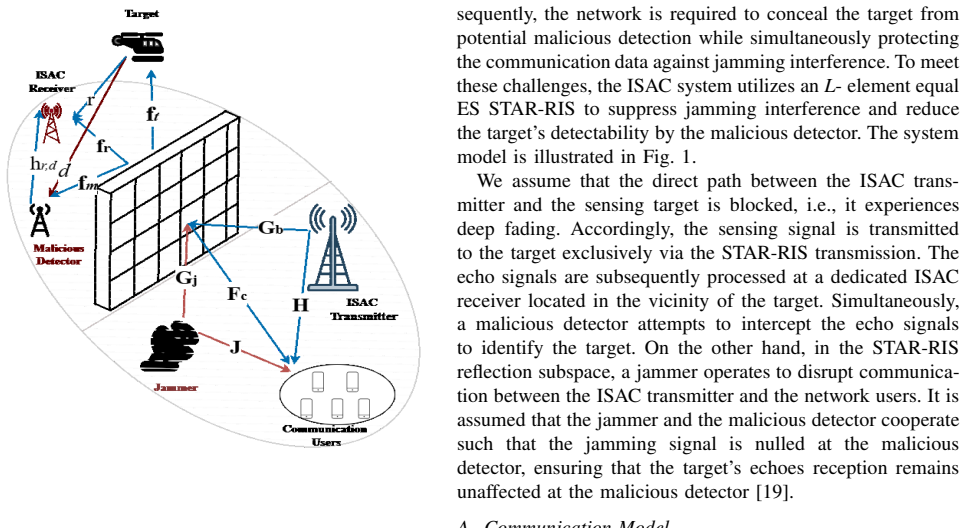
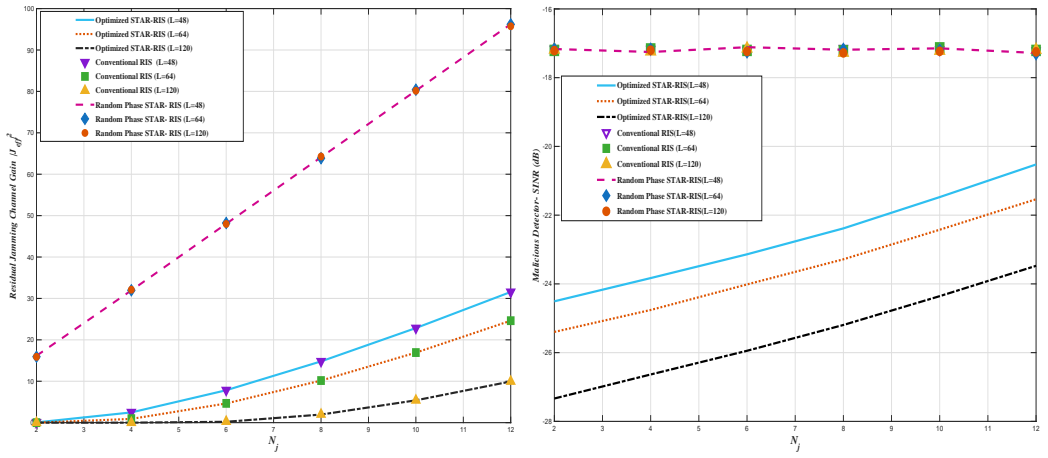
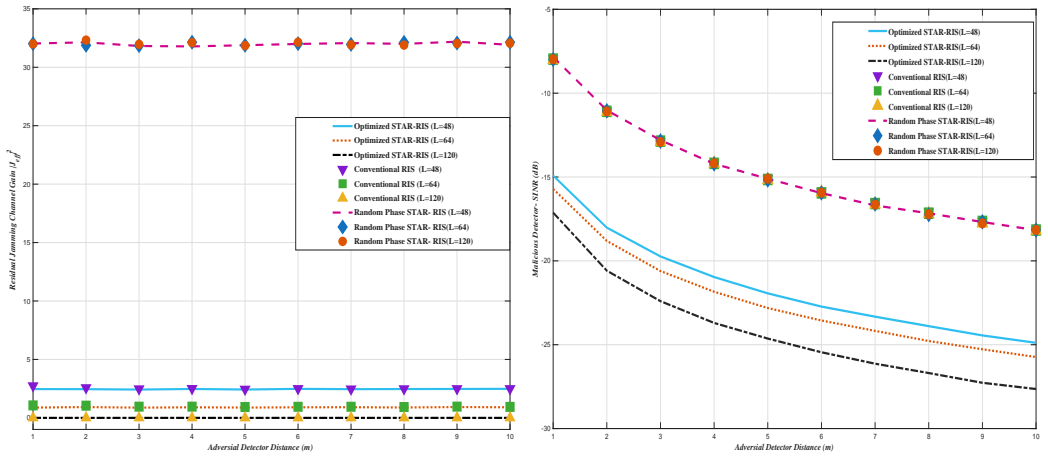
Designing robust architectures that can mitigate sophisticated attacks is now a key priority for modern wireless systems. This paper investigates a single-cell bistatic integrated sensing and communication (ISAC) network facing simultaneous coordinated active jamming and malicious detection. These threats aim to disrupt the downlink communication and detect the presence of the ISAC target, respectively. To counter these attacks, we propose the SAFE-ISAC framework, which utilizes a simultaneous transmit and reflect reconfigurable intelligent surface (STAR-RIS) to jointly suppress jamming power and reduce the malicious detector's Signal-to-Interference-plus-Noise Ratio (SINR). We formulate a joint minimization problem for jamming gain and detection probability by optimizing the STAR-RIS reflection and transmission responses. This non-convex problem is decoupled into two subproblems: i) malicious detection mitigation in the transmission subspace, solved using the Dinkelbach method and Semidefinite Programming (SDP) relaxation, and ii) jamming suppression in the reflection subspace, addressed via Polak-Reib\'ere Riemannian conjugate gradient algorithm. Numerical results validate that the proposed scheme effectively achieves jamming mitigation and target concealment while meeting all communication and sensing Quality-of-Service (QoS) requirements, compared to existing benchmarks.
Editorial analysis
A structured set of objections, weighed in public.
Referee Report
Summary. The manuscript proposes the SAFE-ISAC framework for a single-cell bistatic ISAC network under coordinated active jamming and malicious detection. It uses a STAR-RIS to jointly minimize jamming gain and the malicious detector's detection probability by optimizing the transmission and reflection coefficients, subject to communication and sensing QoS constraints. The resulting non-convex problem is decoupled into a transmission-subspace subproblem solved via the Dinkelbach method and SDP relaxation, and a reflection-subspace subproblem solved via the Polak-Ribiere Riemannian conjugate gradient algorithm. Numerical results are presented to claim that the scheme achieves effective jamming mitigation and target concealment while satisfying all QoS requirements, outperforming existing benchmarks.
Significance. If the decoupling incurs only negligible loss, the work offers a practical algorithmic approach to physical-layer security in ISAC systems by leveraging STAR-RIS for simultaneous jamming suppression and target concealment. The use of established techniques (Dinkelbach, SDP relaxation, and Riemannian CG) is a strength, as is the explicit formulation from SINR and detection probability expressions. The numerical validation against benchmarks, if reproducible, would support the framework's relevance for secure wireless sensing and communication.
major comments (2)
- [Optimization Problem and Solution Approach] Optimization sections (following the problem formulation): The joint minimization over STAR-RIS transmission and reflection coefficients is decoupled into independent transmission and reflection subproblems. Because the effective channels, interference terms, and received signals at the legitimate receiver and malicious detector couple the two subspaces through the same STAR-RIS elements, independent optimization is not guaranteed to be optimal. No analytical bound on the sub-optimality gap is derived, and no comparison against an alternating-optimization baseline is provided. This directly affects the load-bearing claim that numerical results validate the scheme's effectiveness.
- [System Model] System model and assumptions (Section II): The optimization relies on perfect CSI. No robustness analysis or worst-case formulation under CSI estimation errors is included, yet the central performance claims (meeting QoS while mitigating jamming and detection) depend on accurate knowledge of the channels used in the SINR and detection probability expressions.
minor comments (3)
- [Abstract] Abstract: 'Polak-Reibère' should be corrected to 'Polak-Ribiere'.
- [Numerical Results] Numerical results section: The abstract and results claim validation without reporting the number of Monte Carlo trials, confidence intervals, or convergence behavior of the Riemannian CG algorithm; adding these would strengthen the evidence.
- [Figures] Figures: Legends and axis labels for benchmark comparisons should be enlarged for clarity; ensure all curves are distinguishable in black-and-white printing.
Simulated Author's Rebuttal
We thank the referee for the constructive and detailed comments. We address each major comment point by point below, acknowledging where the observations are valid and outlining specific revisions to the manuscript.
read point-by-point responses
-
Referee: [Optimization Problem and Solution Approach] Optimization sections (following the problem formulation): The joint minimization over STAR-RIS transmission and reflection coefficients is decoupled into independent transmission and reflection subproblems. Because the effective channels, interference terms, and received signals at the legitimate receiver and malicious detector couple the two subspaces through the same STAR-RIS elements, independent optimization is not guaranteed to be optimal. No analytical bound on the sub-optimality gap is derived, and no comparison against an alternating-optimization baseline is provided. This directly affects the load-bearing claim that numerical results validate the scheme's effectiveness.
Authors: We agree that decoupling the joint optimization into separate transmission and reflection subproblems does not guarantee global optimality, since the effective channels and interference terms couple the subspaces via the shared STAR-RIS elements. This separation was adopted to render the non-convex problem tractable by applying Dinkelbach with SDP relaxation to the transmission subproblem and the Polak-Ribiere Riemannian conjugate gradient method to the reflection subproblem. The numerical results demonstrate that the resulting scheme outperforms the considered benchmarks in jamming suppression and target concealment while satisfying the QoS constraints. To strengthen the validation, we will revise the manuscript to include a comparison against an alternating-optimization baseline that iteratively solves the two subproblems, thereby quantifying any performance gap, and we will add an explicit remark noting the absence of an analytical sub-optimality bound as a limitation of the current approach. revision: yes
-
Referee: [System Model] System model and assumptions (Section II): The optimization relies on perfect CSI. No robustness analysis or worst-case formulation under CSI estimation errors is included, yet the central performance claims (meeting QoS while mitigating jamming and detection) depend on accurate knowledge of the channels used in the SINR and detection probability expressions.
Authors: The referee is correct that the optimization and performance evaluation assume perfect CSI, which is stated in Section II. This assumption allows us to focus on the derivation of the SAFE-ISAC framework and the proposed algorithmic solution. The numerical results and claims are therefore conditioned on perfect channel knowledge. In the revised manuscript we will expand the discussion of this assumption in the system model section, clarify its implications for the reported QoS and security metrics, and add a short paragraph outlining possible robust extensions (such as worst-case or stochastic robust formulations) as future work. A complete robustness analysis with new derivations and simulations lies beyond the scope of the present contribution. revision: partial
Circularity Check
No circularity in derivation; optimization and numerical validation are independent of inputs
full rationale
The paper starts from explicit system-model-derived SINR and detection-probability expressions, formulates a joint minimization over STAR-RIS coefficients, decouples the non-convex problem into transmission and reflection subproblems, and applies standard solvers (Dinkelbach+SDP, Riemannian CG). The final numerical claims are outcomes of running these algorithms on the formulated objective; they do not reduce by construction to the input expressions or to any fitted parameters. No self-citations, ansatzes, or renamings are load-bearing for the central result. The decoupling step is an approximation whose sub-optimality gap is not bounded, but this is a correctness concern rather than a circularity reduction.
Axiom & Free-Parameter Ledger
axioms (2)
- domain assumption Perfect channel state information is available at the optimizer
- domain assumption STAR-RIS elements can be independently controlled in amplitude and phase for both transmission and reflection
invented entities (1)
-
SAFE-ISAC framework
no independent evidence
Reference graph
Works this paper leans on
-
[1]
On the road to 6G: Visions, requirements, key technolog ies, and testbeds
CH. Wang, X. Y ou, X. Gao, X. Zhu, Z. Li, C. Zhang, H. Wang et al. "On the road to 6G: Visions, requirements, key technolog ies, and testbeds." IEEE Communications Surveys & Tutorials, vol. 25, no. 2, pp. 905-974, Feb. 2023
work page 2023
-
[2]
Unveiling the potential of NOMA: A journey to next-gene ration multiple access
A. Ahmed, X. Wang, A. Hawbani, W. Y uan, H. Tabassum, Y . Liu et al. "Unveiling the potential of NOMA: A journey to next-gene ration multiple access." IEEE Communications Surveys & Tutorials , vol. 27, no. 5, pp. 3099-3164, Oct. 2025
work page 2025
-
[3]
Evolution of NOMA toward next generat ion multiple access (NGMA) for 6G
Y . Liu, S. Zhang, X. Mu, Z. Ding, R. Schober, N. Al-Dhahir, E. Hossain, and X. Shen. "Evolution of NOMA toward next generat ion multiple access (NGMA) for 6G." IEEE Journal on Selected Areas in Communications, vol. 40, no. 4, pp. 1037-1071, Apr. 2022
work page 2022
-
[4]
Z. Wang, M. El-Hajjar, and LL Y ang. "Orbital angular mome ntum for wireless communications: Key performance indicators and p erformance comparison." IEEE Access , pp. 80889- 80913, May 2025
work page 2025
-
[5]
Orbital angular mome n- tum (OAM) in wireless communication: Applications and chal lenges towards 6G
H. Zhang, Z. Cao, H. Xie, and H. Jin. "Orbital angular mome n- tum (OAM) in wireless communication: Applications and chal lenges towards 6G." In 14th International Conference on Information and Communication Technology Convergence (ICTC), Jeju Island, Republic of Korea, Oct. 2023
work page 2023
-
[6]
Full-duplex wireless for 6G: Prog ress brings new opportunities and challenges
B. Smida, A. Sabharwal, G. Fodor, G.C. Alexandropoulos, H.A. Suraweera, and CB. Chae. "Full-duplex wireless for 6G: Prog ress brings new opportunities and challenges." IEEE Journal on Selected Areas in Communications , vol. 41, no. 9, pp. 2729-2750, Jun. 2023
work page 2023
-
[7]
Uplink-downlink cochan nel interfer- ence cancellation in RIS-Aided full-duplex networks
R. Sultan, and A. Shamseldeen. "Uplink-downlink cochan nel interfer- ence cancellation in RIS-Aided full-duplex networks." IEEE Systems Journal, vol. 18, no. 2, pp. 1220-1223, Jun. 2024
work page 2024
-
[8]
STAR-RIS-aided full-du plex commu- nication for massive MIMO IoT systems
R. Sultan, and A. Shamseldeen. "STAR-RIS-aided full-du plex commu- nication for massive MIMO IoT systems." In IEEE 15th International Conference on Computational Intelligence and Communicati on Net- works (CICN) , Bangkok, Thailand, Dec. 2023
work page 2023
-
[9]
Integrated sensing and communications: Toward dual-func tional wire- less networks for 6G and beyond
F. Liu, Y . Cui, C. Masouros, J. Xu, T.X. Han, Y . C. Eldar, an d S. Buzzi. "Integrated sensing and communications: Toward dual-func tional wire- less networks for 6G and beyond." IEEE journal on selected areas in communications, vol. 40, no. 6, pp. 1728-1767, Mar. 2022. Adversial Detector Distance (m) 1 2 3 4 5 6 7 8 9 10 Malicious Detector- SINR (dB) -3...
work page 2022
-
[10]
Integrated sensing and communication signals toward 5G-A and 6G: A survey
Z. Wei, H. Qu, Y . Wang, X. Y uan, H. Wu, Y . Du, K. Han, N. Zhan g, and Z. Feng. "Integrated sensing and communication signals toward 5G-A and 6G: A survey." IEEE Internet of Things Journal , vol. 10, no. 13, pp. 11068-11092, Jul. 2023
work page 2023
-
[11]
Fundamental Limits of I ntegrated Sensing and Communication over Interference Channels
Y . Liu, M. Li, Y . Han, and L. Ong. "Fundamental Limits of I ntegrated Sensing and Communication over Interference Channels." IEEE Jour- nal on Selected Areas in Information Theory , vol. 7, pp. 1-15, Jan. 2026
work page 2026
-
[12]
Multi-Functional RI S-Aided ISAC Systems: Beamforming Design and Performance Analysis
Y . Zhou, W. Xu, W. Xiang, and Y . Wu. "Multi-Functional RI S-Aided ISAC Systems: Beamforming Design and Performance Analysis ." IEEE Transactions on V ehicular Technology, Early Access, Feb. 2026
work page 2026
-
[13]
Joint active and passive beamforming design for secure RIS-aided ISAC syste m
J. Y e, Jianglin, J. Dai, C. Pan, K. Wang, and J. Li. "Joint active and passive beamforming design for secure RIS-aided ISAC syste m." IEEE Wireless Communications Letters vol. 14, no. 3, pp. 916-920, Mar. 2025
work page 2025
-
[14]
Joint Antenna Selection and Beamforming Design for Active RIS-Ai ded ISAC Systems
W. Ma, P . Zhang, J. Y e, R. Guan, XP Li, and L. Huang. "Joint Antenna Selection and Beamforming Design for Active RIS-Ai ded ISAC Systems." IEEE Internet of Things Journal , vol. 12, no. 14, pp. 26500-26513, Jul. 2025
work page 2025
-
[15]
Hiding in plain sight: RIS-aided target obfuscation in ISAC,
A. Magbool, V . Kumar, M. D. Renzo, and M. F. Flanagan. "Hi ding in plain sight: Ris-aided target obfuscation in isac." arXi v preprint arXiv:2503.05418 (2025)
-
[16]
Intelligent Covert ISAC via RIS: A Reinforcement L earning Approach
F. Y ang, C. Xing, H. Wei, M. Jo, N. Deng, N. Zhao, and D. Niyato. "Intelligent Covert ISAC via RIS: A Reinforcement L earning Approach." IEEE Transactions on Wireless Communications , vol. 25, pp. 13107-13120, Mar. 2026
work page 2026
-
[17]
Joint s ecure and covert communications for active STAR-RIS assisted ISAC sy stems
L. Guo, J. Jia, X. Mu, Y . Liu, J. Chen, and X. Wang. "Joint s ecure and covert communications for active STAR-RIS assisted ISAC sy stems." IEEE Transactions on Wireless Communications , vol. 24, no. 9, pp. 7501-7516, Sep. 2025
work page 2025
-
[18]
Energy efficiency optimi zation in RIS-assisted communication systems with RIS power budget,
S. Lin, X. Li, H. Xu, and S. Jin. "Energy efficiency optimi zation in RIS-assisted communication systems with RIS power budget, " IEEE Transactions on V ehicular Technology, Early Access, Aug. 2025
work page 2025
-
[19]
Y . Sun, K. An, J. Luo, Y . Zhu, G. Zheng, and S. Chatzinotas . "In- telligent reflecting surface enhanced secure transmission against both jamming and eavesdropping attacks." IEEE Transactions on V ehicular Technology, vol.70, no. 10, pp. 11017-11022, Oct. 2021
work page 2021
-
[20]
CVX: Matlab software fo r disci- plined convex programming, version 2.0 beta
Michael Grant and Stephen Boyd. CVX: Matlab software fo r disci- plined convex programming, version 2.0 beta. https://cvxr .com/cvx, Sep. 2013
work page 2013
- [21]
discussion (0)
Sign in with ORCID, Apple, or X to comment. Anyone can read and Pith papers without signing in.