Recognition: no theorem link
Derivative Type Mapping Theorem for the Interpolative Berinde Weak Contraction in Metric Spaces with Application
Pith reviewed 2026-05-15 01:26 UTC · model grok-4.3
The pith
A fixed point theorem is proved for mappings satisfying the derivative-type interpolative Berinde weak contraction in complete metric spaces.
A machine-rendered reading of the paper's core claim, the machinery that carries it, and where it could break.
Core claim
If a self-mapping T on a complete metric space satisfies the derivative-type interpolative Berinde weak contraction inequality, then T admits a unique fixed point. The inequality combines the derivative of the distance function with the interpolative factor and the weak contraction term, extending both Olatinwo's derivative-type contractions and the interpolative Berinde condition to metric spaces.
What carries the argument
The derivative-type interpolative Berinde weak contraction inequality, which bounds the distance between iterates by a combination of the derivative of the distance, an interpolative parameter, and a weak contraction factor.
If this is right
- The theorem directly yields existence and uniqueness for solutions of the associated Fredholm integral equation.
- Any mapping satisfying the standard Banach contraction also satisfies the new inequality, recovering the classical result as a special case.
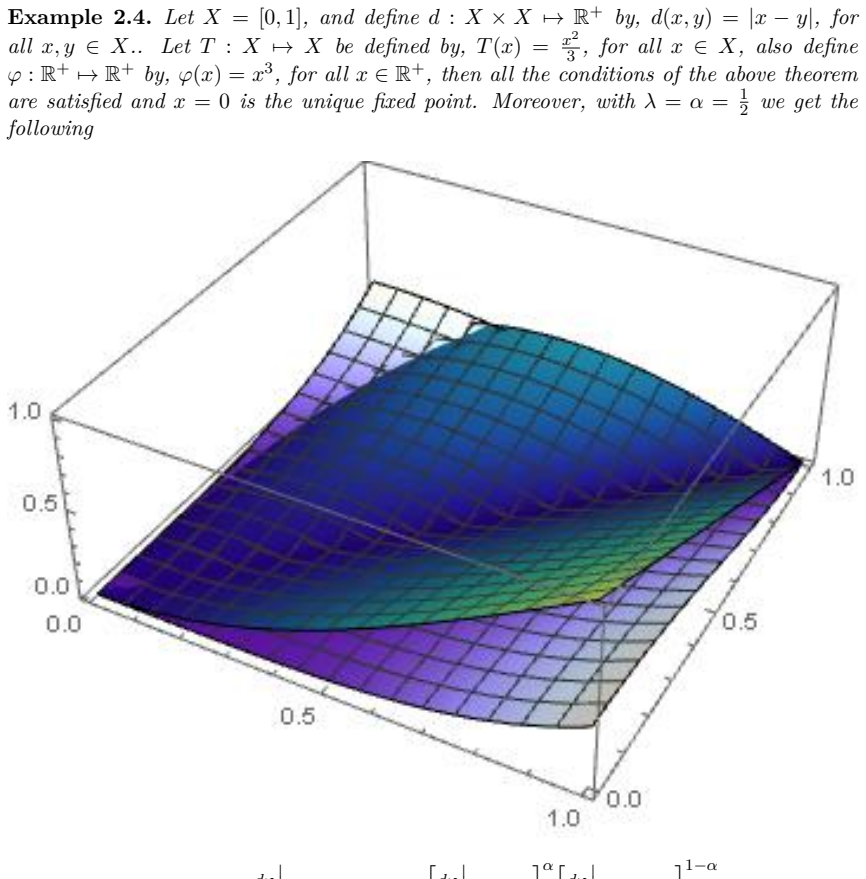
- The example in the paper demonstrates that the condition can hold for mappings that fail stricter contraction requirements.
- Fixed-point iterations under this mapping converge to the unique fixed point.
Where Pith is reading between the lines
- The same derivative-type condition could be studied in b-metric spaces or partial metric spaces to widen the range of applicable integral equations.
- Numerical schemes that approximate the derivative term might be derived to compute the fixed point explicitly.
- The result suggests that other weak contraction classes, such as Suzuki or Reich contractions, could admit derivative-type interpolative versions.
Load-bearing premise
The mapping must satisfy the precise derivative-type interpolative Berinde weak contraction inequality throughout the space.
What would settle it
Construct or exhibit a complete metric space and a self-mapping that obeys the stated inequality yet has no fixed point.
Figures
read the original abstract
Olatinwo [3] introduced contractive definitions of the derivative type, and gave a new characterization of the Banach contraction principle, and fixed point theorems for contractions defined implicitly. On the other hand Ampadu et.al [4] introduced derivative type contractions in the setting of multiplicative metric spaces. In this paper, we have obtained a fixed point theorem of the derivative type for interpolative Berinde weak contractive mappings [2] in the setting of metric spaces. An examples is given to illustrate the main result of the paper. Finally, we apply our result to the Fredholm integral equation
Editorial analysis
A structured set of objections, weighed in public.
Referee Report
Summary. The paper claims to prove a fixed-point theorem of derivative type for interpolative Berinde weak contractive mappings in metric spaces, supplies an illustrative example, and applies the result to the Fredholm integral equation.
Significance. If the central theorem is correctly established, the work extends the fixed-point literature by merging derivative-type contractions with interpolative Berinde weak contractions, offering a modest but concrete addition to the toolkit for existence results in nonlinear analysis and integral equations.
major comments (1)
- [Main theorem (Section 3)] Main theorem (Section 3): The statement is given for metric spaces, yet the standard argument constructs a Cauchy sequence via the contraction inequality and then asserts convergence to a fixed point. Convergence of Cauchy sequences requires completeness, which is not stated in the theorem or the abstract. This is load-bearing for the existence claim.
minor comments (1)
- [Abstract] Abstract: 'An examples is given' is a grammatical error and should read 'An example is given'.
Simulated Author's Rebuttal
We thank the referee for the careful reading and constructive comment on our manuscript. We address the point raised below.
read point-by-point responses
-
Referee: Main theorem (Section 3): The statement is given for metric spaces, yet the standard argument constructs a Cauchy sequence via the contraction inequality and then asserts convergence to a fixed point. Convergence of Cauchy sequences requires completeness, which is not stated in the theorem or the abstract. This is load-bearing for the existence claim.
Authors: We agree that this is a valid and important observation. The proof constructs a Cauchy sequence using the interpolative Berinde weak contraction condition and then invokes completeness to obtain convergence to a limit point, which is subsequently verified to be a fixed point. The original statement and abstract omitted the completeness assumption. We will revise the manuscript to state the main theorem (and all related results) in the setting of complete metric spaces, update the abstract, and adjust the introduction and any relevant remarks accordingly. This correction will ensure the theorem is accurately formulated. revision: yes
Circularity Check
No significant circularity in the fixed-point theorem derivation
full rationale
The manuscript states and proves a new existence result combining derivative-type contractions with interpolative Berinde weak contractions. The derivation proceeds via the standard construction of an iterative sequence shown to be Cauchy under the given inequality, followed by an appeal to completeness to obtain the limit point; none of these steps reduces by definition or by construction to a fitted parameter, a renamed input, or a self-citation whose content is presupposed. The cited works supply background definitions but are not invoked as load-bearing uniqueness theorems or ansatzes that force the target conclusion. The result is therefore self-contained against external benchmarks and receives the default non-circularity finding.
Axiom & Free-Parameter Ledger
axioms (2)
- standard math The ambient space is a complete metric space.
- domain assumption The mapping satisfies the derivative-type interpolative Berinde weak contraction condition.
Reference graph
Works this paper leans on
-
[1]
S. Banach, Sur les operations dans les ensembles abstraits et leur application aux equations integerales, Fundamenta Mathematicae, 3 (1922), 133-181
work page 1922
-
[2]
Clement Boateng Ampadu, Some Fixed Point Theory Results for the Interpolative Berinde Weak Operaotr, Earthline Journal of Mathematical Sciences, Volume 4, Num- ber 2, 2020, Pages 253-271
work page 2020
-
[3]
M.O. Olatinwo, Some fixed point theorems involving weak contraction conditions of the derivative type, Octogon Mathematical Magazine, Vol.17, No.2, October 2009, pp 495-501
work page 2009
-
[4]
Clement Ampadu, Arslan Hojat Ansari, and Memudu Olaposi Olatinwo, Fixed Point Theorems using Multiplicative Contractive Definitions with Application to Multiplica- tive Analogue of C-Class Functions, JP Journal of Fixed Point Theory and Applica- tions, Volume 12, Number 1, 2017, Pages 1-35 5
work page 2017
discussion (0)
Sign in with ORCID, Apple, or X to comment. Anyone can read and Pith papers without signing in.