Learning ultra-compressible hyperelasticity with splines: Constitutive asymmetries and non-unique representations
Pith reviewed 2026-05-10 11:49 UTC · model grok-4.3
The pith
Standard tests on ultra-compressible foams allow many different hyperelastic energy functions to match the observed data.
A machine-rendered reading of the paper's core claim, the machinery that carries it, and where it could break.
Core claim
The authors establish that the strain-energy density for ultra-compressible hyperelastic solids exhibits non-unique representations when identified from homogeneous uniaxial and simple shear experiments. By constructing rich spline-based ansatzes in the space of invariants that include both separable and non-separable multiplicative terms, they demonstrate that a coupling term between isochoric and volumetric deformation is essential for capturing the response, while further couplings mainly highlight the degeneracy. Consequently, multiple distinct models can fit the same experimental curves for foams used in racing shoes, rendering them indistinguishable on available data alone.
What carries the argument
Spline-based strain-energy density functions in the (Ī₁, Ī₂, J) space with multiplicative decompositions that allow non-separable coupling terms between isochoric and volumetric parts.
If this is right
- A coupling term between isochoric and volumetric deformation such as Ψ(Ī₁, J) or Ψ(Ī₂, J) is essential to fit the volumetric response of ultra-light foams.
- Additional coupling terms are not strictly necessary but increase the degree of observed non-uniqueness.
- Multiple distinct models fitted to the same homogeneous data become practically indistinguishable.
- The non-uniqueness extends to traditional invariant-based models and to neural-network constitutive approaches.
- Homogeneous tension, compression, and shear data alone cannot resolve the ambiguity in the energy function.
Where Pith is reading between the lines
- Multi-axial or inhomogeneous tests could be used to select among the currently equivalent models.
- Design applications may require additional physical constraints to pick one representation over others.
- Predictions under complex untested loading paths could differ across the family of fitting models.
- Modeling efforts might shift toward characterizing ranges of possible energies rather than single functions.
Load-bearing premise
Homogeneous uniaxial tension, compression, and simple shear data suffice to expose and quantify the non-uniqueness in the strain-energy representation without multi-axial or inhomogeneous tests.
What would settle it
A multi-axial or inhomogeneous deformation experiment on the same foam that produces stress responses differing from at least one of the equivalent-fitting spline models would demonstrate that the representations are distinguishable.
Figures


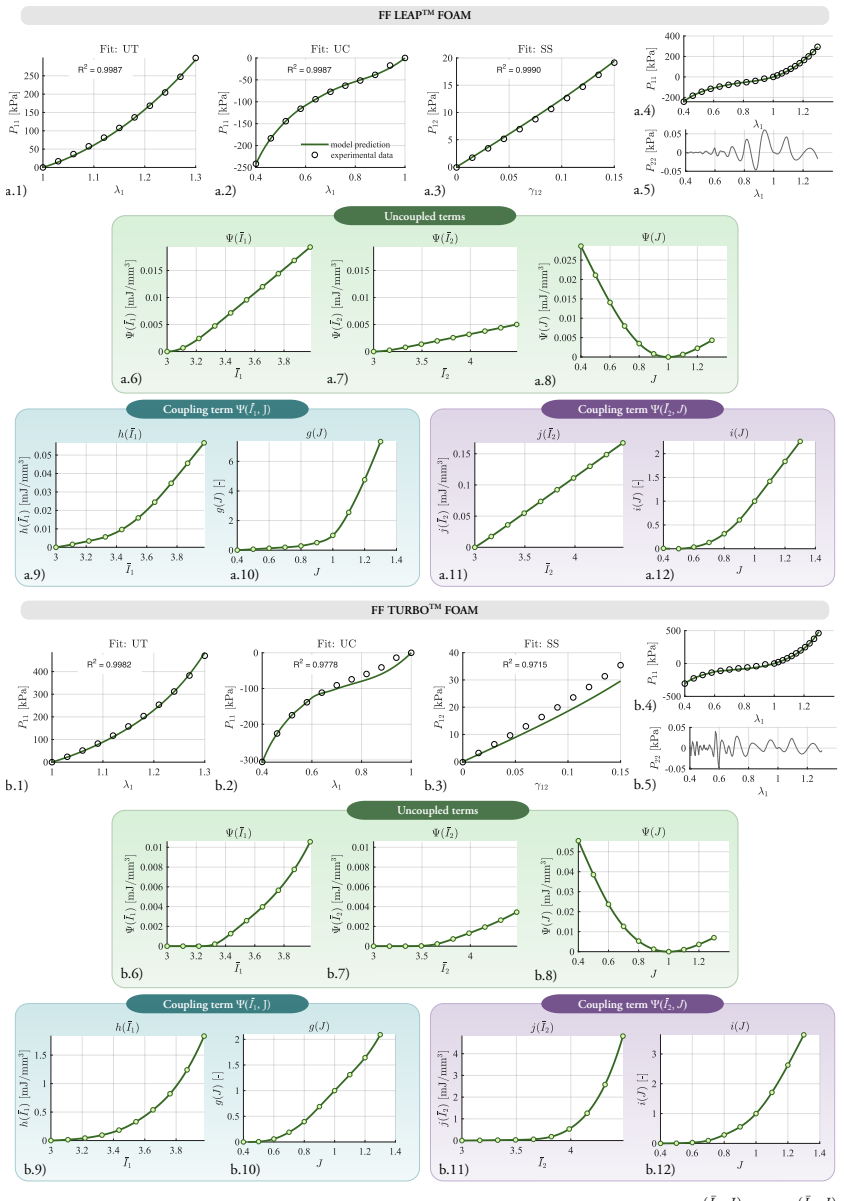


read the original abstract
Highly compressible solids, such as foams, exhibit complex responses, including pronounced tension-compression asymmetry. Capturing such behaviors within unified hyperelastic frameworks remains challenging. Invariant-based hyperelastic models are commonly identified from standard tests such as homogeneous uniaxial tension/compression and simple shear, implicitly assuming a unique energy representation. Here we show that this assumption is fundamentally violated and that, oftentimes, the choice of which term should prevail is just a matter of taste. Using spline-based strain-energy density functions as a data-adaptive tool and stress-strain experimental data for elastomeric foams, we expose this non-uniqueness, often hidden in low-parameter formulations. Our framework captures the volumetric deformation of ultra-light foams used in racing shoes using homogeneous experimental data from tension, compression, and shear. We formulate an overly rich ansatz of separable and non-separable energies in the ($\bar{I}_1$, $\bar{I}_2$, $J$) space \`a la Money-Rivlin. These constructs, defined by multiplicative decompositions, resemble classical invariant-based models while generalizing them to a data-driven spline representation. This serves two purposes: (i) to capture the response under complex volumetric deformation modes and (ii) to allow non-uniqueness in the identification problem to emerge naturally. We find that a coupling term between isochoric and volumetric deformation, such as $\Psi(\bar{I}_1,J)$ or $\Psi(\bar{I}_2,J)$, is essential and that additional coupling terms help but are not fully necessary; rather, they pronounce the non-uniqueness. As a consequence, different models may be indistinguishable on available data. Importantly, these challenges are not specific to splines but extend to traditional and neural network-based models.
Editorial analysis
A structured set of objections, weighed in public.
Referee Report
Summary. The manuscript proposes a spline-based framework for modeling the hyperelastic behavior of highly compressible materials such as elastomeric foams, using rich separable and non-separable ansatzes in the (Ī₁, Ī₂, J) invariants. It demonstrates that the identification of invariant-based strain energy densities from standard homogeneous uniaxial tension/compression and simple shear experiments leads to non-unique representations, with coupling terms between isochoric and volumetric responses being essential for capturing the data, while additional couplings highlight the non-uniqueness. Different models can thus be indistinguishable based on available experimental data, and this issue extends beyond splines to traditional and neural network models.
Significance. If substantiated, this work would be significant for the field of computational mechanics and constitutive modeling, as it challenges the common assumption of unique energy functions in hyperelasticity and provides a data-adaptive tool to explore constitutive asymmetries in ultra-compressible solids. The approach generalizes classical Mooney-Rivlin type models via multiplicative decompositions and applies it to real data from foams used in racing shoes. Strengths include the explicit exposure of non-uniqueness through overly rich ansatzes and the focus on volumetric deformation modes.
major comments (3)
- [Abstract] The claim that the uniqueness assumption 'is fundamentally violated' is not fully supported by the presented evidence, which is based on fits to homogeneous test data only. The abstract itself qualifies the indistinguishability to 'available data,' suggesting the non-uniqueness may be an artifact of under-constrained paths in principal stretch-J space rather than a general property. A concrete test, such as comparing predictions on biaxial or inhomogeneous deformation, is needed to establish if the different spline models diverge outside the training data.
- [Abstract (and implied methods/results)] No quantitative assessment of fit quality, such as error norms, R² values, or cross-validation scores, is provided for the various spline constructions. Additionally, sensitivity to the choice of spline knots or basis functions is not discussed, which is critical for claiming robust non-uniqueness rather than post-hoc selection.
- [Abstract] The assertion that a coupling term Ψ(Ī₁,J) or Ψ(Ī₂,J) 'is essential' requires more detail on what happens without it; for example, do the separable models fail to capture the data within experimental error, or merely fit less well?
minor comments (2)
- [Abstract] The notation for the invariants (Ī₁, Ī₂, J) is standard but could be defined explicitly for readers less familiar with hyperelasticity.
- [Abstract] The phrase 'oftentimes, the choice of which term should prevail is just a matter of taste' is informal for a journal article and could be rephrased more precisely.
Simulated Author's Rebuttal
We thank the referee for the thorough and constructive review of our manuscript. We address each major comment point by point below, indicating the revisions we will make to strengthen the paper while remaining faithful to the scope of the available experimental data.
read point-by-point responses
-
Referee: [Abstract] The claim that the uniqueness assumption 'is fundamentally violated' is not fully supported by the presented evidence, which is based on fits to homogeneous test data only. The abstract itself qualifies the indistinguishability to 'available data,' suggesting the non-uniqueness may be an artifact of under-constrained paths in principal stretch-J space rather than a general property. A concrete test, such as comparing predictions on biaxial or inhomogeneous deformation, is needed to establish if the different spline models diverge outside the training data.
Authors: We agree that the demonstration relies on standard homogeneous uniaxial tension/compression and simple shear data, which is the conventional basis for identifying hyperelastic models. The abstract already limits the claim to 'available data,' and we will revise the abstract and add a dedicated discussion section to clarify that non-uniqueness emerges in the identification problem from these tests. While new biaxial experiments are outside the current scope, we will analyze and illustrate how the different spline models (separable vs. non-separable) produce divergent predictions under biaxial stretch paths and inhomogeneous deformations, thereby showing that the non-uniqueness has consequences beyond the training data and is not merely an artifact of under-constrained paths. revision: partial
-
Referee: [Abstract (and implied methods/results)] No quantitative assessment of fit quality, such as error norms, R² values, or cross-validation scores, is provided for the various spline constructions. Additionally, sensitivity to the choice of spline knots or basis functions is not discussed, which is critical for claiming robust non-uniqueness rather than post-hoc selection.
Authors: We accept this observation and will incorporate quantitative metrics in the revised manuscript. Tables and supplementary figures will report L2 error norms on stress residuals, R² values, and leave-one-out cross-validation scores for each spline construction. We will also include a sensitivity analysis varying knot locations and polynomial degrees, demonstrating that the non-uniqueness between models persists across reasonable choices of these parameters and is therefore not an artifact of post-hoc selection. revision: yes
-
Referee: [Abstract] The assertion that a coupling term Ψ(Ī₁,J) or Ψ(Ī₂,J) 'is essential' requires more detail on what happens without it; for example, do the separable models fail to capture the data within experimental error, or merely fit less well?
Authors: We will expand the results section with direct comparisons of separable (no coupling) versus non-separable models. The added figures and quantitative metrics will show that purely separable forms produce residuals exceeding typical experimental error bands, particularly in the volumetric response under compression and shear for the ultra-light foams. In contrast, inclusion of at least one coupling term Ψ(Ī₁,J) or Ψ(Ī₂,J) brings all residuals within experimental uncertainty. This establishes that the coupling is required for faithful representation rather than a marginal improvement. revision: yes
- Performing new biaxial or inhomogeneous deformation experiments to directly compare model predictions outside the training data, since the study is limited to the existing homogeneous test data for the racing-shoe foams.
Circularity Check
No significant circularity; non-uniqueness shown empirically via external data fits
full rationale
The paper constructs multiple separable and non-separable spline-based strain-energy functions in the (Ī₁, Ī₂, J) space and fits them directly to homogeneous uniaxial tension/compression and simple shear stress-strain data from elastomeric foams. Different combinations (with or without explicit Ψ(Ī₁,J) or Ψ(Ī₂,J) coupling) are shown to reproduce the same observed responses, demonstrating that the energy representation is underconstrained by the available homogeneous tests. This is an empirical comparison against independent experimental inputs rather than any derivation that reduces a claimed prediction back to fitted parameters or self-citations by construction. No load-bearing self-citation, ansatz smuggling, or self-definitional step appears in the provided text; the central claim remains falsifiable against the external data set.
Axiom & Free-Parameter Ledger
free parameters (1)
- spline coefficients for each energy term
axioms (2)
- standard math Existence of a strain energy density function Ψ depending on the invariants of the deformation gradient
- domain assumption Homogeneous deformation modes (uniaxial tension/compression, simple shear) provide sufficient information to identify the energy function
Reference graph
Works this paper leans on
-
[1]
Gibson, L. J. & Ashby, M. F. Cellular Solids: Structure and Properties.Cellular Solids: Structure and Properties, Second Edition1–510 (1997)
work page 1997
-
[2]
Moerman, K. M., Simms, C. K. & Nagel, T. Control of tension–compression asymmetry in Ogden hyperelasticity with application to soft tissue modelling.Journal of the Mechanical Behavior of Biomedical Materials56, 218–228 (2016)
work page 2016
-
[3]
Schrodt, M., Benderoth, G., Kühhorn, A. & Silber, G. Hyperelastic Description of Polymer Soft Foams at Finite Deformations.Technische Mechanik - European Journal of Engineering Mechanics25, 162–173 (2005)
work page 2005
-
[4]
Silber, G., Alizadeh, M. & Salimi, M. Large Deformation Analysis for Soft Foams Based on Hyperelasticity. Journal of Mechanics26, 327–334 (2010)
work page 2010
-
[5]
Holzapfel, G. A. & Wiley, J. Nonlinear Solid Mechanics: A Continuum Approach for Engineering Science. Meccanica 2002 37:437, 489–490 (2002)
work page 2002
-
[6]
Agarwal, V . K. & Carroll, M. M. Admissibility conditions on principal strain invariants.Acta Mechanica177, 89–96 (2005)
work page 2005
-
[7]
Dammaß, F., Kalina, K. A. & Kästner, M. When invariants matter: The role of I1 and I2 in neural network models of incompressible hyperelasticity.Mechanics of Materials210, 105443 (2025)
work page 2025
-
[8]
Kearsley, E. A. Note: Strain invariants expressed as average stretches.Journal of Rheology33, 757–760 (1989)
work page 1989
-
[9]
Miehe, C., Göktepe, S. & Lulei, F. A micro-macro approach to rubber-like materials—part i: the non-affine micro-sphere model of rubber elasticity.Journal of the Mechanics and Physics of Solids52, 2617–2660 (2004)
work page 2004
-
[10]
Aydogdu, A. B., Loos, K., Johlitz, M. & Lion, A. A new concept for the representative directions method: Directionalisation of first and second invariant based hyperelastic models.International Journal of Solids and Structures222-223, 111017 (2021)
work page 2021
- [11]
-
[12]
Li, X., Tao, J., Landauer, A. K., Franck, C. & Henann, D. L. Large-deformation constitutive modeling of viscoelastic foams: Application to a closed-cell foam material.Journal of the Mechanics and Physics of Solids 161, 104807 (2022)
work page 2022
-
[13]
McCulloch, J. A., Delp, S. L. & Kuhl, E. Discovering the mechanics of ultra-low density elastomeric foams in elite-level racing shoes (2026)
work page 2026
-
[14]
Taç, V ., Linka, K., Sahli-Costabal, F., Kuhl, E. & Tepole, A. B. Benchmarking physics-informed frameworks for data-driven hyperelasticity.Computational Mechanics73, 49–65 (2024). 31
work page 2024
-
[15]
A., Wiesheier, S., Steinmann, P
Flaschel, M., Moreno-Mateos, M. A., Wiesheier, S., Steinmann, P. & Kuhl, E. Unsupervised Material Fingerprint- ing: Ultra-fast hyperelastic model discovery from full-field experimental measurements (2026)
work page 2026
-
[16]
Experimental Mechanics48, 381–402 (2008)
Avril, S.et al.Overview of identification methods of mechanical parameters based on full-field measurements. Experimental Mechanics48, 381–402 (2008)
work page 2008
-
[17]
Treloar, L. R. G. Stress-strain data for vulcanised rubber under various types of deformation.Trans. Faraday Soc. 40, 59–70 (1944)
work page 1944
-
[18]
Esmaeili, A., George, D., Masters, I. & Hossain, M. Biaxial experimental characterizations of soft polymers: A review.Polymer Testing128, 108246 (2023)
work page 2023
-
[19]
A., Wiesheier, S., Esmaeili, A., Hossain, M
Moreno-Mateos, M. A., Wiesheier, S., Esmaeili, A., Hossain, M. & Steinmann, P. Biaxial characterization of soft elastomers: Experiments and data-adaptive configurational forces for fracture.Journal of the Mechanics and Physics of Solids205, 106339 (2025)
work page 2025
-
[20]
Ashkenazi, A., Shultz, A., Jordan, L. & Solav, D. Indentation-based anisotropic material parameter identifiability: Validation on a synthetic soft tissue phantom.Journal of the Mechanics and Physics of Solids106417 (2025)
work page 2025
-
[21]
Shojaeifard, M. & Bacca, M. Hyperelastic characterization via deep indentation.Soft Matter21, 7354–7360 (2025)
work page 2025
-
[22]
Moreno-Mateos, M. A. & Steinmann, P. Cutting soft materials: how material differences shape the response.npj Computational Materials12, 15 (2026)
work page 2026
-
[23]
Flaschel, M., Kumar, S. & De Lorenzis, L. Unsupervised discovery of interpretable hyperelastic constitutive laws. Computer Methods in Applied Mechanics and Engineering381, 113852 (2021)
work page 2021
-
[24]
Dal, H., Denli, F. A., Açan, A. K. & Kaliske, M. Data-driven hyperelasticity, Part I: A canonical isotropic formulation for rubberlike materials.Journal of the Mechanics and Physics of Solids179, 105381 (2023)
work page 2023
-
[25]
Tikeno˘gulları, O. Z., Açan, A. K., Kuhl, E. & Dal, H. Data-driven hyperelasticity, Part II: A canonical framework for anisotropic soft biological tissues.Journal of the Mechanics and Physics of Solids181, 105453 (2023)
work page 2023
-
[26]
Wiesheier, S., Mergheim, J. & Steinmann, P. Discrete data-adaptive approximation of hyperelastic energy functions.Computer Methods in Applied Mechanics and Engineering416, 116366 (2023)
work page 2023
-
[27]
Wiesheier, S., Moreno-Mateos, M. A. & Steinmann, P. Versatile data-adaptive hyperelastic energy functions for soft materials.Computer Methods in Applied Mechanics and Engineering430, 117208 (2024)
work page 2024
-
[28]
Wiesheier, S., Moreno-Mateos, M. A. & Steinmann, P. Data-adaptive spline-based viscoelasticity for soft solids. Computer Methods in Applied Mechanics and Engineering451, 118705 (2026)
work page 2026
-
[29]
Chen, P. & Guilleminot, J. Polyconvex neural networks for hyperelastic constitutive models: A rectification approach.Mechanics Research Communications125, 103993 (2022)
work page 2022
-
[30]
A., Linden, L., Brummund, J., Metsch, P
Kalina, K. A., Linden, L., Brummund, J., Metsch, P. & Kästner, M. Automated constitutive modeling of isotropic hyperelasticity based on artificial neural networks.Computational Mechanics69, 213–232 (2022). 32
work page 2022
-
[31]
Linden, L.et al.Neural networks meet hyperelasticity: A guide to enforcing physics.Journal of the Mechanics and Physics of Solids179, 105363 (2023)
work page 2023
- [32]
-
[33]
Thakolkaran, P.et al.Can KAN CANs? Input-convex Kolmogorov-Arnold Networks (KANs) as hyperelastic constitutive artificial neural networks (CANs).Computer Methods in Applied Mechanics and Engineering443, 118089 (2025)
work page 2025
-
[34]
Flory, P. J. Thermodynamic relations for high elastic materials.Transactions of the Faraday Society57, 829–838 (1961)
work page 1961
-
[35]
Steinmann, P., Hossain, M. & Possart, G. Hyperelastic models for rubber-like materials: Consistent tangent operators and suitability for Treloar’s data.Archive of Applied Mechanics82, 1183–1217 (2012)
work page 2012
-
[36]
Rivlin, R. S. Large elastic deformations of isotropic materials iv. further developments of the general theory. Philosophical Transactions of the Royal Society of London. Series A(1948)
work page 1948
-
[37]
Rivlin, R. S. & Saunders, D. W. Large elastic deformations of isotropic materials vii. experiments on the deformation of rubber.Philosophical Transactions of the Royal Society of London. Series A(1951)
work page 1951
-
[38]
Valanis, K. C. & Landel, R. F. The strain-energy function of a hyperelastic material in terms of the extension ratios.Journal of Applied Physics38, 2997–3002 (1967)
work page 1967
-
[39]
Ogden, R. W. Large deformation isotropic elasticity: On the correlation of theory and experiment for incompress- ible rubberlike solids.Proceedings of the Royal Society of London. Series A326, 565–584 (1972)
work page 1972
-
[40]
& Weichert, D.Nonlinear Continuum Mechanics of Solids(Springer Berlin Heidelberg, 2000)
Ba¸ sar, Y . & Weichert, D.Nonlinear Continuum Mechanics of Solids(Springer Berlin Heidelberg, 2000)
work page 2000
-
[41]
Bonet, B. J. & Wood, R. D.Nonlinear Continuum Mechanics for Finite Element Analysis(Cambridge University Press, 1997)
work page 1997
-
[42]
Klein, D. K.et al.Neural networks meet hyperelasticity: A monotonic approach.European Journal of Mechanics - A/Solids116, 105900 (2026)
work page 2026
-
[43]
Kuhl, E. & Goriely, A. I too I2: A new class of hyperelastic isotropic incompressible models based solely on the second invariant.Journal of the Mechanics and Physics of Solids105670 (2024). 33
work page 2024
discussion (0)
Sign in with ORCID, Apple, or X to comment. Anyone can read and Pith papers without signing in.