The free energy of the interacting Bose gas: a variational description with loops and interlacements
Pith reviewed 2026-05-10 11:58 UTC · model grok-4.3
The pith
The limiting free energy of the interacting Bose gas equals the infimum of interaction energy plus specific relative entropy over stationary point processes of loops and interlacements at fixed density.
A machine-rendered reading of the paper's core claim, the machinery that carries it, and where it could break.
Core claim
The paper establishes that the limiting free energy equals the infimum, taken over all stationary point processes consisting of loops and interlacements with prescribed particle density, of the sum of the interaction energy and the specific relative entropy density with respect to the reference Brownian loop soup combined with an independent Markov kernel that describes collections of path shreds inside large boxes.
What carries the argument
The variational problem over stationary point processes of loops and interlacements, whose entropy term is the specific relative entropy density relative to the Brownian loop soup and the Markov kernel for path shreds.
If this is right
- The variational formula holds for every positive temperature and every positive particle density.
- In dimensions three and higher the long loops are represented by the Brownian interlacement Poisson point process with beta-spacing.
- The formula yields separate control on the particle numbers carried by short loops and by long interlacements.
- Existence of the specific relative entropy density is proved via large-deviation theory for the same class of processes.
- The approach recovers and extends the small-density results of earlier work that lacked a description of long loops.
Where Pith is reading between the lines
- Numerical minimization of the functional over discretized or parametrized point processes could yield practical approximations to the free energy in regimes where analytic solutions are unavailable.
- Techniques developed for random interlacements, such as those from percolation theory, might be imported to study the onset of condensation within this variational setting.
- Verification against the exactly solvable ideal Bose gas could provide a direct test of whether the entropy term correctly captures the non-interacting limit.
Load-bearing premise
The specific relative entropy density with respect to the Brownian loop soup together with the Markov kernel for path shreds is well-defined and finite for the relevant processes.
What would settle it
An independent computation of the free energy, for instance by direct Monte Carlo sampling of the path measure in a large finite box followed by extrapolation to the thermodynamic limit, that fails to equal the value of the variational infimum at the same temperature and density.
Figures

read the original abstract
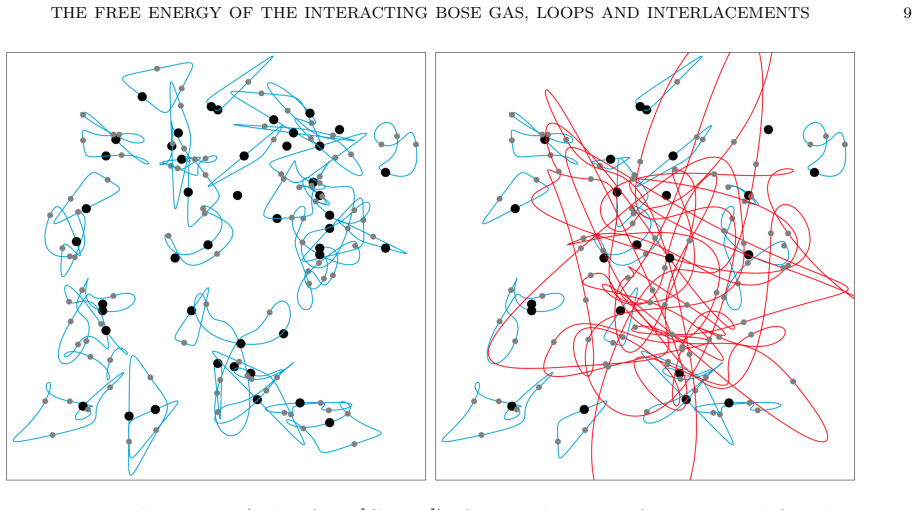
We consider the interacting Bose gas in the thermodynamic limit in a large box in $\R^d$ at positive temperature $1/\beta\in(0,\infty)$ with particle density $\sim\rho\in(0,\infty)$. We follow a path-integral approach and adopt from \cite {ACK10} a description of the free energy in terms of the {\it Brownian loop soup}, a Poisson point process consisting of Brownian bridges, also called loops or cycles. It is the objective of this paper to derive, for any values of $\beta$ and $\rho$, a formula for the limiting free energy with explicit control on the particle numbers in the short and in the long loops. The latter are presumed to play the role of the condensate, according to Feynman's \cite{F53} famous, vague suggestion, and they turn into {\it random interlacements} (bi-infinite, locally finite random processes in $\R^d$) in our formula. In \cite{ACK10} there was no concept that could describe the long loops; only small $\rho$ could be handled successfully. In the present paper we represent the limiting free energy in terms of a variational formula, ranging over the set of all stationary point processes with loops and with interlacements, having each a given particle density, and minimizing the sum of the interaction energy and a characteristic entropy term. The latter is a new kind of a {\it specific relative entropy density} with respect to the reference process of loops (the Brownian loop soup), together with an independent Markov kernel describing collections of path shreds in large boxes. In $d\geq 3$, the latter can be seen as a projection of the {\em Brownian interlacement Poisson point process with $\beta$-spacing}. Our proof tool box comes from large-deviation theory, both for the derivation of the formula for the free energy and for the proof of the existence of the specific relative entropy.
Editorial analysis
A structured set of objections, weighed in public.
Referee Report
Summary. The paper derives a variational formula for the limiting free energy of the interacting Bose gas at positive temperature and arbitrary density ρ in the thermodynamic limit. It represents the free energy as the infimum, over stationary point processes of loops and interlacements with fixed particle density, of the sum of an interaction energy and a new specific relative entropy density with respect to the Brownian loop soup plus an independent Markov kernel on path shreds (projecting to Brownian interlacements in d≥3). The derivation and the existence of the entropy term both rely on large-deviation principles for the joint loop-interlacement processes, extending the loop-soup description of ACK10 to the condensate regime by identifying long loops with random interlacements.
Significance. If the finiteness of the specific relative entropy holds for processes with positive-density interlacements, the result supplies a rigorous variational characterization of the Bose-gas free energy that incorporates Feynman's heuristic for the condensate and yields explicit control on short- versus long-loop particle numbers for all ρ. The construction of a relative-entropy functional that remains finite on interlacement-augmented processes, together with the LDP application to the joint point processes, constitutes a technical advance over prior loop-soup treatments limited to subcritical densities.
major comments (2)
- [Proof of existence of the specific relative entropy density] The central claim that the variational formula represents the free energy for ρ above criticality rests on the specific relative entropy density being finite (rather than +∞) for stationary processes containing positive-density interlacements. The abstract states that existence is proved via large-deviation theory applied to the joint loop-interlacement processes and the Markov kernel on path shreds, yet it is not evident whether the resulting rate function remains finite when the long-loop component deviates from the reference Brownian loop soup; if the entropy is infinite on all such processes, the infimum either excludes the condensate or collapses, undermining the representation for arbitrary ρ.
- [Derivation of the variational formula via LDP] The large-deviation principle invoked for the joint processes of loops and interlacements (used both to derive the variational formula and to establish finiteness of the entropy) must be checked for applicability to the specific reference measure consisting of the Brownian loop soup plus the independent Markov kernel; any gap in the LDP upper or lower bound for the long-loop component would propagate directly into the variational expression.
minor comments (2)
- [Introduction] The abstract refers to 'a new kind of a specific relative entropy density'; a brief comparison in the introduction with existing specific relative entropies for point processes (e.g., those of Georgii or Dereudre) would clarify the novelty.
- [Notation and setup] Notation for the Markov kernel on path shreds and its projection to Brownian interlacements should be introduced with a displayed equation early in the manuscript to aid readability.
Simulated Author's Rebuttal
We are grateful to the referee for the detailed review and for recognizing the technical advances in our work on the variational characterization of the Bose gas free energy. We address each major comment below, providing clarifications from the manuscript and indicating revisions to improve clarity.
read point-by-point responses
-
Referee: [Proof of existence of the specific relative entropy density] The central claim that the variational formula represents the free energy for ρ above criticality rests on the specific relative entropy density being finite (rather than +∞) for stationary processes containing positive-density interlacements. The abstract states that existence is proved via large-deviation theory applied to the joint loop-interlacement processes and the Markov kernel on path shreds, yet it is not evident whether the resulting rate function remains finite when the long-loop component deviates from the reference Brownian loop soup; if the entropy is infinite on all such processes, the infimum either excludes the condensate or collapses, undermining the representation for arbitrary ρ.
Authors: We thank the referee for highlighting this crucial point. The finiteness of the specific relative entropy density for stationary processes with positive-density interlacements is proved in Theorem 5.3 by constructing approximating sequences of processes whose long-loop components converge to the Brownian interlacement process. The rate function is shown to be finite on this set via an explicit upper bound obtained from the exponential moments of the path-shred Markov kernel and the lower semicontinuity of the relative entropy with respect to the reference measure (Brownian loop soup plus independent Markov kernel). This ensures the variational infimum is attained at a finite value for ρ above criticality. To make the argument more transparent, we will revise the abstract and insert a clarifying paragraph in Section 5 that directly references the relevant estimates from the LDP proof. revision: partial
-
Referee: [Derivation of the variational formula via LDP] The large-deviation principle invoked for the joint processes of loops and interlacements (used both to derive the variational formula and to establish finiteness of the entropy) must be checked for applicability to the specific reference measure consisting of the Brownian loop soup plus the independent Markov kernel; any gap in the LDP upper or lower bound for the long-loop component would propagate directly into the variational expression.
Authors: The large-deviation principle for the joint loop-interlacement processes is established in Theorem 4.1 of Section 4. There we verify the hypotheses of the general LDP theorem (exponential tightness of the sequence of finite-volume processes and the identification of the rate function as the Legendre transform of the log-moment generating functional) specifically for the reference measure given by the Brownian loop soup plus the independent Markov kernel on path shreds. The long-loop component is treated by the projection to interlacements in d ≥ 3; the upper bound follows from Varadhan's lemma applied to the continuous interaction functional, while the lower bound is obtained by local approximation with finite-volume Poisson processes. We are confident the conditions hold without gaps, but to address the concern we will add a short appendix that explicitly checks the exponential tightness and the continuity properties for this reference measure. revision: yes
Circularity Check
No circularity: variational formula derived via standard LDP without reduction to inputs or self-citation chain
full rationale
The paper adopts the Brownian loop soup description from prior literature (ACK10) as a starting point for the path-integral representation but then derives a new variational formula for the limiting free energy at arbitrary densities by applying large-deviation principles to stationary point processes that incorporate both short loops and long-loop interlacements. The specific relative entropy density is constructed and its existence is proved within the paper using LDP tools, rather than being presupposed or fitted. No equation reduces the final infimum expression to a previously fitted parameter or to a self-citation whose content is unverified; the extension beyond ACK10 (which handled only small ρ) is explicitly new and relies on external LDP results for point processes. The representation therefore remains self-contained against external benchmarks.
Axiom & Free-Parameter Ledger
axioms (2)
- standard math Large deviation principles hold for the relevant stationary point processes of loops and interlacements
- domain assumption The Brownian loop soup and the Brownian interlacement process satisfy the required stationarity and intensity properties
Reference graph
Works this paper leans on
-
[1]
S. Adams , Large deviations for empirical measures in cycles of integer partitions and their relation to systems of Bosons, Analysis and Stochastics of Growth Processes, LMS, Oxford University Press, 148-172, (2008)
work page 2008
- [2]
-
[3]
S. Adams, N. Dirr, M. Peletier and J. Zimmer , From a Large-Deviations Principle to the Wasserstein Gradient Flow: A New Micro-Macro Passage, Commun. Math. Phys. 307:3 , 791-815 (2011), DOI 10.1007/s00220-011-1328-4
-
[4]
I. Armendáriz, P.A. Ferrari , and S. Yuhjtman , Gaussian random permutation and the boson point process, Commun. Math. Phys. 387:3 , 1515-1547 (2021)
work page 2021
-
[5]
L. Andreis, W. König , and R.I.A. Patterson , A large-deviations principle for all the cluster sizes of a sparse Erd o s-R\'enyi graph, Random Structures Algorithms 59:4 , 522-553 (2021)
work page 2021
-
[6]
L. Andreis, W. König, H. Langhammer , and R.I.A. Patterson , A large-deviations principle for all the components in a sparse inhomogeneous random graph, Probab. Theory Relat. Fields 186 , 521-620 (2023)
work page 2023
-
[7]
Bogachev , Measure Theory , Vol
V.I. Bogachev , Measure Theory , Vol. II, Springer-Verlag, Berlin, Heidelberg (2007)
work page 2007
- [8]
-
[9]
E. Bolthausen, W. König , and C. Mukherjee , Self-repellent Brownian bridges in an interacting Bose gas, preprint, ArXiv:2405.08753, https://arxiv.org/abs/2405.08753 (2024)
-
[10]
T. Bai, W. König, and Q. Vogel , Proof of off-diagonal long-range order in a mean-field trapped Bose gas via the Feynman--Kac formula Elec. J. Prob. 30 , 1-26, (2025) DOI: 10.1214/25-EJP1370
-
[11]
O. Bratteli and D. W. Robinson , Operator Algebras and Quantum Statistical Mechanics II , 2nd ed., Springer-Verlag (1997)
work page 1997
- [12]
-
[13]
A. Chiarini and M. Nitzschner , Lower bounds for bulk deviations for the simple random walk on ^d , d 3 , Ann. Inst. Henri Poincaré, Probab. Stat. , to appear , file:///C:/Users/koeni/Downloads/AIHP2408-005R1A0.pdf (2025)
work page 2025
-
[14]
M. Dickson and Q. Vogel , Formation of infinite loops for an interacting bosonic loop soup, Electron. J. Probab. 29 , article no. 24, 1–39. ISSN: 1083-6489 https://doi.org/10.1214/24-EJP1085 (2024)
-
[15]
D.J. Daley and D. Vere-Jones , An Introduction to the Theory of Point Processes: Volume I: Elementary Theory and Methods, Second Edition, Springer (2003)
work page 2003
-
[16]
D.J. Daley and D. Vere-Jones , An Introduction to the Theory of Point Processes: Volume II: General Theory and Structure, Second Edition, Springer (2008)
work page 2008
-
[17]
A. Dembo and O. Zeitouni , Large Deviations Techniques and Applications\/ , corrected printing of the 2nd edition, Springer, Berlin Heidelberg (2010)
work page 2010
-
[18]
Feynman , Atomic theory of the transition in Helium, Phys
R.P. Feynman , Atomic theory of the transition in Helium, Phys. Rev. 91 , 1291--1301 (1953)
work page 1953
-
[19]
J. Fröhlich, A. Knowles, B. Schlein, and V. Sohinger, A path-integral analysis of interacting Bose gases and loop gases. J. Stat. Phys. 180:1-6 , 810–831 (2020)
work page 2020
-
[20]
H.-O. Georgii , Gibbs Measures and Phase Transitions , Second Edition, De Gruyter Studies in Mathematics 9 (2011)
work page 2011
-
[21]
H.-O. Georgii and H. Zessin , Large deviations and the maximum entropy principle for marked point random fields, Prob. Theory Relat. Fields 96 , 177--204 (1993)
work page 1993
-
[22]
H.-O. Georgii, Large deviations and the equivalence of ensembles for Gibbsian particle systems with superstable interaction, Prob. Theory Relat. Fields 99 , 171--195 (1994)
work page 1994
-
[23]
J. Ginibre, Some Applications of Functional Integration in Statistical Mechanics, and Field Theory\/ , C. de Witt and R. Storaeds, Gordon and Breach, New York (1970)
work page 1970
-
[24]
Zass , Off-diagonal long-range order for the free Bose gas via the Feynman--Kac formula, Ann
W.\ König, Q.\ Vogel and A. Zass , Off-diagonal long-range order for the free Bose gas via the Feynman--Kac formula, Ann. Appl. Probab. , to appear, preprint arXiv:2312.07481, https://arxiv.org/abs/2312.07481 (2023)
-
[25]
G. Last and M. Penrose, Lectures on the Poisson Process. Cambridge University Press, Cambridge (2018)
work page 2018
-
[26]
G.F. Lawler and W. Werner, The Brownian loop soup, Probab. Theory Related Fields 128:4 , 565-588 (2004)
work page 2004
-
[27]
B. Nehring, S. Poghosyan and H. Zessin , On the construction of point processes in statistical mechanics, J. Math. Phys. 54 (6), 063302 (2013)
work page 2013
-
[28]
M.A. Peletier, D.R.M. Renger, and M. Veneroni , Variational formulation of the Fokker--Planck equation with decay: A particle approach. Communications in Contemporary Mathematics 15(05) , 1350017 (2013)
work page 2013
-
[29]
C. Pethick and H. Smith , Bose–Einstein Condensation of Dilute Gases . Cambridge University Press, Cambridge (2001)
work page 2001
-
[30]
L. Pitaevskii and S. Stringari , Bose–Einstein Condensation . Oxford Science Publications, Oxford (2003)
work page 2003
-
[31]
A. Quitmann and L. Taggi , Macroscopic loops in the Bose gas, Spin O(N) and related models, Commun. Math. Phys. 400 , 2081–2136 (2023)
work page 2081
-
[32]
M. Rafler , Gaussian Loop- and Polya Processes: A Point Process Approach , PhD Thesis, University of Potsdam (2009)
work page 2009
-
[33]
Ruelle , Statistical Mechanics: Rigorous Results , W.A
D. Ruelle , Statistical Mechanics: Rigorous Results , W.A. Benjamin, Inc., (1969)
work page 1969
-
[34]
S\"ut o , Percolation transition in the Bose gas, J
A. S\"ut o , Percolation transition in the Bose gas, J. Phys. A: Math. Gen. 26 , 4689--4710 (1993)
work page 1993
-
[35]
S\"ut o , Percolation transition in the Bose gas: II, J
A. S\"ut o , Percolation transition in the Bose gas: II, J. Phys. A: Math. Gen. 35 , 6995--7002 (2002)
work page 2002
-
[36]
Sznitman , Vacant set of random interlacements and percolation, Ann
A.-S. Sznitman , Vacant set of random interlacements and percolation, Ann. Math. 171 , 2039--2087 (2010)
work page 2039
-
[37]
Sznitman , On scaling limits and Brownian interlacements, Bull
A.-S. Sznitman , On scaling limits and Brownian interlacements, Bull. Braz. Math. Soc., New Series 44(4) , 555--592, (2013); special issue of the Bulletin of the Brazilian Mathematical Society--IMPA 60 years
work page 2013
-
[38]
Sznitman , On bulk deviations for the local behavior of random interlacements, Ann
A.-S. Sznitman , On bulk deviations for the local behavior of random interlacements, Ann. Scient. Éc. Norm. Sup. , série 4, t. 56, 801-858 (2023)
work page 2023
-
[39]
Ueltschi , Relation between Feynman cycles and off-diagonal long-range order, Phys
D. Ueltschi , Relation between Feynman cycles and off-diagonal long-range order, Phys. Rev. Lett. 97 , 170601 (2006)
work page 2006
-
[40]
Q. Vogel , Emergence of interlacements from the finite volume Bose soup, Stoch. Proc. Appl. 166 Dezember 2023, 104227 https://doi.org/10.1016/j.spa.2023.104227 (2023)
-
[41]
A. Zass , Gibbs Point Processes on Path Space: Existence, Cluster Expansion and Uniqueness, Markov Process. Rel. Fields 28 (3), 329--364 (2022)
work page 2022
discussion (0)
Sign in with ORCID, Apple, or X to comment. Anyone can read and Pith papers without signing in.