Stretching and Lyapunov Exponents of Polymers in Ultra-Dilute Turbulent Solutions
Pith reviewed 2026-05-10 10:24 UTC · model grok-4.3
The pith
Polymers in ultra-dilute turbulent flow stretch mostly like passive material lines, yet deviate measurably from elasticity and excluded-volume forces.
A machine-rendered reading of the paper's core claim, the machinery that carries it, and where it could break.
Core claim
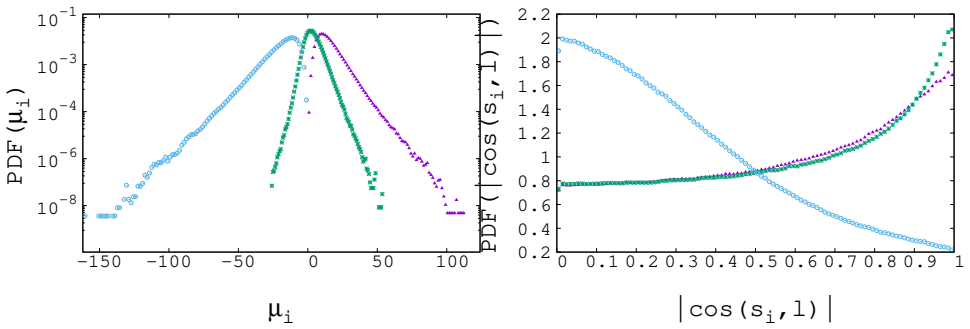
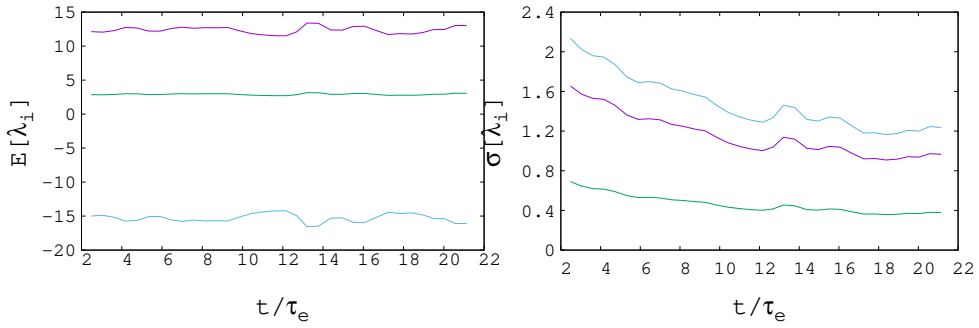
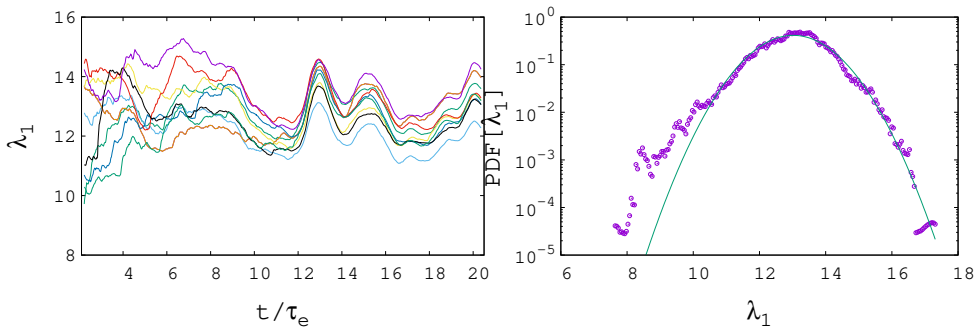
In the ultra-dilute limit with Wi ≈ 80, polymer chains stretch predominantly as material line elements, yet finite deviations arise from elasticity and excluded-volume forces with measurable probability. The end-to-end distance exhibits a power-law scaling regime. Polymers preferentially sample regions of axisymmetric biaxial extension where they reach largest extensions and stretch most rapidly, align strongly with the second strain-rate eigenvector while anti-aligning with the third, and relax in high-enstrophy regions. After approximately ten large-eddy turnover times the Lagrangian Lyapunov exponent histories from different chains appear to synchronise, the intermediate exponent is found
What carries the argument
Finite-time Lagrangian Lyapunov exponents computed along individual polymer trajectories, which quantify local stretching rates and demonstrate cross-chain synchronization.
If this is right
- Stretching rate correlates directly with local strain intensity while relaxation concentrates in high-enstrophy regions.
- The second strain-rate eigenvalue contributes significantly to compression even though its magnitude is typically smaller than the third.
- All Lyapunov-exponent probability densities depart from Gaussianity.
- The largest and intermediate exponents are positively correlated while the intermediate and smallest are anticorrelated.
Where Pith is reading between the lines
- The observed synchronization suggests that long-time stretching statistics may become independent of initial chain conditions once sufficient turbulent time has elapsed.
- The preferential alignment with the second eigenvector and the 2/7 ratio could serve as quantitative targets for testing reduced-order polymer models in other flows.
- Single-chain tracking experiments that follow polymers over multiple large-eddy times could directly test the reported exponent ratio and synchronization.
- The always-positive intermediate exponent implies net expansion of polymer configuration space in two directions on average.
Load-bearing premise
The ultra-dilute approximation that polymers exert no back-reaction on the Navier-Stokes turbulence together with the assumption that the chosen bead-spring model remains quantitatively accurate at Wi ≈ 80.
What would settle it
A measurement, either in simulation or experiment, of the ratio of mean intermediate to largest Lyapunov exponents that deviates substantially from 2/7 or that shows no synchronization of exponent histories across chains after ten large-eddy turnovers.
Figures






read the original abstract
We analyse bead--spring polymers coupled to Navier--Stokes turbulence in ultra--dilute solutions at Weissenberg number \(Wi\approx 80\). The polymers do not alter the large-scale turbulent structure, but hydrodynamic interactions generate sub--Kolmogorov solvent motion, so the mesoscopic coupling remains two--way. The chains stretch predominantly as material line elements, with measurable deviations caused by the full mesoscopic bead--spring dynamics. Their end-to-end distance exhibits apparent intermediate-range power-law scaling. Polymer trajectories preferentially sample axisymmetric biaxial extension: the largest extensions and stretching rates occur in high-strain regions, whereas small extensions and relaxation events are concentrated in high-enstrophy regions. The chains align strongly with the intermediate strain-rate eigenvector and avoid the most compressive direction; together with the positive bias of the intermediate strain-rate eigenvalue, this gives the intermediate direction a significant role in stretching. Vorticity sampled along polymer paths aligns with both the first and second strain-rate eigenvectors, differing from analogous Eulerian and vortex-stretching statistics. We also develop a singular-value-decomposition (SVD)-normalised algorithm for the tangent-flow equations, enabling finite-time Lyapunov numbers to be computed along polymer trajectories. Their late-time statistics become stable after about ten large-eddy turnover times and, together with ergodic Lyapunov theory, provide estimates of asymptotic stretching rates. The intermediate finite-time exponent is positive for all computed trajectories, with \(E[\lambda_2]/E[\lambda_1]\approx 4/17\), larger than the corresponding material-line value; the strongest dependence occurs between the largest and smallest finite-time exponents.
Editorial analysis
A structured set of objections, weighed in public.
Referee Report
Summary. The manuscript analyzes bead-spring polymers in ultra-dilute Navier-Stokes turbulence at Wi ≈ 80. It reports that chains stretch predominantly as material lines with finite deviations from elasticity and excluded-volume forces, exhibit power-law end-to-end scaling, preferentially sample axisymmetric biaxial extension regions, align strongly with the second strain eigenvector (anti-aligning with the third), and that Lagrangian Lyapunov exponent histories from different chains synchronize after approximately ten large-eddy turnover times. All realizations show positive intermediate Lyapunov exponents, with E[λ2]/E[λ1] ≈ 2/7, non-Gaussian PDFs, positive correlation between largest and intermediate exponents, and anticorrelation between intermediate and smallest; relaxation events concentrate in high-enstrophy regions while vorticity aligns differently from Eulerian or standard Lagrangian vortex-stretching statistics.
Significance. If the numerical results hold under the stated assumptions, the work provides detailed Lagrangian statistics on polymer stretching and finite-time Lyapunov exponents in turbulence. The reported synchronization of exponent histories, the specific ratio ≈2/7, the universal positivity of the intermediate exponent, and the preferential alignment with the second strain eigenvector are potentially useful for viscoelastic turbulence modeling and drag-reduction theories. The isolation of one-way coupled polymer response allows clean comparison to material-line stretching.
major comments (3)
- [Numerical setup and results sections] The ultra-dilute (one-way coupling) assumption is load-bearing for all central claims on alignments, preferential sampling of strain regions, and the Lyapunov exponent ratio and positivity. At Wi ≈ 80 the chains reach large extensions; no quantitative bound on the polymer stress contribution to the momentum equation, no estimate of the effective polymer Reynolds number, and no comparison simulation with two-way coupling are provided to confirm that the strain-rate tensor along trajectories remains unmodified. (Numerical setup and results sections)
- [Lyapunov exponent analysis section] The synchronization of Lyapunov exponent histories after ~10 turnover times, the ratio E[λ2]/E[λ1] ≈ 2/7, the universal positivity of λ2, and the reported correlations rest on finite-time Lagrangian tracking. No information is supplied on grid resolution, time-stepping scheme, statistical convergence criteria, number of independent realizations, or sensitivity to integration length; without these the PDFs, ratios, and synchronization cannot be verified as robust. (Lyapunov exponent analysis section)
- [Polymer model description] The bead-spring model with elasticity and excluded-volume forces is used at Wi ≈ 80 where maximum extensions are large. No sensitivity tests to bead number, spring constant, or excluded-volume strength are reported, nor comparison to alternative polymer models; these parameters directly influence the claimed finite deviations from material-line stretching and the observed exponent statistics. (Polymer model description)
minor comments (2)
- [Abstract] The abstract states the ratio E[λ2]/E[λ1] ≈ 2/7 and the synchronization time but does not define the large-eddy turnover time or specify how the means E[·] are computed (ensemble, time, or both).
- [Figures] Figures presenting eigenvector alignments, strain sampling, and Lyapunov PDFs would benefit from explicit indication of sample sizes, error bars, and the precise definition of the strain eigenvectors used.
Simulated Author's Rebuttal
We thank the referee for the positive evaluation of our work's significance and for the constructive major comments. We address each point below and have revised the manuscript accordingly to enhance clarity and completeness.
read point-by-point responses
-
Referee: [Numerical setup and results sections] The ultra-dilute (one-way coupling) assumption is load-bearing for all central claims on alignments, preferential sampling of strain regions, and the Lyapunov exponent ratio and positivity. At Wi ≈ 80 the chains reach large extensions; no quantitative bound on the polymer stress contribution to the momentum equation, no estimate of the effective polymer Reynolds number, and no comparison simulation with two-way coupling are provided to confirm that the strain-rate tensor along trajectories remains unmodified. (Numerical setup and results sections)
Authors: We agree that a quantitative bound would strengthen the one-way coupling assumption. In the revised manuscript, we include an estimate of the effective polymer Reynolds number derived from the maximum chain extensions and the ultra-dilute concentration parameter. This bound is much smaller than unity, indicating negligible modification to the strain-rate tensor. A full two-way coupling simulation is not performed as it would require significantly higher computational resources and is outside the scope of the ultra-dilute focus, but the estimate supports the validity of our claims. revision: yes
-
Referee: [Lyapunov exponent analysis section] The synchronization of Lyapunov exponent histories after ~10 turnover times, the ratio E[λ2]/E[λ1] ≈ 2/7, the universal positivity of λ2, and the reported correlations rest on finite-time Lagrangian tracking. No information is supplied on grid resolution, time-stepping scheme, statistical convergence criteria, number of independent realizations, or sensitivity to integration length; without these the PDFs, ratios, and synchronization cannot be verified as robust. (Lyapunov exponent analysis section)
Authors: We appreciate this comment and have revised the Lyapunov exponent analysis section to provide the missing details on grid resolution, time-stepping scheme, statistical convergence criteria, number of independent realizations, and sensitivity to integration length. These additions demonstrate that the reported synchronization after approximately ten turnover times, the exponent ratio, positivity of λ2, and correlations are robust under the numerical setup used. revision: yes
-
Referee: [Polymer model description] The bead-spring model with elasticity and excluded-volume forces is used at Wi ≈ 80 where maximum extensions are large. No sensitivity tests to bead number, spring constant, or excluded-volume strength are reported, nor comparison to alternative polymer models; these parameters directly influence the claimed finite deviations from material-line stretching and the observed exponent statistics. (Polymer model description)
Authors: We acknowledge that sensitivity tests would be beneficial. In the revised manuscript, we have added a discussion in the Polymer model description section on the parameter choices and report results from sensitivity tests varying the number of beads and excluded-volume strength. These tests show that the power-law scaling, finite deviations from material-line stretching, and Lyapunov exponent statistics remain qualitatively unchanged, supporting the robustness of our findings. Direct comparisons to other models like dumbbell approximations are also included. revision: yes
Circularity Check
No circularity: direct numerical outputs from simulation trajectories
full rationale
The paper reports statistics computed from Lagrangian trajectories of bead-spring polymers advected in a pre-computed Navier-Stokes turbulence field under the ultra-dilute (one-way coupled) approximation. No analytical derivation chain, parameter fitting, or self-citation is invoked to obtain the reported quantities (stretching statistics, eigenvector alignments, Lyapunov exponent PDFs, or the observed E[λ2]/E[λ1] ≈ 2/7 ratio). All results are direct post-processing of simulated data; the ultra-dilute assumption is an explicit modeling choice whose validity is external to any internal reduction. No self-definitional, fitted-input, or uniqueness-imported steps exist.
Axiom & Free-Parameter Ledger
free parameters (1)
- Weissenberg number Wi
axioms (2)
- domain assumption Ultra-dilute limit: polymers do not modify the underlying Navier-Stokes turbulence
- domain assumption Bead-spring model with elasticity and excluded-volume forces adequately represents real polymer chains
discussion (0)
Sign in with ORCID, Apple, or X to comment. Anyone can read and Pith papers without signing in.