REVIEW 2 major objections 2 minor 35 references
Impact of deployment on energy efficiency of sub-THz transmission
T0 review · 2 major / 2 minor · reviewed 2026-05-10 · grok-4.3
Pith's one-line read Sub-THz systems reach target coverage and throughput with substantially different total power depending on base station count and architecture choices.
desk verdict This applies standard energy modeling to sub-THz deployments but the claims rest on an unvalidated power model with no hardware checks or numbers shown. read the letter →
The pith
A machine-rendered reading of the paper's core claim, the machinery that carries it, and where it could break.
The reading
What carries the argument
Accurate power consumption model that includes baseband processing, combined with system-level simulations comparing hybrid beamforming and MIMO schemes under varying numbers of base stations, transmit powers, baseband units, and RF chains.
What would settle it
Direct power measurements from a sub-THz hardware testbed or field deployment using different base station counts and beamforming architectures that show power differences opposite to or much smaller than those predicted by the model and simulations.
Extended reading notes
Core claim
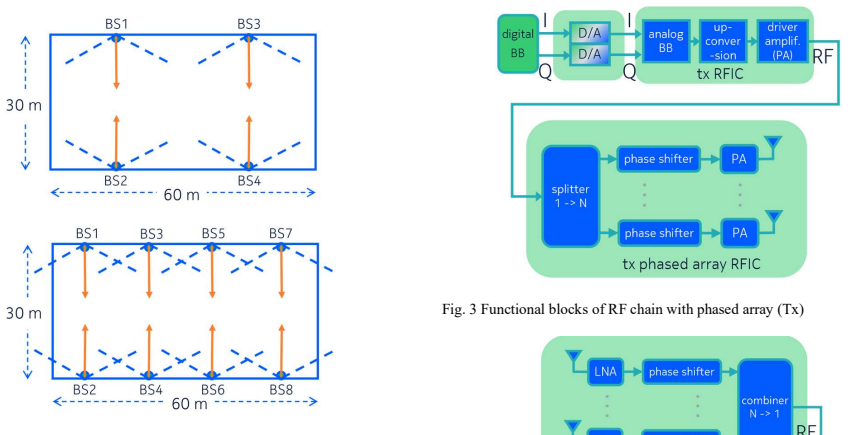
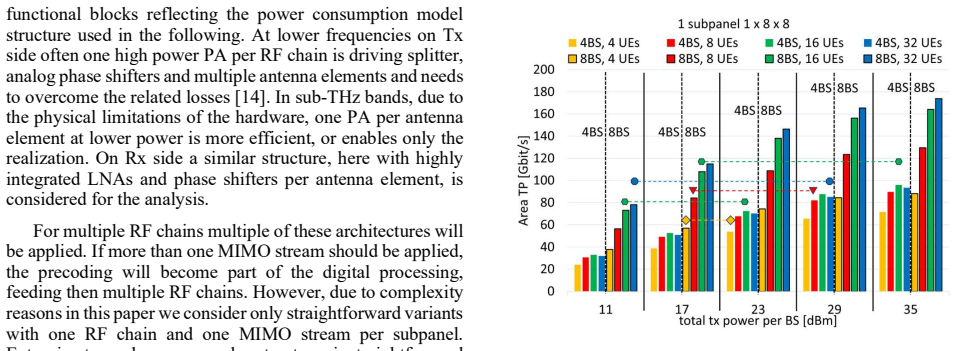
Sub-THz bands offer high bandwidth and data rates but incur increased power consumption from high data rates, data conversion and processing effort, low achievable PA efficiency, and reduced output power. When planning deployments, the same coverage and throughput targets can be met by different scenarios that vary in the number and locations of base stations and in system architectures such as hybrid beamforming and MIMO. Although these scenarios deliver similar performance, they differ significantly in overall power consumption. An accurate power consumption model that includes baseband processing functionality, together with system-level simulations for different hybrid beamforming and MÂ
Load-bearing premise
The power consumption model accurately represents sub-THz hardware behavior and the simulations correctly capture real power variations across the compared schemes.
Editorial extensions
If this is right
- Different numbers of base stations paired with adjusted transmit powers can achieve the same performance at lower total energy cost.
- Tuning the number of baseband units and RF chains provides additional ways to reduce power consumption for a given throughput target.
- Hybrid beamforming schemes can yield better energy efficiency than full MIMO configurations in certain sub-THz deployment scenarios.
- Joint optimization of site density and transceiver hardware parameters is required to minimize energy use in sub-THz networks.
Reading between the lines
- Denser deployments of lower-power base stations may prove more energy efficient than sparse high-power sites for sub-THz coverage in urban settings.
- Hardware designs that allow flexible scaling of RF chains and baseband units would better support energy-optimal deployments across different scales.
- The identified trade-offs could extend to other high-frequency bands, guiding broader network planning principles beyond the specific sub-THz cases simulated.
Editorial analysis
A structured set of objections, weighed in public.
Referee Report
Summary. The paper claims that system-level simulations using an accurate power consumption model (including baseband processing) for sub-THz bands reveal critical energy-efficiency trade-offs across deployment scenarios that vary the number of base stations, transmit powers, BB units, and RF chains under hybrid beamforming and MIMO schemes, while achieving comparable coverage and throughput.
Significance. If the underlying power model and simulations hold, the work would be significant for guiding practical sub-THz deployments in 6G systems, where high data rates make power consumption a dominant constraint. Explicitly modeling BB processing power is a strength, as this term is frequently omitted in prior analyses of mmWave and sub-THz efficiency.
major comments (2)
- [§4] §4 (Power Consumption Model): The model parameters for PA efficiency, data-converter power, and BB processing scaling at >100 GHz are drawn from literature or assumptions rather than validated against measured sub-THz hardware. Because the ranking of deployment scenarios (different BS counts vs. RF-chain counts) is determined by these parameters, the absence of hardware validation or sensitivity analysis means the highlighted trade-offs could invert under plausible variations in PA efficiency or BB power.
- [§5] §5 (Simulation Results): The reported energy-efficiency comparisons lack error bars, Monte-Carlo variation, or sensitivity sweeps over the free parameters in the power model. Without these, it is impossible to assess whether the claimed sub-THz-specific trade-offs are robust or artifacts of the chosen parameter set.
minor comments (2)
- [Abstract] Abstract: Key quantitative outcomes (e.g., percentage power savings or optimal BS/RF-chain counts) should be stated so readers can immediately gauge the magnitude of the reported trade-offs.
- [§5] Figure captions in §5: Explicitly list the exact parameter values (PA efficiency, BB power scaling factor, etc.) used for each curve so that the results can be reproduced or stress-tested.
Simulated Author's Rebuttal
We thank the referee for the constructive comments. We address each major point below and have revised the manuscript to strengthen the analysis where possible.
read point-by-point responses
-
Referee: [§4] §4 (Power Consumption Model): The model parameters for PA efficiency, data-converter power, and BB processing scaling at >100 GHz are drawn from literature or assumptions rather than validated against measured sub-THz hardware. Because the ranking of deployment scenarios (different BS counts vs. RF-chain counts) is determined by these parameters, the absence of hardware validation or sensitivity analysis means the highlighted trade-offs could invert under plausible variations in PA efficiency or BB power.
Authors: We acknowledge that the parameters are drawn from the best available recent literature and models rather than new hardware measurements, as comprehensive measured data for sub-THz components at scale remains limited. To directly address the concern that rankings could invert, we have added a sensitivity analysis in the revised manuscript varying PA efficiency (5-15% range) and BB power scaling factors. The results show that the relative ordering of deployment scenarios remains stable within reported parameter ranges, indicating the trade-offs are not artifacts of the nominal values. revision: partial
-
Referee: [§5] §5 (Simulation Results): The reported energy-efficiency comparisons lack error bars, Monte-Carlo variation, or sensitivity sweeps over the free parameters in the power model. Without these, it is impossible to assess whether the claimed sub-THz-specific trade-offs are robust or artifacts of the chosen parameter set.
Authors: We agree that statistical measures improve interpretability. The revised manuscript now includes error bars derived from Monte-Carlo runs over channel realizations and fading conditions, along with sensitivity sweeps over the power model parameters. These additions confirm that the reported sub-THz energy-efficiency trade-offs hold across the tested variations. revision: yes
- Direct validation of the power model against measured sub-THz hardware data is not feasible, as this would require access to specialized test equipment and proprietary device characterizations beyond the scope of the present simulation study.
Circularity Check
No circularity: results derive from independent system-level simulations
full rationale
The paper's central claims rest on comparative system-level simulations that apply a power consumption model (including BB processing) to evaluate trade-offs across BS counts, transmit powers, BB units, RF chains, and hybrid beamforming/MIMO architectures. No closed-form derivations, fitted parameters renamed as predictions, or self-citation chains are invoked to generate the reported variations in power consumption for given performance targets. The evaluation is self-contained against external benchmarks because the simulation outputs are produced by applying the model to varied deployment scenarios rather than by construction from the target results themselves.
Assumptions & free parameters
free parameters (1)
- Parameters inside the power consumption model
assumptions (1)
- domain assumption Power consumption of sub-THz transceivers, power amplifiers, and baseband processing can be modeled with sufficient accuracy for comparative deployment studies
Cite this review
Pith. "Pith review of Impact of deployment on energy efficiency of sub-THz transmission." pith.science (2026). https://pith.science/paper/2604.14887
@misc{pith2026260414887,
  author       = {Pith},
  title        = {Pith review of: Impact of deployment on energy efficiency of sub-THz transmission},
  year         = {2026},
  howpublished = {\url{https://pith.science/paper/2604.14887}},
  note         = {Machine review of arXiv:2604.14887}
}
read the original abstract
Sub-THz bands are promising high bandwidth and data rates, and in the recent years the device technologies made large progress and provided a multitude of transceiver, power amplifier (PA) and phased array devices supporting the frequency bands above 100 GHz. The more painful aspect of sub-THz transmission is the increased power consumption, caused by the large data rates and the related data conversion and processing effort, and on the analog side the low achievable PA efficiency and the reduced achievable output power. When planning a deployment of sub-THz communication systems, the target coverage and throughput can be achieved with a variety of scenarios, which will be different with respect to locations and number of base stations and system architectures. Although leading to similar performance, they will differ significantly in the overall power consumption. With an accurate power consumption model, including also baseband (BB) processing functionality, and system level simulations for different hybrid beamforming and MIMO schemes the related variations in power consumption in relation to a given performance are evaluated. This paper shows the critical design aspects for energy efficient sub-THz deployments by highlighting the sub- THz specific trade-offs between different number of BS with different transmit powers but also changing number of BB units and RF chains.
Figures

Figures from the paper (5 more)



Reference graph
Works this paper leans on
-
[1]
The cell edge performance, not shown here, behaves similar to the total throughput when applying the same Tx output power reduction. If we assume a PA efficiency of 10% the DC power consumption of the PA is factor of 10 higher, so that the DC power saving is significant, even if the number of BSs is increased by a factor of 2. So the overall power saving ...
-
[2]
LDPC encoding and decoding complexity 𝐶_= ௗ ௗ௦∙್ೞ_ ∙ 𝑠 ∙ 𝐾 ∙ 𝑓𝑐 𝐶_ௗ= ∙_ೝೌ ௦∙್ೞ_ ∙ 𝑠 ∙ 𝐾 ∙ 𝑓𝑐 The formulas were taken from [17], with inclusion of some parameters instead of using numbers directly to better adapt to Fig. 8. Functional blocks of BB processing the configured LDPC codes. With the additi...
-
[3]
With cyclic prefix length nCP=288 symbols, no
Constellation symbol mapping, Cyclic Prefix (CP) and Phase Tracking Reference Signal (PTRS) insertion 𝐶=𝑠ଵ.ହ∙ 𝐾∙ 𝑓𝑐 𝐶்ோௌ__௦=ುାುೃೄ ್ೖ ∙ 𝑛_௦∙ 𝐾∙ 𝑓𝑐 The formula for Cmapping is taken from [17], for CPTRS_CP_ins it is derived from our implementation in [7]. With cyclic prefix length nCP=288 symbols, no. of PTRS symbols...
-
[4]
of operations per filter tap nop_filt and no
Tx and Rx filter 𝐶௧=𝑛_௧∙ 𝑛௧௦∙ 𝑀∙ 𝑓𝑠 For Tx and Rx a similar FIR filter can be assumed, but the values of no. of operations per filter tap nop_filt and no. of filter taps ntaps may also be different. Typical values are nop_filt=2 and ntaps=40, resulting in Cfilter = 1258 GFLOPS
- [5]
-
[6]
are applied, but keeping the parameters no. of stages nstages (typ. = 13 for 212-FFT), no. of operations per butterfly structure nop_bfl (typ. =3) and no. of symbols calculated per butterfly nsym_bfl (typ. =2) generic. With the typical values this results in CFFT = 76.7. 𝐶ிி்=ೞೌೞ∙_್ ೞ_್ ∙ 𝐾∙ 𝑓𝑐
-
[7]
The ratio of data blocks per equalization block is rdata
Channel estimation and equalization Channel estimation complexity depends on the ratio of DMRS symbols per equalization block rDMRS. The ratio of data blocks per equalization block is rdata. For the increased complexity of complex division, a scaling factor nop_factor has been included. Equalization complexity strongly depends on the selected equalization...
-
[8]
Complexity is related to the no
Phase noise compensation Phase noise compensation in time domain uses nop_interp interpolations between the nPTRS PTRS symbols included in the data block of nblock symbols. Complexity is related to the no. of PTRS symbols and the no. of interpolated correction values between the PTRS locations. For the implemented version in [7] we get 𝐶ே =ቀ(𝑛்ோௌ− 1)∙ ...
Show all 35 references
-
[9]
The MaxLogMap demapper (Demap_mlm) shows increasing complexity with constellation size
Demapping Two different demapping variants have been analyzed [7]. The MaxLogMap demapper (Demap_mlm) shows increasing complexity with constellation size. The neural network based demapper (Demap_NN) has higher complexity already for QPSK, but lower increase of complexity with...
-
[10]
ESSENCE-6GM
Network and control processing Complexity values for these blocks representing platform control and network processing for downlink and uplink parts, CNet_&_CTRL_DL, CNet_&_CTRL_UL. The scaling coefficients and exponents for bandwidth, spectral efficiency s and number of strea...
2002
-
[11]
Deliverable D2.3: Radio models and enabling techniques towards ultra-high data rate links and capacity in 6G,
Hexa-X, “Deliverable D2.3: Radio models and enabling techniques towards ultra-high data rate links and capacity in 6G,” 2023. [Online]. Available: https://hexa-x.eu/wp-content/uploads/2023/04/Hexa-X- D2_3_v1.0.pdf (use cases)
2023
-
[12]
Deliverable D2.2: Initial radio models and analysis towards ultra-high data rate links in 6G,
Hexa-X, “Deliverable D2.2: Initial radio models and analysis towards ultra-high data rate links in 6G,” 2021. [Online]. Available: https://hexa-x.eu/wp-content/uploads/2022/01/Hexa-X-D2_2.pdf (channel model) Fig. 10. Total power consumption within deployment area
2021
-
[13]
Deliverable D4.5: Final results of 6G radio key enablers,
Hexa-X-II, “Deliverable D4.5: Final results of 6G radio key enablers,”
-
[14]
Available: https://hexa-x-ii.eu/wp-content/uploads/ 2025/03/Hexa-X-II_D4_5_v1_edit.pdf
[Online]. Available: https://hexa-x-ii.eu/wp-content/uploads/ 2025/03/Hexa-X-II_D4_5_v1_edit.pdf
2025
-
[15]
Towards power efficient 6G sub-THz transmission,
H. Halbauer and T. Wild, “Towards power efficient 6G sub-THz transmission,” in Proc. European Conference on Networks and Communications (EuCNC) & 6G Summit, 2021
2021
-
[16]
Constellation shaping under phase noise impairment for sub-THz communications,
D. Marasinghe, L. H. Nguyen, J. Mohammadi, Y. Chen, T. Wild, and N. Rajatheva, “Constellation shaping under phase noise impairment for sub-THz communications,” in Proc. IEEE International Conference on Communications (ICC), 2024
2024
-
[17]
Waveform learning under phase noise impairment for sub- THz communications,
D. Marasinghe, L.H. Nguyen, J. Mohammadi, Y. Chen, T. Wild and N. Rajatheva, “Waveform learning under phase noise impairment for sub- THz communications,” IEEE Transactions on Communications, 2024
2024
-
[18]
L. H. Nguyen, H. Heimpel, D. Marasinghe, H. Halbauer, and T. Wild, Sub-THz waveform evaluation in the D-band: A proof of concept study,” in Proc. European Conference on Networks and Communications (EuCNC) & 6G Summit, 2024
2024
-
[19]
A D-Band Radio-on-Glass Module for Spectrally-Efficient and Low-Cost Wireless Backhaul,
A. Singh, M. Sayginer, M. J. Holyoak, J. Weiner, J. Kimionis, M. Elkhouly, Y. Baeyens, and S. Shahramian, “A D-Band Radio-on-Glass Module for Spectrally-Efficient and Low-Cost Wireless Backhaul,” in 2020 IEEE Radio Frequency Integrated Circuits Symposium (RFIC)
2020
-
[20]
D-band Phased-Array TX and RX Front Ends Utilizing Radio-on-Glass Technology,
M. Elkhouly, M. J. Holyoak, D. Hendry, M. Zierdt, A. Singh, M. Sayginer, S. Shahramian, and Y. Baeyens, “D-band Phased-Array TX and RX Front Ends Utilizing Radio-on-Glass Technology,” in 2020 IEEE Radio Frequency Integrated Circuits Symposium (RFIC), 2020
2020
-
[21]
Fully Integrated 2D Scalable TX/RX Chipset for D-Band Phased-Array-on-Glass Modules,
M. Elkhouly et al., "Fully Integrated 2D Scalable TX/RX Chipset for D-Band Phased-Array-on-Glass Modules," 2022 IEEE International Solid-State Circuits Conference (ISSCC), San Francisco, CA, USA
2022
-
[22]
140- GHz 2-D Scalable On-Grid 8⨉ 8-Element Transmit–Receive Phased Arrays With Up/Down Converters Demonstrating a 5.2-m Link at 16 Gbps,
A. Ahmed, L. Li, M. Jung, S. Li, D. Baltimas and G. M. Rebeiz, "140- GHz 2-D Scalable On-Grid 8⨉ 8-Element Transmit–Receive Phased Arrays With Up/Down Converters Demonstrating a 5.2-m Link at 16 Gbps," in IEEE Transactions on Microwave Theory and Techniques, vol. 72, no. 5, May 2024
2024
-
[23]
A Four-Channel Bidirectional D-Band Phased-Array Transceiver for 200 Gb/s 6G Wireless Communications in a 130-nm BiCMOS Technology,
A. Karakuzulu, W. A. Ahmad, D. Kissinger and A. Malignaggi, "A Four-Channel Bidirectional D-Band Phased-Array Transceiver for 200 Gb/s 6G Wireless Communications in a 130-nm BiCMOS Technology," in IEEE Journal of Solid-State Circuits, vol. 58, no. 5, pp. 1310-1322, May 2023
2023
-
[24]
Study on channel model for frequencies from 0.5 to 100 GHz,
3GPP TR 38.901, “Study on channel model for frequencies from 0.5 to 100 GHz,” v18.0.0, Technical Report, Mar. 2024
2024
-
[25]
Energy efficient extreme MIMO: Design goals and directions,
S. Wesemann, J. Du, and H. Viswanathan, “Energy efficient extreme MIMO: Design goals and directions,” IEEE Communications Magazine, Oct. 2023
2023
-
[26]
InP / CMOS co- integration for energy efficient sub-THz communication systems,
C. Desset, N. Collaert, S. Sinha and G. Gramegna, "InP / CMOS co- integration for energy efficient sub-THz communication systems," 2021 IEEE Globecom Workshops (GC Wkshps), Madrid, Spain, 2021
2021
-
[27]
A flexible power model for mm-wave and THz high-throughput communication systems,
C. Desset, P. Wambacq, Y. Zhang, M. Ingels, and A. Bourdoux, “A flexible power model for mm-wave and THz high-throughput communication systems,” In PIMRC Workshop on Enabling Technologies for Terahertz Communications (ETTCOM), London, UK, August 2020
2020
-
[28]
Massive MIMO for energy-efficient communications,
C. Desset and B. Debaillie, “Massive MIMO for energy-efficient communications,” in EuMC, London, UK, Oct. 2016
2016
-
[29]
Modeling the hardware power consumption of large scale antenna systems,
C. Desset, B. Debaillie and F. Louagie, "Modeling the hardware power consumption of large scale antenna systems," 2014 IEEE Online Conference on Green Communications (OnlineGreenComm), (Online Only) AZ, USA, 2014
2014
-
[30]
Ultra-high-speed digital-to analog converter for optical communications
H. Huang, “Ultra-high-speed digital-to analog converter for optical communications”, Dissertation, Universität Stuttgart, [Online]. Available: https://elib.uni-stuttgart.de/items/096217dc-b576-478b- b7d0-3d0b749d8686
-
[31]
Available: AD9176 (Rev
Analog Devices, data sheet AD9176, [Online]. Available: AD9176 (Rev. B)
-
[32]
ADC Performance Survey 1997-2024,
B. Murmann, "ADC Performance Survey 1997-2024," [Online]. Available: https://github.com/bmurmann/ADC-survey
1997
-
[33]
A 110-170 GHz Phase-Invariant Variable-Gain Power Amplifier Module with 20-22 dBm Psat and 30 dBm OIP3 Utilizing SiGe HBT RFICs,
M. Sayginer et al., "A 110-170 GHz Phase-Invariant Variable-Gain Power Amplifier Module with 20-22 dBm Psat and 30 dBm OIP3 Utilizing SiGe HBT RFICs," 2023 IEEE Radio Frequency Integrated Circuits Symposium (RFIC), San Diego, CA, USA, 2023
2023
-
[34]
A Full D-Band Low Noise Amplifier in 130 nm SiGe BiCMOS using Zero-Ohm Transmission Lines,
T. Maiwald et al., "A Full D-Band Low Noise Amplifier in 130 nm SiGe BiCMOS using Zero-Ohm Transmission Lines," 2020 15th European Microwave Integrated Circuits Conference (EuMIC), Utrecht, Netherlands, 2021
2020
-
[35]
Full D- Band Transmit–Receive Module for Phased Array Systems in 130-nm SiGe BiCMOS,
A. Karakuzulu, M. H. Eissa, D. Kissinger and A. Malignaggi, "Full D- Band Transmit–Receive Module for Phased Array Systems in 130-nm SiGe BiCMOS," in IEEE Solid-State Circuits Letters, vol. 4
Reviewed May 10, 2026 · model on record in the stance chip above.
Discussion (0). Sign in to comment.