On the exponential rate of the condition number of Fourier submatrices and Vandermonde matrices
Pith reviewed 2026-05-10 10:13 UTC · model grok-4.3
The pith
Square submatrices of the discrete Fourier transform with contiguous rows and columns have an exactly determined exponential ill-conditioning rate, which yields a tight upper bound of 2G/π for all contiguous-column cases and Vandermonde sub
A machine-rendered reading of the paper's core claim, the machinery that carries it, and where it could break.
Core claim
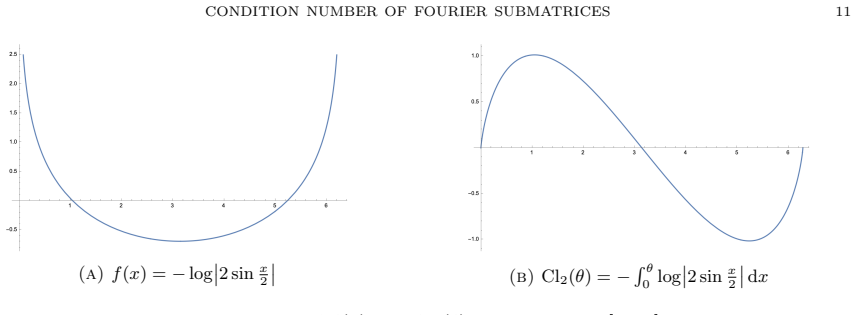
By developing exact estimates for the exponential ill-conditioning of Vandermonde and Vandermonde-like matrices in terms of logarithmic potentials, the paper resolves the precise rate for square Fourier submatrices with contiguous rows and columns, and establishes that 2G/π is a tight upper bound on the rate for all submatrices with contiguous columns or Vandermonde matrices with distinct support points.
What carries the argument
Logarithmic potential analysis of Vandermonde and Vandermonde-like matrices, which supplies exact estimates for the exponential growth of their condition numbers.
If this is right
- The exact exponential rate is now known for every contiguous square Fourier submatrix.
- Every contiguous-column Fourier submatrix and every Vandermonde submatrix on distinct points has exponential conditioning rate at most 2G/π.
- The bound 2G/π is tight, so the worst-case rate is achieved or approached for some choices of columns.
- Applications that rely on these submatrices can use the known rate to forecast numerical stability limits more precisely.
Where Pith is reading between the lines
- The same potential-theoretic approach could be applied to other structured matrices such as Toeplitz or Hankel forms to obtain their conditioning rates.
- Large-scale numerical tests that plot log(condition number) versus size would directly verify the predicted rates.
- Selecting non-contiguous rows may allow avoidance of the worst exponential growth when working with Fourier data.
- The appearance of Catalan's constant hints at possible deeper connections to other analytic problems involving that constant.
Load-bearing premise
That logarithmic potentials accurately capture the exponential ill-conditioning for the stated classes of submatrices without extra unstated restrictions on dimensions or point distributions.
What would settle it
Numerical computation of condition numbers for a sequence of large contiguous square Fourier submatrices, checking whether log(kappa(A_n))/n converges to the rate predicted by the potential analysis or exceeds 2G/π for some contiguous-column Vandermonde example.
Figures

read the original abstract
The discrete Fourier transform matrix is one of the most important matrices in linear algebra, and submatrices of it arise in a variety of applications. Though the discrete Fourier transform matrix is unitary, its submatrices can be exponentially ill-conditioned, an obstacle to accurate computation. This work resolves the exact rate of the exponential ill-conditioning for square submatrices with contiguous rows and columns. As a consequence, we obtain a tight upper bound of $2 G/\pi$ on the exponential rate for all submatrices with contiguous columns, or, equivalently, all Vandermonde submatrices with distinct support points, where $G$ is Catalan's constant. These results follow from a more general analysis of Vandermonde and Vandermonde-like matrices for which exact estimates for exponential ill-conditioning are developed in terms of logarithmic potentials.
Editorial analysis
A structured set of objections, weighed in public.
Referee Report
Summary. The manuscript resolves the exact exponential rate of ill-conditioning for square submatrices of the DFT matrix with contiguous rows and columns. Using logarithmic potential theory, it derives a tight upper bound of 2G/π (G Catalan's constant) on the rate for all submatrices with contiguous columns, equivalently for Vandermonde matrices with distinct nodes. This follows from a general analysis providing exact estimates for exponential ill-conditioning of Vandermonde and Vandermonde-like matrices in terms of logarithmic potentials.
Significance. If the derivations hold, the work supplies precise, closed-form characterizations of exponential ill-conditioning for structured matrices central to numerical linear algebra and approximation theory. The appearance of Catalan's constant as a sharp bound and the parameter-free nature of the potential-theoretic estimates are notable strengths. The results extend prior understanding by handling contiguous-row-and-column cases exactly and providing a uniform bound for the contiguous-column/Vandermonde setting without additional restrictions on dimension or node distribution.
minor comments (2)
- In the general Vandermonde analysis, the transition from the logarithmic potential to the precise exponential rate (likely in the main theorem) would benefit from an explicit statement of the error term or remainder estimate to make the 'exact' claim fully transparent.
- Notation for the submatrix indices (contiguous rows/columns) and the support points could be standardized earlier to avoid minor ambiguity when moving between the DFT and Vandermonde settings.
Simulated Author's Rebuttal
We are grateful to the referee for the positive and accurate summary of our manuscript, as well as for the encouraging assessment of its significance. We note the recommendation for minor revision. As the report lists no specific major comments, we have no point-by-point responses to provide.
Circularity Check
No significant circularity
full rationale
The paper derives exact exponential rates for the condition numbers of contiguous Fourier submatrices and a tight bound of 2G/π for contiguous-column (Vandermonde) cases by applying standard logarithmic potential theory to the underlying measures. This is an external analytic framework from approximation theory, not a self-referential definition, fitted parameter renamed as prediction, or load-bearing self-citation chain. The results are obtained by evaluating potentials on the specific supports (contiguous intervals or DFT frequencies) without reducing the target quantities to the inputs by construction. No uniqueness theorems or ansatzes are imported from the authors' prior work in a manner that forces the conclusion.
Axiom & Free-Parameter Ledger
axioms (2)
- standard math The discrete Fourier transform matrix is unitary
- standard math Logarithmic potentials yield exact asymptotic estimates for the condition numbers of Vandermonde and Vandermonde-like matrices
Reference graph
Works this paper leans on
-
[1]
Ben Adcock, Daan Huybrechs, and Jes´ us Mart´ ın-Vaquero. On the numerical stability of Fourier extensions.Foun- dations of Computational Mathematics, 14(4):635–687, 2014
work page 2014
-
[2]
Nathan Albin and Oscar P Bruno. A spectral FC solver for the compressible Navier–Stokes equations in general domains i: Explicit time-stepping.Journal of Computational Physics, 230(16):6248–6270, 2011
work page 2011
-
[3]
C´ eline Aubel and Helmut B¨ olcskei. Vandermonde matrices with nodes in the unit disk and the large sieve.Applied and Computational Harmonic Analysis, 47(1):53–86, 2019
work page 2019
-
[4]
Alex H Barnett. How exponentially ill-conditioned are contiguous submatrices of the Fourier matrix?Siam Review, 64(1):105–131, 2022
work page 2022
-
[5]
Dmitry Batenkov, Laurent Demanet, Gil Goldman, and Yosef Yomdin. Conditioning of partial nonuniform Fourier matrices with clustered nodes.SIAM Journal on Matrix Analysis and Applications, 41(1):199–220, 2020
work page 2020
-
[6]
Ferm´ ın SV Baz´ an. Conditioning of rectangular Vandermonde matrices with nodes in the unit disk.SIAM Journal on Matrix Analysis and Applications, 21(2):679–693, 2000
work page 2000
-
[7]
Fourier phase retrieval: Uniqueness and algorithms
Tamir Bendory, Robert Beinert, and Yonina C Eldar. Fourier phase retrieval: Uniqueness and algorithms. InCom- pressed Sensing and its Applications: Second International MATHEON Conference 2015, pages 55–91. Springer, 2018
work page 2015
-
[8]
A comparison of numerical algorithms for Fourier extension of the first, second, and third kinds
John P Boyd. A comparison of numerical algorithms for Fourier extension of the first, second, and third kinds. Journal of Computational Physics, 178(1):118–160, 2002
work page 2002
-
[9]
Vandermonde with Arnoldi.Siam Review, 63(2):405– 415, 2021
Pablo D Brubeck, Yuji Nakatsukasa, and Lloyd N Trefethen. Vandermonde with Arnoldi.Siam Review, 63(2):405– 415, 2021
work page 2021
-
[10]
Emmanuel J Cand` es and Carlos Fernandez-Granda. Towards a mathematical theory of super-resolution.Commu- nications on pure and applied Mathematics, 67(6):906–956, 2014
work page 2014
-
[11]
Emmanuel J Cand` es, Justin Romberg, and Terence Tao. Robust uncertainty principles: Exact signal reconstruction from highly incomplete frequency information.IEEE Transactions on information theory, 52(2):489–509, 2006
work page 2006
-
[12]
Sinem Coleri, Mustafa Ergen, Anuj Puri, and Ahmad Bahai. Channel estimation techniques based on pilot arrange- ment in OFDM systems.IEEE Transactions on broadcasting, 48(3):223–229, 2002
work page 2002
-
[13]
The recoverability limit for superreso- lution via sparsity,
Laurent Demanet and Nam Nguyen. The recoverability limit for superresolution via sparsity.arXiv preprint arXiv:1502.01385, 2015
-
[14]
David L Donoho. Superresolution via sparsity constraints.SIAM journal on mathematical analysis, 23(5):1309–1331, 1992
work page 1992
-
[15]
The future fast Fourier transform?SIAM Journal on Scientific Computing, 20(3):1094–1114, 1998
Alan Edelman, Peter McCorquodale, and Sivan Toledo. The future fast Fourier transform?SIAM Journal on Scientific Computing, 20(3):1094–1114, 1998
work page 1998
-
[16]
Ove Edfors, Magnus Sandell, Jan-Jaap Van De Beek, Sarah Kate Wilson, and Per Ola B¨ orjesson. Analysis of DFT-based channel estimators for OFDM.Wireless Personal Communications, 12(1):55–70, 2000
work page 2000
-
[17]
Super-resolution, the recovery of missing samples and Vandermonde matrices on the unit circle
PJSG Ferreira. Super-resolution, the recovery of missing samples and Vandermonde matrices on the unit circle. In Proceedings of the Workshop on Sampling Theory and Applications, Loen, Norway, 1999
work page 1999
-
[18]
Daan Huybrechs. On the Fourier extension of nonperiodic functions.SIAM Journal on Numerical Analysis, 47(6):4326–4355, 2010
work page 2010
-
[19]
Stefan Kunis and Dominik Nagel. On the smallest singular value of multivariate Vandermonde matrices with clus- tered nodes.Linear Algebra and its Applications, 604:1–20, 2020
work page 2020
-
[20]
Stefan Kunis and Dominik Nagel. On the condition number of Vandermonde matrices with pairs of nearly-colliding nodes.Numerical Algorithms, 87(1):473–496, 2021
work page 2021
-
[21]
Weilin Li. Multiscale estimates for the condition number of non-harmonic Fourier matrices.Mathematics of Com- putation, 94(356):2895–2929, 2025
work page 2025
-
[22]
Stable super-resolution limit and smallest singular value of restricted Fourier matrices
Weilin Li and Wenjing Liao. Stable super-resolution limit and smallest singular value of restricted Fourier matrices. Applied and Computational Harmonic Analysis, 51:118–156, 2021
work page 2021
-
[23]
Michael Lustig, David Donoho, and John M Pauly. Sparse MRI: The application of compressed sensing for rapid MR imaging.Magnetic Resonance in Medicine: An Official Journal of the International Society for Magnetic Resonance in Medicine, 58(6):1182–1195, 2007
work page 2007
-
[24]
Fast algorithms for the computation of Fourier extensions of arbitrary length
Roel Matthysen and Daan Huybrechs. Fast algorithms for the computation of Fourier extensions of arbitrary length. SIAM Journal on Scientific Computing, 38(2):A899–A922, 2016
work page 2016
-
[25]
Jianwei Miao, Tetsuya Ishikawa, Ian K Robinson, and Margaret M Murnane. Beyond crystallography: Diffractive imaging using coherent x-ray light sources.Science, 348(6234):530–535, 2015
work page 2015
-
[26]
Super-resolution, extremal functions and the condition number of Vandermonde matrices
Ankur Moitra. Super-resolution, extremal functions and the condition number of Vandermonde matrices. InPro- ceedings of the forty-seventh annual ACM symposium on Theory of computing, pages 821–830, 2015
work page 2015
-
[27]
Victor Y Pan. How bad are Vandermonde matrices?SIAM Journal on Matrix Analysis and Applications, 37(2):676– 694, 2016. CONDITION NUMBER OF FOURIER SUBMATRICES 27
work page 2016
-
[28]
Gagan Rath and Christine Guillemot. Frame-theoretic analysis of DFT codes with erasures.IEEE Transactions on Signal Processing, 52(2):447–460, 2004
work page 2004
-
[29]
Gagan Rath and Christine Guillemot. Recent advances in DFT codes based quantized frame expansions for erasure channels.Digital Signal Processing, 14(4):332–354, 2004
work page 2004
-
[30]
Edward B Saff, Vilmos Totik, et al.Logarithmic potentials with external fields, volume 316. Springer, 1997
work page 1997
-
[31]
Akbar M Sayeed. Deconstructing multiantenna fading channels.IEEE Transactions on Signal processing, 50(10):2563–2579, 2002
work page 2002
- [32]
-
[33]
Nikolaj Tschebotareff. Die bestimmung der dichtigkeit einer menge von primzahlen, welche zu einer gegebenen substitutionsklasse geh¨ oren.Mathematische Annalen, 95(1):191–228, 1926
work page 1926
-
[34]
Bichai Wang, Linglong Dai, Zhaocheng Wang, Ning Ge, and Shidong Zhou. Spectrum and energy-efficient beamspace MIMO-NOMA for millimeter-wave communications using lens antenna array.IEEE Journal on Selected Areas in Communications, 35(10):2370–2382, 2017
work page 2017
-
[35]
Heather Wilber, Ethan N Epperly, and Alex H Barnett. Superfast direct inversion of the nonuniform discrete Fourier transform via hierarchically semiseparable least squares.SIAM Journal on Scientific Computing, 47(3):A1702– A1732, 2025
work page 2025
-
[36]
Zhihui Zhu, Santhosh Karnik, Mark A Davenport, Justin Romberg, and Michael B Wakin. The eigenvalue distribu- tion of discrete periodic time-frequency limiting operators.IEEE Signal Processing Letters, 25(1):95–99, 2017
work page 2017
discussion (0)
Sign in with ORCID, Apple, or X to comment. Anyone can read and Pith papers without signing in.